氢能

Search documents
“氢能+”产业新生态研讨会圆满召开,共探氢能应用新路径
势银能链· 2025-05-22 03:36
Core Viewpoint - The article discusses the development and application of hydrogen energy, emphasizing the establishment of a comprehensive hydrogen industry ecosystem and addressing safety concerns within the sector [2][7][19]. Group 1: Hydrogen Industry Development - The Daxing International Hydrogen Energy Demonstration Zone aims to create a "benchmark hydrogen zone, green hydrogen zone, and global hydrogen zone," supported by a "3+N" hydrogen industry ecosystem that includes hydrogen refueling stations, international exchange centers, and technology parks [7]. - The "Hydrogen+" industry seminar was successfully held, focusing on exploring new applications and ideas in the hydrogen sector [2]. Group 2: Applications and Innovations - The wind-cooled fuel cell technology is highlighted for its high energy density, long endurance, lightweight, and quick refueling capabilities, making it suitable for various applications such as industrial drones, two-wheeled vehicles, and military uses [9]. - The urban rail transit industry in China is entering a new phase of high-quality operation, with a pressing need for innovative green energy solutions to meet carbon neutrality goals by 2060 [11]. Group 3: Technical Challenges and Safety - Liquid hydrogen plays a crucial role in the hydrogen energy field, necessitating advancements in production, storage, transportation, and safety technologies [13]. - Hydrogen safety risks are significant, and industry professionals must address issues related to hydrogen awareness, safety during usage, and risk management [19].

美锦能源(000723) - 000723美锦能源投资者关系管理信息20250520
2025-05-21 07:44
Financial Performance - In 2024, the company experienced its first loss in several years, primarily due to a structural imbalance between the prices and costs of coal and coke, with both sales prices declining more than the corresponding cost reductions [1] - The coke business was the main source of operational losses, with the market showing a weak trend in 2024, leading to a significant drop in prices due to weak terminal demand and reduced cost support [1][2] - Other income increased by 186.18% in Q1 2025, mainly due to increased government subsidies related to the hydrogen energy industry, although the sustainability of these subsidies remains uncertain [4] Hydrogen Energy Initiatives - The company is collaborating with Guohua Technology to promote 10,000 hydrogen commercial vehicles nationwide, addressing high costs and inadequate refueling infrastructure through a comprehensive industrial loop [2][3] - The company has established the Anhui Xun'an Equity Investment Fund in 2025, focusing on advanced manufacturing and new energy sectors, which will enhance its technological reserves in hydrogen and fuel cells [3] - As of Q1 2025, the company has operated over 1,100 hydrogen fuel vehicles, with nearly 4,000 hydrogen fuel cell vehicles promoted, achieving a total operational mileage exceeding 200 million kilometers and reducing carbon emissions by approximately 200,000 tons [10][11] Market and Infrastructure Development - The company is actively participating in the development of hydrogen energy infrastructure, including hydrogen production bases and refueling networks, to create a replicable regional development model [4][6] - The hydrogen energy industry is expected to see significant growth, with the company planning to extend its hydrogen energy supply chain and explore applications in heavy-duty vehicles and shipping [6][7] - The company is also focusing on integrating traditional energy and hydrogen energy sectors to create a circular economy model, enhancing resource efficiency [5][6] Risk Management and Financial Stability - The company is implementing measures to stabilize its stock price amidst high pledge ratios, including optimizing production processes and enhancing communication with investors [9] - Accounts receivable increased by 6.84% due to market competition and customer financial difficulties, prompting the company to strengthen credit risk management and monitoring [8]

AEM双极板企业一览
势银能链· 2025-05-21 05:03
Core Viewpoint - The article discusses the development and manufacturing of AEM electrolyzer bipolar plates, highlighting key players in the industry and their technological advancements in this area [2][3][17]. Group 1: AEM Electrolyzer Bipolar Plates - Bipolar plates are a core component of AEM electrolyzers, responsible for conducting electricity, gas distribution, and separating the electrolyte [2]. - The material selection for bipolar plates must balance alkali corrosion resistance, high conductivity, lightweight, and cost control [2]. - Nickel-based materials are currently the mainstream choice for bipolar plates, despite their higher cost, due to their stability and longevity [2]. Group 2: Key Players in the Industry - Companies involved in AEM bipolar plate production can be categorized into two types: full-stack self-research AEM electrolyzer manufacturers and material manufacturers that produce bipolar plates [3]. - Shenzhen Jinqiayi Technology Co., Ltd. specializes in PEM and AEM bipolar plates, utilizing nickel-plated stainless steel as the base material [4]. - Shanghai Zhizhen New Energy Co., Ltd. focuses on metal bipolar plate R&D and manufacturing, with a strong technical team and plans to expand into SOFC products [6][7]. Group 3: Production Capacities and Innovations - Zhejiang Filter Technology Co., Ltd. has developed over ten innovative core materials and aims to increase its patent portfolio significantly by 2025 [11]. - Suzhou Pluray Electrode Industrial Co., Ltd. has acquired a manufacturing facility to enhance its production capacity for PEM and AEM bipolar plates [12]. - Suzhou Yunfan Hydrogen Energy Technology Co., Ltd. has introduced new micro electrolyzer bipolar plate components, achieving significant material savings and reduced processing time [13]. Group 4: Upcoming Events - The 2025 TrendBank Green Hydrogen Industry Conference will be held on July 16-17 in Wuxi, focusing on the development of the green hydrogen industry and AEM hydrogen production [17].
氢能:从试点探索到有序破局
Zhong Guo Hua Gong Bao· 2025-05-21 02:26
Core Viewpoint - The hydrogen energy industry in China is transitioning from pilot exploration to an orderly breakthrough phase, driven by the new energy security strategy of "four revolutions and one cooperation" [1] Group 1: Production and Consumption Scale - China is projected to have a hydrogen production capacity exceeding 50 million tons in 2024, maintaining the world's largest production and consumption scale [2] - Fossil fuel-based hydrogen production remains dominant, with coal-based hydrogen production at approximately 20.7 million tons (up 6.7% year-on-year), while natural gas-based hydrogen production is around 7.6 million tons (down 4.4% year-on-year) [2] - The main hydrogen consumption sectors include synthetic methanol and ammonia, accounting for 27% and 26% of total consumption, respectively [2] Group 2: Renewable Energy and Electrolysis - The development of renewable energy electrolysis for hydrogen production is accelerating, with 35 new projects expected in 2024, adding about 48,000 tons of capacity (up 62% year-on-year) [3] - By the end of 2024, over 90 projects will be completed, primarily in North and Northwest China, which account for 45% and 44% of the total capacity, respectively [3] Group 3: Market Pricing Trends - Hydrogen production prices are declining, with the average production price dropping to below 30 yuan per kilogram and consumption price below 52 yuan per kilogram in 2024 [4] - By December 2024, production prices fell to 28 yuan per kilogram (down 15.6% year-on-year), while consumption prices decreased to 48.6 yuan per kilogram (down 13.7% year-on-year) [4] Group 4: Technological Advancements and Applications - Key technological breakthroughs in hydrogen production, storage, and transportation are being achieved, including the commercial operation of large-scale electrolysis systems and hydrogen storage solutions [5][6] - Industrial applications are expanding, with projects integrating renewable hydrogen into traditional coal-based processes and new hydrogen applications in metallurgy and energy supply [6] Group 5: International Cooperation and Future Outlook - Chinese companies are signing cooperation agreements with countries like Germany and Saudi Arabia to explore renewable hydrogen projects, contributing to global energy transition [6] - 2025 is identified as a critical year for China's hydrogen industry to achieve economic viability and scale, necessitating enhanced policy support and infrastructure development [7]
山西:6月1日起对氢能货车高速公路通行费实施全额补贴
news flash· 2025-05-21 00:07
Core Viewpoint - The Shanxi Provincial Development and Reform Commission, along with other departments, has announced a full subsidy for highway tolls for hydrogen fuel trucks from June 1, 2025, to May 31, 2027 [1] Group 1 - The subsidy will cover all highway tolls for hydrogen fuel trucks, promoting the use of clean energy vehicles [1] - The initiative is part of a broader effort to support the development of hydrogen energy and reduce carbon emissions in the transportation sector [1] - The policy is expected to encourage more logistics companies to adopt hydrogen fuel trucks, enhancing the overall market for hydrogen energy [1]
国家盐穴储氢库示范工程落户平煤神马
Zhong Guo Neng Yuan Wang· 2025-05-20 10:45
Core Insights - The "Salt Cavern Hydrogen Storage Demonstration Project" and "Million Cubic Meter Hydrogen Storage Demonstration Project" were inaugurated, marking a significant step in utilizing salt cavern resources in China [1] - Salt caverns are recognized for their excellent sealing performance, large storage capacity, low cost, and high safety, making them a promising technology for hydrogen storage [1] - The demonstration projects are located in Pingmei Shenma Group, leveraging its abundant salt field resources and prior experience in salt cavern energy storage [1] Company Overview - Pingmei Shenma Group possesses 6.62 square kilometers of salt field resources, having extracted over 20 million tons of salt from 13 brine wells, with an annual physical volume capacity exceeding 1 million cubic meters [1] - The company has collaborated with China National Petroleum Corporation and Henan Investment Group, gaining experience in salt cavern gas storage, which supports the construction of the national salt cavern hydrogen storage demonstration project [1] Project Details - The demonstration project is set to commence construction in November 2024 and will be the first large-scale deep salt cavern hydrogen storage project in Asia, aiming to store 1.5 million cubic meters of hydrogen [1] - The project is a collaboration between the Wuhan Institute of Rock and Soil Mechanics of the Chinese Academy of Sciences and Pingmei Shenma Group, with the Joint Salt Chemical Company responsible for its implementation [1] - The project has completed geological evaluation, process design, and drilling construction, and is currently progressing with cavity operation [2] - It has been incorporated into the "Deep Earth National Science and Technology Major Project" and the national key research and development plan for "Key Technologies for Geological Hydrogen Storage Applicability and Safety" [2] - The company will also participate in the formulation of national and industry standards related to the safety technology of salt cavern hydrogen storage [2]

多地力推氢能产业,专家看好固体氧化物制氢前景
Di Yi Cai Jing· 2025-05-20 06:23
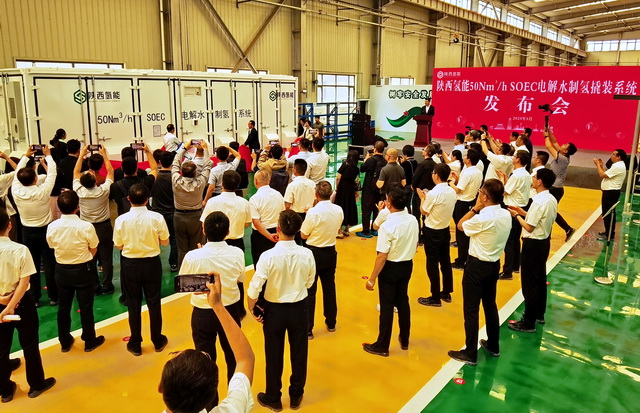
Group 1 - The solid oxide fuel cell/electrolyzer technology in China has seen significant advancements in the past one to two years, with expectations for broader applications in the near future [1] - The solid oxide electrolysis hydrogen production technology is considered a promising new high-efficiency hydrogen production method due to its higher efficiency and lower costs compared to alkaline and proton exchange membrane (PEM) hydrogen production technologies [1] - Since the announcement of the "dual carbon" goals by the government, there has been a surge in the development of solid oxide fuel cells and electrolyzer technologies, supported by multiple policies from various government departments starting in 2024 [1] Group 2 - The hydrogen equipment manufacturing sector in Yulin, where Shaanxi Hydrogen Energy is located, has officially launched in 2024, with multiple high-end hydrogen equipment manufacturing projects under construction [2] - Yulin's hydrogen industry plan aims to establish a "gray hydrogen extraction + green hydrogen preparation" supply system, promoting the development of hydrogen applications in industrial and transportation sectors [2] Group 3 - Shaanxi Hydrogen Energy's first hydrogen equipment project, the solid oxide fuel cell, was launched in March 2024, supported by a technology team from Tsinghua University, and the first fully automated stack production line was completed in September [4] - The company plans to start the construction of a 300-acre industrial park in 2026, aiming to achieve a 300MW full industrial chain cluster [4] - Yulin is recognized as a significant energy and chemical base in the country, possessing unique resource advantages and favorable conditions for the development of the hydrogen industry [4] Group 4 - In recent years, various regions have accelerated the high-quality development of the hydrogen industry, with hydrogen fuel cells and related products gaining widespread application [5] - The development of green hydrogen production projects is primarily led by state-owned enterprises, while the hydrogen equipment sector has seen a diverse participation from both private and state-owned enterprises [5]
电新行业2024年年报与2025年一季报综述:盈利逐步修复,行业有望迎来反转
Bank of China Securities· 2025-05-20 06:18
Investment Rating - The report maintains an "Outperform" rating for the electric power equipment and new energy industry [1] Core Views - The electric power equipment and new energy industry is expected to see a gradual recovery in profitability, with a potential industry turnaround as capacity is gradually cleared [1][2] - In 2024, the industry's total revenue decreased by 3.69% year-on-year to CNY 49,934.98 billion, while net profit attributable to shareholders fell by 44.66% to CNY 2,086.33 billion [2][3] - The average gross margin for the industry in 2024 was 18.88%, down 2.29 percentage points year-on-year, and the net profit margin was 5.04%, down 3.46 percentage points [4][5] Summary by Sections 2024 Industry Performance - The electric power equipment and new energy industry experienced a revenue decline of 3.69% in 2024, with total revenue at CNY 49,934.98 billion and net profit down 44.66% to CNY 2,086.33 billion [2][3] - The new energy vehicle sector achieved revenue of CNY 20,445.81 billion, a slight increase of 0.85%, but net profit decreased by 19.39% to CNY 1,096.23 billion [3][6] - The renewable energy generation sector saw revenue drop by 8.97% to CNY 25,195.68 billion, with net profit down 69.69% to CNY 631.44 billion [3][6] - The electric power equipment sector reported a revenue increase of 10.20% to CNY 4,293.50 billion, with net profit rising by 9.80% to CNY 358.66 billion [3][6] 2025 Q1 Industry Performance - In Q1 2025, the industry achieved revenue of CNY 11,025.27 billion, a year-on-year increase of 5.16%, and net profit of CNY 679.87 billion, up 12.25% [5][7] - The new energy vehicle sector's revenue grew by 19.46% to CNY 4,775.68 billion, with net profit increasing by 75.48% to CNY 332.27 billion [5][7] - The renewable energy generation sector's revenue decreased by 5.65% to CNY 5,335.37 billion, with net profit down 23.46% to CNY 266.15 billion [5][7] - The electric power equipment sector reported revenue of CNY 914.21 billion, a 9.98% increase, and net profit of CNY 81.45 billion, up 18.77% [5][7] Investment Recommendations - For the new energy vehicle sector, the report suggests prioritizing investments in the battery cell segment and midstream material sectors with strong integration [33] - In the photovoltaic sector, it recommends focusing on high-performance auxiliary materials and integrated component segments, as well as new technology such as HJT battery equipment [34] - For wind energy, it advises investing in tower foundations and submarine cable segments with significant growth potential [34] - In the hydrogen energy sector, it highlights the importance of companies with cost and technology advantages in electrolyzer production and hydrogen infrastructure [34]



擎动科技签约韩国SANG-A Frontec:共推PEM制氢降本增效
势银能链· 2025-05-20 04:42
Core Viewpoint - The strategic partnership between Suzhou Qindong Power Technology Co., Ltd. and South Korea's SANG-A Frontec aims to enhance the development and production of key materials in proton exchange membrane (PEM) electrolysis technology, thereby promoting breakthroughs and large-scale applications in the green hydrogen industry [2][4][9]. Group 1: Partnership Details - The collaboration focuses on the research and production of proton exchange membranes and membrane electrodes, leveraging Qindong Technology's expertise in PEM electrolysis catalysts and membrane electrode processes alongside SANG-A Frontec's specialization in membrane material preparation and precision coating technology [6][8]. - The partnership aims to develop high-performance, long-life proton exchange membranes and membrane electrode products to reduce green hydrogen production costs and improve electrolysis efficiency [6][8]. Group 2: Market and Technology Impact - Proton exchange membranes are critical components in PEM electrolysis devices, directly influencing the efficiency and stability of electrolysis cells. The global high-end proton exchange membrane market is currently dominated by a few international companies [8]. - The collaboration is expected to break through technological barriers and provide more competitive PEM electrolysis solutions for both the Chinese and global markets, contributing to the localization of the supply chain from materials to components [8][9]. Group 3: Future Plans - Both companies plan to strengthen their research cooperation on proton membrane and membrane electrode products, focusing on material innovation and optimization [9]. - They aim to expand their market presence in China, South Korea, and Europe, providing core material support for green hydrogen production and energy storage, thus aiding the global energy structure transformation [9].
辰韬资本萧伊婷:氢能是终局确定的赛道,技术上限将决定投资未来
Sou Hu Cai Jing· 2025-05-20 04:38
Core Insights - Hydrogen energy is viewed as the next major opportunity following wind power, photovoltaics, and new energy storage, but it faces skepticism and challenges in commercialization [2][3] - Despite potential short-term downturns, hydrogen energy is considered a long-term viable sector, with significant growth expected around 2035 [3][16] Investment Strategy - Focus on companies with core technologies that can dominate future markets, and projects that can generate stable short-term revenue to withstand downturns [3][11] - Emphasis on sectors with large market sizes and minimal competition, particularly those that can effectively address the "West-to-East hydrogen transport" challenge [9][11] Technological Development - The hydrogen industry is experiencing rapid technological advancements, particularly in electrolyzers and hydrogen storage, but commercial viability remains to be proven [6][10] - The economic viability of hydrogen is closely linked to carbon pricing, with European carbon prices significantly higher than those in China, influencing market dynamics [6][12] Market Dynamics - The hydrogen sector's valuation is affected by global economic conditions and geopolitical factors, which can slow down climate and decarbonization policy implementation [12][13] - The importance of "correct subsidies" is highlighted, advocating for support directed towards leading technology companies to enhance overall industry competitiveness [4][5] Application Scenarios - Key application areas expected to see early breakthroughs include hydrogen-powered mining trucks and electricity peak shaving, driven by the increasing reliance on renewable energy sources [17][10] - The potential for natural hydrogen exploration in coastal regions of China is noted, with competitive production costs compared to traditional hydrogen sources [9][11]