
化工原料

Search documents
全线爆发!002460,午后快速涨停!
证券时报· 2026-03-27 08:37
Market Overview - On March 27, the stock indices in both markets surged, with the Shanghai Composite Index returning above 3900 points, and the ChiNext Index and others rising over 1% [1][2] - The total trading volume in the Shanghai and Shenzhen markets was approximately 1.86 trillion yuan, a decrease of about 93 billion yuan compared to the previous day [2] Pharmaceutical Sector - The pharmaceutical sector showed strong performance, particularly in innovative drugs and weight-loss drug concepts, with companies like Shuyou Shen and Rejing Bio hitting the daily limit [2][5] - Key stocks included: - Shuyou Shen: +20.02% [6] - Rejing Bio: +20.00% [6] - Baili Tianheng: +12.46% [6] - The overall trend for innovative drugs is upward, supported by improved funding conditions and competitive advantages of domestic innovative drugs [8] Lithium Battery Sector - The lithium battery sector experienced a significant surge, with Haike New Energy hitting the daily limit and reaching a historical high [10] - Notable stock performances included: - Haike New Energy: +20.00% [11] - Rongjie Co.: +20.00% [11] - Ganfeng Lithium: +10.00% [11] - Demand for lithium batteries is expected to explode due to high oil prices, with global orders for lithium batteries increasingly directed towards China [12] Chemical Sector - The chemical sector was active, with stocks like Dinglong Co. and Shandong Haohua hitting the daily limit [14] - Key stock performances included: - Dinglong Co.: +17.33% [15] - Six Nations Chemical: +10.07% [15] - The rise in methanol prices has been noted, with a significant increase of 72% since the outbreak of the Middle East conflict [16] - Bromine prices also surged, with a 52.78% increase compared to the beginning of the month [17] - The chemical industry is currently experiencing a large-scale destocking cycle, with expectations for a recovery in profitability as demand rebounds post-conflict [17]







大越期货甲醇早报-20260327
Da Yue Qi Huo· 2026-03-27 03:05
1. Report Industry Investment Rating - Not provided in the given content 2. Core View of the Report - Under the superposition of multiple positive factors, the methanol market is expected to maintain a strong short - term operation. Inland methanol is expected to remain firm, and the port market is expected to continue to be strong this week. The current methanol has shown a leading trend in the chemical market. The follow - up should focus on whether the US will withdraw troops from the Middle East and the sustainability of MTO profits. Once there are signs of the end of the war, the driving logic will change rapidly. It is expected that the methanol price will fluctuate strongly this week, with MA2605 oscillating between 3050 - 3250 [5] 3. Summary According to the Directory 3.1 Daily Tips - The fundamentals of methanol 2605 are positive in the short - term. Although the domestic methanol start - up is at a high level, the olefin demand has increased significantly, the futures have risen sharply, the upstream inventory removal has accelerated, and the port inventory has decreased rapidly. The spot support is further consolidated. The basis shows that the spot is at a discount to the futures. The inventory in East and South China ports has decreased. The 20 - day line is upward, and the price is above the average line. The main positions are net long and increasing. It is expected that the methanol price will fluctuate strongly this week, with MA2605 oscillating between 3050 - 3250 [5] 3.2 Long and Short Concerns - **Likely Positive Factors**: Some devices have stopped or reduced loads; Iranian methanol start - up is at a low level, and imports are expected to continue to shrink in February; the inventory of methanol factories in the production area is low, and some enterprises even limit sales; some downstream users continue to stock up before the Spring Festival [6] - **Likely Negative Factors**: Domestic methanol start - up is at a high level, and there is no shortage of supply; as the Spring Festival approaches, downstream formaldehyde and other industries gradually stop production for holidays, weakening the demand for raw materials; the main olefin devices in the port have stopped, and the local demand has weakened significantly; most downstream users have completed pre - holiday stockpiling, and the phased demand has decreased [7] 3.3 Fundamental Data - **Price Data**: In the spot market, the prices of various regions have different degrees of changes, such as the price of Jiangsu increasing by 7.05% week - on - week, and the price of Hebei increasing by 11.68% week - on - week. In the futures market, the closing price of the main contract has increased by 113 yuan/ton, and the registered warehouse receipts have increased by 340. The basis, import spread, and price differences between regions have also changed [8][9] - **Start - up Rate**: The weighted average start - up rate of the whole country is 74.90%, a decrease of 3.81% compared with last week. The start - up rates in Shandong, Southwest, and Northwest regions have all decreased [8] - **Inventory Situation**: As of March 19, 2026, the total social inventory of methanol in East and South China ports is 82.67 tons, a decrease of 5.39 tons compared with the previous period. The overall available and tradable supply of methanol in coastal areas has decreased by 5.43 tons to 44.15 tons [5] - **Profit of Different Processes**: The profits of coal - to - methanol, coke - oven gas - to - methanol, and natural - gas - to - methanol processes have different performance. For example, the weekly increase of coal - to - methanol profit is 105 yuan/ton, and the profit of coke - oven gas - to - methanol has increased by 592 yuan/ton [22] - **Prices of Traditional Downstream Products**: The prices of formaldehyde remain unchanged, the prices of dimethyl ether remain unchanged, and the prices of acetic acid have increased by 21.21% week - on - week [33] - **Production Profit and Load of Downstream Products**: The production profit of formaldehyde is negative and has decreased, and the load has increased slightly; the production profit of dimethyl ether has decreased, and the load has increased; the production profit of acetic acid has increased, and the load has decreased slightly; the production profit of MTO is negative and has decreased, and the load has decreased [37][40][45][50] 3.4 Maintenance Status - **Domestic Methanol Device Maintenance**: Many domestic methanol devices are in the state of maintenance, parking, or load reduction, involving regions such as Northwest, East, Southwest, and Northeast, with different maintenance start and end times and losses [60] - **Foreign Methanol Device Operation**: The operation status of foreign methanol devices varies. Some devices in Iran are in the process of restarting or running at a low level, and some devices in other countries are running normally or have completed maintenance [61] - **Olefin Device Operation**: The operation status of olefin devices is different. Some devices are in normal operation, some are in maintenance, and some have low loads [62]
两大巨头官宣,PVDF涨价
DT新材料· 2026-03-26 16:03
Core Viewpoint - The article discusses the rising prices of PVDF (Polyvinylidene Fluoride) due to geopolitical tensions and supply chain issues, highlighting the significant cost pressures faced by major manufacturers in the industry [2][3]. Group 1: Price Increases and Supply Chain Issues - Arkema and Syensqo, two major players in the PVDF market, have announced price increases due to logistics and cost pressures stemming from the situation in Iran and Middle Eastern conflicts [2]. - Arkema has indicated potential delivery delays of 2-3 weeks for European shipments and will implement a temporary surcharge linked to a transparent price index to manage raw material and logistics inflation [2]. - Syensqo has also announced additional fees for most products, effective from April 1, 2026, with quarterly adjustments based on cost pressures [2]. Group 2: Raw Material Constraints - The primary reason for the supply gap in PVDF is the rapid growth of the new energy industry and the strict regulatory environment surrounding the core raw material R142b, which is heavily controlled under the Montreal Protocol [3]. - As of August 2025, the price of R142b surged 12 times to 180,000 yuan per ton, significantly impacting the production costs of PVDF, which relies on R142b for over 90% of its costs [3]. Group 3: Market Trends and Future Outlook - The approval process for new raw material capacities and the long lead times for capacity expansion, combined with geopolitical uncertainties, suggest that the trend of rising prices will continue in the short term [4]. - Current average prices for lithium battery-grade PVDF are reported at 186,000 yuan per ton for imported suspension method and 76,800 yuan per ton for emulsion method, with domestic prices for various applications also showing stability [4].

港口库存兑现快速去库
Hua Tai Qi Huo· 2026-03-26 05:49
1. Report Industry Investment Rating - Not provided in the given content 2. Core Viewpoints of the Report - The methanol market showed a pattern of opening low and closing high. The progress of the US - Iran peace talks affected the chemical sector, and currently it is in the "fighting while talking" stage [3]. - The port inventory of methanol has been rapidly reduced, and the expected import arrivals in April are further dropping to a historical low. The sustainability of port de - stocking is related to the duration of the shutdown of Iranian methanol plants [3]. - The inventory of inland factories continued to decline, the coal - based methanol start - up rate only slightly decreased from a high level, and the scale of spring maintenance was still limited. The start - up rate of traditional downstream industries increased [3]. 3. Summary by Relevant Catalogs I. Methanol Basis & Inter - period Structure - Multiple figures are presented to show the basis between methanol in different regions (such as Taicang, Lunan, Inner Mongolia North Line, etc.) and the main futures contract, as well as the price differences between different methanol futures contracts (e.g., methanol 01 - 05, 05 - 09, 09 - 01) [6][7][16] II. Methanol Production Profit, MTO Profit, and Import Profit - Figures display the production profit of coal - based methanol in Inner Mongolia, the MTO profit in East China (PP&EG type), and the import price difference between Taicang methanol and CFR China, as well as price differences between CFR Southeast Asia, FOB US Gulf, FOB Rotterdam and CFR China [6][25][26] III. Methanol Start - up and Inventory - Figures show the total port inventory of methanol, the start - up rate of MTO/P (including integrated ones), the sample inventory of inland factories, and the start - up rate of Chinese methanol (including integrated ones) [6][33][39] IV. Regional Price Differences - Figures present the price differences between different regions, such as Lubei - Northwest - 280, East China - Inner Mongolia - 550, Taicang - Lunan - 250, etc. [6][36][44] V. Traditional Downstream Profits - Figures show the production gross profits of Shandong formaldehyde, Jiangsu acetic acid, Shandong MTBE isomerization etherification, and Henan dimethyl ether [6][46][55]
1个月内,巴斯夫发布5份涨价公告
2 1 Shi Ji Jing Ji Bao Dao· 2026-03-26 01:47
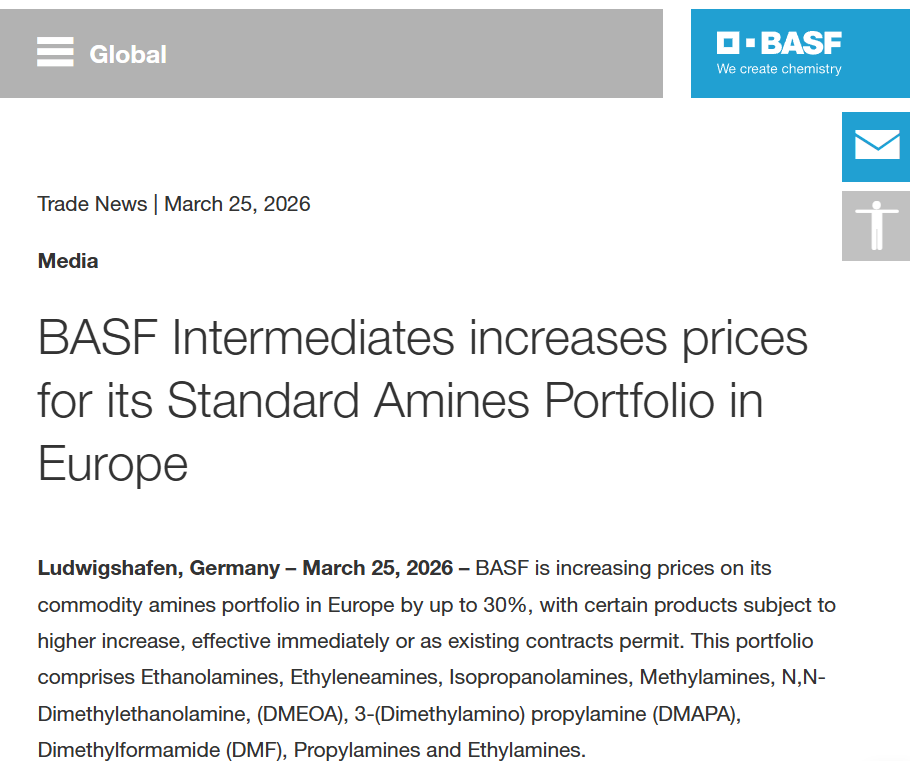
Core Viewpoint - BASF is increasing prices for its commodity amines portfolio in Europe by up to 30% due to rising costs from the ongoing conflict in the Middle East, effective immediately or as existing contracts allow [1][2]. Group 1: Price Increases - The price increase affects a range of basic amine products including Ethanolamines, Ethyleneamines, Isopropanolamines, Methylamines, N,N-Dimethylethanolamine (DMEOA), 3-(Dimethylamino) propylamine (DMAPA), Dimethylformamide (DMF), Propylamines, and Ethylamines [1][2]. - These products are essential intermediates in various industries such as electronics, agriculture, and pharmaceuticals, highlighting their critical role in industrial formulations [1]. Group 2: Industry Context - The price hikes are a response to significant increases in raw material, energy, and logistics costs due to geopolitical tensions, which have become a common trend in the chemical industry [3][4]. - Other chemical companies, such as Lanxess and Dow Chemical, are also raising prices significantly, with increases up to 50% for some products, indicating a broader industry trend driven by supply chain disruptions [4][5]. Group 3: Market Implications - Analysts from JPMorgan suggest that the disruptions caused by the war may create greater pricing power for European chemical companies, potentially leading to meaningful profit increases in the short term [5].

甲醇日报:美伊和谈疑云,短暂回调-20260325
Guan Tong Qi Huo· 2026-03-25 09:50
Report Industry Investment Rating - Not provided Core Viewpoint - Given the new developments in the Middle East situation and the sharp drop in crude oil prices after the peace talk news, methanol is expected to continue to be strong after a short - term correction due to the time needed for supply to return to pre - war levels and the incomplete passage of the Strait of Hormuz. However, short - term risks are high, and it is necessary to closely monitor the US - Iran situation and crude oil trends [4] Summary by Directory Fundamental Analysis - As of the week of March 19, China's methanol production was 2,074,815 tons, an increase of 53,680 tons from the previous week, and the device capacity utilization rate was 92.87%, a 2.65% increase from the previous week. There were new maintenance and production - reduction devices this period, and some devices resumed production. The overall recovery volume was more than the loss volume, resulting in an increase in production and capacity utilization [1] - China's methanol sample production enterprise inventory was 485,400 tons, a decrease of 37,700 tons from the previous period, a 7.21% decrease; the sample enterprise order backlog was 279,300 tons, an increase of 14,000 tons from the previous period, a 5.26% increase [1] - Zhengshang Institute decided to add Anhui Province as a methanol futures delivery area and publicly solicit designated delivery warehouses for methanol futures. The premium and discount for the new delivery area is 150 yuan/ton, to be implemented from the date of the announcement of the new delivery warehouses [1] Macroeconomic Analysis - In March, the traffic volume through the Strait of Hormuz dropped by more than 90%. An Iranian vessel ordered an unauthorized ship to return, and the UK Royal Navy plans to lead a coalition to reopen the Strait of Hormuz [2] - A person from the securities department of China Merchants Energy Shipping revealed that the company has no ships stranded in the Persian Gulf, has no plans to pass through the risk area after the war, and is using other shipping routes. The current tanker freight rate has increased by more than 50% compared to before the war [2] - The US plans to cease fire for one month, and a plan to end the conflict with Iran was exposed [2] Futures and Spot Market Analysis - Not provided
甲醇早报-20260325
Da Yue Qi Huo· 2026-03-25 03:08
Report Summary 1. Report Industry Investment Rating - Not provided in the document. 2. Core Viewpoints - Multiple positive factors are expected to keep the methanol market strong in the short term. Inland, high profits have led to high domestic methanol operation rates, but increased olefin demand and rising futures prices have boosted buying, accelerating inventory reduction. Import arrivals are expected to tighten, further reducing port inventories and supporting spot prices. The market is optimistic, with downstream buyers willing to accept high - priced goods. In ports, imports are shrinking, and inland supplies flowing to ports have slowed inventory decline. If Jiangsu MTO plants restart and the Middle - East conflict continues, the port market will remain strong. The current methanol market is leading the chemical industry, but attention should be paid to US troop withdrawal from the Middle - East and MTO profit sustainability. Once the conflict shows signs of ending, the driving logic will change. It is expected that methanol prices will be strong and volatile this week, with MA2605 trading between 2960 - 3200 yuan/ton [5]. 3. Summary by Directory 3.1 Daily Tips - Methanol 2605: - Fundamental analysis shows a neutral view, with a short - term strong market due to multiple positives. - The basis in Jiangsu shows that the spot price is 3235 yuan/ton, with a basis of 96 for the 05 contract, indicating spot premium over futures (bullish). - As of March 19, 2026, the total social inventory of methanol in East and South China ports was 82.67 tons, a decrease of 5.39 tons from the previous period. The available circulating methanol in coastal areas decreased by 5.43 tons to 44.15 tons (bearish). - The 20 - day moving average is upward, and the price is above the average (bullish). - The main positions are net short, with long positions turning to short (bearish). - It is expected that methanol prices will be strongly volatile this week, with MA2605 trading between 2960 - 3200 yuan/ton [5]. 3.2 Long and Short Concerns - **Bullish factors**: - Some plants have stopped or reduced production, such as Inner Mongolia Heima and Shanxi Zhongxin. - Low methanol operation in Iran, with expected import contraction in February. - Low inventory in production areas, with some companies limiting sales. - Some downstream users are still stocking up before the Spring Festival [6]. - **Bearish factors**: - High domestic methanol operation rates with no supply shortage. - As the Spring Festival approaches, downstream formaldehyde and other industries are shutting down for holidays, weakening raw material demand. - Main olefin plants at ports have stopped, significantly weakening local demand. - Most downstream users have completed pre - festival stocking, resulting in weakened phased demand [7]. 3.3 Fundamental Data - **Price data**: - In the spot market, the price of steam - coal in the Bohai Rim is 687 yuan/ton (unchanged), CFR China Main Port is 388 dollars/ton (down 9 dollars/ton), import cost is 3270 yuan/ton (down 78 yuan/ton), CFR Southeast Asia is 557 dollars/ton (unchanged). Domestic prices vary by region, with Jiangsu at 3210 yuan/ton (down 85 yuan/ton), Shandong at 2310 yuan/ton (unchanged), Hebei at 2725 yuan/ton (up 225 yuan/ton), Inner Mongolia at 2430 yuan/ton (up 28 yuan/ton), and Fujian at 3240 yuan/ton (down 85 yuan/ton). - In the futures market, the closing price of futures is 3139 yuan/ton (down 212 yuan/ton), the registered warehouse receipts are 7641 (unchanged), and the valid forecasts are 487 (up 340). - In terms of price spreads, the basis between Jiangsu and Shandong is 7900 yuan/ton (up 127 yuan/ton compared to the previous value), the import spread is 131 yuan/ton (up 134 yuan/ton compared to the previous value), and there are also various other price spreads with different changes [8]. - **Operation rate data**: - The operation rates in East China are 80.65% (unchanged), Shandong is 68.71% (down 2.39% compared to the previous value), Southwest is 44.06% (down 1.22% compared to the previous value), Northwest is 81.54% (down 3.55% compared to the previous value), and the national weighted average is 74.90% (down 3.81% compared to the previous value) [8]. - **Inventory data**: - East China port inventory is 51.07 tons (down 3.73 tons compared to the previous value), and South China port inventory is 31.60 tons (down 1.66 tons compared to the previous value) [8]. 3.4 Maintenance Status - **Domestic plants**: Many domestic methanol plants are under maintenance or have reduced production, including Shaanxi Black Cat, Qinghai Zhonghao, and many others in the Northwest, East, Southwest, and Northeast regions, with different maintenance start and end dates and production losses [58]. - **Overseas plants**: In Iran, some plants like ZPC and Kimiaya have reported recovery but need verification. Other plants in different countries such as Saudi Arabia, Malaysia, and the US have various operation statuses, including normal operation, restarting, and planned outages [59]. - **Olefin plants**: Some olefin plants are under maintenance or have different operation statuses. For example, Shaanxi Qingcheng Clean Energy's methanol and olefin plants have been shut down for maintenance since March 15, expected for 45 days. Other plants in different regions have different operation and maintenance situations [60].
该化工原料“涨价潮”持续,贸易商“拿不到货”,厂商大客户订单价亦随行就市
摩尔投研精选· 2026-03-24 10:13
Core Viewpoint - The article discusses the impact of geopolitical tensions in the Middle East and the closure of the Strait of Hormuz on the prices of various chemical raw materials, particularly vitamins and amino acids, leading to a significant tightening of supply and rising prices in the market [1]. Supply and Demand Analysis - The supply of vitamins and amino acids has been significantly tightened, with traders reporting that manufacturers are not shipping products, particularly popular varieties like Vitamin A and E [1]. - The current price surge has benefited producers and traders across the industry chain, although opinions on future price trends are divided [1]. Price Trends - The price increase for vitamins and amino acids began at the end of February and has continued for nearly a month, with various products experiencing different degrees of price rises [2]. - As of March 23, Vitamin E was priced at 89 RMB/kg, up 7.23% in the past week, while Vitamin A reached 101.71 RMB/kg, with a weekly increase of 15.96% [2]. - The price of imported methionine rose by 47.79% to 50.25 RMB/kg, and domestic methionine increased by 49.62% to 49 RMB/kg [2]. Inventory and Sales Dynamics - Traders have reported that their inventory has appreciated in value due to rising prices, with many holding back on sales to maximize profits [3]. - Despite the price increases, sales volumes have not shown significant changes compared to previous periods, with some traders indicating that demand is stable but not dramatically increasing [3][4]. Manufacturer Behavior - There are reports of manufacturers withholding stock, with many citing "force majeure" as a reason for halting supplies, leading to a situation where traders have limited access to products [4].

中东冲突加剧,甲醇坚挺上涨
Yin He Qi Huo· 2026-03-23 11:23
1. Report Industry Investment Rating - Not provided in the given content 2. Core Viewpoints of the Report - The conflict between the US and Iran has led to a significant reduction in imported methanol, driving up the price of domestic methanol. The profit of coal - to - methanol has expanded rapidly to around 800 - 850 yuan/ton, and the domestic supply is continuously loose. However, due to the ongoing conflict, the market fears a sharp reduction in future imports, and the inventory in ports is rapidly decreasing. The supply shortage problem in domestic ports is becoming increasingly prominent. With the restart of some downstream MTO devices, the situation of supply contraction and demand increase will accelerate port destocking. Methanol should be treated with a bullish mindset [4]. - The trading strategies include going long at low prices without chasing highs for single - sided trading, paying attention to positive spreads for arbitrage, and selling put options in the over - the - counter market [4]. 3. Summary According to the Directory 3.1 Comprehensive Analysis and Trading Strategies - In the raw coal aspect, the coal mine start - up rate has increased. As of March 20, the start - up rate of coal mines in Ordos is 71%, and that in Yulin is 42%. The daily coal output in Ordos and Yulin is around 4.1 million tons. With the improvement of demand, the pit - mouth price has stopped falling and started to rise. The price of raw coal is generally stable, and the profit of coal - to - methanol has expanded rapidly [4]. - On the supply side, in March, due to the intensification of the US - Iran conflict, the import of methanol has significantly decreased, driving up the price of domestic methanol. The methanol start - up rate remains high and stable, and the domestic supply is continuously loose. The methanol plants in Iran are still in a state of full - scale shutdown, and the daily output has dropped from 23,000 tons to around 1,200 tons. Although some devices are reported to have resumed production, the output is still low [4]. - On the demand side, the start - up rate of MTO devices is low. Some MTO devices are shut down or under - loaded, while some have the expectation of restart. The restart of downstream MTO devices will increase the demand for methanol [4]. - The inventory in ports is rapidly decreasing. As of March 18, 2026, the total port inventory is 1.2617 million tons, a decrease of 51,100 tons compared with the previous period. The import in April is expected to drop to around 550,000 tons, and the port destocking amplitude exceeds 300,000 tons. The supply shortage problem in domestic ports is becoming increasingly prominent [4]. - The trading strategies are: for single - sided trading, go long at low prices without chasing highs; for arbitrage, pay attention to positive spreads; in the over - the - counter market, sell put options [4]. 3.2 Weekly Data Tracking - **Supply - Domestic**: As of March 19, the overall start - up load of domestic methanol plants is 78.11%, an increase of 1.84 percentage points compared with last week and 5.67 percentage points compared with the same period last year. The start - up load in the northwest region is 87.61%, an increase of 1.95 percentage points compared with last week and 4.91 percentage points compared with the same period last year. The average start - up load of non - integrated methanol plants is 72.00%, an increase of 1.45 percentage points compared with last week [5]. - **Supply - International**: In the period from March 14 to March 20, 2026, the international methanol (excluding China) output is 719,549 tons, an increase of 31,540 tons compared with last week. The device capacity utilization rate is 49.32%, a month - on - month increase of 2.16% [5]. - **Supply - Import**: In the period from March 12 to March 18, 2026, the sample arrival volume of Chinese methanol is 151,600 tons, including 131,000 tons of foreign vessels (all visible) and 20,600 tons of domestic vessels [5]. - **Demand - MTO**: As of March 19, 2026, the weekly average capacity utilization rate of MTO devices in the Jiangsu and Zhejiang regions is 40.23%, an increase of 1.28 percentage points compared with last week. The start - up rate of the national olefin devices is 85.57%, with the restart of the second - phase device of Yanchang Yulin Zhongmei and the increase of the load of Tianjin Bohua [5]. - **Demand - Traditional**: The capacity utilization rate of dimethyl ether is 5.49%. The capacity utilization rate of acetic acid is 85.4%, remaining flat. The start - up rate of formaldehyde is 42.43%, an increase compared with last week [5]. - **Demand - Direct Sales**: The weekly signing volume (excluding long - term contracts) of methanol sample production enterprises in the northwest region is 55,400 tons, a decrease of 5,300 tons compared with the previous statistical day, with a month - on - month decrease of 8.73% [5]. - **Inventory - Enterprise**: As of March 18, 2026, the inventory of production enterprises is 485,400 tons, a decrease of 37,700 tons compared with the previous period. The order backlog of sample enterprises is 279,300 tons, an increase of 14,000 tons compared with the previous period [5]. - **Inventory - Port**: As of March 18, 2026, the total port inventory is 1.2617 million tons, a decrease of 51,100 tons compared with the previous period. The inventory in the East China region has decreased by 27,600 tons, and that in the South China region has decreased by 23,500 tons [5]. - **Valuation**: The chemical coal in the northwest region has stopped falling and rebounded. The domestic methanol auction price has risen sharply. The profit of coal - to - methanol in Inner Mongolia is around 860 yuan/ton, and that in northern Shaanxi is 800 yuan/ton. The port - north line price difference is 700 yuan/ton, and the port - northern Shandong price difference is 270 yuan/ton. The MTO loss has significantly narrowed, and the basis is stable [5]. - **Spot Price**: The price in Taicang is 2,990 yuan/ton (+200), and the price in the north line is 2,300 yuan/ton (+160) [8].
未知机构:硫磺行业专家交流20260320中金-20260323
未知机构· 2026-03-23 01:45
Summary of Sulfur Industry Conference Call Industry Overview - The sulfur market is significantly influenced by geopolitical tensions in the Middle East, particularly affecting oil and gas production, leading to supply disruptions and price increases [1][2][3] - Despite price volatility, sulfur demand continues to grow, especially in the fields of new energy and phosphate fertilizers [1][2][3] Key Points Supply and Demand Dynamics - Global sulfur demand is on the rise, but supply growth is lagging, resulting in a tight supply-demand balance. The estimated sulfur production for 2025 is 71.34 million tons, a decrease from 2024 due to production cuts in Central Asia and the Middle East, while East Asia, particularly China, is expected to see production increases [3][4][5] - The Middle East accounts for approximately 30% of global sulfur production, with significant export disruptions due to geopolitical conflicts, leading to an estimated 20% loss in global supply [6][10][32] Price Fluctuations - Sulfur prices have experienced dramatic fluctuations over the past five years, influenced by the pandemic, the Russia-Ukraine conflict, and rising demand from the new energy sector. Current high raw material costs are compressing corporate profits, posing risks to demand [5][30][31] - The price of sulfur is expected to rise further due to ongoing conflicts, with potential impacts on downstream industries and consumer prices [10][11][30] Regional Insights - In China, sulfur supply and demand growth is driven by domestic refining projects and the new energy sector. The Southwest region plays a significant role in natural gas desulfurization, with imports primarily from the Middle East, which are currently affected by the blockade of the Strait of Hormuz [4][26][29] - The phosphate fertilizer industry remains a stable consumer of sulfur, while the new energy sector is showing significant growth in demand [4][28] Impact of Geopolitical Events - The ongoing conflict in the Middle East, particularly attacks on gas facilities in Qatar, could have long-term implications for sulfur production, with potential losses of up to 20,000 tons per year from affected facilities [9][10][34] - The blockade of the Strait of Hormuz has severely restricted sulfur exports from the Middle East, with an estimated 2.16 million tons of sulfur expected to be non-exportable in 2025 [32] Industry Challenges and Future Outlook - The sulfur market faces challenges from high production costs and potential supply disruptions due to geopolitical tensions. The industry must monitor supply changes, policy adjustments, and the development of alternative products [5][31] - The introduction of solid-state battery technology may influence sulfur demand, but its impact remains uncertain as the technology is still in development and may take several years to mature [18][39] Policy and Market Considerations - The Chinese government may implement policies to stabilize fertilizer prices, especially if costs rise significantly due to supply disruptions. The need to ensure a minimum supply of approximately 7 million tons of phosphate fertilizer annually is critical [11][34] - The sulfur market's future will depend on the balance between supply constraints and the ability of downstream industries to absorb higher costs without significant demand destruction [31][35] Conclusion - The sulfur industry is currently navigating a complex landscape shaped by geopolitical tensions, supply chain disruptions, and evolving market demands. Stakeholders must remain vigilant and adaptable to the changing dynamics to ensure stability and growth in the sector [2][22][31]