医美行业

Search documents
“不自杀声明”刷屏,前高管45万字揭造假内幕?华熙生物:已报案,此人曾骗取公司900万
华尔街见闻· 2025-07-27 11:14
Core Viewpoint - The article discusses serious allegations against Huaxi Biological, a leading player in the medical aesthetics industry, regarding financial misconduct and governance issues, which have led to significant market concerns and a drastic decline in the company's stock price and market value [1][4][12]. Company Response - Huaxi Biological quickly responded to the allegations, stating that the claims are fabricated and maliciously distort the facts, and they have reported the matter to law enforcement [2][6][8]. - The company emphasized that the whistleblower, Li, had a brief tenure and was previously involved in a financial misconduct case, which raises questions about the credibility of the allegations [10][11]. Market Impact - Following the allegations, Huaxi Biological's stock price fell to 53.83 CNY, a decrease of 1.73%, with a market capitalization of 25.9 billion CNY, reflecting a significant drop from its peak valuation of over 100 billion CNY [5][14]. - The company's market value has shrunk by over 80% from its peak, indicating a severe loss of investor confidence [14][15]. Financial Performance - Huaxi Biological's financial performance has deteriorated, with a reported revenue of 5.371 billion CNY in 2024, down 11.61% year-on-year, and a net profit of 174 million CNY, a staggering decline of 70.59% [18]. - The first quarter of 2025 showed continued declines in revenue and net profit, with year-on-year decreases of 20.77% and 58.13%, respectively [19]. Industry Context - The medical aesthetics industry is facing intense competition, with Huaxi Biological struggling against rivals like Juzhi Biological, which has seen significant growth and market capitalization [22][24]. - The article highlights a shift in consumer preferences towards product safety and efficacy, suggesting that companies with genuine technological advantages will prevail in the evolving market landscape [24].



华熙生物:已向公安机关报案!
中国基金报· 2025-07-26 08:31
Core Viewpoint - Huaxi Biological has officially responded to false information circulating on online platforms, claiming that the content is fabricated and maliciously distorts facts, which has severely damaged the company's reputation. The company has reported the matter to the public security authorities and will pursue legal action against the spreaders of rumors [1][2]. Summary by Sections - The company discovered serious false information about itself on online platforms, which was confirmed to be fabricated and published on an overseas website. The nature of the content includes political rumors, which the company deems extremely malicious [2]. - The individual responsible for the false information, identified as Li, previously served as the marketing director at Huaxi Xinyu Investment Co., Ltd. Li had a history of embezzlement, having fraudulently obtained 9 million yuan that was supposed to be paid to a brokerage firm. This incident was uncovered during an annual report review [2]. - Following the discovery of Li's actions, the company reported the case to the public security authorities, which led to a criminal prosecution based on the embezzlement charge. During the investigation, Li attempted to mitigate his punishment by writing an apology letter, but the company refused to entertain any additional compensation demands beyond the return of the embezzled funds [2]. - As of July 25, Huaxi Biological's stock closed at 53.83 yuan per share, with a market capitalization of 25.9 billion yuan [2].

前中国首富出手,北交所第一高价股锦波生物魅力几何?
Mei Ri Jing Ji Xin Wen· 2025-06-27 09:28
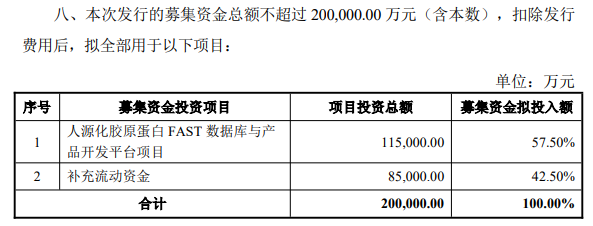
Core Viewpoint - The recent stock issuance by Jinbo Biological, controlled by Zhong Shanshan, aims to raise up to 2 billion RMB to support its growth and development in the collagen market, while also indicating a strategic partnership with Yangshengtang [1][2][7]. Group 1: Company Actions and Financials - Jinbo Biological plans to issue no more than 717,566 shares, representing 6.24% of its total shares before the issuance, to raise funds for a humanized collagen protein database and working capital [1][2]. - The total investment for the projects is 200 million RMB, with 57.5% allocated to the collagen protein project and 42.5% for working capital [2]. - Jinbo Biological's stock price has surged since its listing, with a maximum increase of over 800% from its issue price, reaching a peak of 452.29 RMB [3][9]. Group 2: Market Performance and Growth - Jinbo Biological has shown impressive financial growth, with revenue increasing from 233 million RMB in 2021 to 1.443 billion RMB in 2024, and net profit rising from 57.39 million RMB to 732 million RMB in the same period [9]. - The gross margin improved from 82.29% to 92.02%, and net margin increased from 24.38% to 50.68% [9]. - The Chinese collagen market reached 28.7 billion RMB in 2021, growing at 40.7%, with a significant increase in the penetration of recombinant collagen [9]. Group 3: Strategic Partnerships and Future Outlook - Yangshengtang, controlled by Zhong Shanshan, is entering into a strategic partnership with Jinbo Biological, which is expected to enhance business synergies and accelerate the implementation of their strategic goals [7][8]. - The collaboration aims to leverage technological integration and market channel empowerment, potentially leading to significant advancements in product development [7][8]. - Jinbo Biological's need for strategic investors is highlighted by its relatively small size and the increasing competition in the medical aesthetics industry [10][13].
医美能缓解人们对变老的焦虑吗?
Xin Jing Bao· 2025-06-27 06:47
Industry Overview - The Chinese medical beauty market is projected to reach 312 billion yuan in 2024, representing a growth of 14.8% compared to 2023 [1] - The demand for medical beauty in China is still on the rise, with a notable increase in male participation in the sector [3][5] Market Trends - The global medical beauty industry shows that the United States leads in the number of procedures, followed by Brazil, Japan, China, and India [3] - Common procedures for women include liposuction, breast augmentation, eyelid surgery, abdominal contouring, and breast lift, while men primarily undergo eyelid surgery and gynecomastia correction [3] Consumer Behavior - Many individuals pursue medical beauty not solely for aesthetics but also for self-confidence enhancement [6] - There is a growing trend among younger generations to invest time in beauty routines, raising questions about the motivations behind such practices [6][12] Psychological Aspects - The aging process is a natural phenomenon, and while medical beauty can delay visible signs of aging, it cannot prevent them [7] - The perception of beauty and self-worth is increasingly influenced by societal standards and media portrayals, leading to a complex relationship between self-esteem and appearance [6][12] Aesthetic Diversity - There has been a shift from a homogenized beauty standard, often referred to as "internet celebrity face," to a more diverse representation of beauty in media and entertainment [9] - The industry is moving towards emphasizing individual features rather than conforming to a singular aesthetic [9] Private Aesthetic Procedures - Private aesthetic procedures, particularly in the genital area, are gaining attention, with a focus on addressing both medical and cosmetic needs [14][15] - There is a need for better education and destigmatization surrounding these procedures, as many women may have legitimate health concerns that require attention [15][16]

“汝求战,便得战!”
Guan Cha Zhe Wang· 2025-06-03 10:03
Core Viewpoint - The conflict between Huaxi Biological and Juzi Biological has escalated into a public confrontation over product integrity and industry standards, with both companies making serious allegations against each other regarding the authenticity of their products and testing methods [1][3][16]. Group 1: Company Actions and Statements - Huaxi Biological announced a capital relationship with Dr. Hao Yu, holding 32.4% of the shares in his company, and positioned it as an important member of the "Huaxi ecosystem," promising technical support and personal protection [1][6]. - Huaxi's statement accused Juzi Biological of manipulating public opinion and demanded that they address product integrity issues, threatening to disclose third-party testing evidence if they do not comply [1][7]. - Juzi Biological quickly countered by claiming that the testing agency used by Dr. Hao had not authorized him to use their report and accused Huaxi of maliciously distorting facts [9][12]. Group 2: Market Reactions and Financial Implications - Following the public dispute, Juzi Biological's stock price fell over 4.69%, while Huaxi Biological's stock rose by 6.94%, indicating market concerns about Juzi's upcoming performance during the critical "618" shopping festival [2][12]. - Juzi's flagship product, "Collagen Stick," is projected to generate 3.6 billion yuan in revenue in 2024, raising concerns about the impact of the ongoing controversy on consumer trust and potential sales [2][14]. - In contrast, Huaxi Biological reported a revenue decline of 11.61% year-on-year for 2024, with a net profit drop of 70.59%, highlighting the financial pressures both companies are facing [15]. Group 3: Industry Context and Future Outlook - The dispute reflects a broader competition between two technological routes in the medical beauty industry: the hyaluronic acid camp represented by Huaxi Biological and the recombinant collagen camp represented by Juzi Biological [14][16]. - The market for collagen-based skincare products is expected to surpass that of hyaluronic acid by 2026, with a compound annual growth rate of 52.6%, attracting numerous companies to enter the sector [14]. - The ongoing conflict may lead to increased scrutiny from regulatory bodies, as the lack of clear testing standards for recombinant collagen has resulted in divergent claims from both companies [9][11].
爱美客(300896):关注25年新管线落地及医美回暖进展
HTSC· 2025-03-20 11:36
Investment Rating - The investment rating for the company is maintained as "Buy" with a target price of 237.90 RMB [8][9]. Core Views - The company reported a revenue of 3.026 billion RMB for 2024, a year-on-year increase of 5.45%, and a net profit attributable to the parent company of 1.958 billion RMB, also up by 5.33% year-on-year. However, the Q4 2024 revenue was 650 million RMB, down 7% year-on-year, and net profit was 372 million RMB, down 15% year-on-year, which was below previous expectations due to pressure on the medical aesthetics sector [1]. - The acquisition of 85% of Korean Regen Company for 190 million USD (approximately 1.386 billion RMB) is expected to inject performance momentum and boost market confidence. This marks the company's first overseas acquisition since its listing [1][4]. - Short-term recovery in the medical aesthetics sector may provide room for performance and valuation recovery, while long-term global resource integration and pipeline expansion are anticipated to create new growth trajectories [1]. Revenue and Profit Forecast - The company’s revenue is projected to grow to 3.643 billion RMB in 2025, representing a 20.41% increase, and net profit is expected to reach 2.398 billion RMB, a 22.52% increase. The EPS for 2025 is estimated at 7.93 RMB [5][7]. - The company’s estimated PE for 2025 is 30 times, with a target price of 237.90 RMB based on this valuation [5]. Product Performance - The revenue from gel products reached 1.216 billion RMB, growing by 5.01% year-on-year, driven mainly by the launch of new products. The solution category generated 1.744 billion RMB, with a stable growth of 4.4% year-on-year [2]. Regional Expansion - The company has significant expansion potential in regions such as North China, Central China, and South China, with North China showing a revenue increase of 33.21% year-on-year [3].