咖啡产业

Search documents
自贸港政策释红利 2025海南进口咖啡豆及制品增长5.6倍
Xin Lang Cai Jing· 2026-01-16 10:49
Core Insights - The coffee industry in Hainan is experiencing significant growth due to the dual benefits of tariff exemptions and "zero tariff" policies under the Hainan Free Trade Port initiative [1][2] - In 2025, Hainan enterprises are projected to import 9,110.6 tons of coffee beans and products, with a value of 480 million yuan, representing a year-on-year increase of 5.6 times and 8.3 times respectively [1] Group 1: Import and Export Statistics - The main sources of imported coffee beans and products for Hainan enterprises include Brazil, Indonesia, Vietnam, and Colombia, among 15 countries involved in the Belt and Road Initiative [1] - Hainan's coffee exports are expected to reach 169.5 tons, valued at 12.64 million yuan, with year-on-year growth of 51.9% and 49.6% respectively [1] Group 2: Policy and Regulatory Support - The Hainan Customs has implemented a "report and inspect" model for imported coffee beans, enhancing the efficiency of customs clearance significantly above the national average [2] - Future initiatives will focus on encouraging enterprises to expand import channels and production capacity, supporting the development of high-end and deep-processed coffee products [2]
从咖啡树到咖啡杯 “豫咖”在世界穿豆成链
He Nan Ri Bao· 2026-01-14 23:25
Core Insights - The article highlights the growth of the coffee industry in Henan, China, emphasizing the collaboration between local companies and Ugandan coffee farmers to enhance coffee production and quality [1][2][4] Group 1: Company Initiatives - Henan's Luyuan Wang Biotechnology Co., Ltd. provided leaf fertilizers that significantly increased coffee yield and quality by 30% for Ugandan farmer Gidudu Sulait [1] - Huichuan Industrial Development (Henan) Co., Ltd. has established a complete supply chain from roasting to freeze-drying, positioning itself as a leader in the domestic coffee market [2] - A strategic cooperation memorandum was signed between Huichuan and Luyuan Wang to deepen coffee projects in Uganda, focusing on organic farming techniques and brand development [4] Group 2: Market Trends - The per capita annual coffee consumption in China is steadily increasing, with consumers shifting from merely drinking coffee to considering its origin [2] - Ugandan coffee beans, while still niche in the domestic market, are recognized as premium products by connoisseurs [2] - The collaboration aims to create a replicable and sustainable model for agricultural cooperation between China and Africa, particularly in the coffee sector [1][4] Group 3: Agricultural Development - The companies are working to establish coffee planting bases in Uganda to strengthen the supply chain and improve product quality [2] - Luyuan Wang has developed tailored agricultural solutions based on local soil and crop conditions, enhancing farmers' productivity [3] - The partnership has resulted in a 6-acre trial farm in Uganda, showcasing the application of Chinese agricultural technology and management practices [3]
“十五五”开好局 起好步丨“咖啡+”文化体验地 从一粒咖啡豆看政策新变化
Yang Shi Xin Wen Ke Hu Duan· 2026-01-10 04:51
Core Viewpoint - The article highlights the vibrant coffee culture in Wanning, Hainan, and how the Hainan Free Trade Port policy is injecting new momentum into the local coffee industry [1][3]. Group 1: Coffee Industry Development - Wanning has a coffee cultivation history of over 70 years and is home to the first coffee factory in New China, establishing a unique coffee culture in Hainan [3]. - The local coffee industry has diversified with initiatives like hand-brew experiences, coffee post offices, and cultural museums, attracting thousands of visitors daily since the New Year [3][5]. - The Hainan Free Trade Port's "zero tariff" policy significantly benefits production and processing enterprises, allowing them to utilize automated coffee production lines and enjoy tariff exemptions on value-added processing [5][7]. Group 2: Economic Impact of Policies - The policy allows for a 30% value addition on imported coffee beans, which can lead to an 8% reduction in import tariffs, thus lowering raw material costs and enhancing market competitiveness for Hainan coffee enterprises [7][9]. - The optimization of the tariff exemption policy includes local coffee beans in the value addition calculation, making it easier for companies to achieve the required 30% value addition [9][10]. - Approximately 26,000 acres are dedicated to coffee cultivation in Hainan, and the policy also opens opportunities for local raw materials like coconuts and sugar to be processed alongside coffee beans [10]. Group 3: Collaboration and Future Prospects - Companies are actively seeking partnerships with local coffee growers and suppliers to navigate the newly optimized policy landscape [11]. - The trend of collaboration is evident across Hainan, with various enterprises engaging in tariff-exempt processing of different products, indicating a broader application of the free trade policies [13].

南农晨读 | 元旦
Nan Fang Nong Cun Bao· 2026-01-01 02:05
南农晨读 | 元旦_ 南方+_南方plus 0:00 / 0:18 (南农晨读 | 元旦,时长共18秒) 【今日关注】 在时间的长河 旁,等候一场生 长丨2026南方农 村报新年社论 又是一年将尽 时。当金柚一个 个离开枝头,当 晚稻一穗穗归入 仓廪,2025年悄 然步入尾声,我 们站在时光隧道 的入口,即将迈 进2026年的门 楣。 全国农业农村厅 局长会议召开 12月30日,全国 农业农村厅局长 会议在京召开, 农业农村部党组 书记、部长韩俊 出席会议并讲 话。会议强调, 要以习近平新时 代中国特色社会 主义思想为指 导,深入贯彻党 的二十大和二十 届历次全会精 神,全面贯彻习 近平总书记关 于"三农"工作的 重要论述和重要 指示精神,认真 落实中央经济工 作会议、中央农 村工作会议部 署,锚定农业农 村现代化,深入 学习运用"千万 工程"经验,扎 实推进乡村全面 振兴,加快建设 农业强国,全力 做好明年和今后 一个时期农业农 村工作,奋力开 创农业农村现代 化新局面。 2026,愿每粒种 子都找到属于它 的春天 没有什么比泥土 里长出的相遇更 值得纪念。珠江 潮水记得每一艘 载满农产的航 船,广交会的灯 ...

云上牛岭咖啡庄园冲刺陵水第一批咖啡加工增值免关税业务
Sou Hu Cai Jing· 2025-12-31 11:40
Core Viewpoint - The establishment of the Hainan Free Trade Port and the implementation of the duty-free policy for processed coffee products present significant growth opportunities for the coffee industry in Hainan, particularly for companies like Yunshang Niuling Coffee Manor, which is positioned as a representative of the integrated coffee industry chain [1][3]. Group 1: Policy and Market Context - The Hainan Free Trade Port officially commenced operations on December 18, 2025, marking a new phase in industrial upgrading, policy innovation, and openness [1]. - The coffee market in China is experiencing rapid growth, with a compound annual growth rate exceeding 20% from 2020 to 2025, significantly higher than the global average of 4%-5% [1]. - In 2024, China's total coffee imports are projected to reach 213,300 tons, continuing an upward trend [1]. Group 2: Company Operations and Achievements - Yunshang Niuling Coffee Manor has become the first enterprise in Hainan to benefit from the duty-free policy for processed coffee, addressing challenges related to the variety of coffee beans and supply shortages [1]. - The company completed the application process for the duty-free policy with the support of local government departments, achieving rapid approval for necessary certifications and registrations within 45 minutes [2]. - On December 30, 2025, the company successfully exported processed coffee products to Harbin, marking a significant milestone in the implementation of the duty-free policy [3]. Group 3: Future Outlook and Strategic Plans - The company aims to create a trade loop that includes global green bean procurement, deep processing in Hainan, and distribution in global markets, leveraging the duty-free and value-added processing policies to capture the mid-to-high-end coffee market [3]. - There are plans to enhance trade cooperation with Southeast Asia and Australia/New Zealand, taking advantage of the RCEP to further reduce regional tariff costs [3].
视频|封关启新篇 咖啡闯新路 ——云上牛岭咖啡庄园冲刺陵水第一批咖啡加工增值免关税业务
Sou Hu Cai Jing· 2025-12-31 06:07
Core Viewpoint - The establishment of the "Yunshang Niuling Coffee Plantation" as the first enterprise in Hainan to benefit from the tariff-free policy for value-added processing and domestic sales marks a significant milestone for the coffee industry in the region [1][3]. Group 1: Industry Development - The Hainan Free Trade Port officially commenced operations on December 18, 2025, signaling a new phase of industrial upgrading, policy innovation, and openness to the outside world [3]. - The coffee market in China is experiencing rapid growth, with a compound annual growth rate exceeding 20% from 2020 to 2025, significantly outpacing the global average of 4%-5% [3]. - In 2024, China's total coffee imports are projected to reach 213,300 tons, continuing an upward trend [3]. Group 2: Company Operations - The Yunshang Niuling Coffee Plantation is leveraging the tariff-free policy to address challenges in the processing segment, such as insufficient coffee bean varieties and inadequate self-cultivated supply [3][6]. - The company completed the application process for the tariff-free policy with the support of local government departments, achieving rapid approval for necessary certifications and registrations [7][8]. - On December 30, 2025, the first batch of processed coffee products was successfully airlifted to Harbin, showcasing the effective implementation of the tariff-free policy [8]. Group 3: Government Support - The local government has established a dedicated task force to facilitate the implementation of the tariff-free policy, ensuring efficient communication and support for enterprises [6][11]. - The collaboration between various government departments and the Sanya Customs has streamlined the approval process, allowing for quick certification and registration for companies [7][8]. - The deputy director of the Science and Technology and Industry Information Bureau emphasized the importance of the tariff-free policy in reducing costs and promoting industrial transformation [11]. Group 4: Future Outlook - The Yunshang Niuling Coffee Plantation aims to create a trade loop combining global green bean procurement, deep processing in Hainan, and global market distribution, capitalizing on the tariff-free and value-added processing policies [13]. - The company plans to enhance its market position in the domestic and international high-end coffee sectors by leveraging the RCEP agreement to deepen trade cooperation with Southeast Asia and Australia/New Zealand [13].

抓落实 开新局|全省各企业认真学习领会省委全会和省委经济工作会议精神:凝心聚力担使命 奋楫争先开新局
Xin Lang Cai Jing· 2025-12-28 00:57
Group 1 - The Yunnan provincial government has outlined a grand blueprint for the "14th Five-Year Plan," emphasizing the importance of both state-owned and private enterprises in driving economic progress and contributing to the modernization of Yunnan [1][2] - The provincial meetings highlighted the need to enhance the business environment, stimulate the vitality of various business entities, and support the growth of enterprises to promote high-quality development [2][8] - Companies like Yunnan Investment Management Co. and Yunnan Tianhua Group are committed to focusing on their core responsibilities and enhancing their main businesses to align with the provincial economic development goals [2][3] Group 2 - Yunnan Copper Holdings aims to establish a comprehensive value support system for its industrial group by 2025, with significant increases in profit indicators and a focus on steady operations amid uncertainties [4] - Yunnan Construction Investment Group has successfully managed 160 investment projects, with total assets reaching 450 billion yuan by the end of the "14th Five-Year Plan," and plans to integrate various industries to enhance economic corridors [5] - Yunnan Coffee Factory is set to improve its processing capabilities and brand presence, aiming to elevate the "Yunfei" brand to a national level while supporting local farmers through various initiatives [6][7] Group 3 - The provincial meetings have fostered a strong consensus among enterprises to pursue high-quality development, with companies like Xiangfeng Group and Yunnan Dianxue Grain and Oil Co. expressing confidence in their growth strategies [9][10] - Yunnan Duobao Cable Group is focusing on the development of new energy cable products and energy-saving transformations, leveraging regional advantages to enhance infrastructure in Southeast Asia [10] - The overall sentiment among various enterprises is one of determination to translate provincial directives into actionable strategies for growth and innovation, contributing to the success of the "14th Five-Year Plan" [10]
海南封关运作倒计时 中国开放新棋局落子有声
Sou Hu Cai Jing· 2025-12-12 19:29
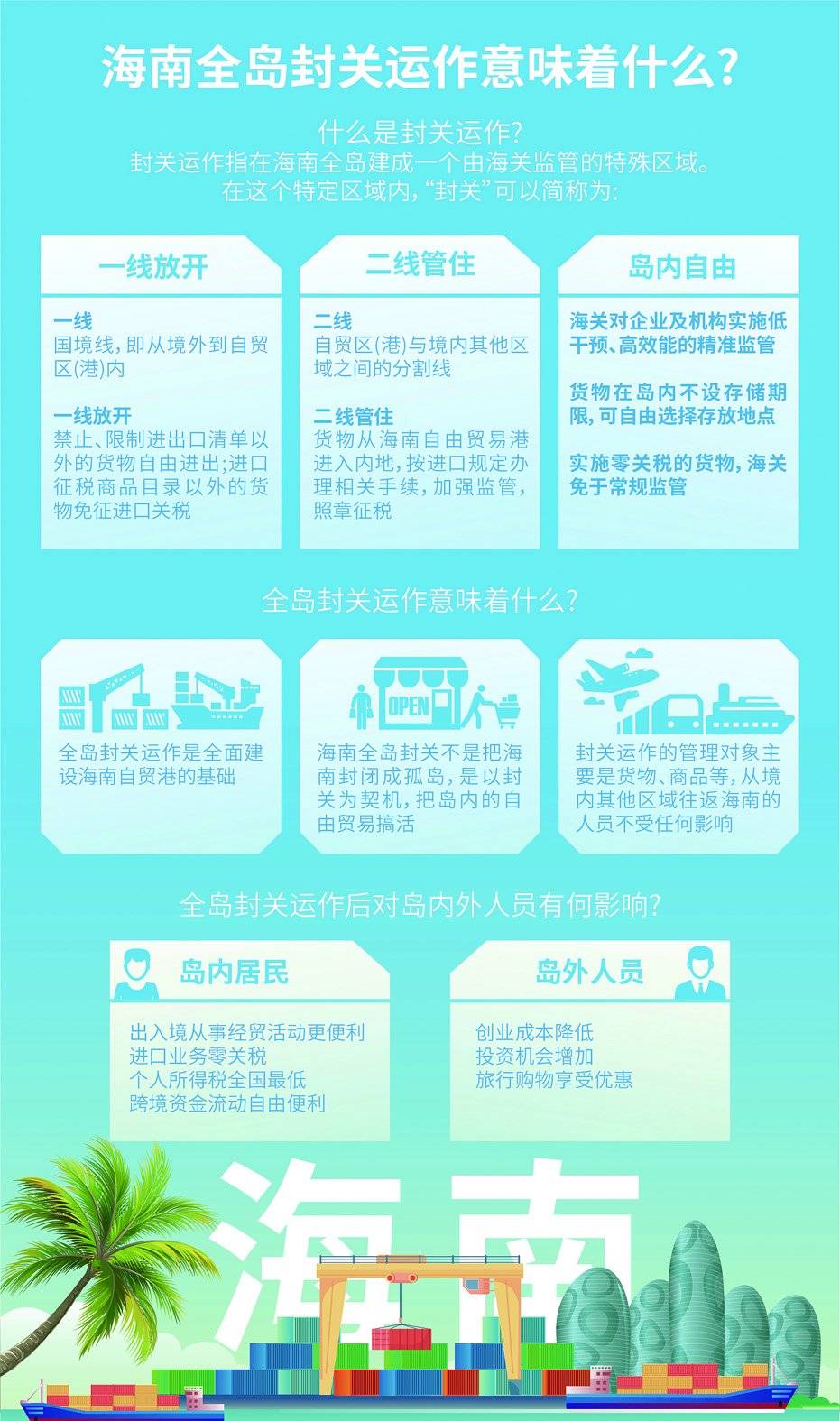
Core Viewpoint - The establishment of the Hainan Free Trade Port marks a significant transformation for Hainan, enhancing its role in China's high-level opening-up strategy and creating a new global link for trade and investment [7][8]. Group 1: Policy Implementation - The Hainan Free Trade Port will officially start its full island closure operation on December 18, which is a crucial step in establishing a policy system for the free trade port [7]. - The policy framework includes "one line" for open access to international markets, "two lines" for controlled access to the mainland, and "island freedom" for internal circulation [9]. - The initial establishment of the policy system aims for a focus on trade and investment facilitation, with a target to mature by 2035 [8]. Group 2: Economic Impact - The zero-tariff policy is a key feature of the Hainan Free Trade Port, expanding the range of zero-tariff goods from 1,900 to approximately 6,600 items, covering about 74% of all goods [10]. - The processing time for importing seafood has been significantly reduced from three days to two hours, enhancing profit margins for businesses [7]. - The new personal income tax policy in Hainan offers lower rates compared to the mainland, making it an attractive destination for talent [11][12]. Group 3: Business Opportunities - Companies like Zhengda (Hainan) Xinglong Coffee are already benefiting from the zero-tariff policy, with a projected 20% profit increase from exporting coffee to Australia [8]. - The free trade port is expected to serve as a "converter" between the Chinese mainland and global markets, testing high-standard international trade rules [12]. - The enhanced duty-free shopping experience in Hainan is attracting consumers, with significant discounts on luxury goods compared to mainland prices [7].
50%关税压垮巴西咖啡,美关税恶果外溢多国经济受创
Zhong Guo Xin Wen Wang· 2025-12-12 07:48
Group 1 - The U.S. has initiated a chaotic trade war since January, leading to the highest average import tariffs since the 1930s, which is causing rising prices in the U.S. and negatively impacting global economies [1] - Switzerland's economy experienced its largest contraction since the COVID-19 pandemic, attributed to significant declines in the chemical and pharmaceutical sectors, linked to the volatility in foreign trade due to U.S. tariff policies [1] - Japan's economy also contracted in the third quarter, primarily due to declining exports and reduced private residential investment [1] Group 2 - Canada has seen a reduction of 36,500 jobs in the manufacturing sector since the beginning of the year, marking the lowest labor force level since September 2021, with manufacturing being one of the hardest-hit industries by U.S. tariff policies [2] - From August to mid-November, Brazilian coffee exports to the U.S. faced a 50% tariff, making it nearly impossible for Brazilian exporters to access the U.S. market, resulting in over a 50% decrease in coffee imports from Brazil compared to the previous year [2] - The coffee industry contributes up to 1.8% to Brazil's GDP, with approximately 3% of the national labor force employed in coffee cultivation, including seasonal and indirect jobs [2]
视频丨从一片树叶、一杯咖啡到美妆小瓶罐 看小产品如何撬动大市场
Yang Shi Xin Wen Ke Hu Duan· 2025-12-09 05:40
Group 1: Matcha Industry - The matcha market in China has reached a scale of 15 billion, with the country becoming the largest matcha producer globally [1] - In the first half of this year, China's matcha export volume has already surpassed the total for the previous year [1] - The number of new matcha stores in Guiyang has exceeded 80 this year, with over 100 registered dining brands using Guizhou matcha nationwide [9] - The annual growth rate of matcha usage in the new tea beverage sector is expected to reach 60% over the next three to five years [9] - Guizhou's matcha exports have doubled year-on-year in the first nine months, covering over 50 countries, with an expected sales volume of 2,500 tons and a value exceeding 750 million by 2025 [21] Group 2: Coffee Industry - China's per capita annual coffee consumption has reached 22.24 cups, with Shanghai averaging around 50 cups [22] - The number of coffee-related enterprises in China has surpassed 250,000, with a 36.8% increase in newly registered coffee businesses this year [31] - The coffee industry in China is projected to exceed 300 billion by 2024, with an expected growth to 369.3 billion by 2025 [37] - The demand for coffee is evolving, with consumers increasingly seeking innovative and experiential offerings [39] Group 3: Beauty Industry - The beauty industry in Huzhou has developed over 300 patents, focusing on innovative technologies to enhance production efficiency [45] - The total industrial output value of the beauty town reached 7.546 billion in the first three quarters, with exports of 284 million, a year-on-year increase of 34.59% [55] - The retail sales of cosmetics in China reached 381.2 billion in the first ten months of this year, marking a 4.6% year-on-year growth [55]