工业化学品

Search documents
不是15%?特朗普10%全球关税生效,还有六个行业关税或在路上
Di Yi Cai Jing· 2026-02-24 09:40
CBP称,对所有国家和地区的进口商品"征收10%从价关税,为期150天,除非另有明确豁免规定。 据美国海关及边境保卫局(CBP)发布消息,特朗普政府将实施的新全球关税为10%。 第一财经收到的CBP通知显示,该项关税名称为"征收临时性第122条款关税",将在2026年2月24日凌晨 12:01(美国东部标准时间)至2026年7月24日凌晨12:01期间,对所有国家和地区的进口商品"征收 10%从价关税,为期150天,除非另有明确豁免规定"。 为何是10%而非美国总统特朗普此前提及的15%?据报道,白宫方面表示,特朗普仍然致力于实施15% 的全球关税。"相关工作在进行之中,稍后会实施,"一位官员表示,但并未给出具体时间表。 目前生效是10%不是15% 据央视新闻报道,当地时间2月20日,美国总统特朗普表示,他将签署一项命令,依据美国《1974年贸 易法》第122条,在目前已经征收的常规关税基础上,额外对全球商品加征10%的关税。 此前,美国最高法院以6比3的投票结果裁定,特朗普政府援引《国际紧急经济权力法》(IEEPA)征收 关税的行为违宪。 随后在当地时间21日,特朗普在社交媒体上发文称,他将"立即把对许多国 ...


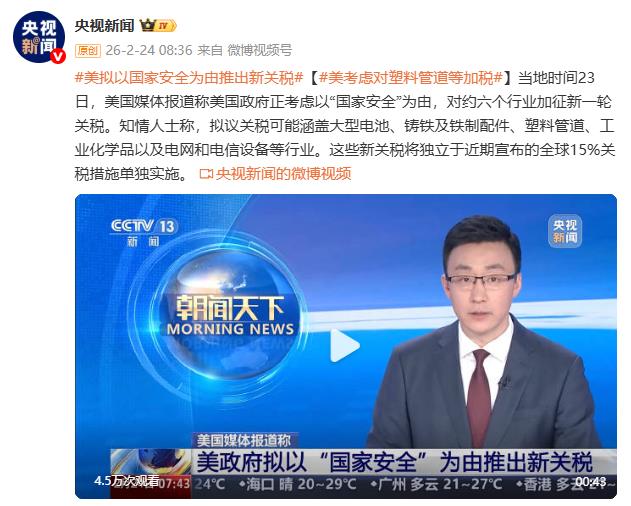
美拟对铸铁等六个行业加征新一轮关税
Yang Shi Xin Wen Ke Hu Duan· 2026-02-24 08:03
消息称相关措施将依据《1962年贸易扩展法》第232条款推出,该条款赋予总统在认定相关进口产品威 胁国家安全时,广泛加征关税的权力。 此前,美国总统特朗普当地时间2月21日在社交媒体上发文称,他将把对全球范围输美商品加征的关税 税率从10%提高到15%,并立即生效。接下来几个月里,美国政府将确定并颁布新的"合法关税"。 当地时间2月23日,美国方面消息称美国政府正考虑以"国家安全"为由,对约六个行业加征新一轮关 税。知情人士称,拟议关税可能涵盖大型电池、铸铁及铁制配件、塑料管道、工业化学品以及电网和电 信设备等行业。这些新关税将独立于近期宣布的全球15%关税措施单独实施。 ...
美国考虑对约六个行业加征新一轮关税,可能涵盖大型电池等
Hua Er Jie Jian Wen· 2026-02-24 01:17
市场有风险,投资需谨慎。本文不构成个人投资建议,也未考虑到个别用户特殊的投资目标、财务状况或需要。用户应考虑本文中的任何 意见、观点或结论是否符合其特定状况。据此投资,责任自负。 当地时间23日,美国媒体报道称美国政府正考虑以"国家安全"为由,对约六个行业加征新一轮关税。知 情人士称,拟议关税可能涵盖大型电池、铸铁及铁制配件、塑料管道、工业化学品以及电网和电信设备 等行业。这些新关税将独立于近期宣布的全球15%关税措施单独实施。(央视新闻) 风险提示及免责条款 ...
美拟以“国家安全”为由对约六个行业加征新一轮关税
Yang Shi Xin Wen· 2026-02-24 01:05
当地时间23日,美国媒体报道称美国政府正考虑以"国家安全"为由,对约六个行业加征新一轮关税。知 情人士称,拟议关税可能涵盖大型电池、铸铁及铁制配件、塑料管道、工业化学品以及电网和电信设备 等行业。这些新关税将独立于近期宣布的全球15%关税措施单独实施。 (文章来源:央视新闻) ...
Element Solutions (ESI) - 2025 Q2 - Earnings Call Transcript
2025-07-31 13:32
Financial Data and Key Metrics Changes - Organic sales grew by 6% in Q2 2025, with adjusted EBITDA increasing by 7% when excluding the Graphics business divestiture [11][12] - Adjusted EBITDA reached $136 million, exceeding initial guidance of $120 million to $125 million [11][12] - Adjusted EBITDA margin declined by approximately 40 basis points year-over-year in constant currency terms, primarily due to higher pass-through metal prices [11][12] Business Line Data and Key Metrics Changes - Electronics business achieved a 9% organic growth, driven by strong demand in high-performance computing and telecommunications [11][12] - Sales from wafer-level packaging products grew over 20% in Q2, with robust order patterns from customers [7][12] - Industrial and Specialty organic net sales increased by 1% year-over-year, with core Industrial Surface Treatment business showing stable or growing adjusted EBITDA [16][12] Market Data and Key Metrics Changes - Offshore business experienced a 15% year-over-year organic sales growth due to the completion of several large projects [17][12] - The company noted macroeconomic weakness in Europe and the Americas, but automotive growth in Asia partially offset this [16][12] - Demand for power electronics remained strong, particularly from electric vehicle manufacturers in Asia and Europe [15][12] Company Strategy and Development Direction - The company is focused on penetrating fast-growing areas within its addressable markets while driving productivity through continuous improvement [6][12] - A new world-class research center was opened in Bangalore, India, to support global formulation research and local applications development [10][12] - The company is investing in technology and strategic initiatives, including the construction of a mid-scale active copper manufacturing site expected to be commissioned by the end of the year [9][12] Management's Comments on Operating Environment and Future Outlook - Management expressed confidence in the company's positioning despite macroeconomic uncertainties, emphasizing structural advantages for long-term growth [10][12] - The adjusted EBITDA outlook for the full year was increased to a range of $530 million to $550 million, reflecting strong performance in leading-edge electronics [20][12] - Management remains cautious about potential demand variability in the second half of the year, particularly regarding tariffs and consumer electronics [21][12] Other Important Information - The company generated $59 million of adjusted free cash flow in Q2 and invested $35 million into working capital [17][12] - The net leverage ratio at the end of the quarter was 2.1 times, with no debt maturities until 2028 [18][12] - The company repurchased approximately 1 million shares at an average price of $20.45 early in the quarter [19][12] Q&A Session Summary Question: Insights on customer demand and potential pull forward - Management indicated no signs of demand pull forward in Q2, with robust investment in data center capacity continuing [27][12] Question: Expectations for Power Electronics in the second half - Power Electronics had strong growth in Q2, but management anticipates a potential slowdown in growth rate due to specific customer issues [30][12] Question: Comparison of current electronics business to previous peaks - Electronics revenue reached a new peak, but volumes are not back to prior peak levels, particularly in the circuitry and assembly businesses [33][12] Question: Competition in power electronics and advanced packaging - Management noted established competition in wafer-level packaging but highlighted a growing competitive landscape in power electronics [36][12] Question: Guidance assumptions and risks - Guidance range reflects uncertainty around tariff impacts, with stronger EV and smartphone activity expected to drive the upper end of the range [64][12] Question: Updates on Cuprion production and capacity - The first production line for Cuprion is expected to be operational by the end of the year, with plans for additional capacity in the next 18 months [66][12]

“申”度解盘 | 市场迎来调整,四月关注以下几点
申万宏源证券上海北京西路营业部· 2025-03-31 02:22
Core Viewpoint - The market situation in April is complex, suggesting a cautious approach and potential reduction in positions [2]. Group 1: Technical Analysis - The Shanghai Composite Index has broken below the important 30-day moving average support, indicating a higher likelihood of weakness in the index [3]. - The index has experienced an upward trend for approximately 11 weeks, but a correction is expected in the next 4-6 weeks based on Fibonacci retracement levels [3]. - The MACD indicator shows a trend of increasing bearishness, suggesting that adjustments in time and space are still insufficient, warranting a cautious stance [3]. Group 2: April Earnings Season - This year marks the first earnings season under the new national regulations, emphasizing full-process supervision of listed companies and improved delisting systems [4]. - The market is expected to place greater weight on earnings performance, with a pessimistic outlook following earnings disclosures from major internet companies [4]. - Companies with high price-to-earnings ratios and low profitability have seen significant declines, with micro-cap stocks dropping nearly 5% this week, reflecting caution towards the April earnings reports [4]. Group 3: Overseas Uncertainties - U.S. President Trump's announcement of a 25% tariff on non-U.S. manufactured cars and specific auto parts, effective April 2, has heightened global economic tensions and increased recession expectations in the U.S. [5]. - The rising gold prices indicate ongoing concerns regarding overseas uncertainties [5]. Group 4: Positive Aspects - Despite the prevailing negative analysis, there are potential positive factors, such as the possibility of a value reassessment of A-shares and Hong Kong tech stocks due to U.S. economic downturns [7]. - The marginal impact of U.S. tariffs on China is decreasing, potentially accelerating domestic substitution efforts [7]. - There is significant room for policy adjustments in China, with indications from the central bank regarding potential interest rate cuts [7]. Group 5: Summary - The market's complexity in April necessitates decisions based on trading volume: observing when below 1.5 trillion, participating between 1.5-2 trillion, and holding strong positions above 2 trillion [8]. - Attention should be given to sectors benefiting from U.S. tariffs stimulating domestic substitutes, such as lithography equipment, and potential countermeasures from China in rare earths and agriculture [8]. - Industries with rising demand and price increases, such as industrial chemicals and cutting-edge technologies like solid-state batteries and controlled nuclear fusion, should also be monitored [8].