铸铁

Search documents
美国贸易代表:有些国家要加15%关税,中国不加
Guan Cha Zhe Wang· 2026-02-26 03:00
Core Viewpoint - The U.S. government, following a Supreme Court ruling against "equivalent tariffs," has implemented a 10% global tariff on goods, with plans to increase rates for certain countries to 15% or higher, while not imposing new tariffs on China [2][6][18]. Group 1: Tariff Implementation and Adjustments - The initial 10% tariff on global goods took effect on Tuesday, with plans to raise rates for some countries to 15% or more [2][6]. - U.S. Trade Representative Jamison Greer indicated that the government intends to adhere to agreements made with China and will not raise tariffs on Chinese goods beyond current levels [2][6][18]. - The government is replacing the emergency tariffs that were struck down by the Supreme Court with new tariffs under the Trade Act of 1974, specifically Section 122 for temporary tariffs and Section 301 for investigations into unfair trade practices [4][16]. Group 2: Trade Investigations and Targets - The investigations will focus on countries accused of overcapacity, forced labor in supply chains, discrimination against U.S. tech companies, and subsidies for products like rice and seafood [5][17]. - Greer has claimed that China has not adequately addressed the issue of overcapacity, which serves as a justification for potential tariffs on China and Vietnam [5][17]. Group 3: Future Trade Agreements and Policies - The U.S. plans to utilize the time following the Supreme Court ruling to conduct trade investigations that could lead to more permanent tariffs on specific countries and industries [6][18]. - The U.S. has reached a reciprocal trade agreement with Indonesia, which includes a 19% tariff, and will investigate Indonesia's trade practices under Section 301 [19][20]. - Greer emphasized the importance of maintaining policy continuity in trade agreements while ensuring that any tariff increases comply with legal procedures [20][21]. Group 4: Concerns from Trade Partners - European and other trade partners are concerned that new tariffs may exceed agreed-upon limits in existing trade agreements, prompting the European Parliament to pause legislative work on a trade framework with the U.S. [21]. - President Trump has warned that countries failing to adhere to agreements could face significantly higher tariffs, indicating a potential for new licensing fees as well [21][22]. Group 5: Additional Tariff Considerations - The administration is considering new tariffs on industries such as large batteries, cast iron, plastic pipes, and telecommunications equipment under the Trade Expansion Act of 1962, citing national security risks [22]. - Ongoing investigations may lead to tariffs on additional sectors, including semiconductors and pharmaceuticals, as the government accelerates its review process following the Supreme Court's decision [22].

美政府被曝酝酿新关税,涉伊最新制裁名单发布!铂强、钯稳格局延续
Qi Huo Ri Bao· 2026-02-26 00:25
Group 1: U.S. Tariff Policy - The U.S. government is preparing to impose new tariffs on various industries following a Supreme Court ruling that deemed its large-scale tariff policy illegal [2] - The Department of Commerce is initiating investigations under the Trade Expansion Act of 1962, focusing on products such as large batteries, cast iron, plastic pipes, and industrial chemicals [2] - The U.S. Trade Representative's office is also starting new trade investigations under the Trade Act of 1974, which may lead to additional tariffs due to perceived unfair trade practices [2] Group 2: U.S. Sanctions on Iran - The U.S. Treasury Department has announced sanctions against over 30 entities, individuals, and oil tankers to combat what it describes as illegal oil sales from Iran [3] - The sanctions coincide with upcoming indirect negotiations between the U.S. and Iran, indicating a continued strategy of maximum pressure on Iran [3] Group 3: Platinum and Palladium Market Trends - The global platinum group metals market is experiencing a strong upward trend, with platinum and palladium prices rising significantly, with platinum surpassing $2300 per ounce and palladium stabilizing around $1880 per ounce [4] - Supply constraints are identified as a key driver of this price surge, with over 75% of global platinum supply coming from mining, primarily in South Africa, and 76% of palladium supply from Russia and South Africa [4] - Demand for platinum and palladium is shifting, with a projected 12% decrease in demand from gasoline vehicles by 2026, while the penetration of hybrid vehicles is accelerating [4] Group 4: Macroeconomic Influences on Precious Metals - The potential for interest rate cuts by the Federal Reserve is seen as supportive for precious metal prices, with expectations of at least two rate cuts in 2026 [5] - Geopolitical tensions, including potential military conflicts, are contributing to a risk-averse sentiment that supports platinum and palladium prices [6] Group 5: Future Price Projections - Short-term projections indicate that platinum prices may remain strong due to supply disruptions and Fed rate cut expectations, while palladium prices may face downward pressure due to demand shifts towards electric vehicles [6] - Long-term outlook suggests that platinum will maintain a supply shortage due to increasing demand from hydrogen energy applications, while palladium may face oversupply as its primary use in gasoline vehicles declines [6][7]
美媒:特朗普政府正酝酿征收新关税
Xin Lang Cai Jing· 2026-02-24 11:51
Core Viewpoint - The U.S. Supreme Court ruled that the large-scale tariffs imposed by the Trump administration under the International Emergency Economic Powers Act were illegal, leading to plans for new tariffs based on national security laws, which may increase economic uncertainty [1][6]. Group 1: New Tariff Investigations - The U.S. Department of Commerce is initiating new investigations under Section 232 of the Trade Expansion Act of 1962 for products in industries such as large batteries, cast iron and iron fittings, plastic pipes, industrial chemicals, and telecommunications equipment [1][6]. - The U.S. Trade Representative's office is also starting new trade investigations under Section 301 of the Trade Act of 1974, which may lead to tariffs on issues like drug pricing and discrimination against U.S. technology companies [2][6]. Group 2: Existing Tariffs and Changes - The Trump administration previously invoked Section 232 to investigate nine categories of products, including semiconductors and solar panels, with many investigations ongoing for nearly a year [2][7]. - There is an intention to modify the algorithm for steel and aluminum tariffs, potentially lowering nominal rates but taxing based on the total value of products rather than just their steel and aluminum content [7]. Group 3: Economic Uncertainty - Following the Supreme Court ruling, the Department of Homeland Security confirmed that tariffs under the International Emergency Economic Powers Act would cease, but tariffs under Sections 232 and 301 remain effective [9]. - The new tariffs announced under Section 122 of the Trade Act of 1974 will impose a 15% tariff on goods from all countries for a maximum of 150 days, requiring Congressional approval for extension [9]. - Experts predict that the complexity and unpredictability of trade policies will increase, leading to greater uncertainty regarding future tariffs [10].
美拟对铸铁等六个行业加征新一轮关税
Yang Shi Xin Wen Ke Hu Duan· 2026-02-24 08:03
Core Viewpoint - The U.S. government is considering imposing new tariffs on approximately six industries under the justification of "national security" [1] Group 1: Proposed Tariffs - The proposed tariffs may cover large batteries, cast iron and iron fittings, plastic pipes, industrial chemicals, and equipment for power grids and telecommunications [1] - These new tariffs will be implemented separately from the recently announced global 15% tariff measures [1] Group 2: Legal Framework - The measures will be introduced under Section 232 of the Trade Expansion Act of 1962, which grants the president broad authority to impose tariffs if certain imports are deemed a threat to national security [1] Group 3: Recent Developments - On February 21, former President Trump announced an increase in tariffs on imported goods to the U.S. from 10% to 15%, effective immediately [1] - The U.S. government will determine and announce new "legitimate tariffs" in the coming months [1]
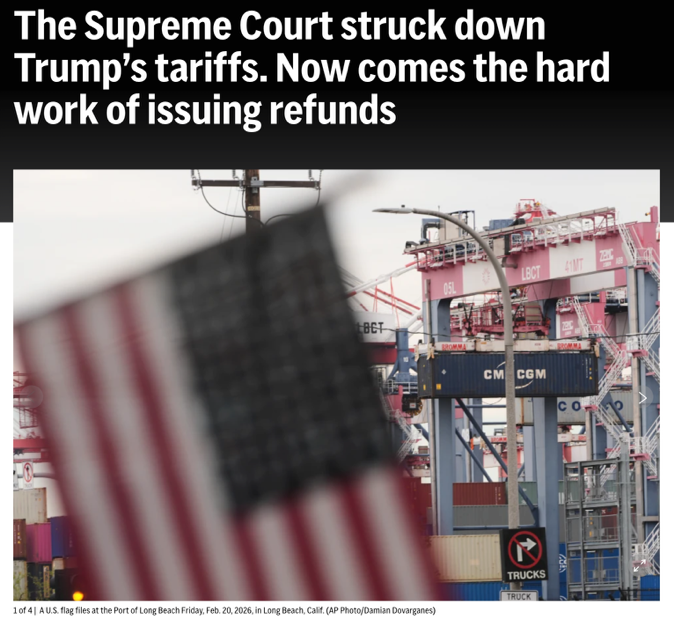
美拟以国家安全为由推出新关税,超1000家企业起诉美国政府要求“退税”
Mei Ri Jing Ji Xin Wen· 2026-02-24 02:12
Group 1 - The U.S. government is considering imposing new tariffs on approximately six industries, citing "national security" as the reason, which may include large batteries, cast iron and iron fittings, plastic pipes, industrial chemicals, and grid and telecommunications equipment [1] - The proposed tariffs will be separate from the recently announced global 15% tariff measures [1] - Over 1,000 companies have joined legal actions against the government, seeking refunds for previously paid tariffs, including major firms like Costco and Reebok [1] Group 2 - U.S. Treasury Secretary Scott Bencet emphasized that the Supreme Court's ruling did not address the refund process for previously collected tariffs, leaving it to lower courts to decide [6][7] - The potential refund amount is estimated to be around $134 billion, with some models suggesting it could exceed $175 billion when considering future adjustments [10] - The refund process is expected to involve a combination of court actions, customs, and administrative departments, with the White House already signing an executive order to terminate additional tariffs under the IEEPA [11][12] Group 3 - The legal battle over the IEEPA tariffs represents a significant financial tug-of-war between companies and the Treasury, with the refund issue becoming a politically sensitive topic for the current U.S. administration [15]