
文旅业

Search documents
从消费“流量”到发展“增量”——许昌推广胖东来式服务观察
Bei Jing Ri Bao Ke Hu Duan· 2026-01-07 11:59
Core Insights - The article highlights the success of the local retail enterprise, Pang Donglai, in enhancing service culture in Xuchang, which has become a key attraction for tourists and a model for service upgrades in the city [1][3]. Group 1: Business Impact - Pang Donglai has transformed from a comprehensive supermarket into a service culture, becoming a must-visit for tourists in Xuchang [1]. - The supermarket's success has inspired other local businesses, such as Guofu Farm, to adopt similar service principles, contributing to a vibrant local retail environment [3]. - Xuchang aims to establish itself as a "benchmark city for quality consumption," leveraging Pang Donglai's model to stimulate market vitality [3][5]. Group 2: Economic Growth - In the first eleven months of 2025, Xuchang received 49.82 million tourists, generating a total revenue of 34.87 billion yuan, reflecting a year-on-year growth of 6.9% and 7.2% respectively [5]. - The local retail sales reached 171.52 billion yuan from January to November 2025, with a year-on-year increase of 7.4%, leading the growth in Henan province [8]. Group 3: Service Innovation - The city government is promoting the "Pang Donglai service model" by optimizing the business environment and enhancing service standards across various sectors [6][8]. - New service offerings, such as free value-added services in hotels and enhanced customer experiences, are being implemented to attract and retain visitors [6][8]. - The focus is on creating a high-quality service ecosystem that extends beyond retail to encompass tourism and hospitality, aiming for a shift from attracting visitors for a single store to creating a comprehensive city experience [8].


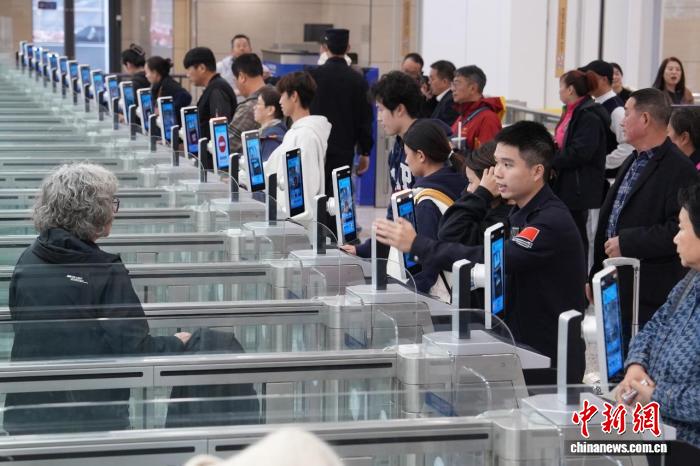
横琴“一签多行”政策实施一周年成效显著
Zhong Guo Xin Wen Wang· 2025-12-31 13:31
Core Insights - The "One Permit, Multiple Entries" policy in Hengqin has shown significant results one year after its implementation, with over 830,000 people using the permit to cross the border into Macau [1][3]. Group 1: Policy Impact - The policy has activated new momentum for integrated development between Hengqin and Macau, with a notable increase in cross-border travel [1]. - As of September 2025, the resident population in the Hengqin Guangdong-Macau Deep Cooperation Zone reached 46,000, a year-on-year increase of 20.4% [3]. - Approximately 60% of eligible residents have successfully applied for the "One Permit, Multiple Entries" permit, indicating a strong alignment between the policy and public demand for cross-border convenience [3]. Group 2: Usage Statistics - The usage of the "One Permit, Multiple Entries" permit has shown a steady growth trend, with monthly crossings increasing from 32,000 in January to over 120,000 in December, representing a growth of over 275% [3]. - Most permit holders travel to Macau at least once a month, with some residents making weekly trips for various purposes such as tourism, shopping, and visiting friends [3]. Group 3: Future Projections - The Hengqin border inspection station anticipates that daily passenger flow during the New Year holiday in 2026 will exceed 100,000, a year-on-year increase of over 30% [4]. - Peak outbound traffic is expected between 9:00 AM and 2:00 PM, while peak inbound traffic will occur from 4:00 PM to 10:00 PM [4].
一块地整好用好,产生多少价值(不掉队 赶上来)
Ren Min Ri Bao· 2025-12-31 00:37
从零碎耕地到连片农田,广西河池推进全域土地综合整治 一块地整好用好,产生多少价值(不掉队 赶上来) 本报记者 张云河 眼前农田连片,41岁的广西河池都安瑶族自治县永仁村脱贫户李荣广不由想起当年。 "九分石头一分土""地薄石头多,撒种像白泼",形容的正是永仁村的土地。不仅如此,耕地碎,"瓢一 块碗一块,一顶草帽盖三块";布局乱,"乱搭又乱占,麻烦一大串"。 可乡亲们的生计要指望它。2021年以前,巴掌大的地块都得用来种玉米,土地贫瘠,机器进不去,收成 不理想。 2021年初,听说要搞全域土地综合整治——耕地"小块并大块"、乡村风貌改造、"田水路林村"打包治 理,永仁村驻村第一书记黄任建挺高兴,但村民们却犯嘀咕。 "把地整平是好事,可整完后还要得回自家原来那块地吗?" "地整完后还是大伙的。因为修渠修路,面积可能少一点,但质量上来了,产量肯定也提高了。" "村里2016年刚'摘帽',整治后,要是把耕作层毁了,还种得出东西来吗?钱从哪赚?" "整治后耕作层暂时受影响,但政府设置管护期,把土地质量提起来,这期间有补助给到大家。" ………… 村民与黄任建一问一答,政策慢慢从"文件语"变为"家常话"。 李荣广心动了,想起 ...
海南高速:12月29日召开董事会会议
Mei Ri Jing Ji Xin Wen· 2025-12-29 11:31
Company Overview - Hainan Highway (SZ 000886) announced its first board meeting of the ninth session on December 29, 2025, held in Haikou, Hainan Province, to discuss the election of the chairman of the board [1] - As of the report, Hainan Highway has a market capitalization of 7 billion yuan [1] Revenue Composition - For the first half of 2025, Hainan Highway's revenue composition is as follows: transportation industry accounts for 54.57%, service sector for 21.11%, cultural tourism for 19.97%, and real estate development and operation for 4.35% [1]

守底线 兴产业 促振兴
Xin Lang Cai Jing· 2025-12-24 19:52
Core Viewpoint - Inner Mongolia is focusing on consolidating poverty alleviation achievements while effectively connecting with rural revitalization strategies, emphasizing industry development, infrastructure improvement, and cultural tourism integration to enhance the livelihoods of rural residents [1] Group 1: Poverty Alleviation and Support Mechanisms - The region has implemented a robust monitoring and support mechanism to prevent poverty, ensuring that 99.6% of the 73,000 households and 153,000 individuals identified as at risk receive targeted assistance [4] - Inner Mongolia has established a dynamic monitoring system that reduces the identification time for at-risk households from one month to 15 days, with 13,155 new monitoring subjects identified in 2025 [3] - Various support measures have been put in place, including employment assistance for 20,000 individuals annually, with the employment scale increasing from 203,000 in 2021 to 243,200 in 2025 [7] Group 2: Industry Development - Inner Mongolia is focusing on specialized and differentiated development, promoting rural characteristic industries to drive income growth, with over 20,000 industry support projects implemented [6][7] - The region has seen a significant increase in funding for industry development, rising from 60% in 2021 to over 70% currently, enhancing economic vitality in poverty-stricken areas [7] - The establishment of a "company + base + farmer" model in livestock farming has led to the acquisition of 54,000 lambs and the signing of contracts with 1,250 cooperative farmers [6] Group 3: Rural Revitalization and Infrastructure - Inner Mongolia is enhancing rural living conditions through comprehensive infrastructure improvements, including the construction of clean roads and community service centers, contributing to a better quality of life for residents [8][10] - The region has initiated a "rural beautification" campaign, achieving a 50.8% toilet coverage rate and improving waste management in 97.2% of administrative villages [10] - The average disposable income for rural residents in Inner Mongolia is projected to reach 22,543 yuan in 2024, ranking first among 12 western provinces and showing a growth rate above the national average for five consecutive years [10]
百亿富豪俞发祥的黄昏,祥源系200亿兑付危机警示录
Sou Hu Cai Jing· 2025-12-23 04:52
Core Viewpoint - The sudden criminal detention of Yu Faxiang, a prominent businessman with a net worth of 14.5 billion, has triggered a liquidity crisis involving 20 billion and nearly 10,000 investors, leading to significant turmoil in his companies [1][3]. Group 1: Incident Overview - On December 22, three publicly listed companies—Xiangyuan Cultural Tourism, Jiaojian Co., and Haichang Ocean Park—announced that their actual controller, Yu Faxiang, was taken away by the police for suspected criminal activities [3]. - Just two months prior, Yu was featured on the Hurun Rich List with a net worth of 14.5 billion, ranking 465th, highlighting the abruptness of his fall from grace [3]. - The crisis began in late November when financial products guaranteed by Xiangyuan Holdings started to default, with an estimated outstanding payment scale exceeding 20 billion, involving over 200 products [3]. Group 2: Financial and Operational Challenges - The company’s executive, Shen Baoshan, admitted that the firm had been relying on a "borrow new to repay old" strategy, and now the cash flow has been severely disrupted due to a halt in financing [3][4]. - Xiangyuan Holdings, which claims total assets of 60 billion, is facing a cash flow crisis due to unsold real estate worth 30 billion and a breakdown in its financing chain [3][4]. Group 3: Business Model and Risks - Yu Faxiang's business model, which heavily relies on high turnover in real estate to fund cultural tourism operations, has proven to be vulnerable, especially when the real estate market cools down [4]. - The over-reliance on financing rather than operational cash flow has exposed the company to significant risks, particularly after the cancellation of trading qualifications at the Zhejiang Financial Center [4]. - The resignation of Yu Faxiang's cousin, Yu Honghua, from all listed company positions and the judicial freezing of over 800 million shares held by Yu and his affiliates indicate potential instability in company control [4].

海南高速:陈敏辞去公司董事等职务
Mei Ri Jing Ji Xin Wen· 2025-12-15 10:09
Group 1 - The core point of the news is the resignation of Chen Min from the board of directors of Hainan Highway due to job relocation, effective December 15, 2025 [1] - Hainan Highway's revenue composition for the first half of 2025 is as follows: transportation industry accounts for 54.57%, service sector for 21.11%, cultural tourism for 19.97%, and real estate development and operation for 4.35% [1] - The current market capitalization of Hainan Highway is 7.3 billion yuan [2]
海南高速:12月12日召开董事会会议
Mei Ri Jing Ji Xin Wen· 2025-12-12 09:34
Group 1 - The core point of the article is that Hainan Highway (SZ 000886) announced a temporary board meeting on December 12, 2025, to discuss the election of non-independent director candidates for the ninth board [1] - The company's revenue composition for the first half of 2025 is as follows: transportation industry accounts for 54.57%, service sector 21.11%, cultural tourism 19.97%, and real estate development and operation 4.35% [1] - As of the report, Hainan Highway has a market capitalization of 7.4 billion yuan [1]
促进文旅与民航业融合发展!两部门印发行动方案
Xin Hua Wang· 2025-12-03 07:50
Core Insights - The integration of culture, tourism, and civil aviation industries aims for deeper, broader, and higher-quality collaboration by 2027, enhancing travel service levels and expanding both domestic and international tourism routes [1][2] Group 1: Action Plan Objectives - The action plan emphasizes improving domestic travel accessibility by incorporating more tourist cities into the "trunk and branch, full network connection" aviation service network [1] - It encourages the opening of popular tourist destination branch airports and the establishment of "air express" and border tourism routes [1] - Airlines are supported to increase flights based on seasonal travel demands, including educational, family, and winter tourism [1] Group 2: Targeted Initiatives - The plan includes the introduction of senior citizen travel flights and off-peak travel discount packages for elderly tourists [1] - It aims to enhance airport infrastructure in red tourism areas and encourages airlines to develop red tourism routes [1] - The action plan also focuses on optimizing inbound tourism routes by increasing direct flights from key source countries, especially those involved in the Belt and Road Initiative [2] Group 3: Promotion and Development - A promotion plan for inbound tourism routes will be implemented, targeting key source countries and major inbound tourism cities to develop a selection of premium inbound travel routes annually [2]
海南高速:11月26日召开董事会会议
Mei Ri Jing Ji Xin Wen· 2025-11-26 10:31
Group 1 - The core point of the article is that Hainan Highway (SZ 000886) announced a board meeting to discuss the acquisition of a 51% stake in Hainan Huate Petrochemical Co., Ltd. [1] - The meeting took place on November 26, 2025, in Haikou, Hainan Province, and involved both in-person and remote voting methods [1]. - Hainan Highway's revenue composition for the first half of 2025 is as follows: transportation industry 54.57%, service sector 21.11%, cultural tourism 19.97%, and real estate development and operation 4.35% [1]. Group 2 - As of the report, Hainan Highway has a market capitalization of 7.3 billion yuan [1].