
智能消费设备制造业

Search documents
11月经济新动能表现强劲 高技术制造业持续领跑
Di Yi Cai Jing· 2025-12-15 14:19
Core Insights - China's macroeconomic indicators continued to show a slowdown in November, but high-tech manufacturing production and investment growth remained strong, indicating a significant contribution of new momentum to the macro economy [1][2] Industrial Performance - In November, the industrial added value of large-scale enterprises increased by 4.8% year-on-year, slightly down by 0.1 percentage points from October, marking the lowest growth since September 2024 [1] - High-tech manufacturing added value grew by 8.4% year-on-year in November, outperforming the overall industrial growth by 3.6 percentage points, with a cumulative growth of 9.2% from January to November [2] - The production of new energy vehicles and lithium-ion batteries for vehicles saw significant increases of 26.5% and 42.2% respectively from January to November [2] Consumer Market - The total retail sales of consumer goods reached 43,898 billion yuan in November, growing by 1.3% year-on-year, but down 1.6 percentage points from October, marking six consecutive months of slowdown [4] - Service retail sales grew by 5.4% year-on-year from January to November, indicating a shift in consumer spending towards services [5] Investment Trends - Fixed asset investment (excluding rural households) totaled 444,035 billion yuan in the first eleven months, down 2.6% year-on-year, with a notable decline in real estate investment by 15.9% [7] - Manufacturing investment increased by 1.9% year-on-year, while infrastructure investment (excluding certain utilities) decreased by 1.1% [7][8] - Despite the overall decline in investment, certain sectors like general equipment manufacturing saw an 8.9% increase in investment [8] Policy and Future Outlook - The Chinese government is focusing on expanding domestic demand and promoting the transformation of traditional industries to support economic stability [3] - Recent policies aim to enhance consumer spending and investment, with a focus on improving investment efficiency and stimulating private investment [9] - The central economic work conference outlined key tasks for the upcoming year, emphasizing the importance of domestic demand and consumer spending [5][9]
11月经济新动能表现强劲,高技术制造业持续领跑
Di Yi Cai Jing· 2025-12-15 14:10
Economic Overview - China's macroeconomic indicators showed a continued slowdown in November, but high-tech manufacturing production and investment growth remained strong, indicating new momentum for the economy [1][2] - The industrial added value for November increased by 4.8% year-on-year, slightly down from October, marking the lowest growth since September 2024 [1][2] - The retail sales of consumer goods grew by 1.3% year-on-year, a significant drop of 1.6 percentage points from October, continuing a six-month trend of slowdown [1][4] High-Tech Manufacturing - In November, the added value of high-tech manufacturing rose by 8.4%, outperforming the overall industrial growth by 3.6 percentage points [2] - From January to November, the cumulative growth of high-tech manufacturing was 9.2%, with smart consumer equipment manufacturing increasing by 7.6% [2] - The development of green and low-carbon industries is advancing, with renewable energy generation increasing by 8.8% year-on-year [2] Consumer Spending - The growth of retail sales of consumer goods has been attributed to a high base from the previous year, but the cumulative growth for the year is better than last year [4][5] - Service consumption is growing rapidly, with service retail sales increasing by 5.4% year-on-year, outpacing goods retail sales [5] - The expansion of consumer spending is linked to rising per capita GDP, ongoing consumption policies, and the emergence of new consumption growth points [5] Investment Trends - Fixed asset investment (excluding rural households) decreased by 2.6% year-on-year in the first eleven months, with a notable decline in real estate investment [7] - Infrastructure investment fell by 1.1%, while manufacturing investment saw a modest increase of 1.9% [7][9] - Despite the overall decline in investment, certain sectors, such as general equipment manufacturing, showed positive growth, with an 8.9% increase [9] Policy and Future Outlook - The Central Economic Work Conference outlined key tasks for the upcoming year, emphasizing the importance of domestic demand and consumption [6] - A series of consumption-boosting policies have been introduced, aiming to enhance the supply of quality goods and services [6] - The government is focusing on stabilizing investment through various measures, including increasing central budget investments and optimizing local government bond usage [10]
11月份国民经济保持稳中有进发展态势实现全年预期目标有较好条件
Zhong Yang Ji Wei Guo Jia Jian Wei Wang Zhan· 2025-12-15 09:30
Core Insights - The macroeconomic policies in place are showing positive effects, with a focus on strengthening domestic circulation and expanding the national unified market [1][2] - The national economy is maintaining a steady growth trend, with industrial production and service sectors showing stable growth [1][2] Economic Performance - In November, the industrial added value for large-scale enterprises increased by 4.8% year-on-year and 0.44% month-on-month [1] - The service sector production index grew by 4.2% year-on-year [1] - The total retail sales of consumer goods reached 43,898 billion yuan, reflecting a year-on-year growth of 1.3% [1] - The total goods import and export volume was 38,987 billion yuan, with a year-on-year increase of 4.1% [1] - The urban surveyed unemployment rate remained stable at 5.1% [1] Sectoral Developments - From January to November, the added value of high-tech manufacturing increased by 9.2% year-on-year, while smart consumer equipment manufacturing grew by 7.6% [2] - The added value of digital product manufacturing rose by 9.3%, and the production index for information transmission, software, and IT services increased by 11.3% [2] - Renewable energy sectors, including hydropower, nuclear power, wind, and solar energy, saw an 8.8% year-on-year increase in production [2] - The coal and chemical industries experienced year-on-year growth in added value of 6.3% and 7.8%, respectively, due to upgrades and improvements in production capacity and technology [2] Challenges and Outlook - Despite the steady growth, external environmental changes are intensifying, leading to a mismatch between strong supply and weak demand in some sectors [2] - The economy's resilience, strong foundation, and potential for long-term growth remain intact, supported by innovation and deepening reforms [2] - The macroeconomic policies are expected to provide strong support for achieving annual economic targets despite existing challenges [2]
从“11月报”看中国经济延续稳中有进发展态势 新质生产力发展成色“足”
Yang Shi Wang· 2025-12-15 07:49
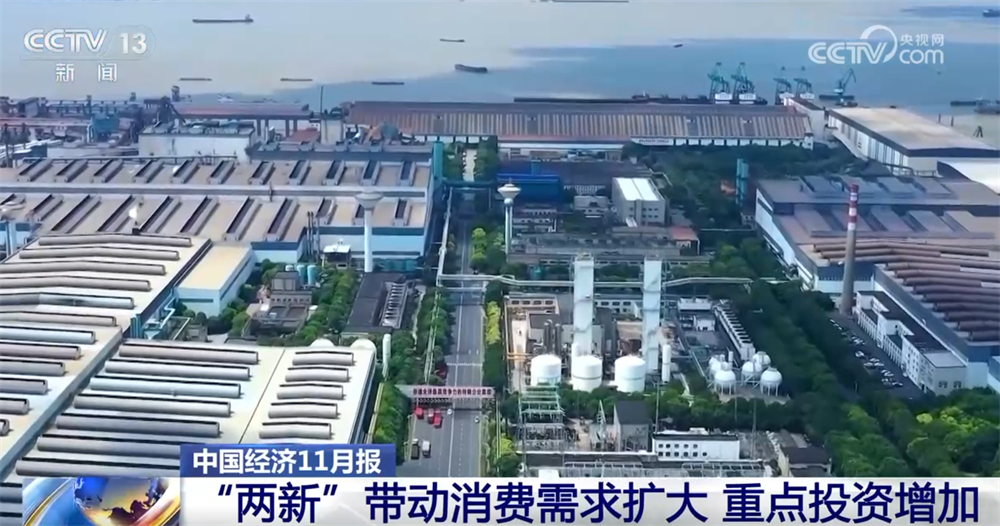
Economic Overview - In November, China's economy continued to show a stable and progressive development trend, with industrial production maintaining steady growth and the added value of industrial enterprises above designated size increasing by 4.8% year-on-year [1] - The service sector also experienced stable growth, with the national service production index rising by 4.2% year-on-year [1] - The total retail sales of consumer goods increased by 1.3% year-on-year, with accelerated growth in service retail [1] - The growth rate of goods import and export rebounded, with total goods import and export increasing by 4.1% year-on-year, indicating an optimized trade structure [1] Consumption and Investment - The "Two New" policies have effectively expanded consumer demand and increased key investments, particularly through the old-for-new policy for consumer goods, which boosted sales in home appliances and communication products [2] - From January to November, retail sales of household appliances and audio-visual equipment, cultural and office supplies, and communication equipment increased by 14.8%, 18.2%, and 20.9% year-on-year, respectively [2] Equipment Investment - From January to November, investment in the purchase of equipment and tools increased by 12.2% year-on-year, contributing 1.8 percentage points to overall investment growth [4] - The large-scale equipment update policy has shown effects, with companies increasingly willing to upgrade and transform their equipment, leading to rapid growth in equipment investment and enhancing corporate competitiveness [4] Digital Economy and High-tech Manufacturing - The added value of the digital product manufacturing industry above designated size increased by 9.3% year-on-year from January to November, reflecting the positive development of the digital economy [4][6] - The production index of information transmission, software, and information technology services grew by 11.3% during the same period [6] - Notable increases in production were observed in servers and integrated circuits, with year-on-year growth of 15.1% and 10.6%, respectively [6] Emerging Industries - In November, the production of industrial robots increased by 20.6%, indicating a steady improvement in industrial production quality [6] - The added value of electronic special materials manufacturing and integrated circuit manufacturing grew by 30.9% and 32.4%, respectively, showcasing rapid growth in smart product production [7] - The production of green materials also saw significant growth, with high-performance chemical fibers and bio-based chemical fibers increasing by 41.3% and 27.7%, respectively [7] Green Industry Growth - The green industry, represented by new energy vehicles, has rapidly grown, exemplifying the industrial upgrade driven by green transformation [8] - From January to November, the production of new energy vehicles and lithium-ion batteries for automotive use increased by 26.5% and 42.2%, respectively [8]

国家统计局:新质生产力助力经济高质量发展取得积极成效
Zhong Guo Xin Wen Wang· 2025-12-15 03:27
Core Viewpoint - The article emphasizes that the development of new productivity is crucial for promoting high-quality economic growth in China, with significant progress observed in various sectors throughout the year [1]. Group 1: Emerging Industries - Emerging industries are growing robustly, with a 9.2% year-on-year increase in the value added of high-tech manufacturing from January to November. The smart consumer equipment manufacturing sector saw a 7.6% increase [1]. - Specific industries such as electronic materials and integrated circuits experienced substantial growth, with value added increasing by 22.9% and 24.6%, respectively [1]. - Breakthroughs in cutting-edge fields like artificial intelligence are accelerating industrial upgrades, with industrial robot production increasing by 29.2% and industrial control computers by 87.6% [1]. Group 2: Traditional Industry Transformation - The country is actively promoting technological upgrades and equipment renewal in traditional industries, leading to significant growth in new materials and processing [2]. - The biomass fuel processing industry saw a 15.6% increase in value added, contributing 1.6 percentage points more to the growth of the petroleum processing industry [2]. - The chemical fiber industry benefited from a 29% increase in bio-based materials manufacturing, contributing 18.4 percentage points to its growth [2]. - The coal and chemical industries also showed positive trends, with value added increasing by 6.3% and 7.8%, respectively [2]. Group 3: Digital Economy Growth - The digital economy is expanding, with a 9.3% year-on-year increase in the value added of digital product manufacturing from January to November. The information transmission, software, and IT services sector saw an 11.3% growth in production index [2]. - Specific products like servers and integrated circuits experienced production increases of 15.1% and 10.6%, respectively [2]. - Online retail sales grew by 9.1%, driven by the expansion of digital consumption and new business models [2]. Group 4: Green Transition - The green and low-carbon development is advancing, significantly impacting the energy sector and driving rapid growth in the new energy industry [3]. - The clean energy sector saw an 8.8% increase in electricity generation from hydropower, nuclear, wind, and solar sources [3]. - Production of hydropower and wind turbine generators increased by 25.8% and 58.9%, respectively [3]. - The production of new energy vehicles and lithium-ion batteries for vehicles grew by 26.5% and 42.2%, respectively [3]. - The recycling industry also benefited, with a 14.2% increase in the value added of comprehensive waste resource utilization [3].
“两新”政策加力扩围继续显效(锐财经)
Ren Min Ri Bao Hai Wai Ban· 2025-05-01 21:51
Core Insights - The "Two New" policy has significantly boosted investment in equipment and consumer goods, leading to a 19% year-on-year increase in equipment and tool purchases in Q1, which in turn supported a 4.6% growth in retail sales of consumer goods [1][2]. Group 1: Consumer Impact - In Q1, the "Two New" policy led to substantial growth in retail sales across various consumer categories, with telecommunications equipment, home appliances, and furniture seeing year-on-year increases of 26.9%, 19.3%, and 18.1% respectively [2]. - The total sales driven by the "Two New" initiatives exceeded 720 billion yuan, with significant contributions from the replacement of old vehicles and appliances [2]. Group 2: Investment Growth - Equipment and tool purchase investment rose by 19% in Q1, outpacing overall investment growth by 14.8 percentage points, indicating strong momentum in the manufacturing and equipment sectors [3]. - Investment in consumer goods manufacturing, equipment manufacturing, and technological upgrades showed growth rates of 13.5%, 8.9%, and 7.2% respectively, all exceeding overall investment growth [3]. Group 3: Industry Benefits - The "Two New" policy has positively impacted related industries, with manufacturing value added in general and specialized equipment, automobiles, and smart consumer devices increasing by 9.4%, 4.1%, 11.8%, and 11.4% respectively [4]. - The recycling of waste electrical and electronic products saw a significant increase, with a 70% rise in collection volumes, reflecting enhanced recycling efforts [4]. Group 4: Future Potential - The potential for expanding domestic demand is substantial, with estimates suggesting that equipment replacement needs could exceed 5 trillion yuan annually as urbanization progresses [7]. - The government plans to continue supporting the "Two New" policy with additional funding, including an allocation of 81 billion yuan in special bonds to further stimulate consumer goods replacement [6][8].

【宏观经济】一周要闻回顾(2025年3月12日-3月18日)
乘联分会· 2025-03-18 08:33
Foreign Investment - In January-February 2025, 7,574 new foreign-invested enterprises were established, a year-on-year increase of 5.8%, while the actual use of foreign capital amounted to 171.21 billion RMB, a year-on-year decrease of 20.4% [2] - The manufacturing sector attracted 47.82 billion RMB in foreign investment, while the service sector attracted 120.49 billion RMB. High-tech industries received 52.49 billion RMB, with significant growth in e-commerce services (33.5%), biopharmaceutical manufacturing (22.9%), and smart consumer equipment manufacturing (40.7%) [2] Retail Sales - The total retail sales of consumer goods reached 837.31 billion RMB in January-February, with a year-on-year growth of 4.0%. Excluding automobiles, retail sales amounted to 768.38 billion RMB, growing by 4.8% [3] - Urban retail sales were 724.62 billion RMB, up 3.8%, while rural retail sales reached 112.69 billion RMB, growing by 4.6% [3] - Online retail sales totaled 227.63 billion RMB, with a year-on-year increase of 7.3%. Physical goods online retail sales were 186.33 billion RMB, growing by 5.0%, accounting for 22.3% of total retail sales [3] Industrial Production - The industrial added value for large-scale enterprises grew by 5.9% year-on-year in January-February, with a month-on-month increase of 0.51% in February [4] - The mining industry saw a 4.3% increase, manufacturing grew by 6.9%, and the electricity, heat, gas, and water production and supply industry increased by 1.1% [4] - Among 41 major industries, 36 experienced year-on-year growth, with notable increases in coal mining (5.4%), food processing (8.3%), and automotive manufacturing (12.0%) [5] Fixed Asset Investment - Fixed asset investment (excluding rural households) reached 526.19 billion RMB in January-February, with a year-on-year growth of 4.1%, accelerating by 0.9 percentage points compared to the full year of 2024 [7] - Investment in the primary industry grew by 12.2%, the secondary industry by 11.4%, and the tertiary industry by 0.7% [7] - In the secondary industry, industrial investment increased by 11.5%, with manufacturing investment rising by 9.0% and electricity, heat, gas, and water production and supply investment growing by 25.4% [8]
