智能穿戴设备

Search documents
EssilorLuxottica股价下跌,此前有报导称苹果公司正加速开发竞争对手的智能眼镜
Jin Rong Jie· 2026-02-18 11:31
Core Viewpoint - EssilorLuxottica's stock price fell by 4.3% following reports that Apple is accelerating the development of competing AI smart glasses [1] Group 1: Company Developments - Apple aims to launch its smart glasses by 2027, intensifying competition in the smart glasses market [1] - Meta and EssilorLuxottica's partnership has so far dominated the U.S. smart glasses market [1] Group 2: Analyst Insights - Jefferies analysts believe that while Apple's entry will increase competition, the Ray-Ban Meta glasses will remain superior [1] - Analysts assert that Meta/EssilorLuxottica will continue to hold a significant market share due to its first-mover advantage, attractive branding, and unique distribution capabilities [1]


已完成数千万元天使融资,原子埃尔的开年剧本:未来,人人都要拥有一枚AI智能戒指
创业邦· 2026-02-18 03:22
Core Viewpoint - The vision of the company is that "everyone will own a smart ring," which signifies a new era of human-machine symbiosis and the integration of AI into daily life [2][5]. Market Potential - The potential market for AI smart rings is estimated to be in the trillion-yuan range, based on a global population of 8 billion and a unit price of around 1,000 yuan [8]. - The AI smart ring is expected to replace traditional wearable devices by offering a seamless and fashionable alternative, targeting users who prefer not to wear wrist devices [8]. - In the Chinese market, the annual shipment of AI smart rings could reach tens of millions, creating a basic market size of hundreds of billions of yuan from hardware sales alone [8]. New Value Creation - The AI smart ring is anticipated to generate significant service value through continuous monitoring of personal physiological and behavioral data, enabling personalized health risk management and dynamic pricing for insurance products [10]. - As a trusted personal device, the smart ring could evolve into a hub for personal data and interactions, facilitating secure payments, health data sharing, and smart living services [10]. Technological Advancements - The convergence of hardware miniaturization, edge AI computing, and advanced health algorithms is expected to create a new category of personal intelligent terminals, with the smart ring being a key carrier due to its discreetness and user-friendliness [12]. - The global wearable market is projected to grow at a compound annual growth rate of over 19%, reaching over $430 billion by 2034, with a shift towards devices focused on proactive health management and seamless interaction [14]. Competitive Advantages - The company possesses a unique capability to manage the entire innovation process, with a team experienced in product definition, AI algorithms, and high-end manufacturing [17]. - The proprietary "vibration AI interaction system" and a self-developed health AI model create a feedback loop that enhances user experience and algorithm accuracy as the user base grows [19]. - The company emphasizes data security and privacy compliance, ensuring user data sovereignty while optimizing models for future collaborations with regulated industries [21]. Ecosystem Development - The AI smart ring is positioned as a key entry point into a broader ecosystem, integrating identity verification, health data management, and local service interactions [28][29]. - The company aims to redefine the value of personal health data by collaborating with health management platforms and insurance providers to create personalized health plans and dynamic pricing models [28]. Future Outlook - The company is poised to play a central role in the transition from "mobile internet" to "spatial internet," with the AI smart ring being a critical form of personal computing that offers continuous, unobtrusive support [31]. - Investment in the company represents an opportunity to engage in the redefinition of human-machine interaction and the construction of the next generation of intelligent ecosystems [33].


在AI眼镜的“战国时代”,做一名激进的落地先锋
Feng Huang Wang Cai Jing· 2026-02-12 13:24
Core Insights - The AI glasses market is transitioning from a niche product to mass production, with companies like Qiu Guo Plan aiming to provide innovative solutions in this space [1] - The company emphasizes the importance of practical applications for AI technology, warning against speculative bubbles if AI fails to deliver real-world value [1] Group 1: Technology and Performance - Qiu Guo Plan's flagship product, the Wigain AR glasses, features aggressive performance specifications, integrating Qualcomm's XR Gen1 and Gen2 chips with a processing power of 42 TOPS [2] - The company has made breakthroughs in self-developed diffraction waveguide technology, achieving an F50 field of view and aiming for F100 [2] - The glasses are designed to function as intelligent agents with capabilities for real-time SLAM spatial positioning, environmental awareness, and complex decision-making [2] Group 2: Market Strategy and Differentiation - Unlike many competitors focusing on gaming or entertainment, Qiu Guo Plan targets the traditional Chinese medicine health sector, presenting a unique cross-industry approach [3] - The company's "1+3+N" strategy includes one core platform (AI OS and intelligent agents), three core hardware products (AR glasses, smart watches, and smart rings), and multiple vertical scenarios focusing on office, health, and industrial applications [4][5][6] - The upcoming smart health watch will serve as a "health sensor," converting traditional Chinese medicine practices into quantifiable digital models, thus creating new opportunities in the health market [6] Group 3: Entrepreneurial Philosophy and Vision - The founder of Qiu Guo Plan embodies a new generation of Zhejiang entrepreneurs, characterized by practical realism and forward-thinking industry insights [7] - The company operates with a flat organizational structure, allowing for rapid responses to market demands, with the founder directly overseeing the R&D team [7] - The founder believes that maintaining a keen sense of market dynamics is crucial for success, especially as the mass production of AI glasses approaches [8]

华米科技发布AI智能眼镜,三季度业绩大幅增长
Jing Ji Guan Cha Wang· 2026-02-11 22:44
经济观察网 华米科技近期在产品布局和财务表现方面有重要动态。公司计划在2026年CES展上推出面 向运动时尚人群的AI智能眼镜,产品已进入量产准备阶段,旨在结合其健康监测算法拓展健康管理生 态。2026年1月9日,公司股价出现显著波动,单日下跌5.24%。财报显示,公司2025年第三季度营收达 7579万美元,同比增长78.5%,Non-GAAP经营利润扭亏为盈。公司对2025年第四季度收入给出了积极 的增长指引。 投资者可留意公司后续财报发布、AI眼镜市场反馈以及智能手表业务的全球销售情况。此外,公司负 债结构及机构评级也可能影响股价波动。 以上内容基于公开资料整理,不构成投资建议。 近期事件 华米科技在2025年12月宣布布局AI眼镜领域,计划推出一款面向运动时尚人群的智能眼镜,并预计在 2026年1月于拉斯维加斯消费电子展(CES)正式亮相。产品已进入量产准备阶段,旨在结合其健康监 测算法与运动数据分析能力,拓展多维健康管理生态。 股票近期走势 2026年1月9日,华米科技股价出现显著波动,单日下跌5.24%,报收26.61美元/股,成交量3.6701万股。 此次波动可能与市场情绪或行业整体表现相关,但 ...
东北证券:AI+AR眼镜有望成为市场主流 镜片制造企业迎来发展新机遇
智通财经网· 2026-02-11 02:21
Group 1 - The core viewpoint is that AI+AR glasses are expected to surpass AI shooting glasses in market share by 2028, capturing nearly two-thirds of the market due to continuous technological updates and decreasing costs [1] - The current mainstream product is AI shooting glasses, with projected sales increasing from 5.5 million units in 2025 to 7 million units, and from 11 million units in 2026 to 18 million units [1] - The AI glasses market is anticipated to reach a scale of 149.996 billion yuan by 2030, with AI+AR glasses expected to meet both vision correction and display needs [1] Group 2 - Major tech companies like Meta and Alibaba are actively developing AI+AR glasses, with Meta's RayBan Display receiving positive market feedback, leading to a focus on fulfilling U.S. orders first [2] - Quark's AI glasses S1 have been well-received, prompting the addition of an assembly line to meet production demands [2] - Leading tech firms including Google, Amazon, Apple, and ByteDance plan to launch multiple AI glasses by 2026-2027, further validating the trend towards AI+AR glasses becoming mainstream [2] Group 3 - The potential user base for AI glasses is expanding from traditional glasses users to those with normal vision, with a focus on meeting both vision correction and display functionalities [3] - Companies like Quark, Rokid, and XREAL have established numerous offline experience stores, emphasizing the importance of traditional glasses users in their strategies [3] Group 4 - The integration challenges of waveguide and refractive lenses need to be addressed, with Rokid and Quark employing different solutions to tackle structural inconsistencies [4] - The one-piece bonding solution is expected to become the mainstream choice for integrating waveguide and refractive lenses, although it presents optical and customization challenges [4]

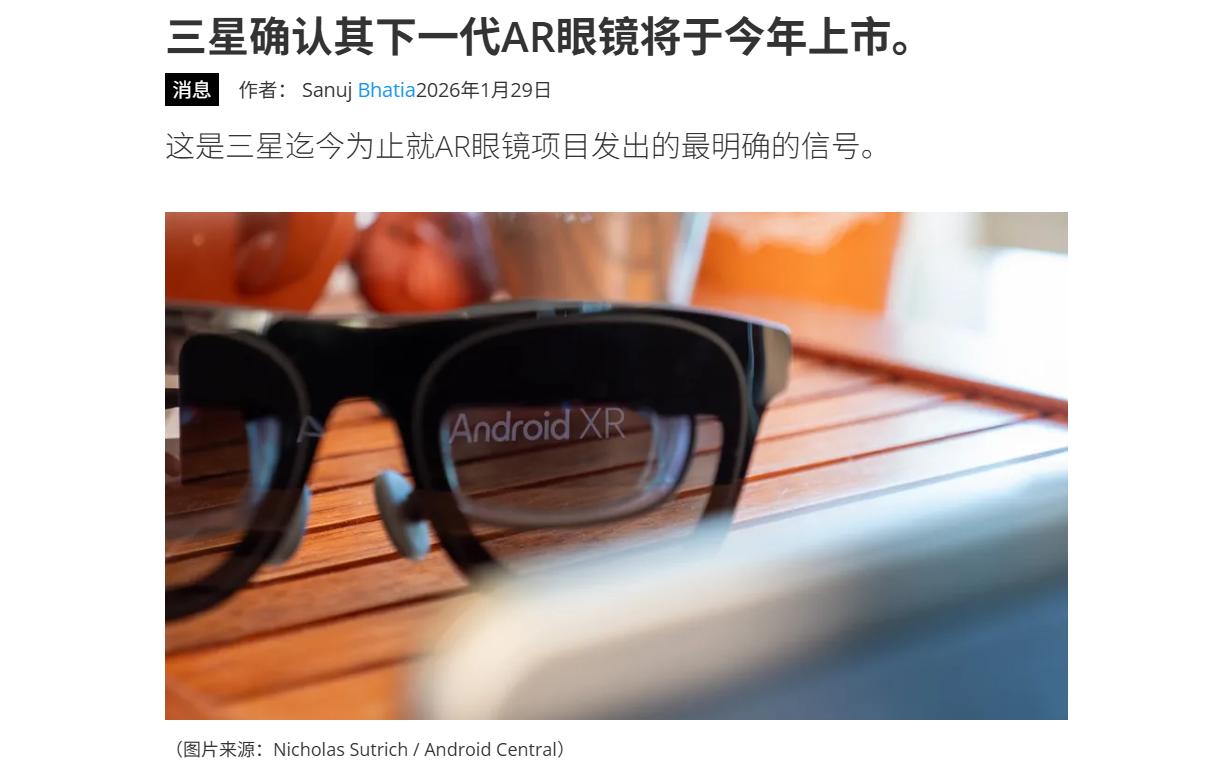
三星AR眼镜定档2026:谷歌加持,剑指Meta,憋大招还是赶晚集?
3 6 Ke· 2026-02-05 12:47
Core Viewpoint - The article discusses the rising trend of AI glasses in the tech industry, highlighting Samsung's upcoming entry into the market with its first AI glasses set to launch in 2026, aiming to provide a rich, immersive multi-modal AI experience [1][3]. Group 1: Market Context - The AI glasses market is currently competitive, with major players like Apple, Meta, and various Chinese startups actively developing and selling products [1]. - Samsung has been relatively quiet in this space but has confirmed its plans to enter the market, indicating a significant shift in strategy [1][3]. Group 2: Product Features - Samsung's AI glasses are designed to weigh around 50 grams, which is comparable to Meta's product and aims to ensure user comfort [6]. - The glasses are expected to be powered by the Qualcomm Snapdragon AR1 Gen 1 chip, suitable for basic AI functions like voice processing and image recognition [9]. - The device will feature a 12-megapixel Sony camera, primarily for AI applications rather than high-quality photography [9]. - Battery capacity is approximately 155mAh, similar to Meta's offering, indicating a focus on casual, intermittent use rather than extended sessions [10]. Group 3: Competitive Advantages - Samsung's integration with its Galaxy ecosystem and Google's software support, including the Android XR system and Gemini AI model, positions it favorably against competitors [14][19]. - The existing user base of Samsung devices provides a significant potential market for the new glasses, as current users may prefer a seamless integration with their existing devices [15][17]. Group 4: Strategic Timing - Samsung's delayed entry into the AI glasses market is attributed to its need for a mature product that meets high standards, contrasting with the rapid iteration seen in smaller companies [26]. - The collaboration with Google and the timing of the product launch are seen as critical to establishing a strong foothold in the emerging AR glasses market [28][29].
夸克、乐奇Rokid等AI眼镜首次接入支付宝集福
Xin Lang Cai Jing· 2026-02-04 07:10
新浪科技讯 2月4日下午消息,2026年支付宝集福活动首次上线智能穿戴设备扫福功能。用户佩戴夸 克、乐奇Rokid等品牌的AI眼镜,无需操作手机,通过"看一下"配合"说一句"的简单方式,即可完成扫 福、集卡、分享等全流程,实现"福在眼前"的沉浸式体验。 具体来说,当用户佩戴AI眼镜看向身边的"福"字并说出"扫福"指令后,眼镜会自动唤起摄像头,实时识 别视野中的"福"字或各类隐藏元素,识别成功后福卡即时到账。据悉,该功能已接入支付宝好友生态, 通过语音指令即可快速分享,让互动更轻松、更流畅。 责任编辑:何俊熹 责任编辑:何俊熹 新浪科技讯 2月4日下午消息,2026年支付宝集福活动首次上线智能穿戴设备扫福功能。用户佩戴夸 克、乐奇Rokid等品牌的AI眼镜,无需操作手机,通过"看一下"配合"说一句"的简单方式,即可完成扫 福、集卡、分享等全流程,实现"福在眼前"的沉浸式体验。 具体来说,当用户佩戴AI眼镜看向身边的"福"字并说出"扫福"指令后,眼镜会自动唤起摄像头,实时识 别视野中的"福"字或各类隐藏元素,识别成功后福卡即时到账。据悉,该功能已接入支付宝好友生态, 通过语音指令即可快速分享,让互动更轻松、更流畅 ...

AI眼镜,如何叫好又叫座
Ren Min Ri Bao Hai Wai Ban· 2026-02-04 02:53
Core Insights - AI glasses are becoming a focal point in the global tech industry, with significant interest showcased at CES 2026, where the number of exhibitors and new products reached a record high, particularly with active participation from Chinese companies [1] - Domestic policies are rapidly supporting the development of AI glasses, as they have been included in national large-scale equipment updates and trade-in subsidy programs, alongside smartphones and tablets [1] - The market is witnessing accelerated growth, with various companies entering the space, including the launch of Quark AI glasses featuring Alibaba's latest Qianwen AI assistant and Li Auto's first AI glasses, Livis [1] Industry Trends - The AI glasses industry is experiencing differentiation as some manufacturers introduce more complex structures and designs, while others focus on consumer needs and usability [1] - The challenge of creating AI glasses that are lightweight, have long battery life, and strong capabilities is referred to as the "impossible triangle," complicating the development of wearable devices [2] - Different manufacturers are adopting unique solutions, with some prioritizing comfort and usability, while others are refining specific use cases such as real-time translation and meeting minutes generation [2] - The continuous advancement of key technologies and the clarification of application scenarios suggest that AI glasses may become an important gateway connecting the digital and real worlds, with ongoing competitive activity expected in this sector [2]
病人离院后的99%时间,华为擎云如何“接管”?
经济观察报· 2026-01-30 10:43
华为擎云将"主动健康"转化为一种普惠服务,这是"科技向 善"最具体的体现,智能硬件正在演变为延长人类健康周期的 伙伴。 作者:冯科翰 封图:企业供图 2025年,"新质生产力"成为产业界出现频率最高的词汇,而在医疗健康领域,这一概念正落子于 具体的诊疗环节。 温州市人民医院的冠心病患者董先生(化名),就在近期刚经历了一次险情。 今年51岁的董先生(化名)不久前才完成心脏支架手术,处于出院后的康复期,按照惯例,这个 阶段的患者通常会与医院"失联",复诊与否全靠自觉。但在一个看似平常的午后,董先生(化 名)佩戴的华为擎云智能穿戴设备在后台捕捉到了一组异常数据:血氧饱和度持续低于90%。 通过成熟的商用终端和数字化技术,医疗机构能够将服务边界从医院内部延伸到患者生活中,将分 散在院外的健康数据转化为可用的医疗资源,从某种程度上来说,提升医疗服务能力,除了增加床 位之外,通过技术挖掘数据价值,同样能让有限的资源服务更多的人群。 破局:从"断连"到"互联" 长期以来,心血管疾病等慢病管理的难点在于"离院即脱管"。 这组数据通过标准接口,实时同步至温州市人民医院的诊后管理平台,几分钟后,医院管理团队的 电话打了进来,医生 ...

国泰海通|轻工:智能眼镜产品力系列二:大模型催化,AI眼镜异军突起
国泰海通证券研究· 2026-01-28 14:08
Core Viewpoint - The article emphasizes that AI glasses without display functions are better suited to meet the underlying needs of traditional eyewear, suggesting they are likely to see earlier market adoption compared to AR glasses [1] Industry Growth Potential - The smart glasses industry is expected to enter a rapid growth phase, with companies in the supply chain poised to benefit from an upturn in market conditions [2] - The launch of the Ray-Ban Meta smart glasses marks a new product cycle, featuring improved audio-visual quality and integration with Meta's social platforms, enhancing user experience and application scenarios [2] Market Penetration Insights - AI glasses are currently at a nascent stage, with a projected penetration rate of only 0.1% in 2024, similar to the early adoption phase of smartwatches [3] - Forecasts indicate that global AI glasses shipments could reach 291 million units by 2034, with a compound annual growth rate (CAGR) of 55.16% from 2025 to 2034 [3] Product Development Challenges - Key factors hindering the rapid penetration of smart glasses include reliance on traditional offline channels for customer engagement, necessitating partnerships between brands and retailers [4] - The comfort of AI glasses is influenced by weight and design, with current models averaging around 50g, while traditional glasses weigh about 20g; achieving a balance between functionality and comfort is crucial [4] - Battery capacity and performance are critical for convenience, requiring advancements in battery materials and technology to enhance longevity [4] - The system-on-chip (SoC) is vital for the performance of AI glasses, impacting user experience through its ability to handle various tasks efficiently [4]