
汽车零件

Search documents
投票结果7比4!美国法院正式做出裁定,莫迪等来重大喜讯,特朗普“枪口”对准美联储
Sou Hu Cai Jing· 2025-09-07 00:14
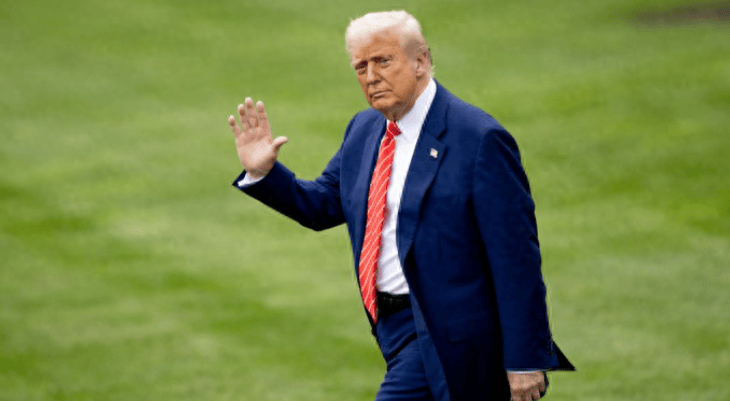
Core Viewpoint - The recent ruling by the Federal Circuit Court limits President Trump's power to impose tariffs unilaterally, stating that the authority to levy tariffs belongs to Congress, not the President [1][3]. Group 1: Legal and Political Implications - The court's decision was a 7-4 vote, indicating significant judicial pushback against the executive branch's use of the International Emergency Economic Powers Act to impose tariffs on countries like China, Canada, and Mexico [1]. - The ruling has sparked intense debate among the three branches of government, with the White House expressing dissatisfaction and claiming that the removal of tariffs could lead to economic collapse [1][3]. - The decision is seen as a victory for Congressional Democrats and state leaders who argue it prevents the imposition of erroneous tariffs [1][3]. Group 2: Economic Impact - The U.S. Treasury previously projected tariff revenues of $142 billion for the fiscal year 2025, but much of this revenue is now deemed illegally collected, potentially requiring refunds to businesses if the ruling is upheld by the Supreme Court [3][6]. - The tariffs have resulted in 64% of the costs being borne by U.S. businesses and 22% by consumers, leading to increased raw material prices and reduced corporate profits [6][8]. - The trade protectionism strategy has not yielded the intended benefits, instead harming domestic enterprises and consumers [6][8]. Group 3: Global Trade Dynamics - The ruling has caused a ripple effect in global trade, with countries like Japan and India reassessing their trade relations with the U.S. and considering retaliatory measures [3][4]. - The uncertainty surrounding U.S. trade policy has led to a loss of trust among international partners, complicating negotiations and agreements [8]. - The court's decision is viewed as a response to U.S. unilateralism in global trade, emphasizing that trade cannot be dictated by a single nation [8].

柬埔寨工业增长面临外部挑战 多元化出口市场成增长关键
Shang Wu Bu Wang Zhan· 2025-08-27 12:23
Group 1 - The Cambodian Ministry of Economy and Finance forecasts a robust growth of 7.1% in the industrial sector by 2025, slightly lower than previous expectations due to a slowdown in the garment and non-garment manufacturing industries [1] - The garment industry, as the largest pillar of Cambodia's industrial sector, is expected to achieve a growth rate of 10.1%, although this growth may weaken towards the end of the year due to new export tariffs imposed by the US starting in August [1] - Non-garment manufacturing is projected to grow by 6.9%, falling short of initial expectations, impacted by tensions at the Cambodia-Thailand border affecting raw material flow and tariffs on various export categories to the US [1] Group 2 - Significant growth was observed in several non-garment export categories in the first half of 2025, including electronic components (24.3%), furniture (39.4%), auto parts (10.1%), bicycles (41.6%), tires (80.4%), and a remarkable 194.9% increase in wires and cables [2] - The export of solar panels plummeted by 98.9% due to increased tariffs in the US market [2] - The diversification of export markets, particularly in the EU and China, is seen as a key driver for growth in the second half of 2025, helping Cambodia mitigate external risks and ensure steady economic development [2]
印度:这就是信任美国的代价
Hu Xiu· 2025-07-14 04:06
Group 1 - India is at a critical juncture, facing a tough test regarding energy security due to a proposed US Senate bill imposing punitive tariffs on countries buying oil from Russia [1][2][3][4] - The US bill threatens to impose tariffs as high as 500%, which could force India to choose between maintaining economic affordability and aligning with US geopolitical interests [2][4][10] - Since early 2022, Russian oil has been significantly cheaper than Middle Eastern oil, saving India nearly $7-8 per barrel, which has helped mitigate inflation and protect citizens' finances [5][6][18] Group 2 - The Indian government’s decision to import Russian oil is based on economic rationality, saving approximately $79 billion in oil import costs over the past year [6][18][19] - The US's geopolitical perspective views India's economic decisions as a lack of cooperation with its sanctions against Russia, leading to potential economic coercion [19][20] - The proposed tariffs are not merely economic penalties but a coercive measure aimed at forcing India to comply with US strategic objectives [20][48] Group 3 - India's long-standing commitment to "strategic autonomy" is now challenged by external pressures, particularly from the US [8][24][26] - The country must demonstrate its ability to maintain core interests, such as energy security and economic stability, under significant external pressure [11][28] - India's reliance on the US market, with exports amounting to $800-900 billion annually, makes it vulnerable to the proposed tariffs, which could devastate key industries [31][32][34] Group 4 - India is currently seeking to diversify its energy sources and reduce dependence on Russian oil, which requires significant time and investment [41][43] - The need for alternative markets and financial systems is critical, as India explores options to bypass reliance on the US dollar [41][42] - The ongoing geopolitical tensions are pushing India to develop a more complex diplomatic strategy, balancing relations with both the US and Russia [36][39][56] Group 5 - The situation reflects a broader trend of countries needing to navigate a complex geopolitical landscape, where they must maintain relationships with multiple powers while safeguarding their national interests [51][55] - The crisis serves as a test of India's national credibility, as it seeks to prove its resilience against US economic pressures while establishing itself as an independent player on the global stage [58][60] - The evolving dynamics indicate a shift towards a multipolar world, where countries must enhance their negotiating power and strategic autonomy to avoid being coerced by larger powers [61][62]
港股收评:新股首挂大涨 恒瑞医药涨超25%
news flash· 2025-05-23 08:16
Core Viewpoint - The Hong Kong stock market experienced fluctuations, with the Hang Seng Index closing up by 0.24% at 23,601.26 points, driven by the strong performance of newly listed stocks, particularly 恒瑞医药 (Hengrui Medicine) which surged over 25% on its debut [1] Market Performance - The Hang Seng Index recorded a trading volume of 203.67 billion HKD [1] - The Hang Seng Technology Index declined by 0.09%, closing at 5,246.87 points [1] Sector Performance - The innovative drug sector saw significant gains due to the listing of 恒瑞医药, contributing to a broader rally in the market [1] - The automotive parts and film sectors also showed strong performance, while the clothing retail sector faced declines [1] Individual Stock Highlights - Mirxes-B (02629.HK) rose by 28.76% on its first trading day [1] - 恒瑞医药 (01276.HK) increased by 25.2% [1] - BYD Company (01211.HK) saw an increase of nearly 2% [1] - Alibaba Pictures (01060.HK) rose by 8% [1] - China Health Group (00673.HK) resumed trading and surged over 110% [1] - Tmall (06110.HK) fell by over 9.4% [1] - Chow Tai Fook (01929.HK) decreased by 3.3% [1] - Xpeng Motors (09868.HK) dropped by 3.9% [1]
