
消防

Search documents
403项重要国家标准发布 涉及新兴领域、安全生产等方面
Yang Shi Wang· 2026-02-10 09:57
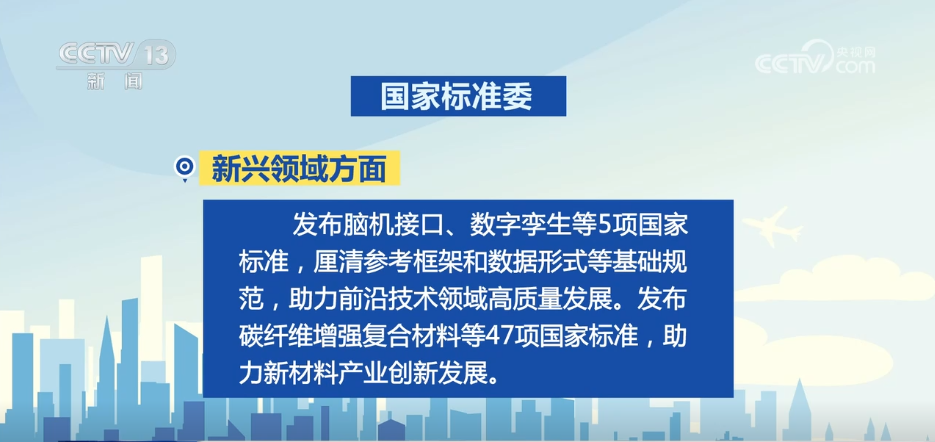
Emerging Fields - The National Standardization Administration has approved the release of 5 national standards related to brain-computer interfaces and digital twins, clarifying reference frameworks and data formats to support high-quality development in cutting-edge technology fields [3] - Additionally, 47 national standards for carbon fiber reinforced composite materials have been published to promote innovation in the new materials industry [3] Transportation and Logistics - Two national standards for intelligent connected vehicles have been released, focusing on performance testing for autonomous driving and automatic parking systems, which will enhance the performance and safety quality of intelligent connected vehicles [5] - Two mandatory national standards for the postal industry have been introduced, addressing safety production operations and equipment configuration for postal and express delivery companies, specifying safety operation norms and equipment requirements for various stages including collection, sorting, transportation, and delivery [5] Ecological and Environmental Protection - Two national standards related to greenhouse gas emission accounting and reporting requirements have been published, aiding companies in accurately calculating and reporting their greenhouse gas emissions, thus providing standard support for greenhouse gas emission management [7] Safety Production - Sixteen mandatory national standards in the fire safety sector have been released, updating technical requirements and inspection rules for related fire safety products, including outdoor fire hydrants and combustible gas detectors [9] Public Welfare - Four national standards for rehabilitation services for children with autism have been published, aimed at improving rehabilitation support for vulnerable groups such as people with disabilities, the elderly, and special children [11]

一批重要国家标准发布!涉脑机接口、数字孪生及百姓生活等领域
Mei Ri Jing Ji Xin Wen· 2026-02-10 01:53
Core Viewpoint - The National Standardization Administration has approved a series of important national standards aimed at promoting high-quality development across various sectors, including emerging technologies, transportation logistics, ecological protection, safety production, and public welfare [1][7]. Emerging Fields - Five national standards have been released for brain-computer interfaces and digital twins, clarifying reference frameworks and data formats to support high-quality development in cutting-edge technology [3][8]. - Forty-seven national standards have been established for aluminum nitride single crystal polishing wafers and carbon fiber reinforced composites, fostering innovation in the new materials industry [3][8]. - Fifteen national standards related to animal model identification and evaluation techniques, as well as skin pathogenic fungi detection methods, have been published to better support biotechnological research and applications [3][8]. Transportation and Logistics - Two national standards for intelligent connected vehicles have been released, focusing on performance testing for autonomous driving and parking systems, enhancing vehicle performance and safety [3][8]. - Six national standards concerning automotive door handles and adaptive cruise control systems have been introduced to improve road traffic safety and sustainability [3][8]. - Two mandatory national standards for postal safety operations and equipment configuration have been established, outlining safety protocols for postal and express delivery services [3][8]. - Four logistics procurement national standards have been published to promote green transformation in supply chains [3][8]. Ecological Protection - Six national standards have been released, including general requirements for natural protected area signage and technical specifications for drone inspections in forest and grassland fire prevention, providing standard support for national ecological security [4][9]. - Two national standards for environmental due diligence assessments and environmental report verification have been published, significantly contributing to green development and enhancing environmental governance effectiveness [4][9]. - Two national standards related to greenhouse gas emission accounting and reporting requirements have been established to assist companies in accurately calculating and reporting their emissions [4][9]. Safety Production - Sixteen mandatory national standards in the fire safety sector have been released, updating technical requirements and inspection rules for fire safety products to mitigate major fire safety risks [4][9]. - Fourteen national standards for special equipment, including gantry cranes and pressure vessels, have been published to ensure the safe and stable operation of such equipment [4][9]. Public Welfare - Four national standards for services related to disabled individuals, including single-arm walking aids and autism rehabilitation institutions, have been introduced to enhance the quality of rehabilitation aids and standardize services for vulnerable groups [5][9]. - Eight national standards have been established to regulate medical laboratory quality and capabilities, as well as the sterilization processes for medical devices [5][9]. Additional Standards - The National Standardization Administration has also released national standards concerning transportation terminology, earth-moving machinery, and reciprocating internal combustion engines [5][10].

涉脑机接口、数字孪生等领域,一批重要国家标准发布
第一财经· 2026-02-10 01:28
Group 1: Emerging Technologies and Standards - The approval of national standards for emerging fields includes brain-computer interfaces and digital twins, which clarify reference frameworks and data formats to support high-quality development in cutting-edge technology [1] - A total of 47 national standards were released for new materials, including aluminum nitride single crystal polishing wafers and carbon fiber reinforced composites, aimed at fostering innovation in the new materials industry [1] Group 2: Transportation and Logistics - Two national standards for intelligent connected vehicles were published, focusing on performance testing for autonomous driving and parking systems, enhancing the performance and safety of intelligent connected vehicles [1] - Six national standards related to automotive components, such as door handles and adaptive cruise control systems, were introduced to improve road traffic safety and environmental sustainability [1] - Two mandatory national standards for the postal industry were released, addressing safety production operations and equipment configuration for postal and express delivery services, thereby enhancing safety governance in the postal sector [1] Group 3: Environmental Protection - Six national standards were established for ecological protection, including general requirements for natural protected area signage and drone inspection technology for forest and grassland fire prevention, providing standard support for national ecological security [2] - Two national standards for environmental due diligence assessments and environmental report verification were published, which are significant for promoting green development and improving environmental governance efficiency [2] - Two national standards related to greenhouse gas emission accounting and reporting requirements were released, aiding companies in accurately calculating and reporting their greenhouse gas emissions [2] Group 4: Safety Production - Sixteen mandatory national standards in the fire safety sector were updated, including outdoor fire hydrants and combustible gas detectors, providing technical guidelines to mitigate major fire safety risks [2] - Fourteen national standards for special equipment, such as gantry cranes and pressure vessels, were published to ensure the safe and stable operation of these devices [2] Group 5: Public Welfare and Healthcare - Four national standards for services for people with disabilities were released, including standards for single-arm walking aids and autism rehabilitation institutions, aimed at improving the quality of rehabilitation aids and services for vulnerable groups [2] - Eight national standards were established for medical laboratories and medical device sterilization processes, regulating practices in medical experiments and manufacturing [2] Group 6: Additional Standards - The market regulatory authority also published national standards related to transportation terminology, earth-moving machinery, and reciprocating internal combustion engines [3]

涉脑机接口、数字孪生等领域 一批重要国家标准发布
Xin Lang Cai Jing· 2026-02-10 01:03
Group 1: Emerging Technologies - The release of 5 national standards in emerging fields such as brain-computer interfaces and digital twins aims to clarify reference frameworks and data formats, supporting high-quality development in cutting-edge technology sectors [1][5] - 47 national standards for new materials, including aluminum nitride single crystal polishing wafers and carbon fiber reinforced composites, are published to promote innovation in the new materials industry [1][5] - 15 national standards related to experimental animals, including identification and evaluation techniques, are introduced to better support biotechnological research and applications [1][5] Group 2: Transportation and Logistics - 2 national standards for intelligent connected vehicles are published, focusing on performance testing for autonomous driving and parking systems, enhancing vehicle performance and safety [1][5] - 6 national standards for automotive components, such as door handles and adaptive cruise control systems, are aimed at improving road traffic safety and sustainability [1][5] - 2 mandatory national standards for postal services address safety operations and equipment requirements across various stages of postal and express delivery, enhancing safety governance in the postal industry [1][5] - 4 logistics procurement national standards related to green logistics indicators and sustainable procurement are released to facilitate the green transformation of supply chains [1][5] Group 3: Environmental Protection - 6 national standards, including general requirements for natural protected area signage and drone inspection techniques for forest and grassland fire prevention, are established to support national ecological security [2][6] - 2 national standards for environmental due diligence assessments and environmental report verification are introduced to promote green development and enhance environmental governance effectiveness [2][6] - 2 national standards related to greenhouse gas emission accounting and reporting requirements are published to assist companies in accurately calculating and reporting their emissions, providing a framework for emissions management [2][6] Group 4: Safety Production - 16 mandatory national standards in the fire safety sector, including outdoor fire hydrants and gas detectors, are updated to enhance technical requirements and inspection rules, providing guidelines for mitigating major fire safety risks [2][7] - 14 national standards for special equipment, such as gantry cranes and pressure vessels, are released to ensure the safe and stable operation of these devices [2][7] Group 5: Public Welfare - 4 national standards for services related to disabled individuals, including single-arm walking aids and autism rehabilitation institutions, are published to improve the quality of rehabilitation aids and standardize services for vulnerable groups [2][7] - 8 national standards concerning medical laboratory quality and capabilities, as well as sterilization processes for medical devices, are established to regulate practices in medical experiments and device manufacturing [2][7]
省安委会办公室部署做好春节前后安全生产工作
Xin Lang Cai Jing· 2026-02-07 06:21
Core Viewpoint - The Jiangsu Provincial Safety Production Committee has issued an urgent notice to enhance safety production efforts before and after the Spring Festival, highlighting the extended holiday period and the associated risks due to adverse weather conditions and high transportation activity [1][2]. Group 1: Construction Safety - Comprehensive safety inspections are mandated for ongoing bridge construction projects, with a focus on analyzing construction risks and eliminating safety hazards [1]. - Strict management of hazardous projects is emphasized, including rigorous fire approval processes and on-site supervision [1]. - Companies are urged to manage construction schedules responsibly, ensuring key personnel are present and maintaining full coverage supervision during construction [1]. Group 2: Fire Prevention - Increased attention is required for fire safety in elderly care facilities, with a pre-holiday electrical safety inspection and a thorough cleaning of fire escape routes [2]. - Ongoing efforts to address fire hazards in crowded venues and self-built commercial properties are necessary, including the removal of obstacles that impede escape routes [2]. Group 3: Transportation Safety - A comprehensive assessment of transportation safety risks during the Spring Festival is essential, particularly for key transport companies [2]. - Enhanced safety measures are required for tunnels, bridges, and culverts, along with the development of emergency response plans [2]. Group 4: Cultural and Tourism Safety - Large public events during the Spring Festival, such as lantern festivals and fireworks displays, require strict crowd monitoring and control measures [2]. - Safety regulations for amusement facilities and special equipment must be enforced to prevent accidents [2]. Group 5: Fireworks and Hazardous Chemicals - Safety regulations for the transportation, storage, and use of fireworks must be strictly followed, with an emphasis on public safety during celebrations [2]. - Companies in high-risk sectors are urged to implement winter safety measures and avoid high-risk operations during the holiday period [2]. Group 6: General Industry Safety - A thorough inspection of equipment and facilities is required across various industries, focusing on high-risk operations involving molten metals and gases [3]. - Safety measures must be strengthened in mining, fisheries, electricity, and other critical sectors to prevent accidents [3]. Group 7: Emergency Preparedness - The importance of maintaining a 24-hour duty system for key positions and timely reporting of major incidents is highlighted [3]. - Emergency preparedness must be enhanced through the development of response plans and practical drills to ensure rapid response to unexpected situations [3].
国务院安委办印发紧急通知!
中国能源报· 2026-02-03 09:16
Core Viewpoint - The State Council's Safety Committee emphasizes the importance of safety production measures before and after the Spring Festival, highlighting the need to prevent major accidents and ensure public safety during this period [1]. Group 1: Safety Production Measures - The notification stresses the need for production and operational units to manage risks effectively, especially during the busy Spring Festival period, where various safety risks are heightened due to increased activity and adverse weather conditions [1]. - It calls for a comprehensive assessment of safety risks and the implementation of strict safety responsibilities at the grassroots level to prevent accidents [1]. Group 2: Fire Safety - The notification requires a focus on fire hazard inspections, particularly in areas with high concentrations of elderly residents, and mandates regular fire emergency drills to prevent fire incidents [2]. - It emphasizes the need for thorough inspections of high-rise buildings and self-built commercial properties to address significant fire risks, implementing a checklist management system for tracking and rectifying issues [2]. Group 3: Hazardous Materials and Fireworks - The notification highlights the importance of safety measures for fireworks and hazardous chemicals, advocating for strict regulation across the entire supply chain, including production, transportation, and usage [3]. - It calls for increased efforts to identify and eliminate illegal sales of fireworks and to enhance public awareness and reporting mechanisms [3]. Group 4: Other Key Industries - The notification underscores the need for heightened safety oversight in industries such as steel, construction, and transportation, particularly during the winter season [4]. - It stresses the importance of adhering to safety regulations for special equipment and ensuring that transportation services are compliant with safety standards, especially during adverse weather conditions [4]. Group 5: Emergency Preparedness - The notification mandates the strengthening of emergency response plans and the pre-positioning of resources in high-risk areas to ensure rapid response to any incidents [5]. - It emphasizes the need for targeted emergency drills to ensure preparedness for unexpected situations, thereby safeguarding public safety and maintaining social stability during the festive period [5].

海伦哲控股及安盾:一次基于产业逻辑的战略协同
Zhong Guo Neng Yuan Wang· 2026-01-30 11:49
Core Viewpoint - The acquisition of 51% stake in Hubei Jidandun Fire Technology Co., Ltd. by Xuzhou Helenzhe Special Vehicle Co., Ltd. marks a strategic integration aimed at enhancing industrial upgrades and achieving significant synergies in the fire safety sector, particularly in the context of rapid developments in energy storage, electric systems, and new energy vehicles [1][4]. Group 1: Acquisition Details - On January 16, 2026, Helenzhe held its first extraordinary shareholders' meeting to approve the acquisition of a controlling stake in Jidandun [1]. - The share transfer agreement was signed on January 19, 2026, and the internal decision-making processes have been completed, with the 51% stake transfer finalized [1]. Group 2: Strategic Rationale - The acquisition is not merely a financial maneuver but is based on long-term strategic collaboration and industrial upgrades [1]. - The fire safety sector is evolving from standalone equipment to integrated system solutions that include early warning, firefighting, and engineering implementation [1]. Group 3: Technological and Product Integration - Jidandun's aerosol fire extinguishing systems and early warning technologies can be deeply integrated with Helenzhe's advanced equipment, such as fire trucks and emergency power vehicles, to create a comprehensive "early warning + response" system solution [3]. - The technological advantages of Jidandun in the energy storage fire safety sector will complement Helenzhe's engineering implementation capabilities in traditional fields like electricity and emergency rescue [3]. Group 4: Market and Business Synergies - The collaboration is expected to enhance the companies' professionalism and stability in high-demand application scenarios, expanding into diverse high-safety applications such as data centers and new energy vehicles [3]. - Jidandun's leading fire technology and strong partnerships with industry leaders will enhance the overall market competitiveness of the combined entity [3]. Group 5: Future Outlook - The synergistic effects of this strategic integration will need to be gradually realized in practice, focusing on the high-demand field of new energy safety [4]. - The companies aim to explore how to integrate professional technology with industrial platforms to promote the application and enhancement of system-level safety standards [4].

全省安全生产调度会召开
Shan Xi Ri Bao· 2026-01-21 00:41
Core Viewpoint - The provincial safety production scheduling meeting emphasized the importance of implementing safety measures across various industries to prevent major accidents and ensure a stable safety production environment [1][2]. Group 1: Meeting Highlights - The meeting included reports from coal mines, hazardous chemicals, medical health, fire safety, oil and gas pipelines, and electricity safety production committees [1]. - The meeting was chaired by Wang Xiao, the provincial party committee member and executive vice governor [1]. Group 2: Key Actions and Requirements - There is a strong emphasis on learning and implementing Xi Jinping's important discussions on safety production and the directives from the central government [2]. - The meeting called for a comprehensive approach to identify and rectify safety hazards, enhance fundamental safety levels, and prevent major accidents and casualties [2]. - Specific actions include maintaining high vigilance, implementing stringent measures, and proactively addressing safety risks across key industries such as coal mining, non-coal mining, hazardous chemicals, and construction [2]. - The meeting aims to ensure a strong safety foundation to support the successful start of the 14th Five-Year Plan [2].
应急管理部:推动传统高危行业、产业向智能化转型,形成新质生产力
Zhong Guo Jing Ying Bao· 2026-01-15 15:59
Core Viewpoint - The Ministry of Emergency Management aims to enhance guidance and services for emerging industries and new business formats, focusing on safety and consumer stimulation in sectors like leisure fishing and marine sports while addressing competition issues in the new energy sector [1][3]. Group 1: Safety Management Initiatives - The Ministry will establish a long-term mechanism for identifying and addressing major accident hazards, creating a complete logical chain for standards, inspections, and accountability [2]. - There will be a focus on enhancing safety training for key industries such as construction, transportation, and fishing vessels, along with specialized inspections and expert guidance [2]. Group 2: Special Rectification Efforts - The Ministry will continue comprehensive rectification efforts across various sectors, including electric bicycles, urban gas, construction insulation materials, and hazardous chemicals, to prevent major fire accidents and improve safety in critical infrastructure [2]. - There will be a strong push for safety measures in mining and maritime operations, with a focus on identifying and addressing safety hazards in construction, railway maintenance, and other key areas [2]. Group 3: Development and Safety Integration - The Ministry emphasizes the integration of development and safety, advocating for the upgrade of safety risk monitoring systems and the transition of traditional high-risk industries towards intelligent production methods [3]. - There is a commitment to improving safety standards in emerging industries and addressing market chaos in the new energy sector to ensure high-quality development through robust safety guarantees [3].
2026年首批625亿元资金已下达 新一轮“国补”落地多地积极部署
Zhong Guo Chan Ye Jing Ji Xin Xi Wang· 2026-01-14 01:08
Core Viewpoint - The 2026 national subsidy program aims to stimulate domestic consumption through a series of financial incentives for consumers purchasing new products, particularly in the electronics and automotive sectors, with a total of 62.5 billion yuan allocated for the first batch of subsidies [1][8]. Subsidy Details - Consumers purchasing eligible digital products such as smartphones, tablets, smartwatches, and smart glasses priced under 6,000 yuan will receive a subsidy of 15% of the product price, capped at 500 yuan per item [2]. - For major home appliances like refrigerators, washing machines, and air conditioners, a similar subsidy of 15% applies, with a maximum of 1,500 yuan per item [2]. - In the automotive sector, scrapping eligible old vehicles for new energy cars will yield a subsidy of 12% of the new car price, up to 20,000 yuan, while scrapping fuel vehicles for smaller fuel cars will provide a 10% subsidy, capped at 15,000 yuan [2]. Regional Implementation - All 21 cities in Guangdong Province launched the 2026 subsidy program on January 1, with the first transactions occurring in Guangzhou, indicating strong local engagement [3]. - Other provinces, such as Yunnan and Zhejiang, have also initiated their own automotive subsidy programs, leading to increased consumer interest and foot traffic in dealerships [3][4]. Process Optimization - Various regions have streamlined the subsidy application process, allowing consumers to apply for automotive subsidies through national systems or mobile apps, while home appliance subsidies are facilitated through major e-commerce platforms [4]. - Cities like Beijing and Shanghai have adopted innovative methods for subsidy distribution, enhancing consumer participation and interest [4]. Market Impact - The expanded subsidy program is expected to create new opportunities in the digital and smart product markets, with significant sales increases observed in smart glasses and AI-enabled home appliances during the New Year holiday [5][7]. - The policy is designed to support small and medium enterprises by lowering investment thresholds for equipment upgrades, thereby enhancing public service and commercial facilities [5]. Economic Outlook - The 2026 subsidy program is viewed as a critical measure for boosting domestic demand and stabilizing economic growth, with long-term benefits anticipated in industrial structure optimization and consumer ecosystem enhancement [8].