
猪肉养殖

Search documents
业绩暴增的行业龙头股出炉(附名单)
Zheng Quan Shi Bao Wang· 2025-08-14 01:33
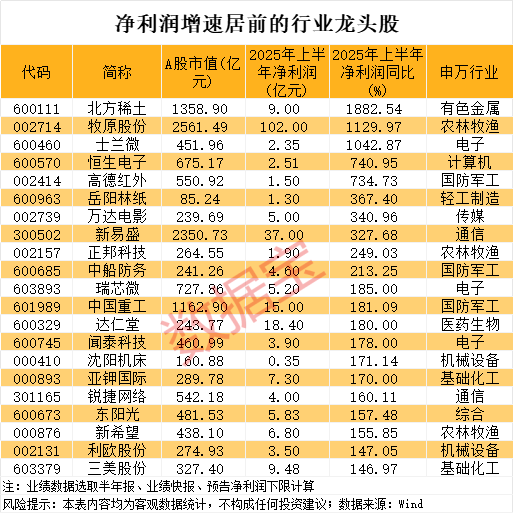
Core Insights - The performance of leading AI hardware stocks has reached new highs, reflecting strong competitiveness and profitability in a complex market environment, which boosts investor confidence in the A-share market [1][2]. Group 1: Performance Highlights - NewEase (300502) expects a net profit of 3.7 billion to 4.2 billion yuan for the first half of 2025, representing a year-on-year growth of 327.68% to 385.47%, driven by increased demand for AI-related computing power [2]. - Industrial Fulian's stock hit the daily limit, with a market capitalization exceeding 860 billion yuan, reporting a net profit of 12.1 billion yuan for the first half of the year, up 38.61% year-on-year [2]. - Over 60% of leading industry stocks reported positive net profit growth for the first half of 2025, with 109 stocks showing year-on-year increases [3]. Group 2: Notable Companies - Northern Rare Earth (600111) anticipates a net profit of 900 million to 960 million yuan, a staggering increase of 18.83 to 20.15 times year-on-year, due to improved production efficiency and product structure optimization [3][4]. - Muyuan Foods (002714) expects a net profit of 10.5 billion to 11 billion yuan, reflecting a year-on-year growth of 9.25 to 9.74 times, attributed to increased pig output and reduced breeding costs [3][4]. - Other companies with significant profit growth include Silan Microelectronics, Hengsheng Electronics, and Wanda Film, among others [3]. Group 3: Market Trends - The average increase of the 109 leading stocks is 24.62% year-to-date, outperforming the Shanghai Composite Index by 14.7 percentage points [5]. - On August 13, 11 leading stocks reached historical highs, indicating strong market interest and potential for further growth [6]. - There are 22 leading stocks with a rolling P/E ratio below 30 and a predicted price increase of over 20%, suggesting substantial upside potential [6][7].







7月起,四大“降价潮”来了:有人偷着乐,有人更焦虑!
Sou Hu Cai Jing· 2025-07-04 23:41
Economic Overview - Starting from 2025, China's economy is entering a deflationary cycle, with the Consumer Price Index (CPI) expected to decline by 0.1% year-on-year in the first half of 2025 [1] - The deflationary environment is causing anxiety among businesses and job seekers due to a sluggish consumer market and rising unemployment [1] Price Decline Trends - **Housing Market**: Housing prices are projected to continue declining, with significant drops observed in both second and first-tier cities. For instance, in Shanghai, housing prices fell from over 96,000 yuan per square meter in 2021 to over 65,000 yuan per square meter by the first half of 2025, representing a decline of over 30% [5] - **Automobile Industry**: The automotive market is experiencing substantial price reductions, with mid-range vehicles seeing price cuts of 15,000 to 20,000 yuan, and luxury imports dropping nearly 100,000 yuan. This trend is expected to persist due to decreased middle-class income and increased competition from new energy vehicles [7] - **Small Appliances**: A price drop of 10-15% is anticipated in small appliances such as air fryers and washing machines, driven by rapid product turnover and stagnant consumer income growth [9] - **Pork Prices**: Pork prices have fallen below 20 yuan per kilogram, currently ranging from 16 to 17 yuan, nearly halving from previous years. This decline is attributed to oversupply in the market and changing consumer preferences towards leaner meats [11] Consumer Impact - The deflationary cycle presents both advantages and disadvantages. While consumers may benefit from increased purchasing power and lower prices, industries and workers face heightened anxiety due to reduced demand and potential job losses [11]
港股收盘 | 恒指收涨0.6% 绩优股走势强劲 恒大汽车午后一度暴涨230%
Zhi Tong Cai Jing· 2025-03-26 08:49
Market Overview - The Hong Kong stock market rebounded, with the Hang Seng Index rising by 0.6% to close at 23,483.32 points, with a total trading volume of 199.765 billion HKD [1] - The Hang Seng Tech Index increased by 1.01%, while the Hang Seng China Enterprises Index rose by 0.44% [1] - Market sentiment has been optimistic, but there are concerns about overseas risks as the U.S. tariff investigation results are expected soon [1] Blue-Chip Performance - Shenzhou International (02313) saw a strong performance post-earnings, rising by 12.66% to 62.3 HKD, contributing 9.75 points to the Hang Seng Index [2] - The company reported a revenue of 28.663 billion RMB for 2024, a year-on-year increase of 14.8%, and a net profit of 6.2406 billion RMB, up 36.9% [2] - Other notable blue-chip stocks include China Resources Mixc Lifestyle (01209) up 10.75%, Haidilao (06862) up 6.14%, and China Merchants Bank (03968) down 5.48% [2] Sector Highlights - The technology sector showed positive movement, with major stocks like Alibaba, Baidu, and Xiaomi rising over 1% [3] - Real estate and property management stocks experienced a broad increase, with China Resources Mixc Lifestyle rising over 10% [3] - The restaurant sector also saw gains, with Haidilao increasing by over 6% [3] Automotive Sector - The automotive sector showed signs of recovery, with companies like Leap Motor rising by 4.85% and Evergrande Auto experiencing a significant surge of 74.79% [3][8] - The Ministry of Commerce is promoting automotive consumption reforms, which may further stimulate the market [6] - The overall sentiment in the automotive market is expected to improve, with significant month-on-month growth anticipated in March [6] Earnings Reports - Haidilao reported a revenue of 42.755 billion RMB for 2024, a year-on-year increase of 3.14%, with a core operating profit of 6.23 billion RMB, up 18.74% [5] - The company served 415 million customers in 2024, a 4.5% increase from the previous year [5] - China Merchants Bank reported a slight decline in revenue for 2024, with total revenue of 337.488 billion RMB, down 0.48% year-on-year [7] Notable Stock Movements - Youjia Innovation (02431) surged by 31.79% after securing contracts with a well-known global car manufacturer [9] - Pop Mart (09992) reached a new high, with a revenue of 13.038 billion RMB for 2024, a 106.92% increase year-on-year [10] - COFCO Joycome (01610) rose by 8.51% after reporting a turnaround to profitability with a net profit of 538 million RMB [11]