现代纺织

Search documents
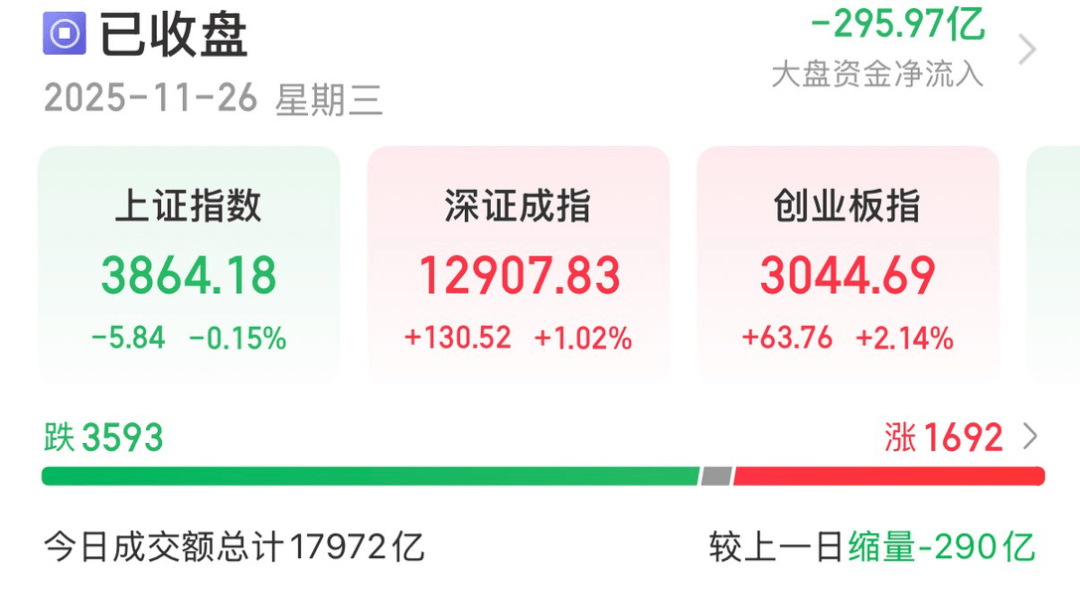
A股尾盘突发!消费板块,大爆发
Sou Hu Cai Jing· 2025-11-26 15:06
Market Performance - The Shenzhen Component Index and ChiNext Index opened lower but rose throughout the day, with the ChiNext Index increasing by over 3% at one point [1] - By the end of trading, the Shanghai Composite Index fell by 0.15%, while the Shenzhen Component Index rose by 1.02% and the ChiNext Index increased by 2.14% [1] - The total trading volume in the Shanghai and Shenzhen markets was 1.78 trillion yuan, a decrease of 28.8 billion yuan compared to the previous trading day, with 1,689 stocks rising and over 3,500 stocks falling [1] Sector Activity - Active sectors included CPO, influenza, and consumer sectors, while military and commercial aerospace sectors experienced adjustments [3] - The Ministry of Industry and Information Technology, along with other government bodies, issued a plan to enhance the adaptability of consumer goods supply and demand, aiming for significant optimization of the consumer goods supply structure by 2027 [3] Policy Initiatives - The plan aims to create three trillion-level consumption fields and ten hundred-billion-level consumption hotspots, focusing on high-quality consumer goods with cultural significance [3] - It emphasizes upgrading consumption to lead industrial upgrades and achieving a dynamic balance between supply and demand, with a goal of improving the contribution of consumption to economic growth by 2030 [3] Key Tasks - The plan outlines 19 key tasks across five areas, including accelerating the application of new technologies, expanding the supply of unique and new products, and fostering new consumption scenarios and business formats [3][4] - Specific focus areas include smart connected vehicles, smart home products, consumer electronics, modern textiles, food, and green building materials, with the goal of creating hundreds of iconic products and innovative companies [4] Market Segmentation - The plan also targets the expansion of green products, enhancement of rural consumer goods, and development of leisure and sports products [4] - It aims to adapt to trends in green and low-carbon consumption, improve product efficiency standards, and strengthen the supply of quality sports and outdoor equipment [4] - Additionally, it seeks to enrich the supply of children's products, enhance quality student supplies, expand fashionable "trendy" products, and optimize products for the elderly [4]

【新华解读】消费新政促供需良性互动 激发消费新潜能
Xin Hua Cai Jing· 2025-11-26 14:55
Core Viewpoint - The implementation plan issued by six departments aims to enhance the adaptability of supply and demand in consumer goods, marking a shift in China's consumption policy from demand stimulation to a dual-sided approach focusing on both supply and demand [1][2]. Group 1: Key Tasks and Objectives - The plan outlines 19 key tasks across five areas: accelerating the application of new technologies and models, expanding the supply of unique and new products, precisely matching the needs of different demographics, cultivating new consumption scenarios and business formats, and creating a favorable development environment [1]. - By 2027, the supply structure of consumer goods is expected to be significantly optimized, forming three trillion-level consumption fields and ten hundred-billion-level consumption hotspots [3]. Group 2: Supply and Demand Dynamics - The core logic of the plan is to break through the long-standing structural contradictions in supply and demand, such as the coexistence of excess low-end supply and a shortage of high-quality supply [2]. - The policy emphasizes the need for a dynamic balance between supply and demand, with consumption upgrades leading to industrial upgrades [2]. Group 3: Technological Innovation and Model Transformation - The plan prioritizes the acceleration of new technology and model applications, focusing on industries like smart connected vehicles, smart home products, and green building materials [4]. - It aims to utilize AI and big data to enhance production efficiency and meet personalized consumer demands through flexible manufacturing systems [4][5]. Group 4: Targeting Specific Markets - The plan emphasizes the importance of accurately matching the needs of different consumer groups, particularly in rural areas and among the elderly and children [7][8]. - It encourages the development of products tailored to rural environments and aims to improve logistics and after-sales services to stimulate consumption in these markets [7]. Group 5: Enhancing Product Offerings for Specific Demographics - In the baby and elderly care sectors, the plan outlines specific directions for product development, focusing on quality, safety, and functionality [8]. - The initiative aims to unlock the significant consumption potential of the elderly and children by promoting high-quality products and services tailored to their needs [8].
利好来了,六部门联合发文
2 1 Shi Ji Jing Ji Bao Dao· 2025-11-26 14:25
Core Viewpoint - The article highlights a significant opportunity emerging from the government's new consumption policy aimed at enhancing the adaptability of supply and demand in consumer goods, with a focus on innovation and quality improvement in the market [1][3]. Group 1: Policy Implementation - The State Council has introduced an implementation plan to enhance the adaptability of supply and demand in consumer goods, which includes multiple key tasks such as accelerating the layout of new fields, promoting efficient manufacturing models, and integrating artificial intelligence [1][3]. - The plan sets clear targets, aiming to form three trillion-level consumption sectors and ten billion-level consumption hotspots by 2027, with a focus on high-quality development and increased contribution of consumption to economic growth [1][3]. Group 2: Industry Focus - The plan emphasizes key industries such as smart connected vehicles, smart home products, consumer electronics, modern textiles, food, and green building materials, aiming to create a hundred iconic products and a hundred innovative enterprises [5][6]. - The automotive sector, particularly in new energy vehicles, has shown strong growth, with October sales reaching 1.715 million units, a 20% year-on-year increase, marking a significant milestone in the market [5]. Group 3: Consumer Demand and Manufacturing - The article discusses the importance of flexible manufacturing to meet personalized consumer demands, highlighting the need for high-quality, small-batch, and specialized products [6][14]. - The plan proposes the promotion of efficient response manufacturing models, including flexible and customized production, to better align with consumer preferences [6][14]. Group 4: Artificial Intelligence Integration - The plan advocates for the application of artificial intelligence across the entire consumer goods industry, aiming to enhance product development efficiency and innovation through tools like generative AI and 3D digital design [8][10]. - AI is expected to play a crucial role in understanding consumer needs, providing customized products and services, and improving the overall shopping experience [11][12]. Group 5: Lifecycle Consumption - The plan addresses the needs of different consumer demographics, including children and the elderly, promoting the development of high-quality, intelligent products tailored to these groups [15]. - The focus on "lifecycle consumption" reflects a shift from merely meeting basic needs to creating quality living experiences, indicating a broader trend in consumer behavior [15].

重大利好来了!国务院同意→
Jin Rong Shi Bao· 2025-11-26 11:20
Core Viewpoint - The implementation plan aims to enhance the adaptability of consumer goods supply and demand, leading to consumption upgrades that drive industrial upgrades, thereby achieving a dynamic balance between supply and demand at a higher level [1][4]. Policy Framework - The plan is jointly issued by multiple government bodies, including the Ministry of Industry and Information Technology, the National Development and Reform Commission, and others, marking it as a significant policy document following the Fourth Plenary Session of the 20th Party Congress [1][2]. Goals and Targets - By 2027, the supply structure of consumer goods is expected to be significantly optimized, forming three trillion-level consumption sectors and ten hundred-billion-level consumption hotspots [4]. - By 2030, a high-quality development pattern characterized by positive interaction between supply and consumption is anticipated, with a steady increase in the contribution of consumption to economic growth [4]. Industry Focus Areas - The plan emphasizes the development of new fields and tracks, focusing on key industries such as smart connected vehicles, smart home products, consumer electronics, modern textiles, food, and green building materials [5]. - It encourages the integration of artificial intelligence across the entire consumer goods industry, promoting the development of AI-enabled products like household service robots and smart appliances [5]. Sports and Health Products - The plan aims to enhance the supply of leisure and sports products, targeting new demands from the sports economy, outdoor economy, and ice and snow economy [6]. - It supports the innovation and development of health products, including special dietary foods and high-end medical devices, while promoting the consumption of organic and geographical indication agricultural products [6]. Diverse Consumer Interests - The plan seeks to expand the supply of interest-based consumer products, including pet-related items, anime, and trendy products, while also promoting low-altitude tourism and private flying [7]. - It encourages the development of local intellectual property and innovative design in cultural products, as well as the transformation of traditional retail spaces to include trendy stores [7]. Customization and Experience - The plan emphasizes the need for precise matching of consumer needs, particularly in the baby and children's product sector, and encourages the development of high-end fashion brands and personalized services [8]. - It promotes the creation of immersive consumer experiences through the use of digital technologies, including virtual reality and the metaverse [10]. Financial Support and Services - The plan highlights the importance of financial support for the consumer goods industry, including policies for equipment upgrades and trade-in programs, as well as enhancing the adaptability and convenience of consumer financial services [11].
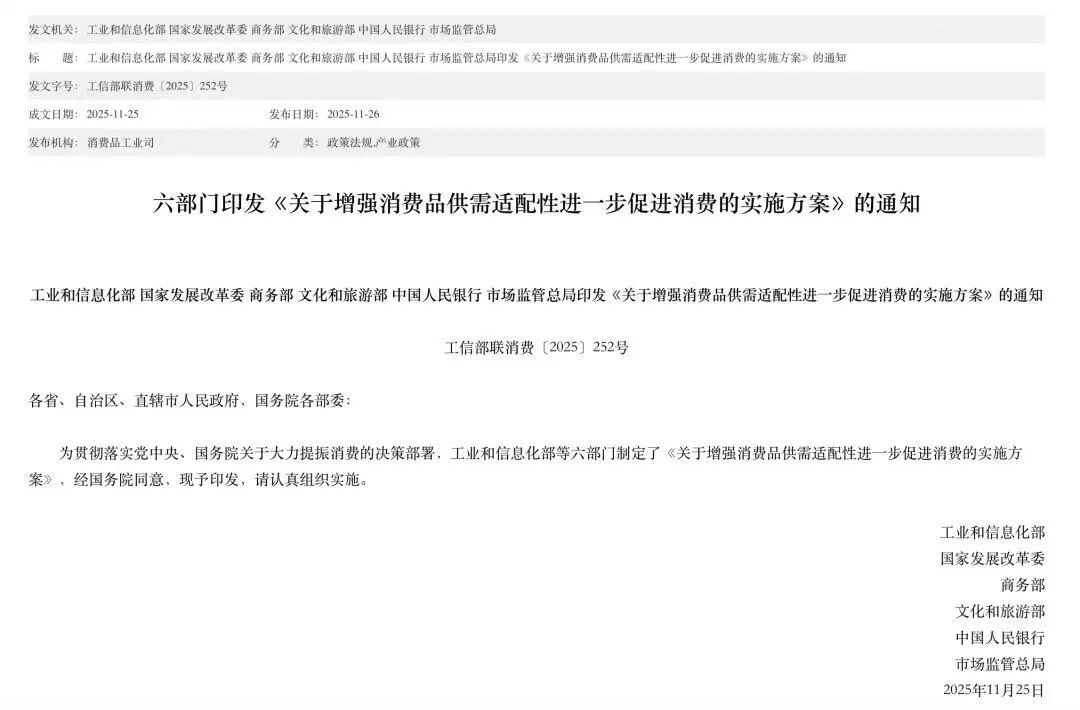
六部门发文!形成3个万亿级消费领域
Zhong Guo Zheng Quan Bao· 2025-11-26 08:41
Core Viewpoint - The implementation plan aims to enhance the adaptability of supply and demand in consumer goods, targeting the formation of three trillion-level consumption sectors and ten hundred-billion-level consumption hotspots by 2027 [1][2] Group 1: Strategic Goals - By 2027, the supply structure of consumer goods is expected to be significantly optimized, with a focus on high-quality consumer products that have cultural significance and global recognition [1] - By 2030, a high-quality development pattern characterized by positive interaction between supply and consumption is anticipated, with a steady increase in the contribution of consumption to economic growth [1] Group 2: Key Tasks - The plan outlines 19 key tasks across five areas: accelerating the application of new technologies and models, expanding the supply of unique and new products, precisely matching diverse consumer needs, cultivating new consumption scenarios and business formats, and creating a favorable development environment [1] - Emphasis is placed on expanding new fields and tracks, promoting efficient manufacturing models, and enhancing the integration of artificial intelligence [1] Group 3: Market Focus - The strategy targets key industries such as smart connected new energy vehicles, smart home products, consumer electronics, modern textiles, food, and green building materials, aiming to create hundreds of iconic products and innovative enterprises [1] - There is a push for the expansion and iteration of green products, improvement of rural consumer goods, and significant development of leisure and sports products [2] Group 4: Targeted Consumer Segments - The plan specifies the need to enrich the supply of baby and children's products, enhance quality student supplies, expand trendy fashion items, and optimize products for the elderly [2] - Development of refined, quality, and intelligent baby and children's products is prioritized, along with the design of writing tools that protect vision and posture [2]
促进消费新方案来了!
清华金融评论· 2025-11-26 07:01
Core Viewpoint - The article outlines a comprehensive plan to enhance the adaptability of supply and demand in consumer goods, aiming to significantly optimize the supply structure by 2027 and establish a high-quality development pattern by 2030, with a focus on cultural and high-quality consumer products [6][7]. Group 1: Key Tasks - The plan includes 19 key tasks across five main areas: expanding new increments, deepening existing stock, segmenting markets, empowering scenarios, and optimizing the environment [4]. - It emphasizes the acceleration of new technology and model innovation, including the promotion of flexible manufacturing and the integration of artificial intelligence in the consumer goods sector [8][9]. Group 2: Product Supply Enhancement - The plan aims to expand the supply of distinctive and new products, focusing on green products, rural consumption upgrades, and the development of leisure and sports products [10][11]. - It encourages innovation in health products and aims to enhance the influence of historical classic products, promoting traditional crafts and cultural heritage [11][12]. Group 3: Market Segmentation - The strategy includes precise matching of different demographic needs, such as enriching the supply of children's products, enhancing quality student supplies, and expanding fashionable "trendy" products [13][14]. - It also focuses on optimizing products for the elderly, ensuring comfort and functionality in elder care products [14][15]. Group 4: New Consumption Scenarios - The plan promotes the establishment of new consumption scenarios and business models, including the support for flagship stores and innovative retail formats [16]. - It encourages the development of platform consumption and shared consumption models, leveraging technology to enhance consumer experiences [16][17]. Group 5: Supportive Environment - The plan outlines measures to strengthen financial support for the consumer goods industry, including the promotion of consumption finance products and government procurement [17]. - It emphasizes the importance of maintaining market order and enhancing regulatory measures to ensure product quality and safety [18].

六部门发文提出2027年形成3个万亿级消费领域
Sou Hu Cai Jing· 2025-11-26 06:56
Core Viewpoint - The implementation plan aims to enhance the adaptability of supply and demand in consumer goods, targeting significant improvements in supply structure by 2027 and establishing a high-quality development pattern by 2030 [1][2] Group 1: Supply Structure Optimization - By 2027, the plan envisions a noticeable optimization in the supply structure of consumer goods, creating three trillion-level consumption sectors and ten hundred-billion-level consumption hotspots [1] - The focus is on leading industrial upgrades through consumption upgrades and achieving a dynamic balance between supply and demand [1] Group 2: Key Tasks and Areas of Focus - The plan outlines 19 key tasks across five areas: accelerating innovation in new technologies and models, expanding the supply of unique and new products, precisely matching diverse consumer needs, cultivating new consumption scenarios and business formats, and creating a favorable development environment [1] - Specific industries targeted include smart connected new energy vehicles, smart home products, consumer electronics, modern textiles, food, and green building materials [1] Group 3: Enhancing Existing Supply - The plan emphasizes the need to promote the expansion and iteration of green products, improve the quality of rural consumer goods, and significantly develop leisure and sports products [2] - It includes adapting to trends in green and low-carbon consumption, enhancing product efficiency standards, and focusing on new demands from event economies and outdoor activities [2] Group 4: Targeting Niche Markets - The plan aims to enrich the supply of baby and children's products, enhance quality student supplies, expand fashionable "trendy" products, and optimize products for the elderly [2] - It promotes the refined, quality, and intelligent development of baby and children's products, including the design of writing tools that protect vision and posture [2]
六部门:增强消费品供需适配性 进一步促进消费
智通财经网· 2025-11-26 06:50
Core Viewpoint - The implementation plan aims to enhance the adaptability of supply and demand for consumer goods, promoting consumption through various new business models and technologies [1][4]. Group 1: Overall Requirements - The plan is guided by Xi Jinping's thoughts and aims to achieve a dynamic balance between supply and demand, with a target of optimizing the supply structure of consumer goods by 2027 and establishing a high-quality development pattern by 2030 [5]. Group 2: Accelerating Innovation in New Technologies and Models - Focus on key industries such as smart connected vehicles, smart home, and green building materials, with initiatives to create flagship products and innovative enterprises [7]. - Promote flexible and customized manufacturing models, establishing a digital system that connects user demand with intelligent design and flexible production [7]. - Encourage the integration of artificial intelligence across the consumer goods sector, supporting the development of smart home products and digital art [8]. Group 3: Expanding Supply of Unique and New Products - Promote green products and set standards for energy efficiency and emissions, encouraging low-carbon consumption in various sectors [9]. - Support the upgrade of consumer goods in rural areas, enhancing infrastructure and promoting high-quality products [9]. - Develop leisure and sports products to meet new demands from events and outdoor activities [10]. Group 4: Precise Matching of Different Consumer Needs - Enhance the supply of baby and children's products, focusing on safety and quality [12]. - Improve the availability of quality student supplies, integrating traditional and smart products [12]. - Expand the supply of fashionable products, fostering independent designers and high-end brands [12]. Group 5: Cultivating New Consumption Scenarios and Business Models - Support the establishment of flagship stores and new concept stores, enhancing core business districts [14]. - Encourage the development of platform consumption models such as live e-commerce and instant retail, utilizing AI and other technologies [14]. - Promote shared consumption models in public spaces, ensuring quality and safety [14]. Group 6: Creating a Favorable Development Environment - Strengthen financial support for the consumer goods industry, enhancing the adaptability of financial services [15]. - Organize promotional activities to highlight quality consumer goods and brands [15]. - Maintain market order by addressing issues like local protectionism and ensuring product safety standards [16].
又一央企抢滩!中交一航院未来港航产业创新研究院落户通州湾
Yang Zi Wan Bao Wang· 2025-09-29 06:19
Core Viewpoint - The signing of a cooperation agreement between the Nantong Tongzhou Bay Demonstration Zone Management Committee and China Communications First Harbor Engineering Institute aims to establish a nationally influential port and shipping innovation platform, providing a technological growth engine for Jiangsu's 14th Five-Year Plan in port and shipping development [1][2]. Group 1: Cooperation Agreement Details - The agreement focuses on high-end research resource aggregation, technology industry integration, technology achievement transformation, technology enterprise incubation, and high-level talent cultivation [2]. - The future Port and Shipping Industry Innovation Research Institute will serve as the core of a high-energy innovation platform system, which includes various specialized technical teams [2]. Group 2: Regional Development Goals - The Tongzhou Bay Demonstration Zone aims to create a trillion-level industrial new city within three years and form a green new materials trillion-level cluster and two 500 billion-level clusters in high-end marine equipment and modern textiles within five years [2][3]. - The zone is positioned as a key area for national strategic development, with a goal to support Nantong's trillion-level green port and shipping industry by 2035 [3].
来宾:以“五千九百”产业体系推动工业经济量质齐升
Guang Xi Ri Bao· 2025-07-26 01:51
Core Viewpoint - The city of Laibin is advancing its industrial economy through the establishment of a "Five Thousand Nine Hundred" modern industrial system, aiming for a significant increase in industrial investment and output by 2024, with a target to exceed 100 billion yuan in total economic output for the first time in 22 years [1][2]. Group 1: Industrial Development - Laibin's industrial investment, total output of above-scale industries, and the number of new above-scale industrial enterprises are all expected to double compared to the end of the 13th Five-Year Plan [1]. - The city's GDP grew by 6.3% in the first half of the year [1]. - Laibin is focusing on building a 10 million kilowatt energy base and several billion-level industrial clusters, including high-performance paper and fiber composite materials, modern agriculture, and two major industrial parks [1][2]. Group 2: Project Management and Services - The city has implemented a "Project Work 20 Method" to enhance project management, categorizing 1,511 related enterprises into four service levels (green, yellow, red, black) for targeted support [2]. - Laibin has achieved a power generation capacity exceeding 6.8 million kilowatts and established a 40 billion yuan modern agriculture industrial cluster [2]. Group 3: Regional Economic Collaboration - Laibin promotes collaborative development of distinctive industries across its counties, leveraging local resources for differentiated growth [3]. - The city has embraced artificial intelligence, implementing a list of key AI projects and establishing 15 "smart factories" and 14 "digital workshops" [3].