谷物种植

Search documents
联合国粮农组织预测2025年全球谷物产量将创新高
Zhong Guo Xin Wen Wang· 2025-09-05 13:34
Group 1 - The United Nations Food and Agriculture Organization (FAO) predicts that global grain production will reach a record high of 2.961 billion tons by 2025, an increase of 3.5% compared to the previous year [1] - The increase in production is primarily attributed to upward adjustments in corn production forecasts for Brazil and the United States, with coarse grain production expected to rise by 5.9% to 1.601 billion tons [1] - Global grain consumption for the 2025/2026 period is forecasted to be 2.922 billion tons, reflecting a 1.6% increase from the previous year, driven by higher feed consumption of corn and wheat in livestock and aquaculture [1] Group 2 - The FAO's latest forecast for global grain stocks at the end of the 2026 season is 898.7 million tons, which is 3.7% higher than the beginning level, marking a historical record [1] - The ratio of global grain stocks to consumption for the 2025/2026 period is expected to reach 30.6%, an increase of nearly one percentage point from the previous season, indicating a market outlook of ample supply [1] - The FAO forecasts global grain trade volume for the 2025/2026 period to be 493.4 million tons, representing a 1.4% increase from the previous year [1] Group 3 - In August, the international food price index averaged 130.1 points, a slight increase from July's revised 130.0 points, and up 6.9% year-on-year [2] - The vegetable oil price index rose by 1.4% in August, reaching its highest level in three years, while the grain price index decreased by 0.8% [2] - The meat price index increased by 0.6% in August, reaching a historical high, primarily driven by rising international beef prices [2]
2025年6月中国谷物及谷物粉进口数量和进口金额分别为186万吨和5.63亿美元
Chan Ye Xin Xi Wang· 2025-08-30 01:47
Core Insights - The report by Zhiyan Consulting highlights a significant decline in China's grain and grain flour imports in June 2025, with a total import volume of 1.86 million tons, representing a year-on-year decrease of 53.4% [1] - The import value for the same period was $563 million, which reflects a year-on-year decline of 51.5% [1] Industry Overview - The data is sourced from Chinese customs, indicating a notable trend in the grain import sector [1] - Zhiyan Consulting is recognized as a leading industry consulting firm in China, specializing in in-depth industry research and providing comprehensive consulting services [1]


多方共话燕麦产业提质升级
Xin Hua She· 2025-08-21 10:48
Core Insights - The article discusses the development and upgrading of the oat industry in Fengning County, Hebei, highlighting the collaboration between the Chinese Academy of Agricultural Sciences and local authorities to enhance oat production and quality [1][2]. Group 1: Industry Development - The oat market in China is currently facing a supply-demand imbalance, with a significant production gap that necessitates imports to meet domestic needs [1]. - Fengning County has become a key oat production area, with an annual planting area of 400,000 acres, benefiting from optimal growing conditions such as long sunlight hours, high altitude, and large temperature variations [3]. Group 2: Technological Advancements - The Chinese Academy of Agricultural Sciences has been working with Fengning County since 2020 to improve oat varieties and cultivation techniques, focusing on the "Zhongyan No. 1" variety, which has high yield and beneficial β-glucan content exceeding 5% [2]. - The collaboration aims to enhance the technological content and added value of the oat industry, with plans to strengthen partnerships with enterprises to create a more influential oat brand [2]. Group 3: Industry Structure - Fengning County's leading enterprise, Yuanshi Planting Co., adopts a "company + farmer" model to promote oat cultivation among local farmers, emphasizing the importance of establishing a sustainable benefit-sharing mechanism [2]. - The industry stakeholders are encouraged to identify their strengths within the supply chain to enhance their roles and contributions to the overall oat industry [2].
现在人又重新爱上吃小米了?
Bei Jing Ri Bao Ke Hu Duan· 2025-08-11 00:43
Core Insights - The article discusses the transformation of millet from a staple grain to a high-yield crop, driven by technological innovations and changing consumer preferences [1][5][9] - The "Zhangza" millet series has been developed to enhance yield and adaptability, significantly increasing production levels [2][5][8] Industry Overview - Millet, once a primary food source in China, has seen a drastic reduction in planting area from approximately 1.3 million acres in 1978 to less than 1 million acres in 2022 due to low yields and lack of mechanization [1][2] - The introduction of hybrid varieties has led to a yield increase, with some varieties achieving up to 800 kg per acre, marking a significant turnaround for the millet industry [2][5] Market Trends - There is a growing market demand for whole grain products, with millet being recognized for its health benefits, including reducing risks of chronic diseases [5][9] - New product forms such as meal replacements, grain bars, and beverages are emerging, catering to modern dietary preferences [6][9] Global Impact - The "Zhangza" millet has been successfully introduced in over ten African countries, significantly increasing local yields and contributing to poverty alleviation [8][9] - The millet has been recognized as a key project for global food security, with substantial contributions to both domestic and international agricultural productivity [8][9]

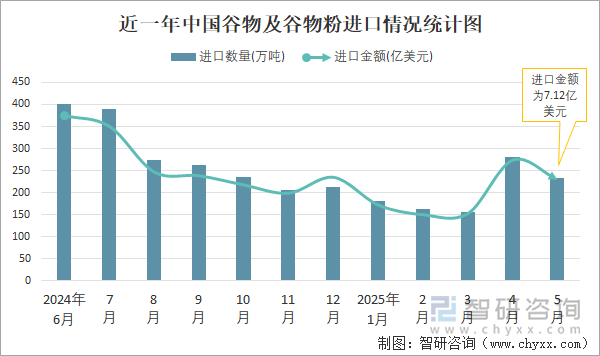
2025年5月中国谷物及谷物粉进口数量和进口金额分别为234万吨和7.12亿美元
Chan Ye Xin Xi Wang· 2025-08-05 03:51
Group 1 - In May 2025, China's grain and grain flour imports amounted to 2.34 million tons, representing a year-on-year decrease of 56.7% [1] - The import value for the same period was $71.2 million, which is a year-on-year decline of 55.9% [1] - The data is sourced from China Customs and organized by Zhiyan Consulting [3]
山西晋中农高区搭建科创平台 力推有机旱作农业升级
Zhong Guo Fa Zhan Wang· 2025-07-31 08:33
Core Viewpoint - The establishment of the organic dry farming innovation achievement database and the signing of the first transaction in the Jinzhong National Agricultural High-tech Zone mark significant progress in promoting agricultural technology innovation and achievement transformation, injecting strong momentum into regional agricultural high-quality development [1][2]. Group 1: Agricultural Innovation and Development - The Jinzhong National Agricultural High-tech Zone focuses on organic dry farming and agricultural product processing, emphasizing technological innovation and project construction to enhance agricultural productivity [1]. - The newly established organic dry farming innovation achievement database aims to integrate quality seeds, methods, opportunities, and land to boost grain production and income in northern dry farming areas [1]. - The establishment of the National Millet Improvement Center's work station in Jinzhong is seen as a starting point for accelerating the "green revolution" of millet and enhancing millet yield, contributing to national food security [1]. Group 2: Collaboration and Strategic Agreements - A transaction agreement was signed between the Hebei Academy of Agricultural and Forestry Sciences' millet research institute and Shanxi Zhigu Agricultural Technology Co., marking the first transaction under the new framework [2]. - A strategic cooperation agreement was signed between the Jinzhong National Agricultural High-tech Zone Management Committee and the National Millet Improvement Center to enhance the integration of technological and industrial innovation [2]. - The establishment of the work station in Jinzhong aims to leverage both parties' strengths to facilitate the transformation of scientific research achievements into practical applications in the region [2].

乌克兰农业部长:乌克兰2025年春季播种的谷物已完成97%,面积达550万公顷。
news flash· 2025-05-30 06:41
Core Insights - The Ukrainian Minister of Agriculture announced that 97% of the grain sowing for the spring of 2025 has been completed, covering an area of 5.5 million hectares [1]
俄乌战争结束对全球商品和金融市场的影响
CHIEF SECURITIES· 2025-03-12 06:50
Investment Rating - The report indicates that the overall impact of the end of the Russia-Ukraine war on the global economy is expected to be minimal due to the low GDP and export shares of both countries [2]. Core Insights - The report anticipates that the Russia-Ukraine conflict will likely conclude this year, leading to increased focus on post-war reconstruction and its implications for global commodity and financial markets [1]. - It highlights that Russia's economy has become increasingly reliant on energy exports due to the war, with significant changes in export structures and market dynamics [5][9]. - The report suggests that while short-term energy prices have not yet reflected recent developments, mid-term prices may face downward pressure as Russia resumes pre-conflict export levels [19][39]. Summary by Sections 1. Overall Impact on Global Economy - Russia's GDP in 2023 is projected at $6.45 trillion, accounting for 3.51% of global GDP, while Ukraine's GDP is only $622 million, representing 0.34% [2]. - The export totals for Russia and Ukraine are $424.22 billion (1.78% of global exports) and $36.04 billion (0.15% of global exports) respectively, indicating limited global economic influence [2]. 2. Impact on Global Energy Prices - In 2022, Russia's mineral fuels and oils exports totaled $358.02 billion, making up 61% of its total exports, a significant increase from 2021 [5]. - Russia's share of global oil exports in 2023 is 10.5%, ranking second globally, while its natural gas exports accounted for 2.16% in 2021, ranking tenth [9][13]. - The report notes a substantial decrease in the EU's dependency on Russian oil and gas, with Russian oil imports dropping from 25.7% in 2020 to 3.37% in 2023 [15]. 3. Impact on Global Grain and Oilseed Prices - Ukraine's grain exports in 2023 are estimated at $8.306 billion, down 30% from 2021, while oilseed exports are at $5.648 billion, down 18% [23]. - The report indicates that Ukraine's share of global grain exports was 8.53% before the conflict, ranking second globally, but is expected to face challenges in recovery post-war [24]. - It predicts that as Ukraine gradually restores agricultural production, there will be significant potential for increased exports of grains and oilseeds in the mid-term [25]. 4. Impact on Global Financial Markets - The report notes a strong performance in European and Russian financial markets following the expectation of conflict resolution, with the Russian RTS index rising over 16% [35]. - It anticipates further appreciation of the ruble and euro, while the US dollar index may face downward pressure, potentially dropping to 105 [40].
研客专栏 | 高粱及大麦产量及进口分析
对冲研投· 2025-03-04 13:44
Group 1 - The article discusses the importance of sorghum and barley as energy grain feed components, highlighting their protein content comparable to corn and their role as substitutes due to lower prices and significant import volumes [1][3]. - Global sorghum production is approximately 60 million tons, with the United States being the largest producer at 8.73 million tons, followed by Nigeria and Brazil [3][4]. - Global barley production is around 142.5 million tons, with the European Union as the leading producer, contributing 50.4 million tons [4]. Group 2 - China has a high demand for feed, leading to significant imports of sorghum and barley, with projected imports of 7 million tons of sorghum and 9 million tons of barley for the 2024/25 period [5]. - The main sources of sorghum imports for China include the United States (66%), Australia (22%), and Argentina (12%) [5]. - For barley, the primary import sources are Australia (37%), France (15%), and Canada (13%) [5]. Group 3 - The pricing of international sorghum and barley is closely aligned with corn prices, with imports remaining profitable due to lower international corn prices compared to domestic prices [6][7]. - The import volumes of sorghum and barley are influenced by domestic policies, with 2024 expected to see record high imports since 2020 [7]. - The uncertainty in China-US relations may impact sorghum imports, particularly if tariffs are imposed on US goods, while tensions with Australia could lead to anti-dumping investigations on Australian barley [7].