远程医疗

Search documents
BFB HEALTH登陆港交所 加速远程医疗健康管理的大众化普及
Zheng Quan Ri Bao Wang· 2026-01-23 10:48
相比美国Hims,BFBHEALTH多了品牌模块。拆解BFBHEALTH的战略布局,可以发现,BFBHEALTH实行"1+N"模式:旗 下拥有1个跨境购药平台一海享购,以及N个独立品牌(DYESOO、多燕瘦、寿春堂、美丽奇迹、爱森发、比比高等),全面 守护用户的健康与美。此举也构建了品牌壁垒,难以被单纯的产品销售企业复制,这也将助力其成为中国远程医疗健康管理的 领导者。 BFBHEALTH也将对中国医疗健康产业的升级产生影响。作为扎根于安徽亳州的民营企业上市公司,BFBHEALTH依托当 地产业优势,带动了中药材种植、深加工、物流配送等配套环节升级。公司的发展吸引了健康食品研发、智能设备制造等配套 企业落户亳州,完善了产业生态,带动"亳州品牌"走向世界,强化亳州中医药之都的影响力。同时,公司提供大量就业岗位, 增加地方税收,助推区域经济增长,实现企业发展与区域经济的协同共赢。 BFBHEALTH带来的红利最终将惠及广大用户。在服务体验优化上,技术迭代将让在线问诊更便捷、慢病管理更精准、远 程会诊更高效。还将让更多地区的用户享受到优质医疗资源,无论是县域地区,还是农村与偏远地区,用户无需长途奔波,即 可通过手机 ...
中国远程医疗健康管理公司BFB HEALTH登陆港交所 市值超12亿港元
Huan Qiu Wang· 2026-01-23 03:07
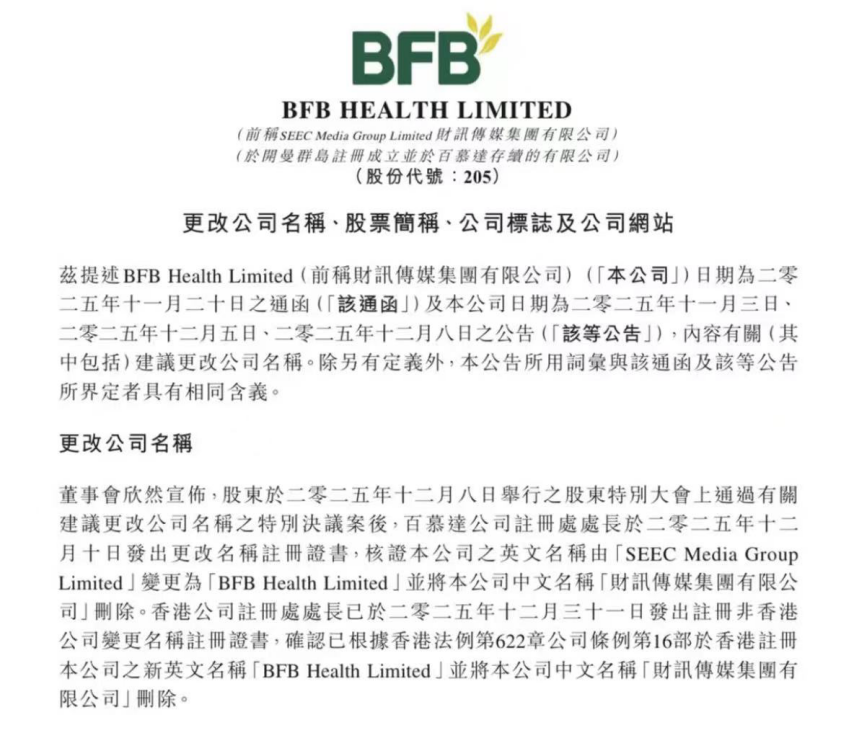
Group 1 - The company formerly known as 财讯传媒集团有限公司 has officially changed its name to BFB Health Limited, with the stock code remaining 00205.HK [1] - The name change ceremony took place in Bozhou, Anhui, and BFB Health aims to become "the first stock in China's remote medical health management" [3] - As of the closing on the day of the announcement, BFB Health's stock price was 0.99 HKD, with a total market capitalization exceeding 1.2 billion HKD [3] Group 2 - BFB Health plans to allocate 50% of its secondary market financing for AI upgrades in the health industry and new drug development, while the other 50% will be used for product iteration, brand building, and upgrading intelligent production lines [3][5] - The company has established a scalable and standardized operation for remote medical services, creating a closed-loop model of "online diagnosis + health management + product services," aligning with the "Internet + healthcare" development path [5]

中国远程医疗健康管理第一股登陆港交所,BFB HEALTH对标Hims本土化破局
3 6 Ke· 2026-01-23 02:41
Core Viewpoint - BFB HEALTH, formerly known as 财讯传媒集团, has officially rebranded as "BFB HEALTH," marking its position as the first publicly listed company in China's remote medical health management sector, with a market capitalization exceeding 1.2 billion HKD [1][3] Group 1: Company Overview - The rebranding ceremony took place in Bozhou, Anhui, which is recognized as the "World Capital of Traditional Chinese Medicine" [1] - BFB HEALTH's stock closed at 0.99 HKD, indicating strong market interest and confidence in the company's future [1] - The company plans to allocate 50% of its secondary market financing towards AI upgrades and new drug development, while the other 50% will focus on product iteration, brand building, and upgrading intelligent production lines [1][5] Group 2: Market Context - The National Healthcare Security Administration issued guidelines for remote surgical assistance pricing, paving the way for the commercialization of remote medical services [3] - The remote medical market in China has surpassed 100 billion CNY, with a compound annual growth rate of over 25% [8] - BFB HEALTH fills a gap in the market as the first dedicated player in the remote medical sector on the Hong Kong stock exchange, leveraging its regional advantages in traditional Chinese medicine [3][4] Group 3: Business Model and Strategy - BFB HEALTH's business model mirrors that of U.S. telehealth giant Hims & Hers, focusing on a closed-loop system of online diagnosis, product services, and health management [4] - The company employs a "1+N" strategy, utilizing a cross-border drug purchasing platform to support multiple independent brands, thereby addressing diverse health needs and creating competitive advantages [5] - BFB HEALTH aims to enhance user engagement through a subscription model, similar to Hims, which locks in long-term users and stabilizes cash flow [4] Group 4: Industry Impact - BFB HEALTH is set to drive digital transformation in the healthcare industry by utilizing digital channels and AI technology, thus improving service efficiency and accessibility [6] - The company promotes personalized health services, shifting the industry focus from product-driven to user-centered approaches [6] - As the first private enterprise listed in Bozhou, BFB HEALTH is expected to stimulate local economic growth and attract related businesses, enhancing the regional healthcare ecosystem [7]

VC亲自操刀“重组”:明星消费品牌刚刚上市了
投中网· 2026-01-22 06:06
Core Viewpoint - BFB HEALTH successfully listed on the Hong Kong Stock Exchange through an unconventional asset securitization method, led by its early investor, Huaying Capital, rather than traditional investment banks or large PE firms [4][5][16]. Group 1: Company Background - BFB HEALTH, formerly known as Duoyanshou, was co-founded in 2015 by Wu Mansheng and Zheng Duoyan, initially focusing on health food products [8]. - The company achieved a cumulative GMV exceeding 10 billion yuan by 2020, primarily through popular products like SOSO jelly [8]. Group 2: Investment Journey - Huaying Capital invested over 100 million yuan in Duoyanshou's A-round financing in 2021, recognizing the potential of functional food and the company's strong private traffic moat [9][10]. - The investment was prompted by the company's stable revenue and profit, supported by a direct-to-consumer (DTC) model that enhanced user loyalty and repeat purchases [10]. Group 3: Strategic Transformation - In 2022, Duoyanshou faced external challenges, including negative public sentiment towards functional foods and tightening IPO regulations, prompting a strategic pivot [11][12]. - Huaying Capital proposed a merger and acquisition (M&A) strategy to help Duoyanshou transition beyond health products, inspired by the success of U.S. telemedicine company Hims & Hers [13][14]. Group 4: Execution of M&A Strategy - The strategic transformation involved collaboration with an A-share listed company to develop domestic semaglutide and establishing a cross-border drug supply chain to meet immediate user needs [14][15]. - The complex M&A process required deep expertise in Hong Kong's capital market, which was facilitated by Huaying Capital's partner, who had extensive experience in successful listings [15][16]. Group 5: Active Management Strategy - The successful listing of BFB HEALTH signifies Huaying Capital's shift from traditional financial investment to proactive management, aiming to create controllable alpha returns [18][19]. - The firm plans to identify and actively manage "proactive management assets" and engage deeply in the strategic and operational aspects of its portfolio companies [20]. Group 6: Future Outlook - BFB HEALTH is envisioned as an industry integration platform, with plans to acquire synergistic brands and supply chain companies to enhance its market value [21][22]. - Huaying Capital's ongoing evolution includes expanding its team with investment banking professionals to support its proactive management and ecosystem-building strategies [22][24].

提升全球资源要素配置能力 加快建设全国重要对外交往中心
Xin Lang Cai Jing· 2025-12-23 20:11
Core Viewpoint - Chengdu aims to enhance its role as a significant center for international exchanges, focusing on high-level openness and deep reforms to boost global resource allocation capabilities, thereby driving high-quality urban development [1]. Group 1: Infrastructure Development - Chengdu has expanded its international and regional direct flight routes to 82, ranking fourth nationally and first in the Midwest, with plans to further enhance its international aviation hub capabilities [1]. - The city has launched over 38,000 China-Europe freight trains, connecting to more than 100 global cities and establishing 25 "Belt and Road" international supply chain service stations, with a target of 100 by the end of 2027 [1]. - Chengdu is developing a digital hub as part of the "Digital Silk Road," aiming to become a key information communication node and data center [1]. Group 2: Economic Growth and Trade - Chengdu is focusing on innovative development in foreign trade, enhancing trade relations with Europe, ASEAN, and Latin America, and promoting key foreign trade industry clusters [3]. - The city is encouraging the establishment of national service export bases in digital services, cultural services, and human resources, aiming to boost the growth of digital service trade [3]. - Chengdu is actively attracting foreign investment by broadening channels and encouraging multinational companies to establish regional headquarters in the city [4]. Group 3: Manufacturing and Innovation - The city plans to eliminate restrictions on foreign investment in manufacturing, aiming to create world-class advanced manufacturing clusters in electronics, high-end energy equipment, and software services [5]. - Chengdu is promoting the integration of advanced manufacturing with strategic emerging industries and modern services, while also enhancing its technological infrastructure [5]. - The city is fostering international collaboration in technology and innovation, encouraging global enterprises and research institutions to establish a presence in Chengdu [5]. Group 4: International Consumption Center - Chengdu is working towards becoming an international consumption center by developing new consumption formats and enhancing its cultural soft power [6][7]. - The city is focusing on creating high-quality living environments and promoting international consumption through various initiatives, including the development of major commercial districts [7]. - Chengdu aims to enhance its international appeal by promoting local cuisine and health services, while also improving the consumer experience for foreign visitors [7]. Group 5: International Relations and Cultural Exchange - Chengdu is committed to deepening international cooperation and cultural exchanges, optimizing its network of international friendship cities to enhance its global presence [8]. - The city plans to integrate cultural exchanges with trade, investment, and educational collaborations to support national diplomatic efforts and improve its economic benefits [9].
补贴政策争论加剧,对冲基金做空医疗服务提供商
Xin Lang Cai Jing· 2025-12-22 11:52
Core Insights - Goldman Sachs reported that hedge funds experienced net selling of U.S. healthcare stocks for the first time in 14 weeks due to the impending expiration of subsidy policies and lawmakers' urgency to control related costs [1][4] - Approximately 24 million Americans purchase health insurance through the Affordable Care Act, with increased subsidies during the COVID-19 pandemic set to expire on December 31, leading to potential significant premium increases unless Congress enacts an extension [1][4] - President Donald Trump announced plans to meet with health insurance companies in the coming weeks to discuss feasible ways to lower premiums [1][4] Hedge Fund Activity - The report indicated that hedge funds were net sellers of stocks in healthcare service providers, pharmaceuticals, and biotech companies, with only the life sciences and medical technology sectors recording net buying [1][4] - Goldman Sachs noted that short positions in the healthcare sector were more than eight times larger than long positions, indicating a bearish outlook among investors [1][4] Market Conditions - Current holdings in healthcare stocks remain relatively high compared to the averages of the past year and five years [2][5] - Rising healthcare costs, combined with increasing prices of other consumer goods, have led to public dissatisfaction, which may become a focal issue in the 2026 midterm elections [2][5] Legislative Developments - The U.S. House of Representatives passed a bill supported by Trump that will lower insurance premiums for certain groups starting January 2027, while simultaneously reducing subsidies for others, potentially increasing costs for some [6] - The timing of this bill's implementation is noteworthy as it is only two months before the election [6] Short Selling Trends - According to data from HazelTree, a financial data service tracking 700 asset management firms and 15,000 stocks, the telehealth company Him & Hers and scientific instrument manufacturer Bruker were the top two shorted mid-cap stocks in the U.S. in November [6]
AI医疗兴起前夜,硅谷远程医疗惊现巨大丑闻,引发信任危机与监管加码
Tai Mei Ti A P P· 2025-12-04 23:16
Core Viewpoint - The article highlights a significant scandal in the telemedicine sector, particularly involving Done Global, which has been accused of illegal drug distribution and fraudulent practices, raising concerns about ethics and safety in the healthcare industry [2][6]. Group 1: Company Overview - Done Global, founded by Ruthia He, rapidly expanded during the COVID-19 pandemic by offering online ADHD diagnosis and Adderall prescription services, capitalizing on relaxed telemedicine regulations [3][4]. - The company charged patients a subscription fee of $79 per month for online assessments and prescriptions, making it easy for users to access controlled substances [3]. Group 2: Legal Issues and Allegations - Ruthia He and David Brody were found guilty of illegal distribution of Adderall and submitting fraudulent claims, with the case involving over $100 million [2][4]. - The company employed aggressive marketing strategies, misleading potential patients about their need for ADHD treatment, and pressured doctors to limit consultation times to 30 minutes [4][5]. Group 3: Financial and Operational Practices - Done Global's revenue exceeded $100 million, with practices such as automatic prescription renewals and submitting false claims to insurance companies, resulting in over $14 million in fraud [5]. - The company faced severe consequences, including patient harm due to easy access to medications, which contributed to a nationwide shortage of Adderall [6]. Group 4: Regulatory Implications - The case has prompted a call for stricter regulations in the telemedicine sector, particularly regarding the prescription of controlled substances, with potential increases in compliance requirements [6]. - The U.S. Department of Justice indicated that this case marks the beginning of ongoing efforts to combat illegal drug distribution in the digital health space [6].

Teladoc Health (NYSE:TDOC) FY Conference Transcript
2025-12-02 18:32
Summary of Teladoc's Conference Call Company Overview - **Company**: Teladoc Health - **Industry**: Digital Health and Virtual Care - **Segments**: Integrated Care (60% of revenue, 90% of earnings) and BetterHelp Key Points Long-term Growth and Profitability - **Growth Outlook**: Expected low single-digit growth for 2026, influenced by macroeconomic uncertainties and selling season dynamics [4][6] - **Tailwinds**: Growth in virtual visit revenues, operational excellence, new product launches, and international expansion [5][6] - **Headwinds**: Rising medical costs for employers and challenges faced by health plans [6] Revenue Drivers - **Membership Growth**: Transition from subscription-based to visit-based models; focus on service utilization rather than just membership numbers [8][10] - **Chronic Care Management**: Over 1 million enrolled, with significant potential for cross-selling [9][14] - **Integrated Care Revenue**: $1.575 billion with a 3% growth rate and 15% margins expected in 2025 [10] Business Segmentation - **US vs. International**: The US business is the largest segment, followed by a smaller international business and health system services [11][12] - **Chronic Care and Telehealth**: Chronic care and virtual care are the primary revenue drivers, with mental health services integrated into the offerings [14][27] Behavioral Health Services - **Access to Mental Health**: 60 million members have access to mental health services, with a focus on integrated care [27][29] - **BetterHelp Integration**: Plans to launch Wellbound, an employee assistance product that combines Integrated Care with BetterHelp's therapy network [34] BetterHelp Transition - **Direct-to-Consumer Model**: BetterHelp is the largest virtual therapy business, facing challenges with conversion rates due to its cash-pay model [36][37] - **Insurance Integration**: Transitioning to insurance coverage to improve conversion rates and stabilize growth [41][42] Financial Position and Strategy - **Cash and Debt**: $726 million in cash with $1 billion in convertible debt maturing in 2027; potential for tuck-in acquisitions [45][46] - **M&A Strategy**: Open to mergers and acquisitions while focusing on organic growth [46][47] Market Dynamics - **Employer Market**: Increased interest and activity in the employer market channel, while health plan channels face pressure [23][24] - **2026 Selling Season**: Uncertainty in health plans could impact membership roles and enrollment for 2026 [26] Conclusion - Teladoc is navigating a complex healthcare landscape with a focus on integrated care, virtual health services, and strategic growth through both organic development and potential acquisitions. The company aims to enhance its service offerings while addressing market challenges and optimizing its financial structure.

LifeMD(LFMD) - 2025 Q3 - Earnings Call Transcript
2025-11-17 22:30
Financial Data and Key Metrics Changes - LifeMD reported consolidated revenue growth of 13% year-over-year to $60.2 million for Q3 2025, with telehealth revenue increasing 18% to $47.3 million [18] - Adjusted EBITDA for the quarter was $5.1 million, up from $4.3 million in the prior year, while telehealth adjusted EBITDA grew 30% to $2.9 million [19][20] - The company ended the quarter with $23.8 million in cash and no debt, marking the strongest balance sheet in its history [20] Business Line Data and Key Metrics Changes - The RexMD business added approximately 10,000 net new subscribers, rebounding from previous lows, with 8,000 of these coming from the sexual health segment [4][43] - Telehealth subscriber growth remained strong, with active subscribers increasing 14% year-over-year to over 310,000 [18] - Weight management continues to represent over 50% of total revenue, although there was a slight sequential decline in subscriber base [23] Market Data and Key Metrics Changes - The company is positioned to offer branded GLP-1 therapies at significantly reduced prices, with Wegovy and Ozempic available for $199 for the first two doses, a 60% reduction from current prices [8] - The anticipated approval of the Wegovy pill is expected to broaden access and accelerate demand, with estimates suggesting a potential market expansion of 25-50% due to patient preference for oral medications [56] Company Strategy and Development Direction - LifeMD's strategic priorities for 2026 include accelerating growth in weight management, scaling women's and behavioral health businesses, and launching a unified LifeMD platform [6] - The company aims to leverage collaborations with Novo Nordisk and Eli Lilly to enhance its competitive advantage in the GLP-1 space [7] - LifeMD is investing in a 503A compounding pharmacy to improve margins and control over patient experience, which is expected to drive growth across multiple health categories [11][55] Management's Comments on Operating Environment and Future Outlook - Management expressed optimism about 2026, highlighting the potential for improved pricing and coverage for branded therapies, which could significantly enhance revenue streams [25][30] - The competitive landscape in the weight management category remains challenging due to low-cost compounded products, but management believes that maintaining a focus on high-quality offerings will create long-term shareholder value [7][41] - The integration of insurance coverage is expected to positively impact customer acquisition costs and overall business performance [31] Other Important Information - The company divested its majority interest in WorkSimpli, strengthening its balance sheet and allowing it to focus solely on virtual care and pharmacy [5] - LifeMD is launching a new consumer-facing app and website, which is anticipated to enhance cross-selling capabilities and improve patient retention [52] Q&A Session Summary Question: Can you talk about the mix of telehealth product revenue, especially in weight loss? - The weight management segment still constitutes over 50% of total revenue, with a slight sequential decline in subscriber base noted [23] Question: How much of the growth in RexMD is driven by men's HRT versus ED? - Approximately 8,000 of the 10,000 new subscribers came from the sexual health business, primarily ED [43] Question: What impact do you expect from the approval of oral obesity products? - The Wegovy pill is expected to significantly expand the market, with estimates suggesting a 25-50% increase in patient uptake due to preference for oral medications [56] Question: How will insurance coverage affect your revenue? - A significant percentage of patients currently drop out due to lack of insurance coverage, and increased coverage is expected to have a massive positive impact on revenue [31] Question: What are the expectations for telehealth margins going forward? - Margins may slightly decline due to a shift in business mix, but all new offerings are expected to be accretive to the bottom line [46]

LifeMD, Inc. (NASDAQ: LFMD) Earnings Preview and Financial Challenges
Financial Modeling Prep· 2025-11-16 18:00
Core Insights - LifeMD, Inc. is preparing for its quarterly earnings announcement on November 17, 2025, with an expected EPS of -$0.06 and revenue projections of approximately $62.1 million [1][6] - The company has rescheduled its third-quarter earnings release due to necessary corrections in revenue recognition, impacting cumulative revenue by about $4.6 million, or 1.4% for the affected periods [2][6] Financial Metrics - LifeMD has a negative price-to-earnings (P/E) ratio of -30.66, indicating negative earnings [3][4] - The price-to-sales ratio is around 0.94, suggesting the market values the company slightly below its sales [3] - The enterprise value to sales ratio stands at 0.88, reflecting a lower valuation when accounting for debt and cash [3] - The enterprise value to operating cash flow ratio is 10.54, indicating the company's valuation relative to its cash flow from operations [4] - The earnings yield is at -3.26%, further highlighting the negative earnings situation [4] - The debt-to-equity ratio is -12.37, indicating a negative equity position, which may raise investor concerns [4] Liquidity Concerns - LifeMD's current ratio is approximately 0.77, suggesting potential challenges in meeting short-term obligations and indicating difficulties in covering short-term liabilities with current assets [5][6]