Commercial Space

Search documents
商业航天28股封板,巨头密集砸钱入局
2 1 Shi Ji Jing Ji Bao Dao· 2026-01-23 10:53
Core Insights - The commercial space sector in China has seen significant growth since 2025, with 50 commercial launches accounting for 54% of total space launches that year [1] - The commercial space index (886078.TI) surged by 73.13% in 2025, indicating a strong market performance [1] - The traditional dominance of state-owned enterprises in the space sector is being challenged as private capital and venture capitalists increasingly enter the market [1][10] Investment Trends - Corporate venture capital (CVC) investments in commercial space have nearly doubled from 19 events in 2023 to 35 in 2025, reflecting a growing interest in the sector [3] - CVC investments are characterized by a trend towards earlier and smaller investments, with 9 seed and angel round investments and 16 A-round investments in 2025 [5] - The geographical distribution of CVC investments shows Beijing leading with 8 events, followed by Jiangsu with 6 and Guangdong with 4 [7] Notable Investments - The largest disclosed investment in 2025 was a 300 million yuan (approximately 43 million USD) Pre-A round for Shaanxi Xingyi Space Technology Co., backed by a consortium of 8 investors [7] - Beijing Lizheng Technology Co., which provides drone control solutions, also secured 300 million yuan in a C+ round from 7 institutions [7] Industry Expansion - CVC investments are expanding beyond traditional rocket and launch services to include areas such as engines, aerospace electronics, and downstream applications [8] - Notable investments include Shenzhen Xiandeng Aerospace Technology Co., which focuses on ground support for rockets, and Hunan Lanyue Electromechanical Technology Co., which manufactures satellite components [8] Investment Institutions - The investment landscape includes three main types of institutions: state-owned enterprises and national capital platforms, local state-owned capital, and industry leaders' investment platforms [9] - Examples include China Electronics Technology Group's investment arm and local funds like Shenzhen Innovation Capital [9] Cross-Industry Involvement - Increasingly, non-space industry giants from sectors like automotive, oil, and AI are investing in commercial space, indicating a shift in investment dynamics [12] - Companies like Huichuan Technology, a leader in industrial automation, have made significant investments in the space sector, reflecting a broader trend of cross-industry capital flow [13] Market Dynamics - The commercial space industry is evolving into a competitive landscape focused on large-scale delivery and system capabilities, with leading firms gaining market share through technological and operational advantages [15] - The entry of diverse capital sources is expected to enhance the growth potential of the commercial space sector, making it more integrated into the broader industrial ecosystem [10][15]



商业航天28股封板,巨头密集砸钱入局
21世纪经济报道· 2026-01-23 10:46
Core Viewpoint - The commercial aerospace sector in China has seen significant growth since 2025, with a notable increase in investment activities and market participation from various industries, indicating a shift towards commercialization and diversification in funding sources [1][10]. Investment Trends - The number of CVC investment events in commercial aerospace has increased from 19 in 2023 to 35 in 2025, nearly doubling within two years [3][5]. - CVC investments are showing a trend towards earlier and smaller investments, with 9 seed and angel round investments and 16 A-round investments in 2025, compared to only 15 such investments in 2024 [5][10]. Geographic Distribution - Beijing leads in CVC investment events with 8 occurrences, followed by Jiangsu with 6 and Guangdong with 4, all from Shenzhen [8]. Notable Investments - Shaanxi Xingyi Space Technology Co., a commercial aerospace service provider, received 300 million yuan in a Pre-A round, marking the largest CVC investment in commercial aerospace for 2025 [9]. - Beijing Lizheng Technology Co., which provides drone control solutions, also secured 300 million yuan in a C+ round from several investment firms, including a private equity fund under SAIC Group [9]. Investment Focus - CVC investments are expanding beyond traditional rocket and launch services to include areas such as engines, aerospace electronics, and downstream applications [9][10]. - The investment landscape includes three main types of investors: state-owned enterprises and national capital platforms, local state-owned capital, and industry leaders' investment platforms [10]. Cross-Industry Participation - Increasingly, non-aerospace industries such as automotive, energy, and AI are entering the commercial aerospace sector, indicating a broader interest in aerospace technologies and applications [11][12]. - For example, Huichuan Technology, a leader in industrial automation, has made multiple investments in commercial aerospace, reflecting a trend of cross-industry investment [12]. Market Dynamics - The commercial aerospace industry is transitioning into a competitive phase focused on large-scale delivery and system capabilities, where leading companies can leverage their technological and operational advantages for market share [13]. - The perception of commercial aerospace is evolving from a high-risk frontier technology to a long-term investment opportunity that can be integrated into existing industrial frameworks [14].
“太空”再添玩家 银行扎堆发卫星
Mei Ri Shang Bao· 2026-01-22 22:29
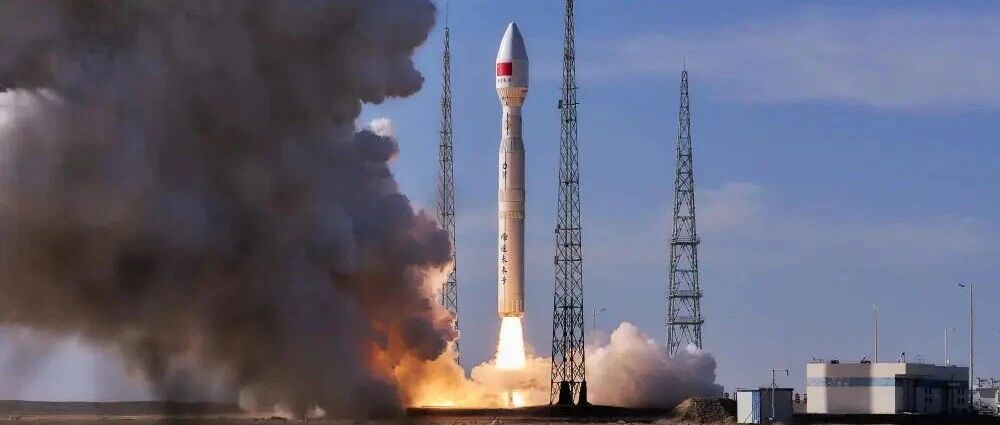
Group 1 - The banking industry is increasingly exploring space, with China Merchants Bank and Shanghai Pudong Development Bank successfully launching two satellites as part of the "Tianqi Constellation," China's first global low-orbit satellite IoT constellation [1][2] - China Merchants Bank has launched satellites for three consecutive years, with "Zhaoyin 1" and "Zhaoyin 2" launched in 2024 and 2025, respectively, while Ping An Bank has also launched its own satellites [1][2] - The recent launches aim to enhance global communication capabilities, improve data transmission, and support more terminal devices, marking the establishment of a comprehensive low-orbit satellite communication matrix for China Merchants Bank [2] Group 2 - The banking sector's involvement in space is driven by practical needs such as business upgrades, risk management, and supporting national strategies, rather than merely chasing trends [1][2] - The commercial space industry is entering a golden era, with multiple companies actively pursuing capital market opportunities and several firms updating their IPO progress [4] - The 14th Five-Year Plan has prioritized the construction of a strong space nation, which is expected to accelerate industry development [4][5] Group 3 - Data from the National Space Administration indicates that by 2025, China plans to complete 50 launches, with commercial rockets accounting for 25 of these, and a significant number of commercial satellites expected to be launched [5][6] - The commercial space sector is experiencing rapid growth, with a notable increase in stock prices for companies involved in this industry, reflecting strong market interest [6]

A股午盘丨创业板跌1.83%,房地产、零售板块逆势上涨
Di Yi Cai Jing· 2026-01-20 06:39
Market Performance - The Shanghai Composite Index fell by 0.3%, the Shenzhen Component Index decreased by 1.22%, the ChiNext Index dropped by 1.83%, and the STAR Market Index declined by 1.43% [1][1][1] - Sectors such as satellite internet, CPO, commercial aerospace, and 6G experienced significant declines, while real estate, advanced packaging, and retail sectors saw gains [1][1][1] Technical Indicators - A MACD golden cross signal has formed, indicating potential upward momentum for certain stocks [1][1]

“申”度解盘 | 指数持续上涨后震荡盘整,AI应用板块表现活跃
申万宏源证券上海北京西路营业部· 2026-01-20 02:49
Core Viewpoint - The A-share market has experienced a period of adjustment following a recent continuous rise in indices, with notable corrections in the commercial aerospace sector and active performance in the AI application sector [6][7]. Market Overview - The commercial aerospace sector has shown signs of divergence and adjustment, with multiple companies issuing risk warnings regarding their business activities. This indicates a potential overheating in the sector, prompting calls for improved information disclosure and investor education to guide rational market development [7]. - The AI application sector has benefited from capital inflows as funds from the commercial aerospace sector have shifted towards it. Key concepts such as Generative Engine Optimization (GEO) and AI healthcare have gained traction, with GEO expected to reshape advertising marketing in the AI era, presenting a vast market opportunity [7]. - In the AI healthcare space, there have been significant developments, including increased traffic for Ant Group's AI health assistant and collaborations between OpenAI and major pharmaceutical companies to invest in AI drug research [7]. Policy Adjustments - On Wednesday, the Shanghai and Shenzhen Stock Exchanges announced an adjustment to the financing margin ratio, increasing the minimum margin for investors from 80% to 100%. This change follows a previous reduction in August 2023, aimed at promoting long-term market stability amid recent price increases [8]. Market Outlook - Following a peak trading volume of nearly 4 trillion yuan, the indices are expected to undergo slight adjustments to digest the gains made since December 2022. Future attention will be on the performance of resource and precious metal prices, as well as the impact of AI industry trends on hot topics [10].

A股午评:沪指跌0.6%险守4100点,超3600股下跌!AI应用板块大幅回调
Ge Long Hui· 2026-01-15 03:35
Market Overview - The three major A-share indices collectively declined, with the Shanghai Composite Index falling by 0.6% to 4101.52 points [1] - The Shenzhen Component Index decreased by 0.44%, while the ChiNext Index dropped by 1.02% [1] - The North Stock 50 index experienced a significant decline of 2.31% [1] Trading Activity - The total market turnover was 189.52 billion yuan, which represents a decrease of 35.06 billion yuan compared to the previous day [1] - Over 3600 stocks experienced a decline during the trading session [1] Sector Performance - The gold, lithium mining, and other non-ferrous metal sectors saw a counter-trend increase [1] - Hotel and tourism stocks experienced a general rise [1] - Conversely, sectors such as AI applications, military electronics, commercial aerospace, and medical services collectively underwent a correction [1]
午评:创业板指跌1.02% AI应用、商业航天等热门板块大幅调整
Xin Lang Cai Jing· 2026-01-15 03:31
Market Overview - The Shanghai Composite Index fell by 0.6%, the Shenzhen Component Index decreased by 0.44%, the ChiNext Index dropped by 1.02%, and the Northern Stock 50 declined by 2.31% [1] - The total market turnover was 1,895.2 billion yuan, a decrease of 350.6 billion yuan compared to the previous day [1] Sector Performance - Precious metals, energy metals, and agricultural chemicals sectors were active, while commercial aerospace and AI application sectors experienced adjustments [1] - The precious metals sector continued to strengthen, with Sichuan Gold hitting the daily limit, and Hunan Silver and Xiaocheng Technology rising nearly 6% [1] - The energy metals sector saw gains, with Huayou Cobalt and Yuanhang Precision increasing over 6% [1] - The agricultural chemicals sector performed well in the morning, with Dongfang Tower rising over 8%, and Baiao Chemical and Lianhua Technology increasing over 7% [1] Notable Declines - The commercial aerospace sector adjusted, with multiple stocks such as Zhongke Xingtou, Tianrun Technology, and Hongxiang Co. falling over 10% [1] - Stocks like Leike Defense, Changjiang Communication, and Aerospace Electronics hit the daily limit down [1] - The AI application sector also faced adjustments, with Tianlong Group, Zhidema, and Hongbo Medicine hitting the daily limit down, and stocks like Tongda Hai and Guangha Communication dropping over 10% [1]
刷新历史!A股市场成交额逼近4万亿元大关
Mei Ri Shang Bao· 2026-01-14 23:16
Market Overview - The Shanghai Composite Index experienced a strong rise in the morning, approaching 4200 points, but fell back in the afternoon, closing down 0.31% at 4126.09 points. The Shenzhen Component Index rose 0.56%, and the ChiNext Index increased by 0.82% [1] - The total trading volume in the A-share market reached approximately 4 trillion yuan, setting a new record, surpassing the previous high of 3.7 trillion yuan on January 13 [1] AI Application Sector - The AI application sector continued its active performance, with notable stocks like ZhiDeMai (300785) hitting a 20% limit up, marking an over 80% increase in the last four trading days [2] - Institutions highlighted the broad development potential of AI commercialization, particularly in Generative Engine Optimization (GEO) applications, which are evolving to enhance user interaction and experience [2] - The report emphasized the importance of product implementation with revenue structures in AI applications, suggesting that GEO could adapt to new marketing paradigms in the AI era [2] Semiconductor Sector - The semiconductor sector showed strong performance, with stocks like Canxin (涨近15%) and Jingfeng Mingyuan (涨逾13%) leading the gains [4] - The approval of NVIDIA to export its AI chip H200 to China by the U.S. government was a significant catalyst, with a 25% fee on related transactions [4] - Analysts noted that global semiconductor demand is expected to improve, driven by growth in AI servers and electric vehicles, while cautioning about ongoing high costs in technology-intensive sectors due to U.S. policies [4] Commercial Aerospace Sector - The commercial aerospace sector remained active, with stocks like Qifeng Precision and Liujin Technology seeing significant gains [6] - Recent successful satellite launches, including the Remote Sensing 50 satellite and a batch of low-orbit satellites, have catalyzed interest in the sector [6] - Analysts recommend focusing on satellite manufacturing companies with large-scale production capabilities and commercial rocket companies with advanced technology to address the current launch capacity gap [6]
冲刺4200点!A股大盘涨超1%,商业航天概念强势反弹
Sou Hu Cai Jing· 2026-01-14 03:22
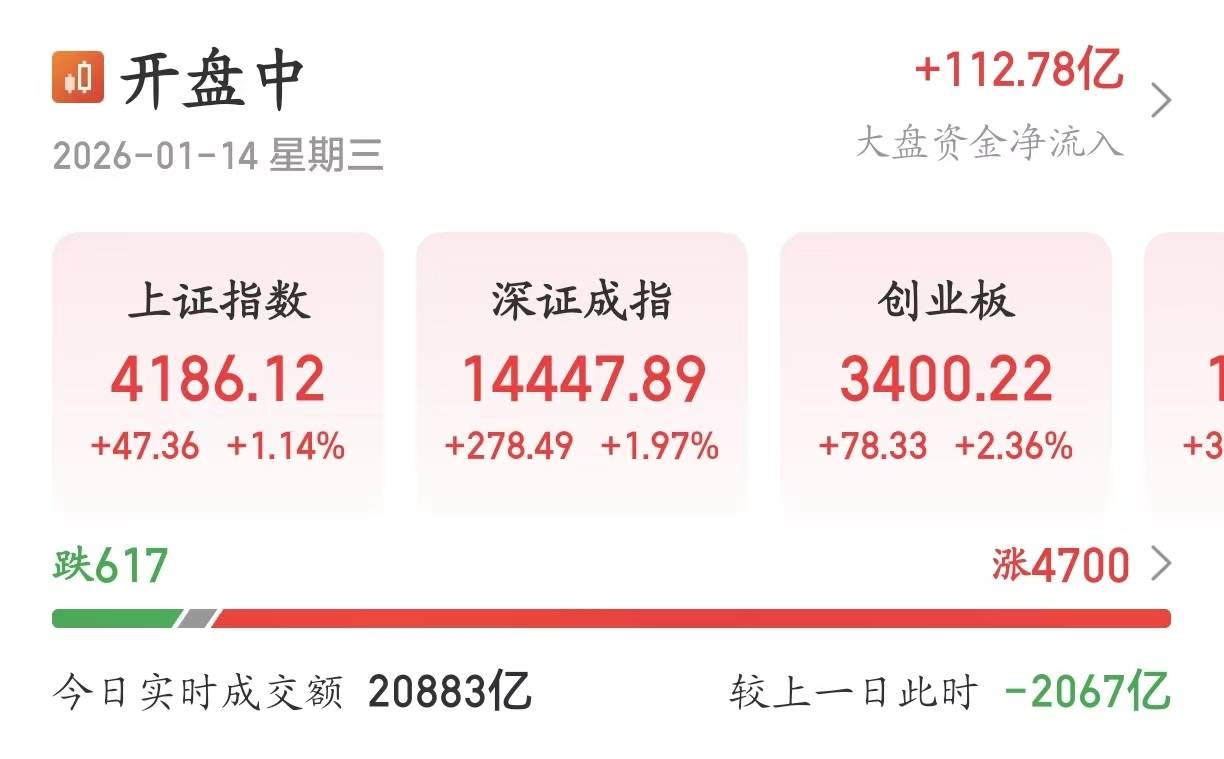
Market Overview - The total trading volume across three markets reached 2.08 trillion yuan, a decrease of 206.7 billion yuan compared to the previous day, with 4,700 stocks showing gains [2]. Sector Performance - The leading sectors in terms of growth included: - Internet Services: +5.87% - Software Development: +5.59% - Cultural Media: +4.77% - Healthcare Services: +3.94% - Gaming: +3.86% - Electronic Chemicals: +3.29% - Education: +3.08% - Communication Equipment: +2.96% - Communication Services: +2.91% - Computer Equipment: +2.82% [3]. Commercial Aerospace Sector - The commercial aerospace sector rebounded strongly after a previous decline, with notable stocks such as: - YF Communication hitting a historical high with a limit-up increase - Galaxy Electronics achieving a limit-up for the eighth consecutive day - Other stocks like Sanwei Tiandi, Jiayuan Technology, and Datang Telecom also reached limit-up [4]. Satellite Launch Success - On January 13, at 23:25, China successfully launched 18 low-orbit satellite internet satellites using the Long March 8A rocket from the Hainan Commercial Aerospace Launch Site, with all satellites entering their designated orbits successfully [6].


17连阳!“AI+”涨疯了
Ge Long Hui A P P· 2026-01-12 10:47
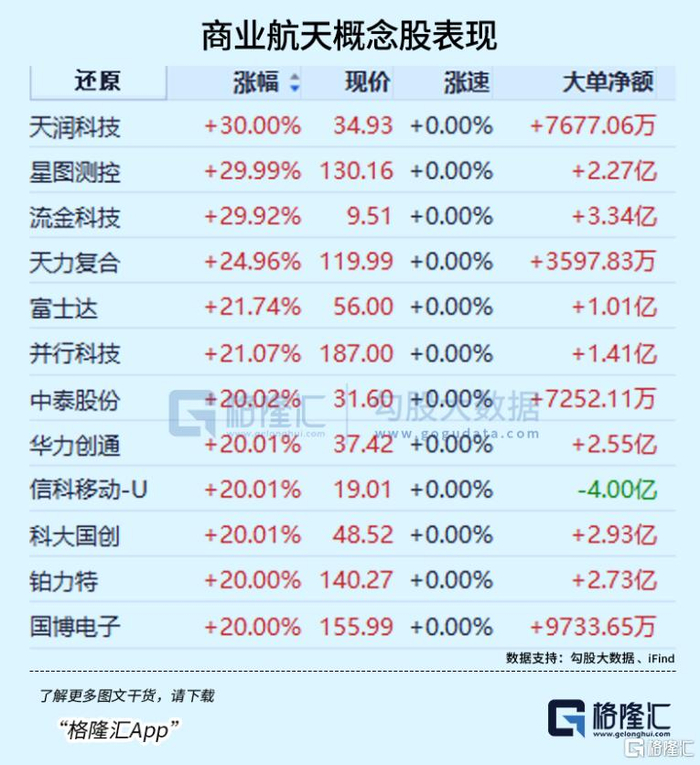
Core Viewpoint - The A-share market is experiencing a significant surge, with the Shanghai Composite Index rising by 1.09%, marking a 17-day consecutive increase and reaching a new high not seen in over a decade [1]. Market Performance - The single-day trading volume exceeded 3.6 trillion yuan, setting a new historical record, indicating heightened market enthusiasm [2]. - The "AI+" concept has seen a resurgence, with sectors such as AI healthcare, AI marketing, and various AI-related concepts leading in gains. The medical device ETF (562600) rose by 2.27% today and has increased by 11.66% year-to-date [3]. Sector Analysis - The "AI+" concept has concentrated its explosive growth, with sectors like AI applications, commercial aerospace, photovoltaics, retail, and precious metals showing significant gains, while oil and coal sectors faced declines [4]. - Notable stocks in the commercial aerospace sector include Luxin Venture Capital, which has seen 10 trading limits in 12 days, and other companies like Goldwind Technology and Tongyu Communication also performed well [4]. Specific Stock Performance - In the commercial aerospace sector, stocks such as Tianrun Technology (+30.00%), Xingtou Measurement Control (+29.99%), and Liujin Technology (+29.92%) have shown remarkable increases [6]. - The photovoltaic sector has also benefited from advancements in perovskite batteries and space photovoltaic concepts, with companies like Dongfang Risheng and Maiwei Shares leading the gains [7]. AI Applications - The AI application sector has collectively strengthened, with stocks like Yidian Tianxia and Liou Shares hitting the daily limit [9]. - Recent developments in AI applications include Walmart's collaboration with Google to enhance shopping experiences through AI [11]. Future Outlook - The AI industry is shifting focus from "computing power competition" to "application value," with 2026 expected to be a pivotal year for AI applications transitioning from "technology validation" to "commercial promotion" [14]. - The medical device ETF (562600) is highlighted for its significant exposure to the brain-computer interface sector, with a 23.79% concentration in this area, making it a key investment vehicle [20]. Investment Trends - The medical device ETF has seen a net inflow of 1.31 billion yuan over the past five days, indicating strong investor interest [22]. - The Hang Seng Medical ETF (159892) is also noted for capturing the trend of Chinese biopharmaceuticals going global, with significant inflows and a 13.56% increase year-to-date [24]. Conclusion - The integration of technology and healthcare is at a critical juncture, with investment strategies focusing on quality index tools to capitalize on long-term growth opportunities in AI healthcare and brain-computer interfaces [26].