疫苗

Search documents
全国流感进入快速上升期,哪些疫苗、药品需求大?
Di Yi Cai Jing· 2025-11-24 08:26
Core Insights - The flu season in China has entered a rapid increase phase, with many provinces reaching moderate to high epidemic levels, leading to a significant rise in demand for flu vaccines and antiviral medications [1][4] Group 1: Flu Vaccine Supply and Demand - Flu vaccine and antiviral drug supplies remain stable across multiple regions, with no significant price increases reported, although some innovative and imported vaccines are experiencing temporary shortages [1][2] - There is a notable increase in flu vaccine appointment requests in northern provinces, with four-valent subunit flu vaccines facing tight inventory, while adult flu vaccines are generally available [2][3] Group 2: Targeted Vaccination Initiatives - Beijing has included school students and frontline workers in a free vaccination program, aiming to complete the initiative by the end of the month, with other regions extending vaccination hours for minors [3] Group 3: Antiviral Drug Demand Surge - The demand for antiviral medications has surged, with sales figures showing a 22-fold increase in flu medication transactions since the onset of the flu season, and specific products like Oseltamivir and Favipiravir seeing significant sales growth [4][5] Group 4: Drug Efficacy and Market Regulation - Current antiviral medications remain effective against circulating flu strains, with no evidence of increased virulence in flu viruses; regulatory bodies are actively monitoring and ensuring stable supply and pricing of these medications [5][6]
财联社11月24日早间新闻精选
Xin Lang Cai Jing· 2025-11-24 00:30
Group 1 - The Chinese government emphasizes the importance of economic and trade cooperation with the U.S. as a stabilizing factor in bilateral relations [1] - Sixteen hard technology products have been approved for fundraising, involving major fund companies such as E Fund and Huatai-PB [3] - The low-altitude economy market in China is projected to reach 1.5 trillion yuan by 2025 and exceed 2 trillion yuan by 2030, indicating strong growth in the industry [8] - Changxin Memory Technologies has launched its latest DDR5 product series with speeds up to 8000 Mbps and capacities up to 24 Gb [9] - Huawei has released Flex:ai AI container software, which allows for the division of a single GPU/NPU into multiple virtual computing units, enhancing AI workload management [10] Group 2 - Huaxia Happiness's debt committee has authorized Ping An Asset Management to conduct a special due diligence investigation on the company's financial status [12] - Wentech has urged Nexperia Netherlands to address control issues to ensure global supply chain stability [13] - Nenghui Technology has signed a contract worth 100 million yuan for new energy power battery assemblies [14] - The global first EGFR×HER3 dual antibody ADC drug izabren has had its market application accepted [16] - The China Securities Regulatory Commission has initiated investigations into several companies for suspected information disclosure violations [17]
中信建投:CXO行业调整基本完成 重点关注出海能力强的CDMO企业及临床CRO龙头
智通财经网· 2025-11-23 23:45
Group 1 - The innovative pharmaceutical sector is experiencing three major trends: deepening internationalization 2.0, unprecedented policy support, and continuous technological breakthroughs [1] - By 2025, the number of license-out transactions is expected to reach 103, with upfront payments hitting a record high of $8.45 billion, benefiting companies that expand internationally [1] - The CXO industry adjustment is nearly complete, with stable overseas demand and a rebound in domestic investment and financing, focusing on CDMO companies with strong overseas capabilities and leading clinical CROs [1] Group 2 - The Chinese pharmaceutical industry is enhancing its competitiveness despite increasing external challenges, leveraging advantages in population, domestic demand, manufacturing, and supply chains [1] - The policy outlook indicates a shift towards high-quality growth, with a focus on optimizing drug and consumable procurement policies and diversifying payment and medical service pricing reforms by the second half of 2025 [2] - The industry is witnessing a transformation with an emphasis on supply chain security, innovation, and the integration of new technologies such as AI and brain-machine interfaces [2]

疫苗行业周报:流感活动度继续攀升至近三年同期高位,继续关注结构性机会-20251123
Xiangcai Securities· 2025-11-23 12:47
Investment Rating - The industry investment rating is maintained at "Overweight" [2] Core Viewpoints - The flu activity has risen to near three-year highs, highlighting the urgent demand for flu and related vaccines, and structural opportunities in the flu vaccine market should be closely monitored [5][9] - Recent developments in vaccine companies include clinical trial applications for new vaccines, indicating ongoing innovation and regulatory support for the industry [4][5] - The industry is experiencing a transition from scale expansion to innovation-driven growth, with a focus on high-tech barriers and differentiated pipeline layouts [9][10] Summary by Relevant Sections Recent Industry Performance - The vaccine sector has seen a relative decline of 28% over the past 12 months compared to the CSI 300 index, with a recent absolute decline of 14% [4][6] - The vaccine sector's PE (ttm) is 94.34X, down 7.53X from the previous period, while the PB (lf) is 1.85X, reflecting a decrease of 0.14X [8] Market Dynamics - The National Influenza Center reported a 53.8% increase in flu-like illness cases, with significant activity in both northern and southern provinces [4][5] - The China Vaccine Industry Association has advocated against "involutionary" competition to promote high-quality development in the vaccine sector [4] Investment Recommendations - The vaccine industry is under pressure, with a focus on finding alpha opportunities amid differentiation. Long-term attention should be given to innovation and international expansion [9][10] - Companies with strong R&D capabilities and differentiated products, such as CanSino and Kanghua Biotech, are recommended for investment [10][27]
内斗不止,分红530亿:科兴生物遭纳斯达克驱逐退市
Guan Cha Zhe Wang· 2025-11-21 08:57
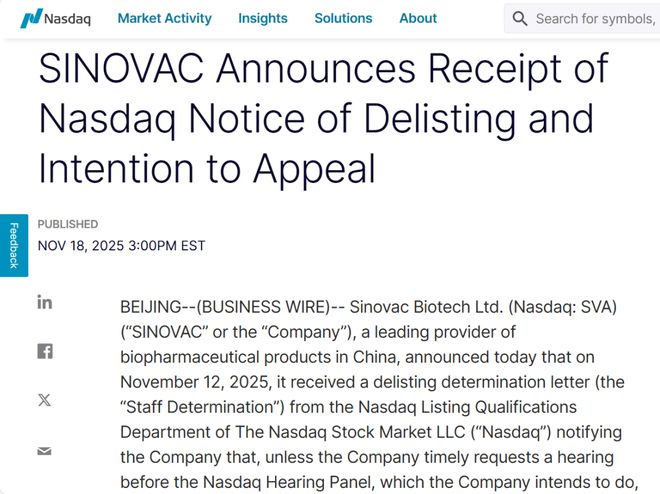
Core Viewpoint - Sinovac Biotech, once a leading player in the vaccine industry, is facing a severe delisting crisis due to a prolonged internal power struggle rather than market competition or business decline [1] Group 1: Company Background - Sinovac Biotech was founded in 2001 by Yin Weidong and Pan Aihua, combining technical expertise and capital investment [2] - The company expanded its product line from hepatitis A vaccine to various vaccines, including those for influenza and SARS [2][3] - Sinovac successfully went public on NASDAQ, but internal conflicts began to emerge as the company grew [3] Group 2: Internal Conflicts - Fundamental disagreements arose between the founders regarding the ownership and control of the company, leading to factionalism among shareholders [3] - The conflict escalated in 2018, resulting in physical altercations at the company’s facilities and significant financial losses, including the destruction of 6 million vaccine doses [3] - NASDAQ suspended trading of Sinovac shares in 2019 due to the company's failure to provide required information, leading to a stagnant stock price of $6.47 and a market cap of approximately 28 billion RMB [3] Group 3: Financial Performance and Dividends - The COVID-19 pandemic provided a temporary revival for Sinovac, with the company earning a net profit of $8.46 billion (approximately 600 billion RMB) in 2021 from its vaccine [4] - Despite the financial success, internal disputes meant that not all founders benefited equally, with Pan Aihua receiving no dividends and facing legal issues [4] - A controversial "liquidation-style dividend" proposal was introduced, offering up to $124 per share, totaling around 74.4 billion USD (approximately 530 billion RMB), which was overwhelmingly supported by shareholders [6] Group 4: Current Situation and Future Outlook - The company is currently in a precarious position, having failed to publish its annual report on time, leading to NASDAQ's decision to delist it on November 21 [6][7] - Sinovac has appealed the delisting decision, but the situation appears more dire than previous instances [6][7] - The internal power struggle has left the company in a state of decline, with no clear winners among the founders or shareholders [7]
疫苗价格暴跌90%,行业协会坐不住了!
Jin Tou Wang· 2025-11-21 08:29
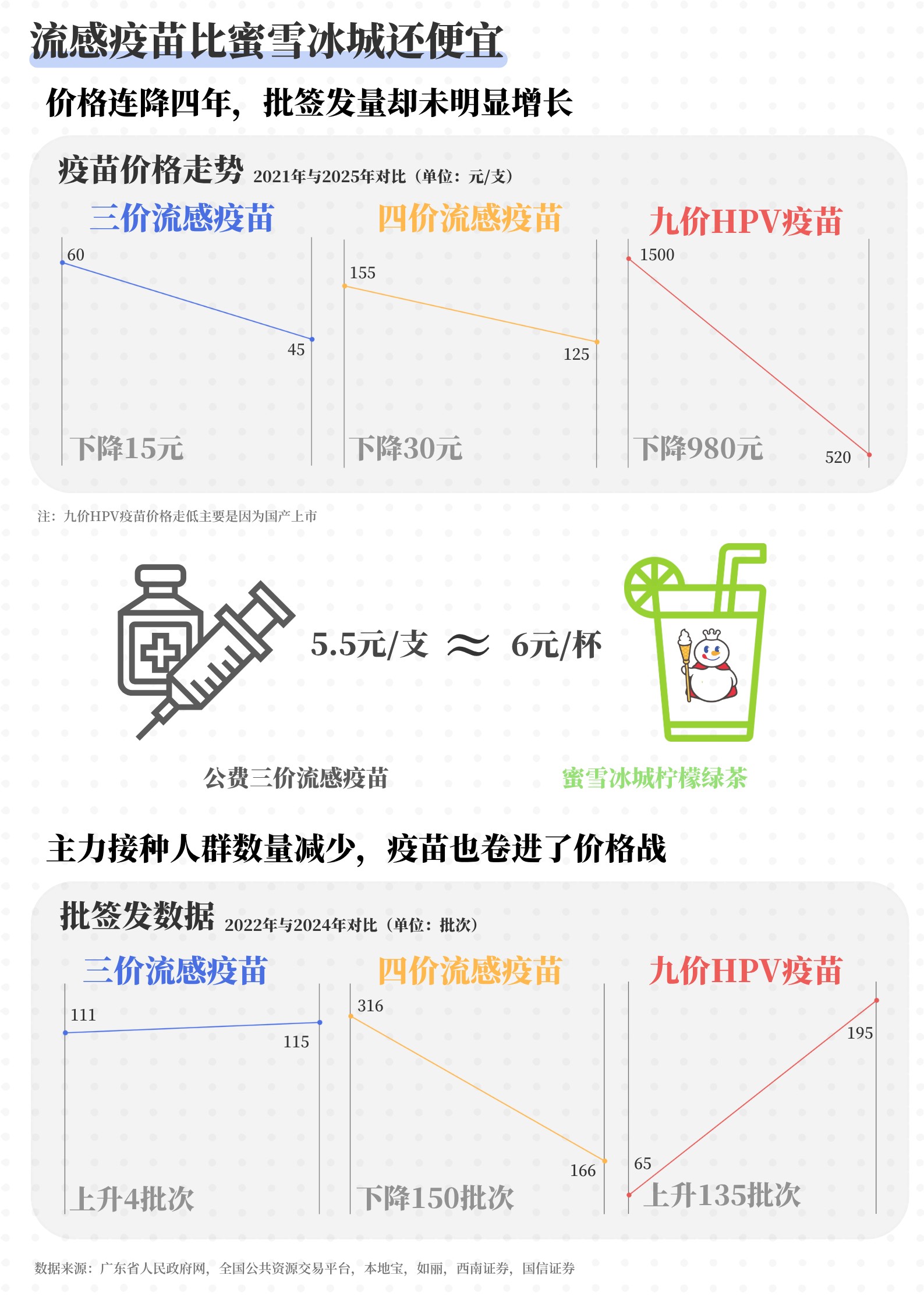
Core Viewpoint - The Chinese vaccine industry is experiencing a severe price war, leading to significant price drops, with some vaccines falling over 90% in price, prompting the China Vaccine Industry Association to call for an end to the price competition to avoid unsustainable costs [1][3]. Group 1: Price Decline and Industry Impact - The price of common vaccines, such as the flu vaccine, has plummeted to about 1/10 of previous prices, with three-valent vaccines previously priced around 60 yuan now being offered as low as 6.5 yuan [3]. - The HPV vaccine has also seen drastic price reductions, with Watson Bio's two-valent HPV vaccine dropping nearly 90% over three years, resulting in significant profit declines for leading vaccine companies, with net profits falling by 70%-90% last year [3][4]. - In the first three quarters of this year, 10 out of 14 publicly listed vaccine companies in China reported profit declines, with over 70% experiencing this trend, and 5 companies are currently operating at a loss [3]. Group 2: Causes of Price Decline - The decline in birth rates has reduced the market size for vaccines, particularly affecting those targeting infants, while competition among manufacturers has intensified, leading to price cuts due to a lack of product differentiation [4]. - The approval of 59 flu vaccine products has resulted in oversupply, with 40% of flu vaccines going unsold and subsequently wasted last year, forcing companies to sell at a loss [4]. Group 3: Long-term Implications for Public Health - While lower vaccine prices may seem beneficial for consumers, the long-term impact on innovation and quality is concerning, as companies may lack the financial incentive to invest in new vaccine development [6]. - The risk of using cheaper raw materials to maintain low prices could compromise vaccine quality, posing a threat to public health [6]. - The industry must balance price reductions with the need for effective and safe vaccines, as the focus should not solely be on affordability but also on health outcomes [6]. Group 4: Strategies for Industry Recovery - Vaccine companies are increasingly looking to expand into emerging markets in Southeast Asia, Latin America, and Africa, with companies like Wantai Biologics significantly increasing their export volumes [8]. - Chinese vaccine firms are moving beyond simple product exports to include technology licensing and localized production, which helps them navigate trade barriers and integrate into local markets [8]. - Achieving international certifications is crucial for these companies, indicating that their quality management systems meet global standards, which is essential for future growth in the global vaccine market projected to reach $86.2 billion by 2032 [8].


“反内卷”风吹向疫苗行业 严禁以低于成本报价参与竞标
Bei Jing Shang Bao· 2025-11-21 00:00
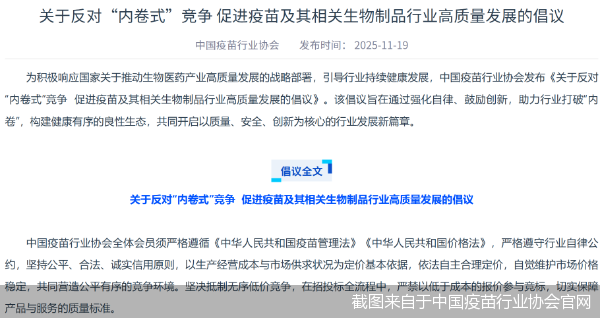
Core Viewpoint - The Chinese vaccine industry is facing intense price competition, leading to significant profit declines for many companies. The China Vaccine Industry Association has called for members to resist disorderly low-price competition and adhere to fair pricing practices to stabilize the market and promote innovation [1][2][3]. Group 1: Industry Challenges - The price war in the vaccine industry has intensified, with the price of the bivalent HPV vaccine dropping to as low as 27.5 yuan per dose, and flu vaccines reaching as low as 5.5 yuan per dose [4][6]. - In the first three quarters of this year, 71.43% of A-share vaccine companies reported a decline in net profit, with notable losses from companies like Wantai Biological Pharmacy and BCG Biological [6][7]. Group 2: Association's Initiative - The China Vaccine Industry Association has issued an initiative to promote high-quality development in the vaccine sector by advocating for self-discipline, innovation, and fair competition [2][3]. - The initiative emphasizes compliance with national laws and industry self-regulation, urging members to set prices based on production costs and market demand, while strictly prohibiting bidding below cost [2][3]. Group 3: Long-term Outlook - Experts believe that if the association's initiative is effectively implemented, it could lead to a more orderly competitive landscape, enhancing the industry's sustainability and improving vaccine safety and efficacy [3][7]. - The vaccine industry is seen as a crucial segment of the biopharmaceutical sector, with potential for growth as public health awareness and innovation capabilities improve [7].


“反内卷”风吹向疫苗行业
Bei Jing Shang Bao· 2025-11-20 12:39
Core Viewpoint - The Chinese Vaccine Industry Association has issued an initiative to combat chaotic price competition in the vaccine industry, advocating for self-discipline and innovation to promote high-quality development in the sector [4][5]. Group 1: Industry Challenges - The vaccine industry is experiencing intense price wars, with the price of the bivalent HPV vaccine dropping to as low as 27.5 yuan per dose, and flu vaccines reaching as low as 5.5 yuan per dose [7][9]. - In the first three quarters of this year, 71.43% of A-share vaccine companies reported a decline in net profit, with notable losses from companies like Wantai Biological Pharmacy and BCG Biological [8][9]. Group 2: Association's Initiative - The initiative calls for all members of the association to adhere to the Vaccine Administration Law and the Price Law, ensuring fair and legal pricing based on production costs and market demand [4][5]. - The association emphasizes the need to resist disorderly low-price competition and prohibits bidding below cost, aiming to stabilize market prices and improve product quality [4][6]. Group 3: Long-term Outlook - If effectively implemented, the initiative could lead to a more orderly competitive landscape, enhancing the industry's sustainable development and improving the safety and efficacy of vaccine products [5][6]. - Companies are encouraged to increase R&D investment to develop differentiated products, optimize production processes, and explore international markets to mitigate risks and enhance competitiveness [10].
流感疫苗「跌妈不认」:一针5.5,卖不过一杯蜜雪冰城
3 6 Ke· 2025-11-20 07:39
Group 1 - The core viewpoint of the article highlights that the public price of the trivalent influenza vaccine has dropped to a historical low of 5.5 yuan per dose in some provinces, indicating that the vaccine industry is entering a "price reduction cycle" [1] - The decline in prices is attributed to a decrease in the primary vaccination demographic (children aged 0-9), leading to weakened market demand, and intensified competition due to the influx of Me-too products, with the nine-valent HPV vaccine being a typical example [5] - The gross profit margins of several vaccine companies have shown a year-on-year decline, with notable decreases such as -10.9 percentage points for WanTai Biologics and -32.2 percentage points for Watson Biologics [9] Group 2 - In response to intensified domestic market competition, vaccine companies are accelerating their international expansion, as exemplified by Kangtai Biologics, which registered its 23-valent pneumonia vaccine in Uzbekistan in 2020 and has since expanded its business to multiple countries in Asia and Africa [12] - Over the past five years, Chinese vaccine companies have transitioned from being "followers" to becoming "global suppliers," with successful registrations in ten countries across Asia and Africa [16]
科兴生物收到纳斯达克退市通知,最新回应
2 1 Shi Ji Jing Ji Bao Dao· 2025-11-20 06:38
Core Points - Sinovac Biotech Ltd. received a delisting determination letter from Nasdaq due to the failure to submit its 2024 annual report by the extended deadline of November 11, 2025 [1][3] - The company intends to request a hearing to delay the delisting process, which must be submitted by November 19, 2025, to trigger a 15-day suspension of the delisting process [1][3] - The delay in submitting the annual report is attributed to a change in the auditing firm, with the previous firm resigning on April 15, 2025, leading to the appointment of UHY LLP to assist with the audit and report preparation [1][3] Company Background - Sinovac was founded in 2001 and has undergone several changes in its listing status, moving from OTCBB to AMEX and then to Nasdaq [4] - The company has been embroiled in a control dispute since 2016, with significant conflicts between founder Yin Weidong and co-founder Pan Aihua over management and privatization efforts [5][6] Financial Performance - Sinovac's sales peaked at $19.4 billion in 2021 due to the approval of its CoronaVac vaccine, up from $510.6 million in 2020 [7] - However, the company reported a sales decline of 13.6% year-on-year to $121.3 million in the first half of 2024, with a net loss of $68.6 million [7] - The company has a stable core business with several vaccines on the market, but internal control deficiencies remain unresolved [7]