原料药

Search documents
原料药上市公司董秘PK:奥锐特李芳芳年薪年薪117.6万 已在公司任职8年
Xin Lang Zheng Quan· 2025-08-08 02:47
Core Insights - The report highlights the significant role of company secretaries (董秘) as a bridge between investors and listed companies, emphasizing their importance in capital operations within the A-share market [1] Salary Overview - The total salary for A-share company secretaries in 2024 reached 4.086 billion yuan, with an average annual salary of 754,300 yuan [1] - In the raw material pharmaceutical sector, the average annual salary for company secretaries is 608,400 yuan [1] Demographics - The age distribution shows that 60% of company secretaries are between 30-50 years old, while 38% are over 50, and only 2% are 30 or younger [1] - Educational background indicates that over 50% of company secretaries hold a bachelor's degree, with 9% having an associate degree, 39% holding a master's degree [1] Salary Distribution in Raw Material Pharmaceutical Sector - Among company secretaries in the raw material pharmaceutical sector, 49% earn below 500,000 yuan, 40% earn between 500,000 and 1 million yuan, and 11% earn over 1 million yuan [1] Top Earners - The top five highest-paid company secretaries are from Guobang Pharmaceutical, Saifen Technology, Keyuan Pharmaceutical, Aorite, and Zhejiang Pharmaceutical, with salaries ranging from 1.0832 million to 1.9309 million yuan [2] - The lowest-paid company secretaries earn below 200,000 yuan, with their salaries ranging from 174,200 to 190,700 yuan [2]


原料药上市公司董秘PK:董秘年薪均值60.84万元 新天地谢雨珊年薪17.42万元行业垫底
Xin Lang Zheng Quan· 2025-08-08 02:45
专题:专题|2024年度A股董秘数据报告:1144位董秘年薪超百万 占比超21% 董秘作为连接投资者与上市公司的"桥梁",在上市公司资本运作中发挥着关键作用。新浪财经《2024年 度A股董秘数据报告》显示,2024年A股上市公司董秘薪酬合计达40.86亿元,平均年薪75.43万元。 分行业来看,统计数据显示,A股共有47家上市原料药公司,董事会秘书聘任总体情况如下(部分统计 口径剔除无效数据)。 其中,年薪排行前五的董秘分别为国邦医药的龚裕达、赛分科技的王中蕾、科源制药的李春桦、奥锐特 的李芳芳、浙江医药的邵旻之。其年薪分别为193.09万元、151.4万元、120万元、117.6万元和108.32万 元。从任职年限看,五位最高薪董秘分别于公司任职5年、不足1年、5年、8年、不足2年。 年薪不足20万的董秘共三人,分别为新天地的谢雨珊、东亚药业的周剑波、欧康医药的曹永强,三人 2024年年薪分别为17.42万元、18.75万元、19.07万元。从任职年限看,三位薪酬最低董秘均为近两年任 职。 责任编辑:公司观察 从董秘的年龄分布来看,介于30-50岁的董秘是市场的中坚力量,占比共计达到60%;50岁以上的董秘 ...
8月7日早间重要公告一览
Xi Niu Cai Jing· 2025-08-07 03:56
Group 1 - Tianeng Heavy Industry plans to reduce its shareholding by up to 2.94%, totaling no more than 30.08 million shares [1] - Huafa Co. has received approval from the China Securities Regulatory Commission to issue convertible bonds to specific investors [1] - ST Jiaotou has been identified as the first candidate for the general contracting of a project with a total investment of 58.28 million yuan [1] Group 2 - Pizaihuang's subsidiary plans to invest 200 million yuan in a health industry investment fund with a target size of 1 billion yuan [2] - ST Weihai has been selected as a candidate for a design and construction project with a bid of 156 million yuan [4] - Kangqiang Electronics plans to reduce its shareholding by up to 1%, totaling no more than 3.75 million shares [6] Group 3 - Zongsheng Pharmaceutical's vice president plans to reduce his shareholding by up to 900,000 shares [6] - Tapai Group reported a net profit of 435 million yuan for the first half of the year, a year-on-year increase of 92.47% [7] - Tapai Group plans to repurchase shares worth between 50 million and 100 million yuan [7] Group 4 - Xinghua Co.'s subsidiary has completed annual maintenance and resumed production [8] - Huaxi Co. intends to acquire 100% equity of Xiefeng Cotton and Hemp for 90 million yuan [9] - Mind Electronics' major shareholders plan to reduce their holdings by a total of 4% [10] Group 5 - Tianhe Co.'s director plans to reduce his shareholding by up to 0.15% [11] - Longxin Zhongke's shareholders plan to transfer a total of 1.37% of the company's shares through a private transfer [12] - Kory Technology's major shareholders plan to reduce their holdings by up to 3.03% [13] Group 6 - Hehua Co. is undergoing a change in actual control, with stock resuming trading [14] - Focus Media plans to acquire 100% of New潮传媒 for 8.3 billion yuan [15] - Lionhead Co. intends to acquire 97.44% of Lipu Technology for 662 million yuan [16] Group 7 - ST Tianmao's major shareholder is planning a significant matter, leading to a temporary suspension of stock trading [18] - Lianjian Technology plans to acquire 60% of Zhongren Tongce for 21 million yuan [19]


九洲药业(603456):以技术创新为核心 打造创新药CDMO一站式服务平台
Xin Lang Cai Jing· 2025-08-06 00:34
Group 1: Small Molecule CDMO Business - The company focuses on technological innovation to build a leading global CDMO platform for innovative drugs, serving major pharmaceutical companies like Novartis [1] - The sales of the company's Noxintin project raw materials have significantly increased, with sales growing from $507 million in 2017 to $7.822 billion in 2024, reflecting a CAGR of 47.83% [1] - In the first half of 2025, sales reached $4.618 billion, representing a year-on-year growth of 22.27% [1] Group 2: Peptide Conjugate CDMO Services - The company has established a TIDES division to expand peptide conjugate drug and small nucleic acid technology platforms, providing comprehensive CDMO services from preclinical research to commercial production [2] - The company is actively expanding its peptide production capacity, with the second phase of peptide capacity construction initiated by the end of 2024, including the expansion of OEB5 level high-activity workshops [2] Group 3: API Business - The company is strategically positioning itself in the market by focusing on specialty APIs in areas such as anti-infectives, central nervous system drugs, non-steroidal anti-inflammatory drugs, and hypoglycemic agents [3] - Sales of anti-infective APIs increased from 292.46 tons in 2021 to 325.32 tons in 2024, with a CAGR of approximately 3.61% [3] - Sales of central nervous system APIs grew from 863.34 tons in 2021 to 1003.08 tons in 2024, with a CAGR of approximately 5.13% [3] - Sales of non-steroidal APIs rose from 298.93 tons in 2021 to 368.45 tons in 2024, with a CAGR of approximately 7.22% [3] - Sales of hypoglycemic APIs increased from 328.26 tons in 2021 to 362.66 tons in 2024, with a CAGR of approximately 3.38% [3] Group 4: Investment Recommendations - The company is projected to achieve net profits attributable to shareholders of 921 million yuan, 1.052 billion yuan, and 1.158 billion yuan from 2025 to 2027, representing year-on-year growth of 52.0%, 14.2%, and 10.0% respectively [4] - Based on the average valuation of comparable A-share listed companies, a PE ratio of 23 times is assigned for 2025, with an expected EPS of 1.04 yuan per share, leading to a target price of 23.92 yuan per share in six months [4]

海森药业:公司坚持全球化市场布局战略,原料药产品已有销往美国
Zheng Quan Ri Bao Zhi Sheng· 2025-08-05 12:37
Core Viewpoint - The company is committed to a global market layout strategy, with its raw material products already being sold in the United States, although their contribution to overall revenue is currently low [1]. Group 1 - The company aims to enhance its competitiveness in the global pharmaceutical supply chain through continuous accumulation in R&D collaboration, lean production, and quality management systems [1]. - The company is steadily advancing its international business expansion [1].
海森药业:公司原料药产品已有销往美国,但现阶段其对整体营收的贡献程度相对较低
Mei Ri Jing Ji Xin Wen· 2025-08-05 01:28
(记者 张明双) 每经AI快讯,有投资者在投资者互动平台提问:董秘你好,请问咱们公司产品卖往美国的多吗?美国 现在要求他们药企巨头全部降低药价,这是不是意味着他们向我们这边性价比高的原料和研发服务有可 能加大比例? 海森药业(001367.SZ)8月5日在投资者互动平台表示,公司坚持全球化市场布局战略,原料药产品已 有销往美国,但现阶段其对整体营收的贡献程度相对较低。公司将依托自身在研发协同、精益生产及质 量管理体系的持续积累,提升在全球医药产业链中的竞争力,稳步推进业务的国际化拓展。 ...
奥锐特:累计回购141.42万股
Mei Ri Jing Ji Xin Wen· 2025-08-04 08:00
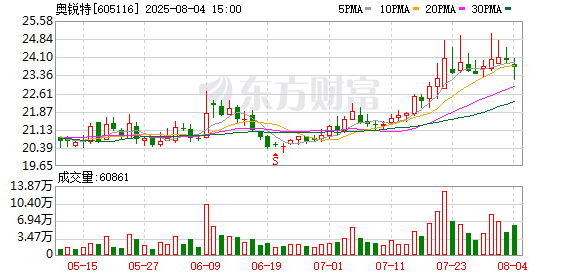
Group 1 - The company Aorite (SH 605116, closing price: 23.69 CNY) announced on August 4 that as of July 31, 2025, it has repurchased a total of 1.4142 million shares through the Shanghai Stock Exchange trading system, accounting for 0.35% of the current total share capital, with a total expenditure of approximately 28.22 million CNY [2] - The highest repurchase price was 21.3 CNY per share, while the lowest was 18.83 CNY per share [2] Group 2 - For the year 2024, the revenue composition of Aorite is as follows: self-produced raw materials and intermediates accounted for 77.29%, formulations accounted for 14.91%, trade accounted for 7.55%, and other businesses accounted for 0.25% [2]

西部证券晨会纪要-20250804
Western Securities· 2025-08-04 05:17
Group 1: Chemical Industry Insights - The report highlights that the chemical industry is expected to benefit from policies aimed at addressing "involution," potentially leading to higher-than-expected profitability [6][7]. - The current valuation and profitability of the chemical sector are at historical lows, creating opportunities for profit recovery driven by policy changes [6][7]. - Recommended companies with safety margins include Boyuan Chemical, Longbai Group, Tongkun Co., Hualu Hengsheng, and Yuntu Holdings, among others [6][8]. Group 2: Pharmaceutical Company Analysis - The report on Puluo Pharmaceutical indicates that the company is entering a growth phase for its CDMO business, with significant project growth and advanced capacity construction [10][11]. - Revenue projections for Puluo Pharmaceutical are set at 10.26 billion, 11.27 billion, and 12.52 billion yuan for 2025-2027, with net profit expected to grow by 2.1%, 25.5%, and 24.2% respectively [10][11]. - The company is leveraging its integrated raw material and formulation advantages to expand its formulation business rapidly, benefiting from centralized production and cost efficiencies [11]. Group 3: Computer Industry Performance - Hikvision's half-year report shows resilience with revenue of 41.82 billion yuan in H1 2025, reflecting a year-on-year increase of 1.48% [13][14]. - The company is experiencing pressure in its domestic business while its overseas and innovative segments are showing good growth, particularly in the Middle East and Africa [13][14]. - Future revenue projections for Hikvision are optimistic, with expected revenues of 95.86 billion, 102.28 billion, and 110.64 billion yuan for 2025-2027 [15]. Group 4: Macro Economic Observations - The report discusses the potential for the Federal Reserve to lower interest rates in September, influenced by recent economic data indicating a slowdown in U.S. demand [17][19]. - Key indicators such as retail sales and manufacturing output have shown signs of weakness, suggesting a cooling labor market and reduced economic momentum [18][19]. - The overall economic environment is characterized by moderate inflation and strong consumer resilience, which may affect the urgency of rate cuts [17][19].
破发股亨迪药业1年1期净利连降 2021年上市募15.48亿
Zhong Guo Jing Ji Wang· 2025-08-03 06:57
Core Viewpoint - Hendi Pharmaceutical (301211.SZ) reported a decline in revenue and net profit for the first half of 2025, indicating ongoing financial challenges for the company [1] Financial Performance - For the first half of 2025, the company achieved operating revenue of 235 million yuan, a year-on-year decrease of 2.93% [1] - The net profit attributable to shareholders was 18.55 million yuan, down 72.92% year-on-year [1] - The net profit after deducting non-recurring gains and losses was 4.42 million yuan, a decline of 93.21% year-on-year [1] - The net cash flow from operating activities was 8.40 million yuan, down 73.71% year-on-year [1] - In 2024, the company reported operating revenue of 446 million yuan, a decrease of 32.75% year-on-year [1] - The net profit attributable to shareholders for 2024 was 91.55 million yuan, down 48.02% year-on-year [1] - The net profit after deducting non-recurring gains and losses for 2024 was 72.95 million yuan, a decline of 57.14% year-on-year [1] - The net cash flow from operating activities for 2024 was 96.07 million yuan, down 29.91% year-on-year [1] IPO and Fundraising - The total amount raised from the initial public offering (IPO) was 1.548 billion yuan, with a net amount of 1.401 billion yuan, exceeding the original target by 210 million yuan [2] - The company initially planned to raise 1.19 billion yuan for various projects, including the production of ibuprofen and other active pharmaceutical ingredients [2] - The IPO expenses amounted to 147 million yuan, with underwriting fees of 132 million yuan [2] Stock Actions - On May 24, 2023, the company announced a stock bonus plan of 2 shares for every 10 shares held, along with a pre-tax dividend of 4 yuan [3] - On August 1, 2025, the company announced a new stock bonus plan of 4.5 shares for every 10 shares held [4]
原料药上市公司董秘PK:新天地谢雨珊、东亚药业周剑波、欧康医药曹永强年薪不足20万远低于行业均值
Xin Lang Cai Jing· 2025-08-01 06:12
Core Insights - The report highlights that in 2024, the total salary for A-share listed company secretaries reached 4.086 billion yuan, with an average annual salary of 708,000 yuan [1] - A total of 1,144 company secretaries earned over 1 million yuan, accounting for more than 21% of the total [1] Salary Distribution - The average annual salary for company secretaries in the A-share raw material pharmaceutical sector is 608,400 yuan [2] - The distribution of salaries shows that 49% earn below 500,000 yuan, 40% earn between 500,000 and 1 million yuan, and 11% earn above 1 million yuan [2] - The top five highest-paid company secretaries have annual salaries of 1.9309 million yuan, 1.514 million yuan, 1.2 million yuan, 1.17 million yuan, and 1.1 million yuan respectively [2] Age and Education Distribution - Company secretaries aged between 30 and 50 constitute 60% of the market, while those over 50 account for 38%, and those aged 30 or below make up 2% [1] - More than half of the company secretaries hold a bachelor's degree, with 9% having an associate degree, 52% a bachelor's degree, and 39% a master's degree [1] Investor Engagement - There is significant variation in the number of investor meetings held by companies, with 43% of companies hosting fewer than 10 meetings annually [2] - The top five companies with the most investor meetings conducted 520, 437, 325, 323, and 291 meetings respectively [3]