日用品

Search documents
广州净护日用品有限公司成立 注册资本3万人民币
Sou Hu Cai Jing· 2025-08-31 11:18
Group 1 - Guangzhou Jinghu Daily Necessities Co., Ltd. has been established with a registered capital of 30,000 RMB [1] - The company's business scope includes the sale of maternal and infant products, outdoor products, sanitary ware, and various daily necessities [1] - The company is also involved in internet sales, office equipment consumables, cosmetics retail, and sports equipment retail [1]
临沂商城价格指数分析(8月21日—8月27日)
Zhong Guo Fa Zhan Wang· 2025-08-29 06:59
Core Viewpoint - The overall price index in Linyi Mall has decreased slightly, indicating mixed trends across various product categories, with some experiencing price increases while others face declines [1]. Price Index Summary - The total weekly price index for Linyi Mall is 102.32 points, down 0.25 points or 0.25% from the previous week [1]. Categories with Price Increases - **Lighting Products**: The weekly price index for lighting products rose to 104.44 points, up 0.08 points, driven by increases in home, commercial, outdoor lighting, and accessories [1]. - **Home Appliances and Audio-Visual Equipment**: This category's index reached 103.21 points, up 0.07 points, primarily due to rising prices in refrigeration appliances, with air conditioners and refrigerators showing notable price fluctuations [2]. - **Daily Necessities**: The index for daily necessities increased to 102.77 points, up 0.04 points, with strong demand for luggage and jewelry contributing to the price rise [3]. Categories with Price Decreases - **Steel Products**: The weekly price index for steel products fell to 96.35 points, down 1.77 points, as demand weakened in the construction sector and prices followed the downward trend in the futures market [4]. - **Building and Decoration Materials**: This category's index decreased to 105.29 points, down 0.03 points, influenced by lower raw material prices and promotional discounts despite increased sales of waterproof materials [5]. - **Educational and Office Supplies**: The index for educational and office supplies dropped to 109.15 points, down 0.02 points, with a mixed performance in cultural and sports supplies as the market prepares for the school season [6].


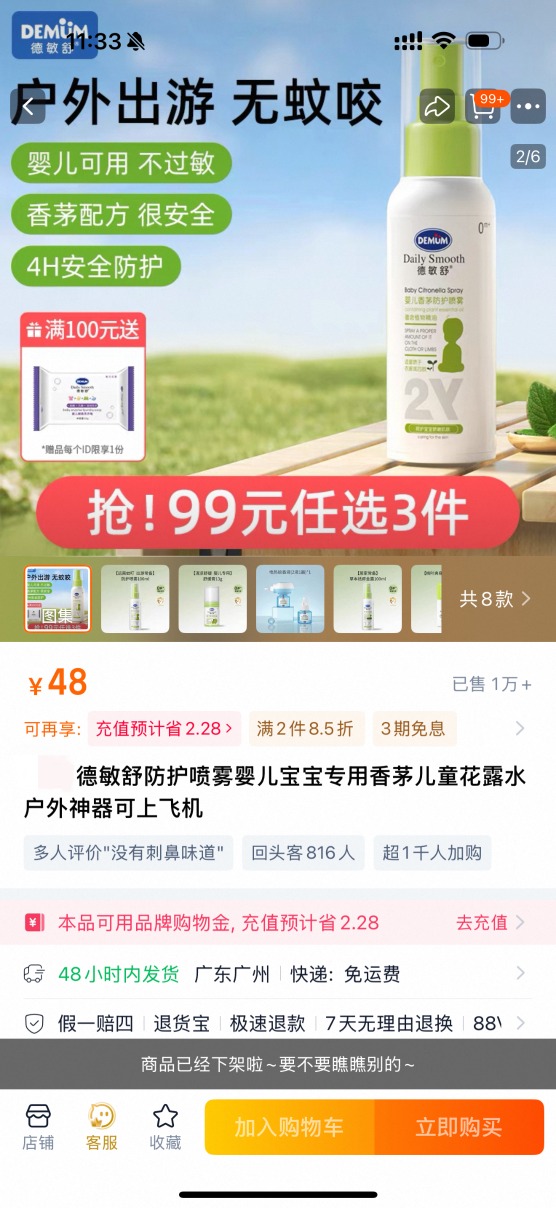
驱蚊产品调查追踪:德敏舒一喷雾已下架 swekp精油贴被立案
Xin Jing Bao· 2025-08-29 06:06
Core Viewpoint - Recent reports highlight issues regarding the unlicensed sale of certain mosquito repellent products, leading to investigations and product removals from online platforms [1][4]. Group 1: Product Issues - The "Deminshu Baby Lemongrass Protection Spray" has been removed from the "Deminshu Flagship Store" on an e-commerce platform [4]. - The product claimed to provide mosquito protection but lacked necessary pesticide registration and labeling, which is required for products making such claims [4][5]. - The "swekp Plant Essential Oil Bead Patch" is under investigation for similar issues, as it also lacks pesticide registration while claiming to repel mosquitoes [6][7]. Group 2: Regulatory Actions - The Jiangsu Province market supervision authority has initiated an investigation into the "swekp Plant Essential Oil Bead Patch" for its unlicensed claims [1][6]. - The Guangzhou Market Supervision Administration clarified that products claiming mosquito repellent functions fall under pesticide regulations, necessitating proper registration and labeling [4][6]. - Reports indicate that both the "Deminshu" and "swekp" products are being scrutinized for potential false advertising and regulatory evasion [5][7]. Group 3: Company Responses - The distributor of the "Deminshu Baby Lemongrass Protection Spray" and the manufacturer have not responded to inquiries regarding product compliance and advertising practices [5]. - The manufacturer of the "swekp Plant Essential Oil Bead Patch" stated it is a brand OEM and is not the seller, indicating a potential shift in responsibility for compliance [7]. - Both companies involved in the "swekp" product have been listed in the business anomaly record for failing to comply with reporting regulations [7].
汕头市爱优汇生活用品有限公司成立 注册资本10万人民币
Sou Hu Cai Jing· 2025-08-29 05:41
Group 1 - A new company, Shantou Aiyouhui Daily Necessities Co., Ltd., has been established with a registered capital of 100,000 RMB [1] - The company's business scope includes manufacturing plastic products, rubber products, and metal daily necessities, as well as providing information technology consulting services [1] - The company also engages in the wholesale and retail of various daily necessities, including kitchenware, office supplies, and household appliances [1] Group 2 - The company is involved in the sales of non-medical masks, pet food and supplies, and offers intellectual property services [1] - The establishment of this company reflects the growing demand for diverse consumer goods and services in the daily necessities sector [1] - The wide range of products and services indicates a strategic approach to capture multiple market segments [1]
合肥义蕴日用品有限公司成立 注册资本20万人民币
Sou Hu Cai Jing· 2025-08-28 01:41
Core Viewpoint - Hefei Yiyun Daily Necessities Co., Ltd. has been established with a registered capital of 200,000 RMB, indicating a new player in the daily necessities market [1] Company Summary - The legal representative of Hefei Yiyun Daily Necessities Co., Ltd. is Tao Yiyun [1] - The company is engaged in a variety of business activities including the sale and wholesale of daily necessities, household goods, and second-hand daily goods [1] - The company also sells non-medical daily masks, plastic products, and maternal and infant products, among other items [1]
长沙里物科技有限公司成立 注册资本10万人民币
Sou Hu Cai Jing· 2025-08-27 05:22
Group 1 - A new company, Changsha Liwu Technology Co., Ltd., has been established with a registered capital of 100,000 RMB [1] - The legal representative of the company is Tan Lei [1] - The business scope includes sales of various products such as food detergents, daily chemical products, cosmetics, and personal hygiene products, as well as specialized cleaning and disinfection services [1] Group 2 - The company is also involved in the research and development of IoT technology, clothing, and household appliances [1] - The operations are conducted independently based on the business license, except for projects that require approval [1]
广州市强胜包装材料有限公司成立 注册资本100万人民币
Sou Hu Cai Jing· 2025-08-26 05:46
Core Viewpoint - Guangzhou Qiangsheng Packaging Materials Co., Ltd. has been established with a registered capital of 1 million RMB, indicating a new player in the packaging materials industry [1] Company Summary - The company is engaged in a wide range of activities including domestic trade agency, sales of daily necessities, and sales of packaging specialized equipment [1] - It also involves wholesale of electronic components, sales of metal chains and other metal products, and sales of electrical facilities and electronic components [1] - The company is involved in the sales and manufacturing of various wood products, including cork products and wooden containers, as well as wood processing and acquisition [1] Industry Summary - The establishment of this company reflects ongoing growth and diversification in the packaging materials sector, with a focus on both traditional and new materials [1] - The wide range of services and products offered suggests a comprehensive approach to meet various market demands in the packaging and materials industry [1]
东莞市巧兮日用品有限公司成立 注册资本10万人民币
Sou Hu Cai Jing· 2025-08-26 05:17
Group 1 - Dongguan Qiaoxi Daily Necessities Co., Ltd. has been established with a registered capital of 100,000 RMB [1] - The legal representative of the company is Chen Mingjun [1] - The business scope includes wholesale and retail of kitchenware, daily necessities, clothing, and various other consumer goods [1] Group 2 - The company is also involved in the sale of personal hygiene products, office supplies, outdoor products, and electronic products [1] - Additional services offered include professional cleaning, disinfection, and housekeeping services [1] - The company provides intellectual property services, excluding patent agency services, and trademark agency services [1]
昌南新区祥晟陶瓷店(个体工商户)成立 注册资本10万人民币
Sou Hu Cai Jing· 2025-08-26 03:24
Core Viewpoint - The establishment of Changnan New District Xiangsheng Ceramic Store indicates a growing interest in the ceramics market, with a diverse range of products and services being offered [1] Company Summary - The newly established Xiangsheng Ceramic Store is registered with a capital of 100,000 RMB [1] - The legal representative of the store is Luo Jiao [1] - The store's business scope includes sales of daily ceramic products, non-metallic minerals and products, tea sets, daily necessities, arts and crafts, jewelry retail, office supplies, and internet sales among others [1] Industry Summary - The store's operations encompass a wide variety of categories, including but not limited to: - Daily ceramic products sales - Non-metallic minerals and products sales - Kitchenware and sanitary ware wholesale - Cultural and artistic exchange activities organization - Food sales (only pre-packaged food) [1] - The inclusion of internet sales and marketing planning indicates a trend towards digitalization in the ceramics and related industries [1]
稳健医疗:全棉时代将从多方面推进棉柔巾业务
Zheng Quan Ri Bao Wang· 2025-08-25 11:42
Core Viewpoint - The company, Stable Medical, is optimistic about the growth potential of its cotton soft towel business, driven by consumer preference for 100% cotton products over synthetic materials, and plans to enhance product offerings and channel strategies to achieve high growth in the second half of the year [1] Product Strategy - The company will focus on using 100% cotton as raw material without adding chemical fibers, aiming to upgrade the product experience around "softness" [1] - New product launches include adult cream facial towels and upgraded classic cotton soft towels, which have improved softness by 45% without softeners [1] - The company plans to introduce differentiated packaging products that emphasize emotional value in the second half of the year [1] Market Expansion - The company aims to expand its product range to meet diverse consumer needs, including beauty and personal care applications, with packaging upgrades for various usage scenarios [1] - The company will explore new market segments by developing products tailored to different demographics and preferences [1] Channel Strategy - In response to the slowdown in traditional e-commerce growth, the company will embrace high-growth channels such as interest e-commerce and instant retail (O2O delivery economy) [1] - The company is committed to strengthening its channel construction to enhance market reach [1] Growth Confidence - The company expresses strong confidence in restoring high growth for its cotton soft towel business in the second half of the year through product innovation, new product promotion, and channel development [1]