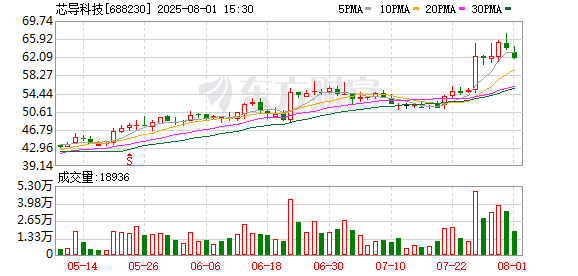
功率半导体

Search documents
宏微科技携手瀚海聚能 国产IGBT首次进军可控核聚变核心环节
Zheng Quan Shi Bao Wang· 2025-08-05 13:52
Group 1 - The core viewpoint of the news is the strategic collaboration between Hongwei Technology and Hanhai Juneng to advance the application of domestic IGBT power modules in controlled nuclear fusion experiments, marking a significant step towards the commercialization of fusion energy in China [1][4][5] - The global nuclear fusion commercialization process is accelerating, with significant investments and plans from various countries, including China, which aims to establish a fusion engineering experimental reactor by 2025 and a commercial demonstration power plant by 2050 [2][3] - Hanhai Juneng, established in 2022, is a representative of innovative enterprises exploring the commercialization of fusion energy, having successfully developed China's first commercial linear field reversed configuration (FRC) fusion device, HHMAX-901 [3][4] Group 2 - Hongwei Technology will provide customized IGBT power modules for the core pulse power system of Hanhai Juneng's HHMAX series devices, which are crucial for generating and maintaining plasma [4][5] - The collaboration signifies the entry of domestic power semiconductor devices into the core aspects of controlled nuclear fusion, showcasing the potential for domestic alternatives in high-power IGBT technology, which has traditionally been dominated by foreign companies [5][6] - The partnership reflects a trend where Chinese manufacturing enterprises are increasingly integrating into advanced energy technology systems, potentially accelerating breakthroughs in fusion power systems and establishing a self-controlled future energy industry chain [6]

晶能:车规级SiC模块连续多月交付量超万套,上车极氪全系产品
Ren Min Wang· 2025-08-05 07:31
Core Insights - Zhejiang Jingneng Microelectronics Co., Ltd. has achieved a continuous monthly delivery of over 10,000 automotive-grade SiC modules, supporting the "power chip" needs of the Zeekr product line [2] - The company is extending its third-generation semiconductor technology into eVTOL and embodied intelligent robotics industries while consolidating its advantages in the electric vehicle sector [2] - Jingneng is actively exploring diversified application scenarios, with significant growth in markets such as electric two-wheelers, industrial control, and charging stations through various discrete devices like SGT, IGBT, super junction MOS, and SiC MOS [2] Strategic Partnerships and Developments - Jingneng has established a joint venture, Taixin Semiconductor, with Chint to integrate industry chain advantages and expand into new fields such as photovoltaics, energy storage, and next-generation switches [2] - The company is strategically collaborating with leading firms in emerging industries, including WoFei ChangKong and YiXing Robotics, to develop innovative system solutions [2] Industry Trends and Future Outlook - The power semiconductor industry is undergoing a rapid transformation, driven by the unstoppable wave of artificial intelligence [2] - The company aims to balance technological innovation with practical application, continuously optimizing product performance and enhancing scenario application innovation to provide valuable solutions for clients [2]

这家公司理财占净利“半壁江山”!现要重大资产重组!
Guo Ji Jin Rong Bao· 2025-08-05 06:27
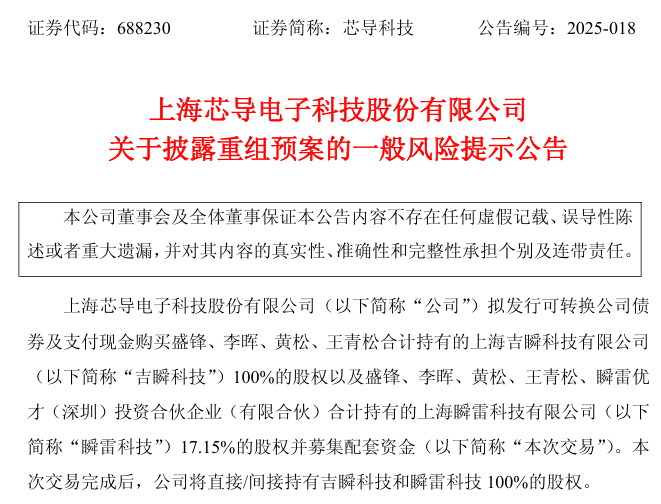
Core Viewpoint - The company, Shanghai Chip导 Technology Co., Ltd. (688230.SH), announced a restructuring plan to acquire 100% of Shanghai Jishun Technology Co., Ltd. and 17.15% of Shanghai Shunlei Technology Co., Ltd. for a total price of 402.6 million yuan, marking its first major asset restructuring since its IPO [1][3]. Group 1: Acquisition Details - The company plans to issue convertible bonds and pay cash to fund the acquisition, with an additional fundraising of up to 50 million yuan for transaction costs [1]. - After the transaction, the company will hold 100% of the equity in both Jishun Technology and Shunlei Technology [1]. - Jishun Technology is the controlling shareholder of Shunlei Technology, which focuses on the research, production, and sales of power devices, including automotive-grade and industrial-grade power semiconductor products [2][3]. Group 2: Financial Performance - The target companies are projected to generate revenues of 195 million yuan, 217 million yuan, and 104 million yuan for the years 2023, 2024, and the first half of 2025, respectively, with net profits of 25.26 million yuan, 38.79 million yuan, and 18.61 million yuan [3]. - The transferor has committed to achieving audited net profits of no less than 35 million yuan, 36.5 million yuan, and 40 million yuan for the years 2025 to 2027 [3]. - The company has experienced a decline in revenue since its IPO in 2021, with a 29.33% decrease in 2022 and a 4.68% decrease in 2023 [5][6]. Group 3: Strategic Rationale - The acquisition is expected to enhance the company's performance and market presence, allowing it to leverage Shunlei Technology's established customer base in various sectors, including automotive electronics and industrial applications [3][4]. - The company has relied heavily on investment income for its net profits since 2022, with investment returns accounting for a significant portion of its earnings [7].

15亿“闲钱”傍身仍再融资,芯导科技并购谋扩张|并购一线
Sou Hu Cai Jing· 2025-08-05 01:25
Group 1 - The core point of the article is that Chipway Technology (688230.SH) plans to acquire 100% control of Shunlei Technology through a combination of cash and convertible bonds, marking a significant asset restructuring move aimed at expanding into the automotive electronics market from its current focus on consumer electronics [2][8] - The acquisition price is set at 402.6 million, while the company has 1.5 billion in idle funds from its initial public offering, raising questions about the need for refinancing tools despite having sufficient cash reserves [3][6] - The company has delayed the completion of its initial fundraising projects to December 2026, resulting in only 140 million being invested in these projects over three years, indicating a slow utilization of raised funds [6][8] Group 2 - The acquisition aligns with the company's strategy to focus on high-growth areas such as automotive electronics, which is seen as a key growth market for power semiconductor companies [7][8] - Shunlei Technology, like Chipway Technology, operates in the power semiconductor sector and has a diverse customer base, although it has not progressed towards its planned IPO since 2020 [9] - The acquisition is expected to enhance Chipway Technology's supply chain management and production capabilities, as Shunlei Technology possesses its own wafer and packaging production lines, which Chipway has previously outsourced [11]
并购重组市场活跃度提升
Zhong Guo Zheng Quan Bao· 2025-08-04 21:06
Core Viewpoint - The Chinese government is signaling strong support for mergers and acquisitions (M&A) and restructuring in the market, emphasizing the need for listed companies to enhance investment value and implement management measures for significant asset restructuring [1] Group 1: Accelerated Professional Integration - A-share listed companies are actively engaging in M&A and restructuring focused on their core businesses, reflecting an accelerated trend of professional integration [1] - China Shenhua has initiated a large-scale asset restructuring, planning to integrate 13 core coal and related industry entities, which will fundamentally improve the overlap issues with its controlling shareholder, the State Energy Group [1] Group 2: Traditional and Emerging Industries - M&A activities are occurring across both traditional and emerging industries, with significant interest in sectors like semiconductors and high-end manufacturing [2] - Notable transactions include Chipone Technology's acquisition of a 72.33% stake in Chipone Yuzhou and Northern Huachuang's acquisition of Chip Source Micro, aimed at enhancing their semiconductor equipment industry chain [2] - High-tech companies, often in early loss stages but with substantial growth potential, are being targeted by mature firms for M&A to facilitate technology upgrades and industry transformation [2] Group 3: Diverse M&A Forms - The implementation of the "Six Guidelines for M&A" has led to a more diversified approach in M&A forms, including absorption mergers, private placements, and asset swaps [3] - Absorption mergers are particularly encouraged, with new regulations establishing simplified review processes for such transactions, thereby unlocking potential in this area [3] Group 4: Institutional Participation - The recent amendments to the Major Asset Restructuring Management Measures are expected to increase private equity fund participation in M&A activities, enhancing institutional capabilities in post-investment empowerment and resource integration [4]



688230,重大资产重组!不停牌
Zheng Quan Shi Bao· 2025-08-04 00:33
Core Viewpoint - The semiconductor sector is witnessing a significant asset restructuring, with Chipway Technology planning to acquire 100% of Jishun Technology and 17.15% of Shunlei Technology, aiming for full control of Shunlei Technology [1][5]. Group 1: Transaction Details - The transaction price for the target assets is tentatively set at 402.6 million yuan, comprising a cash payment of 126.54 million yuan and convertible bonds worth 276.06 million yuan [3][4]. - The company plans to raise no more than 50 million yuan in matching funds, which will not exceed 100% of the transaction price and will involve issuing shares to no more than 35 specific investors [4]. Group 2: Financial Performance - Chipway Technology reported a revenue of 353 million yuan for 2024, a year-on-year increase of 10.15%, and a net profit of 117 million yuan, up 15.70% from the previous year [5]. - Shunlei Technology achieved a revenue of 217 million yuan and a net profit of 38.79 million yuan in 2024, both showing growth [6]. Group 3: Strategic Implications - The acquisition will allow Chipway Technology to leverage Shunlei Technology's customer resources to enter various sectors, including automotive electronics and industrial applications, enhancing market synergy [5][6]. - Shunlei Technology's established wafer and packaging production lines will help Chipway Technology improve supply chain management and increase production capacity [7].
688230,重大资产重组!不停牌!
Zheng Quan Shi Bao· 2025-08-04 00:22
Core Viewpoint - The semiconductor sector is witnessing a significant asset restructuring, with ChipGuide Technology planning to acquire 100% of Jishun Technology and 17.15% of Shunlei Technology, aiming for full control of Shunlei Technology [1][5]. Group 1: Transaction Details - The transaction price for the assets is tentatively set at 402.6 million yuan, comprising a cash payment of 126.54 million yuan and convertible bonds worth 276.06 million yuan [3][4]. - The company plans to raise no more than 50 million yuan in matching funds, which will not exceed 100% of the transaction price and will involve issuing shares to no more than 35 specific investors [4]. Group 2: Financial Performance - ChipGuide Technology reported a revenue of 353 million yuan for 2024, a year-on-year increase of 10.15%, and a net profit of 117 million yuan, up 15.70% from the previous year [5]. - Shunlei Technology achieved a revenue of 217 million yuan and a net profit of 38.79 million yuan in 2024, both showing growth [6]. Group 3: Strategic Implications - The acquisition will allow ChipGuide Technology to leverage Shunlei Technology's customer resources to enter various sectors, including automotive electronics and security instruments, enhancing market synergy [5][6]. - Shunlei Technology's established wafer and packaging production lines will help ChipGuide Technology improve supply chain management and increase production capacity [7].
688230,重大资产重组!不停牌!
证券时报· 2025-08-04 00:21
Core Viewpoint - The article discusses a significant asset restructuring in the semiconductor sector, where ChipGuide Technology plans to acquire 100% of Jishun Technology and 17.15% of Shunlei Technology, aiming for full control of Shunlei Technology through a combination of cash and convertible bonds [1][5]. Group 1: Transaction Details - The total transaction price for the assets is set at 402.6 million yuan, with cash payment of 126.54 million yuan and convertible bond payment of 276.06 million yuan [3][4]. - The company plans to raise up to 50 million yuan through a private placement, which will not exceed 30% of the total share capital before the transaction [4]. Group 2: Financial Performance - ChipGuide Technology reported a revenue of 353 million yuan in 2024, a 10.15% increase year-on-year, and a net profit of 117 million yuan, up 15.70% [5]. - Shunlei Technology achieved a revenue of 217 million yuan and a net profit of 38.79 million yuan in 2024, both showing growth [6]. Group 3: Strategic Implications - The acquisition allows ChipGuide Technology to leverage Shunlei Technology's customer base in automotive electronics and other sectors, enhancing market synergy [5][6]. - The transaction is expected to increase the total assets and revenue of ChipGuide Technology, strengthening its operational capabilities [7].

芯导科技拟4.03亿元收购瞬雷科技100%股权,完善功率半导体产业链布局
Sou Hu Cai Jing· 2025-08-03 15:58
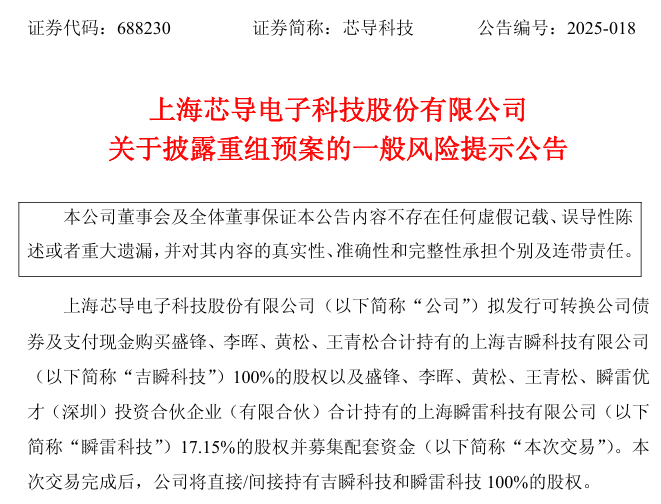
Group 1 - The core point of the article is that Xindao Technology (688230) announced a major asset restructuring plan to acquire 100% equity of Jishun Technology and 17.15% equity of Shunlei Technology for a total transaction price of 403 million yuan [1][3] - The restructuring involves issuing convertible bonds and cash payments to various stakeholders including Shengfeng, Li Hui, Huang Song, Wang Qingsong, and Shunlei Youcai (Shenzhen) Investment Partnership [3] - The acquisition will allow Xindao Technology to gain complete control over Shunlei Technology, which specializes in the research, production, and sales of power semiconductor devices [3] Group 2 - The strategic significance of the acquisition lies in the high business synergy between Xindao Technology and the target companies, both of which operate in the power semiconductor sector [4] - Shunlei Technology has a comprehensive product layout with hundreds of product models, providing a full range of circuit protection solutions, which will complement Xindao Technology's product lines [4] - The acquisition will enable Xindao Technology to leverage Shunlei Technology's customer resources to enter various application fields such as automotive electronics, security instruments, and industrial markets [4]

688230,拟重大资产重组
Zhong Guo Zheng Quan Bao· 2025-08-03 14:40
Group 1 - The company plans to issue convertible bonds and pay cash to acquire 100% equity of Jishun Technology and 17.15% equity of Shunlei Technology, aiming for full control of Shunlei Technology [2][4] - The transaction price is tentatively set at 402.6 million yuan, with cash consideration of 126.54 million yuan and convertible bond consideration of 276.06 million yuan [3][4] - The company intends to raise up to 50 million yuan in supporting funds, which will be used for part of the cash consideration and intermediary fees related to the transaction [4] Group 2 - The target company, Shunlei Technology, specializes in the research, production, and sales of power devices, while Jishun Technology holds 82.85% of Shunlei Technology's shares [5] - The company reported a revenue of approximately 353 million yuan in 2024, a year-on-year increase of 10.15%, and a net profit of about 112 million yuan, up 15.7% [7] - The target company and the listed company both operate in the power semiconductor sector, providing a high degree of business synergy [8]