水泥

Search documents
2025年中国水泥产量为16.9亿吨 累计下降6.9%
Chan Ye Xin Xi Wang· 2026-01-28 03:35
2020-2025年中国水泥产量统计图 上市企业:青松建化(600425),金隅集团(601992),四川金顶(600678),福建水泥(600802),上峰水 泥(000672),祁连山(600720),冀东水泥(000401),华新水泥(600801),天山股份(000877),海螺 水泥(600585) 相关报告:智研咨询发布的《2026-2032年中国水泥行业市场运行格局及发展策略分析报告》 根据国家统计局数据显示:2025年12月中国水泥产量为1.4亿吨,同比下降6.6%;2025年中国水泥累计 产量为16.9亿吨,累计下降6.9%。 数据来源:国家统计局,智研咨询整理 知前沿,问智研。智研咨询是中国一流产业咨询机构,十数年持续深耕产业研究领域,提供深度产业研 究报告、商业计划书、可行性研究报告及定制服务等一站式产业咨询服务。专业的角度、品质化的服 务、敏锐的市场洞察力,专注于提供完善的产业解决方案,为您的投资决策赋能。 ...


工业转型规模化:2025年高排放行业与净零转型进展
Zhong Guo Yin He Zheng Quan· 2026-01-28 03:24
Group 1: Industrial Transition Overview - The report highlights that global industrial transition is entering a decisive phase by 2025, with a clear decarbonization path established[3] - The focus has shifted from "can emissions be reduced" to "how to achieve large-scale reductions at acceptable costs"[6] - In 2024, global CO2 emissions are projected to reach 3.82 billion tons, marking a historical high with a year-on-year increase of 0.9%[8] Group 2: Key Challenges - Five core constraints identified include technology deployment pace differences, insufficient low-carbon demand, fragmented policies, infrastructure gaps, and uneven capital allocation[4] - Approximately 50% of industrial emissions can be reduced using existing mature technologies, while the remaining emissions rely on advanced technologies like hydrogen and CCUS[6] - The rising interest rates are expected to increase the costs of wind and solar energy by approximately 30%[6] Group 3: Sector-Specific Insights - In 2024, the aviation sector is expected to see a 10.4% increase in operational activity, contributing 1.108 billion tons of CO2 emissions, a 6.4% rise from the previous year[8] - The cement and steel industries are projected to experience slight decreases in emissions, while sectors like aviation and aluminum will see significant increases[8] Group 4: Policy and Economic Environment - The global industrial transition exhibits significant regional differentiation, with the EU leading compliance, the US balancing incentives and compliance, and emerging markets developing frameworks[14] - The economic environment is characterized by rising interest rates and cost inflation, which elevate the economic feasibility threshold for low-carbon projects[15] Group 5: Recommendations for Scaling Transition - The report suggests five strategic actions to promote large-scale transition: standardizing demand mechanisms, accelerating shared infrastructure construction, optimizing financing costs, prioritizing mature technology deployment, and enhancing policy and innovation collaboration[23]
报告点评:工业转型规模化:2025年高排放行业与净零转型进展
Yin He Zheng Quan· 2026-01-28 02:55
Group 1: Industrial Transition Overview - The report highlights that global industrial transition is entering a decisive phase by 2025, with a clear decarbonization path established[3] - Approximately 50% of industrial emissions can be reduced using existing mature technologies, while the remaining emissions rely on deep innovation and large-scale application of frontier technologies like hydrogen and CCUS[6] - In 2024, global CO2 emissions are projected to reach 38.2 billion tons, marking a historical high with a year-on-year increase of 0.9%, where high-emission industries contribute nearly 40% of the emission growth[8] Group 2: Key Challenges - The core challenges for high-emission industries have shifted from technical feasibility to economic feasibility and system coordination for large-scale deployment[4] - Five main constraints identified include: technology deployment pace differences, insufficient low-carbon demand, fragmented policies, infrastructure gaps, and uneven capital allocation[4] - The rise in interest rates and cost inflation has increased the economic viability threshold for low-carbon projects, making financing and policy coordination critical for project implementation[15] Group 3: Sector-Specific Insights - In the aviation sector, operational activity is expected to grow by 10.4% in 2024, with emissions increasing to 1.108 billion tons, a rise of 6.4%[8] - The shipping industry will see a 5.5% increase in operational activity, with emissions reaching 0.847 billion tons, up by 2.7%[8] - The cement and steel industries are projected to experience slight decreases in emissions, while sectors like aluminum and basic chemicals will see significant increases in emissions[8] Group 4: Policy and Economic Environment - The global industrial transition exhibits significant regional differentiation, with the EU leading compliance, the US balancing incentives and compliance, and emerging markets developing frameworks[14] - The EU's carbon market is expected to cover over 45% of industrial emissions by 2030, while the US faces policy volatility affecting corporate decision-making[14] - Emerging markets like China and India are accelerating carbon accounting systems, but face challenges in policy maturity and infrastructure development[14] Group 5: Recommendations for Scaling Transition - Establish standardized low-carbon demand mechanisms to enhance the credibility of demand signals and promote public procurement of low-carbon products[23] - Accelerate the construction of shared infrastructure, including integrated energy networks and CO2 transport pipelines, to support large-scale reductions[23] - Innovate financial tools to lower financing costs and support the scaling of frontier technologies like hydrogen and CCUS[24]
浙江尖峰集团股份有限公司2025年年度业绩预告
Xin Lang Cai Jing· 2026-01-27 19:59
Core Viewpoint - Zhejiang Jianfeng Group Co., Ltd. anticipates a significant increase in net profit for the year 2025, while also forecasting a substantial decrease in net profit after excluding non-recurring gains [2][4]. Group 1: Performance Forecast - The company expects to achieve a net profit attributable to shareholders of approximately 460 million yuan for the year 2025, representing an increase of about 352.01 million yuan, or 325.97% compared to the previous year [2][4]. - The forecasted net profit attributable to shareholders after excluding non-recurring gains is approximately -215 million yuan, indicating a decrease of about 311.62 million yuan, or 322.53% year-on-year [2][4]. Group 2: Previous Year Performance - In the previous year, the total profit was approximately 201.20 million yuan, with a net profit attributable to shareholders of about 107.99 million yuan, and a net profit after excluding non-recurring gains of approximately 96.62 million yuan [6]. Group 3: Reasons for Performance Changes - The significant increase in net profit is primarily due to the equity method accounting for Tian Shili Biological Pharmaceutical Industry Group Co., Ltd., which sold its equity assets, resulting in substantial non-recurring gains [8]. - The decrease in net profit after excluding non-recurring gains is attributed to reduced demand in the cement industry and declining prices and sales in the pharmaceutical sector, influenced by policies such as drug procurement and price reductions [9][10].

上峰水泥:公司不存在逾期担保
Zheng Quan Ri Bao Wang· 2026-01-27 14:13
证券日报网讯1月27日,上峰水泥(000672)发布公告称,截至公告披露日,公司及其控股子公司对外 担保总额为511081.88万元,占公司2024年12月31日经审计净资产的57.11%,公司不存在逾期担保金额 或涉及诉讼的担保金额等情形。 ...

海螺水泥拟投500亿理财,专家建议回购股份更利股东
Bei Jing Shang Bao· 2026-01-27 13:47
因此,海螺水泥不妨重新审视其巨额理财计划,可以考虑将部分资金用于回购股份并注销,以实际行动 回应股东关切,实现公司与股东的共赢发展。这不仅是对股东负责的体现,也是公司实现长期可持续发 展的重要举措。 北京商报评论员 周科竞 (图源 意图网) 【#海螺水泥巨额理财计划不如回购股份#】#海螺水泥#近日发布了2026年度委托理财计划公告,其中, 结构性存款单日最高余额不超过300亿元,银行理财产品、收益凭证产品、资产管理计划单日最高余额 不超过200亿元。不过,对海螺水泥而言,把资金用于回购股份比购买理财产品对股东或许更加有利。 从海螺水泥2025年三季度报告数据看,公司每股净资产约35.93元,最新股价为23.69元,股价远低于每 股净资产值,这意味着公司股票在市场上存在被低估的可能。在此种情况下,海螺水泥若动用大额资金 进行股份回购,相当于以较低的价格买入自身优质资产。回购的股份可以注销,从而减少公司总股本, 在盈利不变的前提下,每股收益将得到提升,进而推动股价上涨,使股东所持股份的价值增加。这无疑 是对股东权益的直接维护和提升,比将资金投入理财产品获得收益更具吸引力。 从资金运用效率角度分析,购买理财产品虽然 ...

四川双马:公司生产经营平稳,各项业务按既定战略推进
Zheng Quan Ri Bao· 2026-01-27 13:41
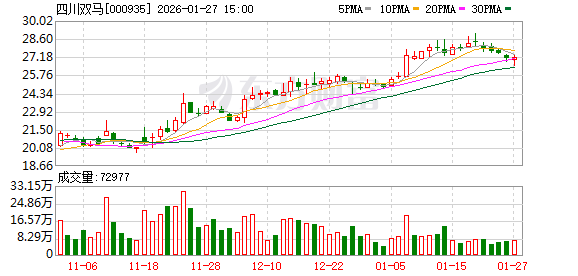
(文章来源:证券日报) 证券日报网讯 1月27日,四川双马在互动平台回答投资者提问时表示,公司信息披露遵循现行法律法规 与监管规定,信息披露工作规范有序、合规透明。目前公司生产经营平稳,各项业务均按既定战略扎实 推进。公司将持续聚焦核心业务,积极提升运营效能与资产质量,增强核心竞争力,努力为股东带来长 期且稳定的价值回报。 ...

侃股:海螺水泥巨额理财计划不如回购股份
Bei Jing Shang Bao· 2026-01-27 13:17
海螺水泥近日发布了2026年度委托理财计划公告,其中,结构性存款单日最高余额不超过300亿元,银 行理财产品、收益凭证产品、资产管理计划单日最高余额不超过200亿元。不过,对海螺水泥而言,把 资金用于回购股份比购买理财产品对股东或许更加有利。 从海螺水泥2025年三季度报告数据看,公司每股净资产约35.93元,最新股价为23.69元,股价远低于每 股净资产值,这意味着公司股票在市场上存在被低估的可能。在此种情况下,海螺水泥若动用大额资金 进行股份回购,相当于以较低的价格买入自身优质资产。回购的股份可以注销,从而减少公司总股本, 在盈利不变的前提下,每股收益将得到提升,进而推动股价上涨,使股东所持股份的价值增加。这无疑 是对股东权益的直接维护和提升,比将资金投入理财产品获得收益更具吸引力。 从资金运用效率角度分析,购买理财产品虽然能获得一定收益,但收益水平往往较为有限,且存在一定 的不确定性。而回购股份则是一种更为直接且高效的资金运用方式。通过回购,公司能够优化自身的资 本结构,增强公司的财务稳健性。 同时,回购股份可以向市场传递出海螺水泥对自身发展前景充满信心的积极信号,有助于提升市场对公 司的认可度和信任度 ...
上峰水泥:1月26日召开董事会会议
Sou Hu Cai Jing· 2026-01-27 09:57
Group 1 - The company announced that its 11th Board of Directors held its 12th meeting on January 26, 2026, via telecommunication voting [1] - The meeting reviewed the proposal regarding the company's external guarantee plan for the year 2026 [1] Group 2 - International gold prices have surpassed $5,000, marking a 280% increase over the past seven years [1] - Experts suggest that the future of gold prices will depend significantly on the U.S. dollar, with a focus on the international monetary system, interest rate cuts, and technological revolutions [1]
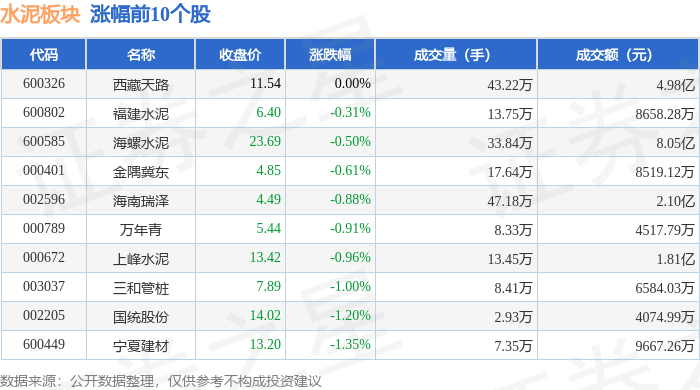
水泥板块1月27日跌1.21%,四方新材领跌,主力资金净流出2.88亿元
Zheng Xing Xing Ye Ri Bao· 2026-01-27 09:06
Market Overview - The cement sector experienced a decline of 1.21% on January 27, with Sifang New Material leading the drop [1] - The Shanghai Composite Index closed at 4139.9, up 0.18%, while the Shenzhen Component Index closed at 14329.91, up 0.09% [1] Individual Stock Performance - Sifang New Material (605122) closed at 13.55, down 3.76% with a trading volume of 63,000 shares and a turnover of 85.06 million yuan [2] - Other notable declines include Tianshan Co. (000877) down 2.46% and Xibu Construction (002302) down 2.42% [2] - The trading volume and turnover for major cement stocks are detailed in the provided tables, indicating varied performance across the sector [1][2] Capital Flow Analysis - The cement sector saw a net outflow of 288 million yuan from institutional investors, while retail investors contributed a net inflow of 246 million yuan [2] - The detailed capital flow for individual stocks shows varying levels of net inflow and outflow among different companies, with Dragon Spring Co. (002671) showing a net inflow from retail investors despite overall sector declines [3] - Sifang New Material experienced a net outflow of 82,500 yuan from institutional investors, indicating a lack of confidence among larger investors [3]