通用设备制造

Search documents
国家发改委:经济运行会很快回归正常轨道 下一步将抓紧谋划增量政策工具
Xin Hua Wang· 2025-08-12 06:26
Economic Outlook - The new wave of the pandemic and changes in the international situation have increased downward pressure on the economy, but effective handling of the domestic pandemic and proactive policy measures are expected to restore normal economic order quickly [1] Fixed Asset Investment - In the first four months of this year, the National Development and Reform Commission (NDRC) approved 38 fixed asset investment projects with a total investment of 533.3 billion yuan, showing a significant increase compared to 28 projects and 132.7 billion yuan in the same period last year [2][3] - The acceleration of project approvals is expected to support the growth of infrastructure investment [3] Economic Policy Measures - The NDRC plans to enhance the implementation of existing policies and accelerate the pace of new policy tools to expand domestic demand and effective investment [3] - There is an expectation of more frequent policy actions in the second and third quarters to achieve the annual economic growth target of 5.5% [3] Industrial Performance - The manufacturing sector, particularly the automotive, general equipment, pharmaceutical, and specialized equipment industries, faced significant declines in April, with year-on-year growth rates of -31.8%, -15.8%, -3.8%, and -5.5% respectively [4] - The main internal issues affecting economic performance include logistics bottlenecks, service sector restrictions, and ongoing declines in real estate investment [4] Supply Chain Stability - The NDRC is working to ensure smooth logistics and supply chain stability by improving transportation channels and monitoring risk [5][6] - Measures include guiding transportation in key regions, establishing material transfer stations, and enhancing risk monitoring systems [5][6] Foreign Investment - In the first four months of this year, actual foreign investment in China reached 74.47 billion USD, a year-on-year increase of 26.1% [7] - High-tech industries saw a significant increase in foreign investment, growing by 45.6%, while the central and western regions also experienced substantial growth [7] - The NDRC plans to implement policies to further encourage foreign investment, particularly in manufacturing and productive services [8]
阶段性缓缴社保费政策扩大到22个特困行业
Xin Hua Wang· 2025-08-12 06:26
通知要求,各省(区、市)要在确保各项社保待遇按时足额发放基础上制定具体实施办法,同时简 化办事流程,大力推行"网上办"等,方便企业办理。 【纠错】 【责任编辑:柴峥】 2022年5月26日,安徽省阜阳市太和县,一家服装企业工人生产出口到海外的服装。当地落实减税 降费、稳企用工等各项支持政策,进一步加大助企纾困力度。新华社发(梁孝鹏 摄) 通知提出,要进一步发挥失业保险稳岗作用。加大稳岗返还支持力度,将大型企业稳岗返还比例由 30%提至50%。拓宽一次性留工培训补助受益范围,由出现中高风险疫情地区的中小微企业扩大至该地 区的大型企业,有条件的省份可进一步拓展至未出现中高风险疫情地区的餐饮等5个特困行业企业。企 业招用毕业年度高校毕业生,签订劳动合同并参加失业保险的,可按每人不超过1500元的标准发放一次 性扩岗补助,实施期限截至2022年年底。 新华社北京5月31日电(记者姜琳)人社部等四部门5月31日发布《关于扩大阶段性缓缴社会保险费 政策实施范围等问题的通知》,将阶段性缓缴养老、失业、工伤保险费政策实施范围,在餐饮、零售、 旅游、民航、公路水路铁路运输等5个特困行业基础上,再增加汽车制造业、通用设备制造业等 ...
新筑股份股价下跌3.20% 上半年业绩预亏引关注
Jin Rong Jie· 2025-08-11 19:51
Group 1 - The stock price of Xinzhu Co., Ltd. is reported at 7.27 yuan, down 0.24 yuan or 3.20% from the previous trading day, with a trading volume of 2.24 billion yuan [1] - Xinzhu Co., Ltd. primarily engages in the manufacturing of bridge functional components and rail transit, with products including bridge bearings, expansion devices, and prestressed anchors, indicating its involvement in the infrastructure construction sector [1] - The latest earnings forecast indicates that Xinzhu Co., Ltd. expects a net loss attributable to shareholders in the first half of 2025, ranking among the highest losses in the public utility sector [1] Group 2 - On August 11, the net outflow of main funds was 46.66 million yuan, accounting for 0.84% of the circulating market value [1] - Over the past five trading days, the cumulative net outflow reached 65.23 million yuan, representing 1.17% of the circulating market value [1]

江顺科技股价下跌2.45% 股东户数连续两期下降
Jin Rong Jie· 2025-08-11 18:48
Core Viewpoint - Jiangshun Technology's stock price has declined, reflecting challenges in revenue and profit, with a notable decrease in shareholder numbers and net capital outflow [1] Company Overview - Jiangshun Technology's stock price as of August 11, 2025, is 58.55 yuan, down 1.47 yuan or 2.45% from the previous trading day [1] - The company has a total market capitalization of 3.513 billion yuan and a price-to-earnings ratio of 35.45 [1] - The company specializes in general equipment manufacturing, with products in areas such as reducers and automotive thermal management [1] - Jiangshun Technology holds the qualification of a specialized and innovative enterprise, registered in Jiangsu Province [1] Financial Performance - For the first half of the year, the company reported operating revenue of 494 million yuan, a year-on-year decrease of 14.07% [1] - Net profit for the same period was 49.56 million yuan, down 40.73% year-on-year [1] Shareholder Activity - As of August 10, the number of shareholders decreased to 9,971, a reduction of 705 or 6.60% compared to July 31 [1] - This marks the second consecutive period of decline in the number of shareholders [1] Capital Flow - On August 11, the net outflow of main funds was 3.36 million yuan, with a cumulative net outflow of 4.51 million yuan over the past five trading days [1]
申科股份股价小幅下跌 股东户数披露为10495户
Jin Rong Jie· 2025-08-11 18:47
申科股份股价报16.66元,较前一交易日下跌0.60%。公司最新披露股东户数为10495户。 申科股份主要从事通用设备制造业务,属于浙江板块上市公司。公司当前总市值24.99亿元,流通市值 24.89亿元。 根据公司披露,截至2025年8月8日,申科股份股东户数为10495户。 8月11日申科股份主力资金净流出113.28万元,占流通市值0.05%。近五日主力资金净流入312.15万元, 占流通市值0.13%。 风险提示:股市有风险,投资需谨慎。 ...

亿利达股价小幅下跌 子公司拓展高分子材料应用领域
Jin Rong Jie· 2025-08-11 18:47
Group 1 - As of August 11, 2025, Yilida's stock price closed at 7.03 yuan, down 1.40% from the previous trading day [1] - The trading volume for the day was 177,400 hands, with a transaction amount of 125 million yuan [1] - Yilida primarily engages in general equipment manufacturing, with its subsidiary Qingdao Ocean focusing on the research and production of waterproof, anti-corrosive, and wear-resistant high polymer materials [1] Group 2 - Qingdao Ocean plans to expand its focus on markets such as the pipeline industry, water conservancy and hydropower, infrastructure, engineering construction, and new energy [1] - On August 11, the company stated through an interactive platform that Qingdao Ocean will continue to promote the application of high polymer materials in various fields [1] - The net outflow of main funds on that day was 6.77 million yuan, with a cumulative net outflow of 12.61 million yuan over the past five trading days [1]

诚益通股价微涨0.19% 合成生物概念股成交额突破6.5亿元
Sou Hu Cai Jing· 2025-08-11 15:03
Group 1 - The core stock price of Chengyitong closed at 21.39 yuan on August 11, with a slight increase of 0.04 yuan from the previous trading day [1] - The trading volume for the day was 305,876 hands, with a total transaction amount of 657 million yuan, and the stock experienced a fluctuation of 5.71% [1] - Chengyitong operates in the general equipment manufacturing industry, focusing on smart manufacturing and biomedical sectors, with products including automation control systems and medical rehabilitation equipment [1] Group 2 - On the morning of August 11, Chengyitong's stock experienced a rapid decline, dropping over 2% within five minutes, reaching a low of 20.81 yuan before recovering slightly by the end of the day [1] - The net outflow of main funds on that day was 39.62 million yuan, with a cumulative net outflow of 98.78 million yuan over the past five trading days [1]

分析|扩内需政策效应持续显现,7月核心CPI同比涨幅回升至0.8%
Sou Hu Cai Jing· 2025-08-09 09:57
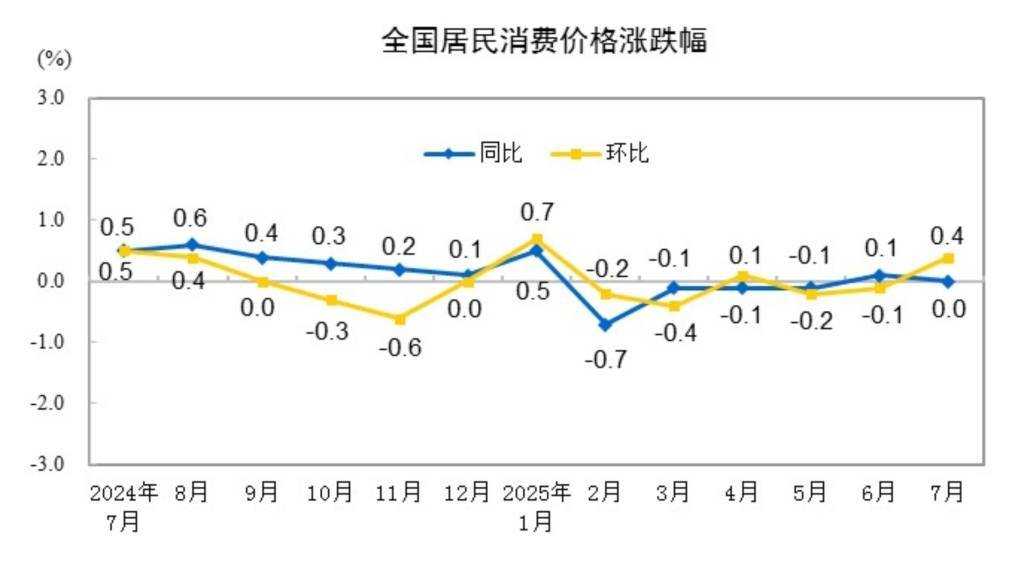
Group 1: Consumer Price Index (CPI) Insights - In July, the national Consumer Price Index (CPI) remained flat year-on-year and increased by 0.4% month-on-month, with an average decline of 0.1% from January to July compared to the previous year [1] - The decline in food prices significantly impacted the CPI, with food prices dropping by 1.6% year-on-year, contributing approximately 0.29 percentage points to the CPI's year-on-year decline [5][6] - The core CPI, excluding food and energy prices, rose by 0.8% year-on-year, marking the highest level since March 2024, indicating a gradual improvement in market supply and demand relationships [6][10] Group 2: Producer Price Index (PPI) Insights - In July, the Producer Price Index (PPI) decreased by 0.2% month-on-month, with the decline narrowing for the first time since March, while the year-on-year decline remained at 3.6% [8][9] - The PPI's year-on-year decline has ended a four-month trend of increasing declines, with some industries showing price recovery due to improved supply-demand relationships [9][12] - The "anti-involution" policy is expected to support a rebound in industrial product prices, particularly in August, although overall PPI month-on-month growth is anticipated to be around 0.0% [12][13] Group 3: Economic Policies and Market Trends - The ongoing effects of demand expansion policies are leading to positive changes in consumer prices, with service prices rising by 0.6% month-on-month, contributing significantly to the CPI increase [6][10] - The "anti-involution" policy is projected to reshape industry supply-demand structures, particularly in overcapacity sectors, potentially leading to a more reasonable price recovery [13] - The overall economic environment remains uncertain, with external trade conditions and domestic demand pressures influencing price trends [11][12]

长沙芸汇生科技有限公司成立 注册资本5万人民币
Sou Hu Cai Jing· 2025-08-09 05:17
Group 1 - A new company, Changsha Yunhui Biological Technology Co., Ltd., has been established with a registered capital of 50,000 RMB [1] - The legal representative of the company is Peng Jun [1] - The company's business scope includes wholesale and retail of auto parts, manufacturing of auto components, general equipment manufacturing, and various technical services [1] Group 2 - The company is involved in a wide range of activities including metal processing machinery manufacturing, mechanical and electrical equipment sales, and installation services [1] - It also focuses on research and development in biobased materials and IoT technology [1] - The company is permitted to engage in activities that are not prohibited or restricted by laws and regulations [1]
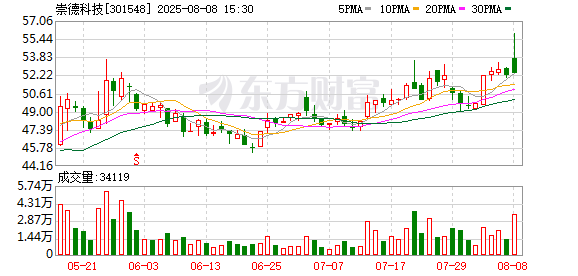
崇德科技:公司的动压油膜滑动轴承产品主要聚焦于能源发电等领域
Zheng Quan Ri Bao· 2025-08-08 15:41
Group 1 - The core focus of the company's dynamic pressure oil film sliding bearing products is in the fields of energy generation, industrial drive, petrochemicals, and shipping [2] - The products are critical components for major equipment and high-precision devices such as heavy gas turbines, large steam turbines, wind power generation equipment, efficient compressors, high-speed motors, pumps, and gearboxes [2] - The main customers of the company are manufacturers of the aforementioned key equipment [2]