
公路运输

Search documents
西藏乡镇道路通畅率达100%
Ren Min Ri Bao· 2026-01-05 22:31
Core Viewpoint - The Tibet Autonomous Region is set to enhance its transportation infrastructure significantly during the 14th Five-Year Plan period, focusing on road improvements and expansions to boost connectivity and logistics efficiency [1] Group 1: Infrastructure Development - A total of 3,432 kilometers of major highway upgrades and 6,595 kilometers of rural road construction will be implemented [1] - The total length of roads in the region is expected to reach 125,200 kilometers, with 110,000 kilometers classified as high-grade roads [1] - The proportion of ordinary national highways at level three or above is projected to reach 95% [1] Group 2: Rural Connectivity - By 2025, 167 rural road projects will be executed, with 14 towns and 231 administrative villages gaining access to paved roads [1] - 171 dangerous bridges will be renovated, and 1,624 kilometers of safety protection projects will be implemented to enhance safety [1] - An additional 28 administrative villages will gain bus access, improving transportation services for 623 towns and 3,902 administrative villages [1] Group 3: Transportation Capacity and Efficiency - A transportation logistics plan aims to reduce costs and improve quality, with expected completion of 16.26 million passenger trips and 49.90 million tons of freight in the year [1]
路网越织越密 川渝越来越“近”
Si Chuan Ri Bao· 2026-01-05 21:46
Core Viewpoint - The transportation integration between Chengdu and Chongqing has significantly improved over the past six years, enhancing connectivity and reducing travel times, which supports the development of the Chengdu-Chongqing economic circle [1][2][4]. Group 1: Transportation Infrastructure - The Chongqing-Zizhong Expressway is set to open on December 31, 2025, which will further reduce transportation time for blood oranges from Zizhong to Chongqing, showcasing the ongoing development of transportation networks between Sichuan and Chongqing [1]. - The Chengyu Expressway, after its expansion, will increase its capacity to accommodate an average of 100,000 vehicles per day, reducing travel time between the two cities by an additional hour [2]. - A total of 21 regional transportation standards have been established between Sichuan and Chongqing, leading the region in local standards and supporting high-quality transportation integration [3]. Group 2: Transportation Efficiency - The Chengdu-Chongqing high-speed rail has achieved a public transport-like operation, with the shortest travel time now at 62 minutes, and the average number of daily trains has increased from 87.5 pairs to 104.5 pairs [4]. - The daily passenger volume on the high-speed rail has risen from over 100,000 in 2021 to over 130,000, with train frequency improving from every 20 minutes to an average of every 5-10 minutes [4]. - The integration of over 300 bus stations and 1,123 routes between the two cities has facilitated a seamless ticketing system, significantly reducing commuting times by 60% [6]. Group 3: Economic Impact - The cross-province public transport system has created a "one-hour living circle," with 26 intercity bus routes serving over 4 million passengers annually, benefiting millions of commuters [5][6]. - Chengdu and Chongqing have been selected as the first batch of national comprehensive freight hubs, enhancing regional logistics capabilities and improving the efficiency of logistics operations [6]. - The establishment of direct shipping routes from Chongqing to Ningbo and Zhoushan has reduced transportation time by approximately five days, with a cargo loss rate maintained at below 0.01% [6].
【安康】加快建设全国性综合交通枢纽城市
Shan Xi Ri Bao· 2026-01-05 00:28
Core Viewpoint - The development of transportation infrastructure in Ankang City is transforming its geographical limitations into opportunities for economic growth and connectivity, enhancing the region's integration into national and international logistics networks [2][6]. Transportation Infrastructure Development - The construction of the Xikang High-Speed Railway, part of the national "eight vertical and eight horizontal" high-speed rail network, is set to significantly reduce travel time between Xi'an and Ankang from approximately 3 hours to under 1 hour [2]. - Ankang's total road mileage has reached 26,800 kilometers, with a per capita road network density ranking first in the province [4]. - The city has completed the construction of key highway projects, including the Ning-Shi Expressway and several other significant routes, enhancing connectivity [3]. Multi-Modal Transportation - Ankang is the only city in the province equipped with all four modes of transportation: water, land, air, and rail, which supports a comprehensive modern transportation system [3]. - The airport in Ankang has seen a significant increase in passenger throughput, surpassing 400,000 annually, and has expanded its reach to major cities like Beijing and Shanghai [3]. Economic Impact - The improved transportation infrastructure is expected to boost rural revitalization and economic development in the region, facilitating the movement of agricultural products and enhancing local industries [5]. - The logistics sector in Ankang is evolving, with a notable increase in air cargo throughput, which grew by 77.6% year-on-year, indicating a robust demand for logistics services [6]. International Connectivity - The establishment of the China-Europe Railway Express has enhanced Ankang's role in the international logistics network, with plans for regular operations of return trains from Moscow to Ankang, further integrating the city into the global supply chain [7].
元旦假期出行活力足 运输新场景成为假期经济新动力
Zhong Guo Zheng Quan Bao· 2026-01-04 22:17
Core Insights - The travel market experienced significant growth during the New Year holiday, with a total of 595 million cross-regional trips made from January 1 to January 3, 2026, representing a 19.62% increase compared to the same period last year [1] Group 1: Transportation Statistics - Railway passenger volume reached 48.09 million during the New Year holiday, with a daily average of 16.03 million, marking a year-on-year increase of 52.66% [2] - Self-driving remains the dominant mode of travel, with non-commercial small passenger vehicles accounting for 442 million trips, averaging 147 million trips per day, a 14.6% increase year-on-year [2] - Waterway passenger volume was 2.25 million, with a daily average of 749,300, reflecting a 32.9% year-on-year growth [2] - Civil aviation passenger volume reached 5.88 million, averaging 1.96 million per day, up 10.4% year-on-year [2] Group 2: Travel Trends and Innovations - The launch of the "China Snow Capital: My Altay" ice-themed train service aims to enhance the ice and snow tourism experience, reducing travel time by up to 4 hours [3] - The rental car market saw a surge, with Didi's rental bookings increasing by 243% during the holiday, with about half of users planning 2 to 4-day self-driving trips [2][5] - The development of autonomous driving technology is enhancing the self-driving experience, with L4 autonomous vehicles being piloted in Hainan, providing a unique travel experience [6] Group 3: Future Outlook - The integration of travel and tourism is expected to create new consumption scenarios, with the number of tourist trains increasing by 33.6% in 2025 [3] - The cruise and yacht sectors are anticipated to become significant growth points in transportation consumption [4]

交通出行人数5.95亿人次
Xin Lang Cai Jing· 2026-01-04 22:08
Core Insights - The total cross-regional population flow during the New Year holiday (January 1-3) reached 595 million person-times, with an average of 198 million person-times per day, representing a year-on-year increase of 19.62% compared to the same period in 2025 [3] Transportation Sector Summary - Road transportation accounted for a cumulative flow of 539 million person-times, averaging 180 million person-times per day, with a year-on-year increase of 15.7% [3] - Railway passenger volume totaled 48.087 million person-times, averaging 16.029 million person-times per day, showing a significant year-on-year increase of 52.66% [3] - Waterway passenger volume reached 2.248 million person-times, averaging 749,300 person-times per day, with a year-on-year increase of 32.9% [3] - Civil aviation passenger volume was 5.876 million person-times, averaging 1.959 million person-times per day, reflecting a year-on-year increase of 10.4% [3]

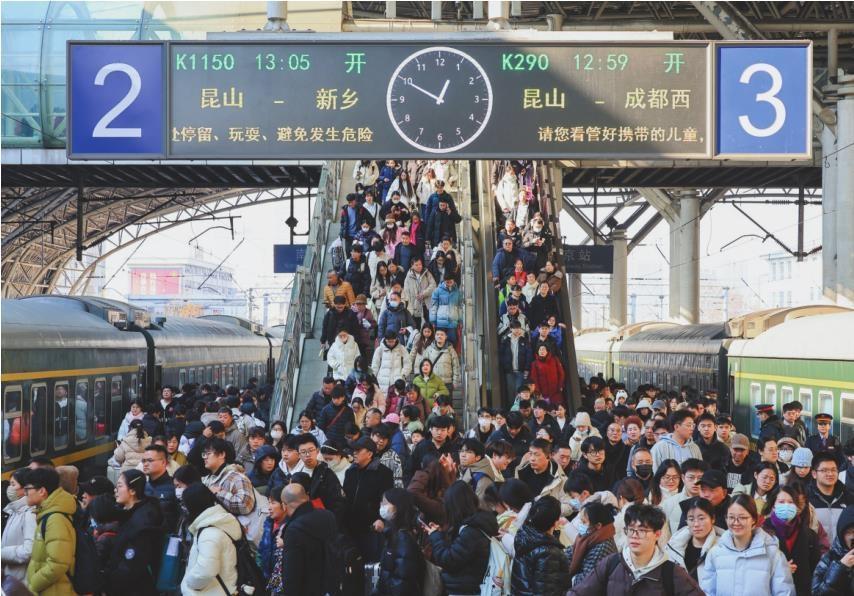
元旦假期青海公路铁路民航运送旅客量再创新高
Xin Lang Cai Jing· 2026-01-04 19:01
Group 1 - The transportation departments in Qinghai province effectively coordinated and optimized services during the New Year holiday, utilizing big data to meet travel demands [1] - The traffic flow on Qinghai's highways reached 632,100 vehicles, an increase of 11.44% compared to last year [1] - Airports in Qinghai executed a total of 416 flights and transported 42,000 passengers, representing year-on-year growth of 5.6% and 12.4% respectively [1] Group 2 - The average daily passenger volume at Xining Railway Station was 38,500, marking a significant increase of 50.4% compared to the same period last year [1] - Qinghai's transportation authorities analyzed traffic peak periods in advance and developed plans to ensure smooth traffic flow, enhancing safety and convenience for travelers [1] - The Qinghai Transportation Holding Group implemented tailored plans for highway operations, optimizing personnel allocation and improving traffic efficiency at toll stations [1] Group 3 - Qinghai airports reduced passenger wait times by dynamically increasing check-in counters and security channels, as well as enhancing on-site guidance and increasing shuttle bus frequency [2] - The China Railway Qinghai-Tibet Group adjusted its operations to accommodate student, tourism, and family visit flows, implementing peak operation schedules and adding temporary passenger trains [2] - Coordination with public transport and taxis was strengthened to facilitate seamless travel for passengers, addressing the "last mile" of travel service [2]
2026年元旦出行数据点评:供需两旺,境内外双线并进
GOLDEN SUN SECURITIES· 2026-01-04 09:58
Investment Rating - The report does not explicitly state an investment rating for the transportation industry Core Insights - The transportation sector is experiencing robust growth in both domestic and international travel, with a significant increase in cross-regional personnel flow during the 2026 New Year holiday, reaching 590 million trips, a year-on-year increase of 19.5% [1] - Domestic tourism demand is strong, with ticket bookings for scenic spots increasing over fourfold compared to the previous year, and inbound travel also showing significant growth due to relaxed visa policies [2] - The young demographic, particularly families with children and the Z generation, is driving travel demand, with family trips increasing by over 80% during the holiday period [3] Summary by Sections Transportation Demand - The total cross-regional personnel flow during the 2026 New Year holiday is expected to average 198 million trips per day, with daily figures showing a year-on-year increase of 19.5% [1] - Railway and road transport have seen notable growth, with railway passenger volume increasing by up to 78% year-on-year during the holiday [4] - Air travel also performed well, with a year-on-year increase in passenger volume of 21.2% on the first day of the holiday [5] Travel Trends - The report highlights a significant increase in travel spending, with average purchases and spending per traveler rising by over 20% and 30% respectively [3] - Short-distance travel remains a popular choice, with nearly 70% of travelers opting for 2-3 day trips, supported by the popularity of "4-hour high-speed rail circles" [4] - Self-driving travel is on the rise, with domestic car rental bookings increasing by over 120% during the holiday [4] International Travel - Inbound travel is experiencing a strong resurgence, with inbound flight bookings increasing by 20% on the first day of the holiday and ticket bookings for attractions rising by 110% [2] - The report notes that outbound travel is also thriving, with a year-on-year increase of over 40% in travelers heading to popular international destinations [2]
春节假期成都客流总量2816.9万人次 自驾出行热度高 民航铁路客流恢复明显
Si Chuan Ri Bao· 2026-01-04 01:47
为强化运力保障,春节假期期间,铁路开行固定列车3206对,增开临客164对;民航双流机场起降 正班航班3826架次,加班94架次,成都天府国际机场起降正班航班2419架次,加班72架次;道路运输投 入正班客车5000余辆、储备运力200辆,全力满足节日旅客出行需求。此外,成都市内组织地铁列车36 列、公交车300辆、出租车200辆作为储备运力,全力做好到达旅客疏运工作。 2月8日,记者从成都市交通运输局获悉,2022年春节假期期间(1月31日至2月6日),成都客流总 量2816.9万人次,同比下降3.13%,呈现出自驾出行热度高涨、民航铁路客流恢复明显、道路客运客流 下降和城市公共交通保障有序四大特点。 这期间,成都市域内高速公路车流量为1817万辆次,同比增长9.5%;全市民航、铁路运送旅客 300.37万人次,同比增长50.15%;全市道路客运量86.68万人次,同比下降14.48%;地铁、公交、出租 车(含网约车)总客流达2429.85万人次,同比下降6.68%。 另外,节日期间成都全市农村客运(含农村公交)运送旅客147.82万人次。下一步,成都还将全力 重点做好返程客流接续接驳和农民工外出(返蓉)务 ...
超500亿元打造“四好农村路”升级版
Xin Lang Cai Jing· 2026-01-03 22:19
在安全保障提升行动中,将常态化开展公路风险隐患排查整治,以平交路口、穿村过镇、跨学校 等事故多发易发路段为重点,建设农村公路安全生命防护工程1.2万公里以上。 在运输效率提升行动中,将因地制宜推动城市公交线路延伸、农村客运班线公交化运营等模式, 推进城乡客运公交化。深化"客货邮""交商邮供"融合发展,持续完善县乡村三级物流体系,提升 末端循环效率。 在治理效能提升行动中,全面落实农村公路建设工程质量终身制和公示制度,完善专业力量为 主、群众参与为辅的建设质量监管体系。加快信息化建设,开展农村公路"一路一档"试点,推进 农村公路数字化发展,实现"一张图"动态监管。 在养护水平提升行动中,加大养护投入,提高养护质效。按照"县道县管、乡村道乡村管"原则, 构建完善与农村公路行政等级相匹配的养护管理责任体系,规范路长制运行机制,确保"有路必 养"。 ●城乡交通运输一体化发展水平达5A级的县(市、区)占比超80% 本报讯(四川日报全媒体记者 寇敏芳)省政府办公厅日前印发《四川新一轮农村公路提升行动实 施方案》,提出实施"八大提升行动",推动路网从"规模领先"迈向"质量领先"。到2027年,全省 农村公路完成投资500亿 ...
青海全力配备运力保障群众安全顺畅出行
Xin Lang Cai Jing· 2026-01-03 19:18
为保障旅客出行需求,中国铁路青藏集团有限公司根据客流情况,按照"一日一图"精准调配运力,通过 加开临时旅客列车、安排动车组重联、普速列车加挂运行等方式,重点补充西宁至格尔木间朝发夕至临 客2对,西宁至德令哈间临时动车组1对,拉萨至日喀则间临时动车组1对,安排西宁至西安北动车组重 联运行3对。同时,管内各车站及时增加安检、验票通道,增派工作人员与志愿者做好引导服务,集中 在服务台配备应急药品、胶带等便民物品。 青海省交通控股集团有限公司高速公路运营分公司制定"一路一策"保畅方案,在收费站,根据车流量预 测科学调配人员,开足收费车道,优化通行流程,提高通行效率;在服务区,加强环境卫生、食品安 全、商品供应和停车秩序管理,为司乘人员提供暖心服务。并针对冬季恶劣天气及交通事故、突发事件 等可能带来的影响,进一步完善各类应急预案,加强应急储备与保障。此外,与交警、消防、医疗、属 地应急管理部门沟通协调,建立完善信息共享和协同联动机制,最大限度保障道路安全畅通。 假日期间,西宁机场航班直达城市45个,覆盖国内主要城市。青海各机场通过动态增开值机柜台及安检 通道、加强现场引导、增加班车频次等方式缩短旅客排队等候时间。针对老 ...