
军工制造

Search documents
德国内阁通过扩军计划 民众担忧军费开支挤压民生投入
Yang Shi Xin Wen· 2025-08-30 07:00
Group 1 - The German government has approved a draft plan to expand its military, aiming to increase active military personnel from 180,000 to 260,000 by around 2030, along with a significant increase in reserve forces [1] - To attract eligible individuals to enlist, the draft includes various salary and subsidy policies, and if voluntary enlistment does not meet targets, the government may consider reinstating mandatory military service for men aged 18 to 60 [1] - There are concerns among some German citizens and scholars that this move indicates a shift towards increased militarization, potentially diverting funds from other critical areas such as education and healthcare, thereby harming public welfare [1][2] Group 2 - Supporters of the military expansion argue that it is necessary to strengthen the Bundeswehr to address security threats and fulfill commitments to NATO and the EU [2] - Opponents worry that rising military expenditures could crowd out social spending on education, healthcare, and pensions, and may push Europe towards further militarization, straying from Germany's post-war identity as a peace-oriented nation [2] - The new draft law on military service faces internal disputes within the ruling coalition, with low enlistment interest among young people and protests from anti-war organizations expressing concerns about readiness for conflict [2]
晨枫:特朗普要大干快干“美国特色资本主义”
Guan Cha Zhe Wang· 2025-08-30 02:08
Group 1: Government Involvement in Defense Companies - The U.S. government is considering acquiring stakes in defense companies like Lockheed Martin, Boeing, and Palantir, as these companies heavily rely on government contracts for revenue [1][20] - Trump's administration has already taken steps to acquire a 10% stake in Intel, indicating a trend towards government ownership in key industries [1][20] - The historical context shows that European countries have long engaged in government ownership of major companies, particularly in defense, to protect strategic industries [2][5] Group 2: Challenges in the Defense Industry - The defense industry is facing consolidation due to high technological barriers and decreasing military procurement, leading to a situation where only a few large companies can survive [4][8] - The U.S. currently has only three major companies capable of designing and manufacturing fighter jets, raising concerns about competition and innovation in the sector [9][10] - The government’s potential stake in defense companies could lead to conflicts of interest and favoritism in procurement processes, which may hinder competition [11][20] Group 3: Implications for the Technology Sector - The acquisition of stakes in companies like Intel and Palantir may signal a shift towards more government control in technology sectors, which could stifle competition and innovation [14][15] - Palantir is expanding into civilian markets, indicating a potential for growth in data analytics and AI, which could be influenced by government partnerships [15][16] - The U.S. faces a challenge in maintaining its competitive edge in manufacturing and technology, especially as China continues to grow in these areas [17][18] Group 4: Economic Context and Future Outlook - The U.S. is experiencing a paradox of rapid wealth growth alongside relative decline in manufacturing competitiveness, with a significant portion of its GDP still derived from manufacturing [17][18] - The trend towards government ownership in key industries may reflect a broader strategy to revitalize American manufacturing and technology sectors [19][20] - The future of U.S. industrial policy may involve more direct government intervention, which could reshape the landscape of both defense and technology industries [16][20]


山西证券研究早观点-20250829
Shanxi Securities· 2025-08-29 01:15
Market Trends - Major domestic indices showed varying degrees of increase, with the Shanghai Composite Index rising by 3.49% and the ChiNext Index increasing by 5.85% [4][6][9] - The total trading volume in A-shares reached 12.94 trillion yuan, with an average daily trading volume of 2.59 trillion yuan, reflecting a week-on-week increase of 23.10% [7] Industry Commentary Non-Bank Financial - The China Securities Regulatory Commission (CSRC) has revised the classification regulations for securities companies, emphasizing the enhancement of professional capabilities and encouraging differentiated development among small and medium-sized firms [6][7] - Recent mergers and acquisitions in the industry include Guosen Securities becoming the major shareholder of Wanhua Securities, which is expected to enhance its competitive edge [7] Communication - Nvidia is set to launch the Spectrum-XGS Ethernet DCI product, which aims to redefine "scale across" for connecting geographically dispersed data centers [8] - The release of DeepSeek V3.1 is expected to enhance the capabilities of domestic chips, particularly in AI applications [8] Company Reviews Yongtai Energy (600157.SH) - In the first half of 2025, Yongtai Energy reported a revenue of 10.676 billion yuan, a year-on-year decrease of 26.44%, and a net profit of 126 million yuan, down 89.41% [11] - The company anticipates a rebound in coal prices in the third quarter, which may improve its coal business performance [11] Sinochem Fertilizer (00297.HK) - Sinochem Fertilizer achieved a revenue of 14.715 billion yuan in the first half of 2025, up 7.56% year-on-year, with a net profit of 1.104 billion yuan, an increase of 5.04% [12][14] - The company is focusing on optimizing its product structure and enhancing profitability through its "Bio+" strategy [14] Glodon Company (002410.SZ) - Glodon reported a revenue of 2.8 billion yuan in the first half of 2025, a decrease of 5.37%, but net profit increased by 23.65% to 237 million yuan [15][16] - The company is optimizing its business structure and has begun to see the benefits of its AI initiatives [16][17] Lianrui New Materials (688300.SH) - Lianrui New Materials achieved a revenue of 519 million yuan in the first half of 2025, a year-on-year increase of 17.12%, with a net profit of 139 million yuan, up 18.01% [20] - The company is focusing on high-end powder materials and has plans for a convertible bond project to support growth [20][21] Jujiao Co., Ltd. (301283.SZ) - Jujiao reported a record high quarterly performance in Q2 2025, with revenue of 990 million yuan, a year-on-year increase of 5.5%, and a net profit of 80 million yuan, up 41.4% [24][25] - The company is expanding its production capacity in response to strong demand in the hygiene hot melt adhesive market [25] Sailun Tire (601058.SH) - Sailun Tire's revenue for the first half of 2025 was 17.59 billion yuan, a year-on-year increase of 16.1%, but net profit decreased by 14.9% [28] - The company is expected to see cost improvements in Q3 due to a decrease in raw material prices [28][30] AVIC Xi'an Aircraft Industry Group (000768.SZ) - The company reported a revenue of 19.416 billion yuan in the first half of 2025, a decrease of 4.49%, while net profit increased by 4.83% to 689 million yuan [31] - AVIC is focusing on expanding its international subcontracting business and enhancing its capabilities in the civil aviation sector [31][32] Megachip Coatings - The company achieved a revenue of 888 million yuan in the first half of 2025, a year-on-year increase of 17.09%, with a net profit of 110 million yuan, up 48.83% [35] - The demand for new energy coatings is driving growth, with significant contributions from the wind power sector [35][36]
美政府考虑入股军工企业
Di Yi Cai Jing· 2025-08-28 00:55
Group 1 - The U.S. government is considering acquiring equity in defense contractor Lockheed Martin, following its recent investment in Intel [1][2] - U.S. Commerce Secretary Gina Raimondo highlighted that 97% of Lockheed Martin's revenue comes from the U.S. government, indicating a close relationship between the company and the government [1] - In 2024, Lockheed Martin reported that 73% of its net sales would come from the U.S. government, with 65% specifically from the Department of Defense [1] Group 2 - Intel announced a deal with the U.S. government for an $8.9 billion investment, acquiring 9.9% of the company's common stock [2] - The funding for Intel's investment comes from previously allocated subsidies under the CHIPS and Science Act, totaling $5.7 billion, along with an additional $3.2 billion from government-funded projects [2] - Following the transaction, the U.S. government will become a major shareholder in Intel, with President Trump expressing interest in similar future investments [2]



特朗普政府考虑入股军工企业
Bei Jing Ri Bao Ke Hu Duan· 2025-08-27 22:25
Core Viewpoint - The U.S. government, under the Trump administration, is considering acquiring equity in defense contractors, specifically targeting Lockheed Martin, following a recent investment in Intel [1] Group 1: Government Interest in Defense Sector - U.S. Commerce Secretary Ross revealed that the government is interested in purchasing shares of defense contractors, with Lockheed Martin being specifically mentioned [1] - Lockheed Martin generates 97% of its revenue from the U.S. government, indicating a close relationship between the company and the government [1] - The discussion around funding for military procurement is ongoing, with further deliberations needed among defense officials [1] Group 2: Recent Investment in Intel - The U.S. government recently announced an investment of $8.9 billion in Intel, acquiring 9.9% of the company's shares [1] - The funding for this investment comes from $5.7 billion in subsidies granted to Intel under the CHIPS and Science Act, along with an additional $3.2 billion from government-funded projects [1] - Following this transaction, the U.S. government will become a major shareholder in Intel, with President Trump expressing a desire for more similar investments in the future [1]
全球军工市值前20曝光,印度全面碾压中方,可惜实战一败涂地
Sou Hu Cai Jing· 2025-08-27 06:09
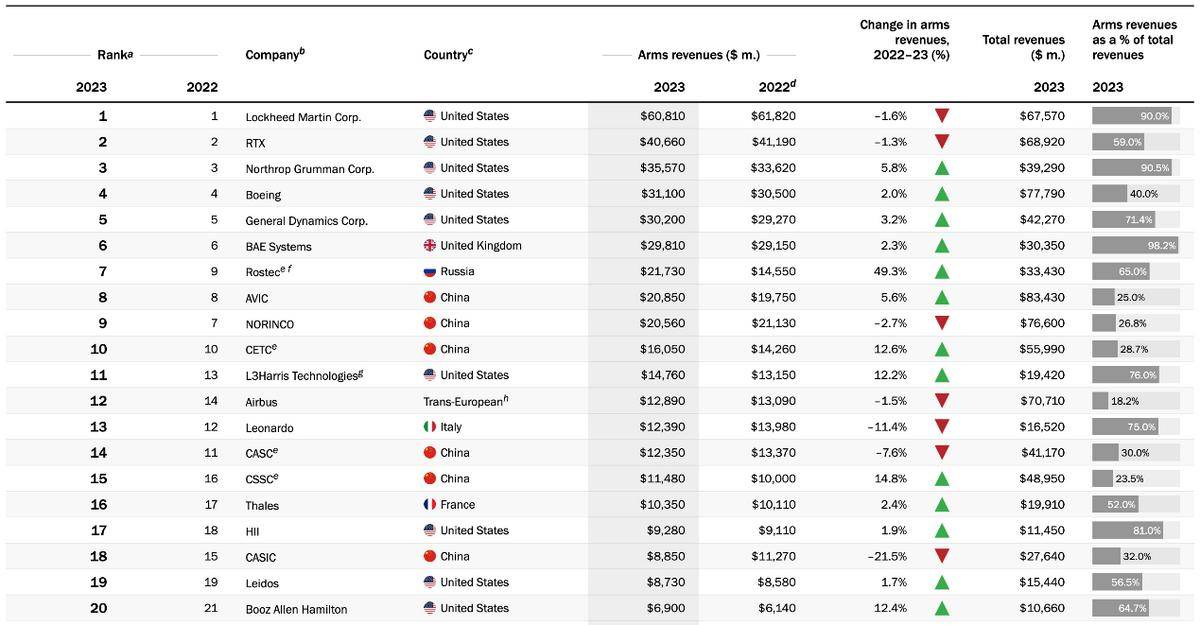
Core Viewpoint - The rapid development of China's military industry has created pressure on countries opposing China, particularly India, which has begun to feel anxious about its own military capabilities. However, recent rankings of global military companies have shown that two Indian firms have surpassed their Chinese counterparts in market value, providing a temporary boost to Indian sentiment [1][7]. Group 1: Market Value Rankings - The global military company market value ranking shows that Hindustan Aeronautics Limited (HAL) ranks 12th with a market value of $34.22 billion, while Bharat Electronics ranks 13th with $31.28 billion. In contrast, China's AVIC ranks 8th with $20.85 billion, and NORINCO ranks 9th with $20.56 billion [1][6]. - The ranking indicates that 16 out of the top 20 positions are held by companies from the US, Europe, and Israel, highlighting the dominance of these regions in the military sector [1][6]. Group 2: Company Performance and Capabilities - HAL, India's largest state-owned aerospace manufacturer, primarily assembles Su-30MKI fighter jets under license and has limited original development capabilities, with its only indigenous fighter being the Tejas series, which has faced performance criticisms [3][5]. - In comparison, China's military aviation company, AVIC, has demonstrated significant advancements in developing advanced fighter jets, including the J-15, J-16, and J-35, showcasing a clear technological and production advantage over HAL [3][5]. - Bharat Electronics, India's largest state-owned military electronics company, has not yet developed advanced radar systems comparable to China's CETC, which leads in the region and has the capability to independently develop advanced AESA radar systems [5][6]. Group 3: Market Dynamics and Perceptions - The recent market value rankings have been perceived as a strategy to undermine China's military strength while artificially inflating the market values of Indian companies, reflecting the volatility and speculative nature of the Indian stock market [7][9]. - According to the Stockholm International Peace Research Institute (SIPRI), HAL ranks 43rd and Bharat Electronics ranks 67th in terms of sales revenue, indicating that their market values may not accurately reflect their actual military capabilities [9].
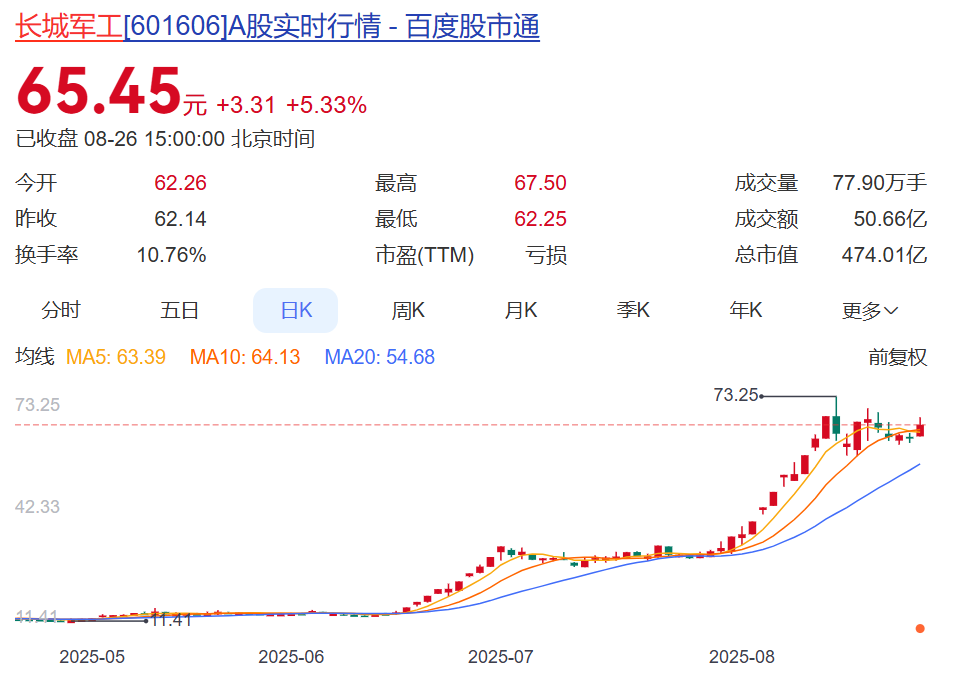
知名军工巨头,半年亏了2700万元!股价年内暴涨450%,公司曾提醒:击鼓传花效应十分明显,交易风险极大
Mei Ri Jing Ji Xin Wen· 2025-08-26 13:41
Core Viewpoint - Longcheng Military Industry (601606.SH) reported a revenue of 699 million yuan for the first half of 2025, marking a year-on-year increase of 29.55%, while the net profit attributable to shareholders was a loss of 27 million yuan, narrowing the loss by 30.85% compared to the previous year [1][4]. Group 1: Financial Performance - The company's revenue structure is primarily driven by military products, with military revenue growing by 33.07% year-on-year [4]. - For the first half of 2025, the net cash flow from operating activities was -130 million yuan, an increase of over 32% year-on-year [4]. - The company reported a basic earnings per share of -0.04 yuan, indicating it has not yet turned profitable [4]. Group 2: Shareholder Restructuring - The indirect controlling shareholder, China Ordnance Equipment Group, is planning a restructuring that may lead to a change in the controlling shareholder [3][7]. - The restructuring process has led to significant stock price fluctuations, with the stock price increasing over 456% from the beginning of the year to August 26 [1][6]. - The company has issued multiple announcements regarding abnormal stock price fluctuations, indicating potential market speculation and risks associated with trading [8]. Group 3: Business Operations - Longcheng Military Industry operates in both military and civilian sectors, with civilian products including pre-stressed anchoring series and automotive components [4]. - The company experienced a decline in net profit in 2024, attributed to adjustments in product pricing based on customer evaluations, which impacted revenue and gross margin [4]. - Management expenses increased by 6.6%, while sales and financial expenses saw declines of 6.56% and 23.4%, respectively [5].

长城军工: 安徽长城军工股份有限公司2025年半年度报告摘要
Zheng Quan Zhi Xing· 2025-08-25 16:34
第三节 重要事项 公司应当根据重要性原则,说明报告期内公司经营情况的重大变化,以及报告期内发生的对公司 经营情况有重大影响和预计未来会有重大影响的事项 □适用 √不适用 安徽长城军工股份有限公司2025 年半年度报告摘要 公司代码:601606 公司简称:长城军工 安徽长城军工股份有限公司 安徽长城军工股份有限公司2025 年半年度报告摘要 第一节 重要提示 展规划,投资者应当到 www.sse.com.cn 网站仔细阅读半年度报告全文。 完整性,不存在虚假记载、误导性陈述或重大遗漏,并承担个别和连带的法律责任。 未出席董事职务 未出席董事姓名 未出席董事的原因说明 被委 托人姓名 董事 李昌坤 工作原因 周鸿彦 无 第二节 公司基本情况 公司股票简况 股票种类 股票上市交易所 股票简称 股票代码 变更前股 票简称 A股 上海证券交易所 长城军工 601606 无 联系人和联系方式 董事会秘书 证券事务代表 姓名 张兆忠 侯峻 电话 0551-62187330 0551-62187330 办公地址 安徽省合肥市包河区山东路508号 安徽省合肥市包河区山东路508号 电子信箱 ahccjg@ahccjg.com ...
光电股份(600184.SH):使用募集资金3.92亿元向全资子公司西光防务进行增资
Ge Long Hui A P P· 2025-08-25 13:04
Group 1 - The company, Guangdian Co., Ltd. (600184.SH), announced that it will hold the 18th meeting of the 7th Board of Directors on August 25, 2025 [1] - The board approved a proposal to use part of the raised funds to increase capital for its wholly-owned subsidiary, Xiguang Defense [1] - The company will allocate 391.8 million yuan for the project aimed at enhancing the digital research and manufacturing capabilities of precision-guided products [1]

8月25日涨停分析
Xin Lang Cai Jing· 2025-08-25 07:35
Group 1 - A total of 77 stocks reached the daily limit up today, with 12 stocks on consecutive limit up boards [1] - 40 stocks failed to maintain their limit up status, resulting in a sealing rate of 66% (excluding ST and delisted stocks) [1] - The computing power industry chain continues to lead the market, with notable stocks including Wantong Development achieving 7 limit ups in 12 days, Huasheng Tiancheng with 7 limit ups in 13 days, and Garden Shares with 6 consecutive limit ups [1] Group 2 - Military industry stocks also showed strong performance, with Chengfei Integration achieving 4 consecutive limit ups [1]


