
医疗卫生

Search documents
五大特色中心同步揭牌! 南京市第一医院与秦淮区探索紧密型医联体建设“秦淮样板”
Yang Zi Wan Bao Wang· 2025-11-08 14:19
Core Points - The strategic cooperation between Nanjing First Hospital and Qinhuai District Health Commission marks a significant step in implementing the "Healthy China" strategy and enhancing the hierarchical medical service system in Nanjing [1][2] - The partnership aims to integrate high-quality medical resources and improve healthcare services at the grassroots level, ensuring that residents can access tertiary hospital-level services locally [2][3] Group 1: Strategic Cooperation - The signing ceremony signifies the beginning of a new phase in the construction of a tightly-knit urban medical group, emphasizing the hospital's commitment to public health and social responsibility [1] - Nanjing First Hospital will leverage its expertise in cardiovascular, respiratory, and rehabilitation fields to empower grassroots medical institutions [1][2] Group 2: Implementation and Development - The cooperation will involve the establishment of five specialized centers, including hypertension management and cardiovascular care, to create an integrated service loop for prevention, treatment, management, and rehabilitation [2][3] - The initiative aims to transform the medical alliance from a "loose" to a "tight" model, focusing on resource sharing and collaborative development among healthcare providers [3] Group 3: Future Goals - The partnership seeks to enhance the capabilities of grassroots healthcare through talent cultivation and the establishment of a robust medical workforce [3] - Nanjing First Hospital will continue to promote management, technology, talent, and cultural sharing, aiming to create an efficient and collaborative medical service system [3]
“中国好医生、中国好护士”走进湖南现场交流活动举行
Xin Hua She· 2025-11-06 10:56
Core Viewpoint - The event held in Changsha on November 6 highlighted the contributions of outstanding medical professionals in China, emphasizing their dedication and selflessness in serving the community [1] Group 1: Event Overview - The event was organized by the Central Spiritual Civilization Construction Office and the National Health Commission, focusing on the second batch of "Chinese Good Doctors and Good Nurses" for 2025 [1] - A total of 30 exemplary healthcare workers from the health system were honored during the event [1] Group 2: Stories of Medical Professionals - The event featured various storytelling formats, including videos and interviews, showcasing the commitment of healthcare workers who have made significant sacrifices [1] - Some honorees have worked in remote areas, earning the title of "Good Mamba" (Good Doctor), while others returned to their hometowns to serve their communities [1] - The event included tributes to historical figures, with veterans recalling the bravery of medical personnel during the Anti-Japanese War, urging current healthcare workers to uphold these traditions [1] Group 3: Impact and Future Commitment - The "Chinese Good Doctors and Good Nurses" initiative has conducted 24 exchange activities across 20 provinces, promoting high-quality development in the health sector [1] - Young healthcare professionals expressed their determination to follow the examples set by these role models to contribute to the advancement of health services [1]
美国服务业回暖但就业亮红灯 价格指数触及三年新高
智通财经网· 2025-11-05 15:42
Core Insights - The US services sector activity returned to expansion in October, with the ISM services PMI recorded at 52.4%, up from 50% in September, marking the eighth consecutive month above the threshold [1] - The business activity index rose significantly to 54.3%, a 4.4 percentage point increase from September's 49.9%, indicating a return to expansion [1] - The new orders index surged to 56.2%, a rise of 5.8 percentage points, reflecting improved demand in the services sector [1] Industry Performance - Eleven industries experienced growth in October, including accommodation and food services, retail, wholesale, real estate, healthcare, and transportation and warehousing [2] - Six industries faced contraction, including arts and entertainment, management services, finance and insurance, public administration, and construction [2] Employment and Inventory Trends - The employment index remained in contraction at 48.2%, indicating weak hiring intentions despite a slight improvement from September [1] - The inventory index recorded at 49.5%, still in contraction, as businesses generally reduced inventory levels to manage demand and cost uncertainties [2] Price and Supply Chain Dynamics - The prices index rose to 70%, the highest level since October 2022, indicating persistent inflationary pressures in the services sector, driven by tariffs affecting material and service costs [1] - The supplier deliveries index stood at 50.8%, indicating a continued slowdown in delivery speeds, which is typically associated with improved demand or supply chain constraints [1] Order Backlog and Economic Signals - The backlog of orders index dropped significantly to 40.8%, the second-lowest level since 2009, suggesting that businesses can manage current orders without significant delivery delays [2] - Feedback from industries indicated mixed economic signals, with some sectors experiencing seasonal demand improvements while others faced challenges from import restrictions and rising prices [2]
恒生指数早盘跌0.28% AI概念股悉数走低
Zhi Tong Cai Jing· 2025-11-05 04:06
Group 1 - The Hang Seng Index fell by 0.28%, down 73 points, closing at 25,878 points, while the Hang Seng Tech Index decreased by 0.80%. The early trading volume in Hong Kong stocks was HKD 138.2 billion [1] - AI concept stocks experienced a decline, with concerns over high valuations. Institutions suggest that the long-term outlook for Hong Kong tech stocks remains attractive [1] - Hui Liang Technology (01860) dropped over 6%, and Kingsoft (03888) fell by 2.81% [1] Group 2 - Longpan Technology (603906) saw an increase of over 9% as lithium battery midstream prices continue to rise, with institutions expecting further price momentum [2] - Yimai Sunshine (02522) rose by 3.27% following several directors' share purchases, and the "AI + healthcare" sector is expected to benefit from new policies [3] - China Duty Free Group (601888) (01880) increased by over 4%, marking its first interim dividend, with recent policies likely to boost the duty-free industry [3] Group 3 - Yihua Tong (02402) surged by 7.7%, with significant cash flow improvement in the first three quarters, and fuel cell vehicle production is expected to accelerate [4] - Tianli International Holdings (01773) rose by 4.9%, with its AI learning companion already implemented in over 100 schools nationwide [5] - Mixue Group (02097) increased by 2.89%, planning to collaborate with Anjun Express for cold chain operations in Brazil [6] Group 4 - Huishang Bank (03698) rose by 4%, reporting a net profit of CNY 14.149 billion in the first three quarters, with institutions indicating potential for future growth [7] - Sanhua Intelligent Control (002050) (02050) fell by 1.94%, as Goldman Sachs pointed out overly optimistic robot expectations, while the market is focused on Tesla's trillion-dollar compensation plan [7] - Home Control (01747) dropped by 13%, facing scrutiny from the Hong Kong Securities and Futures Commission due to high stock ownership concentration [7] - Long Fiber Optic (601869) (06869) declined by 2.81%, with Q3 net profit down nearly 11%, and UBS stated that the impact of hollow-core fiber on profitability is limited in the short term [7]


港股午评|恒生指数早盘跌0.28% AI概念股悉数走低
智通财经网· 2025-11-05 04:05
Market Overview - The Hang Seng Index fell by 0.28%, down 73 points, closing at 25,878 points, while the Hang Seng Tech Index decreased by 0.80%. The early trading volume in Hong Kong stocks was HKD 138.2 billion [1]. AI Sector - AI concept stocks experienced a decline, with concerns over high valuations intensifying. Institutions suggest that the long-term outlook for Hong Kong tech stocks remains attractive. HuiLiang Technology (01860) dropped over 6%, and Kingsoft (03888) fell by 2.81% [1]. Lithium Battery and Healthcare - Longpan Technology (02465) saw a midday increase of over 9% due to ongoing price hikes in the lithium battery midstream, with institutions predicting further price momentum. Yimai Sunshine (02522) rose by 3.27% following several directors' share purchases, indicating a positive outlook for the "AI + healthcare" sector amid new policies [1]. Duty-Free Industry - China Duty Free Group (01880) rose over 4% against the market trend, marking its first interim dividend. Recent policy developments are expected to boost growth in the duty-free industry [1]. Fuel Cell Vehicles - Yihua Tong (02402) increased by 7.7%, with significant cash flow improvement in the first three quarters, and the potential for accelerated release of fuel cell vehicles [1]. Other Companies - Tianli International Holdings (01773) rose by 4.9% as its AI companion has been implemented in over 100 schools nationwide [2]. - Mixue Group (02097) increased by 2.89% due to a planned cold chain cooperation with Anjun Express in Brazil [3]. - Huishang Bank (03698) rose by 4%, reporting a net profit of CNY 14.149 billion for the first three quarters, with expectations for future inclusion in the stock connect [3]. - Sanhua Intelligent Control (02050) fell by 1.94% as Goldman Sachs indicated overly optimistic robot expectations, with market attention on Tesla's trillion-dollar compensation plan [4]. - HOME CONTROL (01747) dropped by 13% after being named by the Hong Kong Securities and Futures Commission for high shareholding concentration [5]. - Changfei Optical Fiber and Cable (06869) fell by 2.81%, with Q3 net profit declining nearly 11%. UBS stated that the impact of hollow-core fiber on profitability is limited in the short term [6].
五部门联合发文促进和规范“人工智能+医疗卫生”应用发展
Zhong Guo Zheng Quan Bao· 2025-11-04 23:32
Core Insights - The National Health Commission and five other departments have jointly issued implementation opinions to promote and regulate the application of "Artificial Intelligence + Healthcare" [1] - By 2027, the goal is to establish high-quality health industry data sets and trusted data spaces, along with the widespread application of intelligent decision-making and patient service systems in healthcare institutions [1] Group 1: Clinical Diagnosis - The implementation opinions emphasize the promotion of intelligent diagnostic services in medical imaging, supporting the collective development of AI-assisted diagnosis and report generation in provincial hospitals [2] - There is a focus on enhancing diagnostic efficiency and report quality by expanding AI-assisted diagnosis from single diseases to multiple diseases affecting single organs [2] - High-level hospitals are encouraged to gather and develop high-quality medical imaging data for AI model research and upgrades [2] Group 2: Health Industry Development - The implementation opinions support collaboration between medical equipment manufacturers and healthcare institutions to advance intelligent medical equipment development [2] - Key areas for intelligent upgrades include medical imaging, diagnostic testing, treatment, monitoring, and life support equipment [2] - There is encouragement for the application of domestically produced intelligent medical equipment in healthcare institutions, particularly for innovative tasks in AI medical devices [2]
“人工智能+医疗卫生”迎新政 多家上市公司有望受益
Shang Hai Zheng Quan Bao· 2025-11-04 19:09
Core Insights - The National Health Commission released implementation opinions to promote and regulate the application of "Artificial Intelligence + Healthcare," outlining eight key application areas and development goals for 2027 and 2030 [1][2]. Group 1: Key Application Areas - The eight key areas identified include AI + grassroots applications, AI + clinical diagnosis, AI + patient services, AI + traditional Chinese medicine, AI + public health, AI + research and education, AI + industry governance, and AI + health industry [2][3]. - The focus on grassroots applications aims to enhance intelligent services in areas such as medical imaging, ECG diagnosis, and public health management [3]. Group 2: Development Goals - By 2027, the goal is to establish high-quality health data sets and intelligent applications in clinical settings, with a focus on major diseases and enhancing diagnostic capabilities [2][4]. - By 2030, the aim is for intelligent applications in grassroots diagnosis to achieve full coverage, with advanced AI applications in secondary and tertiary hospitals [2]. Group 3: Company Opportunities - A-share companies like Shanhai Mountain, Yunnan Baiyao, and Aojiahua have already made early investments in AI + healthcare, positioning themselves to benefit from the policy's support [1][4]. - Companies such as Keda Xunfei and Yunkang Life are developing AI solutions for imaging and comprehensive healthcare services, enhancing patient experience and operational efficiency [4][5]. Group 4: Focus on Medical Robots - The implementation opinions emphasize the promotion of intelligent medical devices, including rehabilitation and acupuncture robots, indicating a growing market for AI-driven medical equipment [5]. - Companies like Aojiahua are developing smart massage robots based on traditional Chinese medicine principles, showcasing innovation in the sector [5]. Group 5: Patient Services and Research - The implementation opinions highlight the need for AI to enhance patient services, including intelligent appointment scheduling and pre-consultation services in hospitals [5][6]. - Companies like Yunnan Baiyao are advancing drug research through AI systems that predict the effects of new molecules, indicating a trend towards integrating AI in pharmaceutical research [6].


利好来了!五部门发布
证券时报· 2025-11-04 12:42
Core Viewpoint - The article discusses the implementation opinions on promoting and regulating the application of "Artificial Intelligence + Healthcare" in China, outlining a strategic framework for the development of AI in the healthcare sector by 2027 and 2030 [1][4]. Group 1: Overall Requirements - The guiding ideology emphasizes government guidance, multi-party participation, innovation-driven approaches, and safety control, aiming to meet the growing health service demands of the public [7]. - By 2027, the goal is to establish high-quality datasets and trusted data spaces in the healthcare sector, with widespread applications of AI in clinical decision-making and patient services [7][8]. - By 2030, the aim is for comprehensive coverage of intelligent assistance in grassroots diagnosis and the establishment of a standard system for AI applications in healthcare [8]. Group 2: Deepening Key Applications - AI applications will focus on eight areas, including grassroots healthcare, clinical diagnosis, patient services, traditional Chinese medicine, public health, scientific research, industry governance, and health industry development [9][10][11][12]. - Specific initiatives include enhancing intelligent applications in community healthcare, promoting intelligent diagnostic services in medical imaging, and improving management of chronic diseases [9][10]. Group 3: Strengthening Application Foundations - Emphasis on infrastructure development, including the construction of a national health information platform connecting all healthcare institutions [14]. - The article highlights the need for rich medical data supply and optimized AI algorithms, as well as the establishment of comprehensive co-creation platforms for AI applications [15][16]. Group 4: Regulating Safety and Supervision - Proposals include optimizing industry management and review systems, innovating regulatory methods, and enhancing data security and personal privacy protection [17]. Group 5: Strengthening Organizational Support - The article calls for improved institutional frameworks, pilot demonstrations, and collaborative promotion of AI in healthcare to ensure mutual benefits and shared outcomes [17].


多部门联合发布实施意见,促进规范“人工智能+医疗卫生”应用发展
Bei Jing Shang Bao· 2025-11-04 09:01
Core Viewpoint - The implementation opinion released by the National Health Commission and other departments aims to promote and standardize the application of "Artificial Intelligence + Healthcare" with specific development goals set for 2027 and 2030, focusing on enhancing healthcare efficiency and addressing resource shortages through AI technology [1][4]. Group 1: Development Goals - By 2027, a high-quality data set and trusted data space for the healthcare industry will be established, along with the development of clinical specialized models and intelligent applications [4]. - By 2030, intelligent auxiliary applications for grassroots diagnosis and treatment will achieve full coverage, with secondary hospitals widely adopting AI technologies for medical imaging and clinical decision-making [4]. Group 2: Key Application Areas - The opinion outlines 24 key applications across eight areas, including grassroots applications, clinical diagnosis, patient services, traditional Chinese medicine, public health, research and education, industry governance, and the health industry [4][5]. - AI will enhance grassroots medical institutions by providing intelligent services for common diseases, prescription reviews, and follow-up management [5]. Group 3: Clinical Diagnosis and Treatment - The opinion encourages the expansion of AI-assisted medical imaging diagnostics in secondary hospitals and supports high-level hospitals in aggregating and developing high-quality medical imaging data [6]. - Specialized diagnostic services will focus on pediatrics, mental health, oncology, and rare diseases, utilizing AI clinical decision support systems to improve diagnostic capabilities [6]. Group 4: Intelligent Services and Patient Experience - Comprehensive intelligent services will be provided in hospitals, including precise appointment scheduling, intelligent pre-consultation, and follow-up services, significantly improving patient experience [6][7]. - Smart bedside devices will enable condition monitoring and intelligent nursing, while cross-regional sharing of test results will become a reality [7]. Group 5: Integration of Traditional Chinese Medicine - The opinion emphasizes the integration of traditional Chinese medicine with AI, focusing on building clinical knowledge bases and implementing full-cycle intelligent management of traditional Chinese medicine [7]. - Intelligent diagnostic devices for traditional Chinese medicine will be developed to modernize traditional practices, including the use of robots for acupuncture and massage [7].
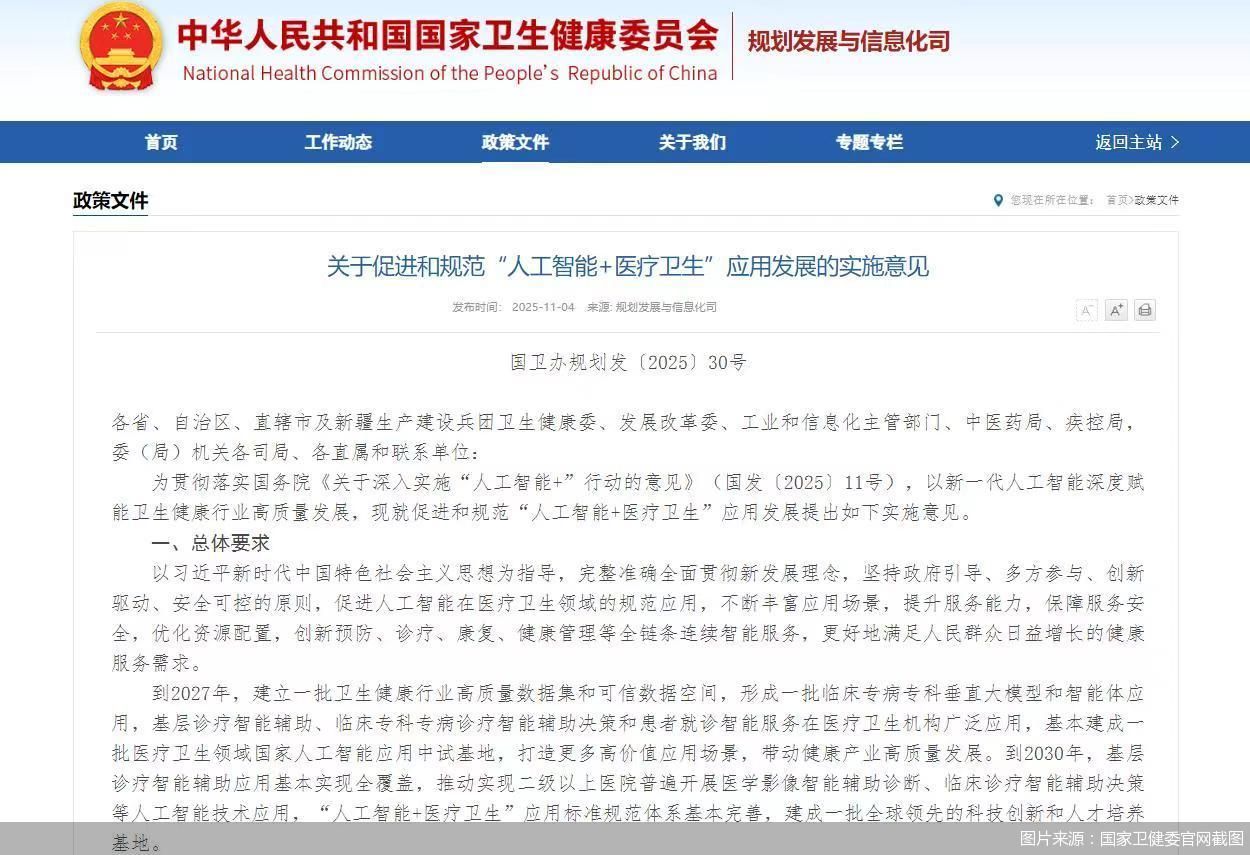
热门赛道再迎利好!“人工智能+医疗卫生”迎政策文件
Zheng Quan Shi Bao· 2025-11-04 05:47
Core Insights - The article discusses the implementation of the "Artificial Intelligence + Healthcare" initiative, aiming to enhance the healthcare sector through AI by 2027 and 2030 [1][6][31]. Group 1: Implementation Goals - By 2027, a series of high-quality datasets and trusted data spaces in the healthcare sector will be established, along with the development of specialized AI models and applications for clinical decision-making and patient services [1][6][31]. - By 2030, AI-assisted applications in primary care will achieve full coverage, and secondary hospitals will widely adopt AI technologies for medical imaging and clinical decision support [1][7][31]. Group 2: Key Considerations - The initiative emphasizes application-driven approaches, focusing on real business needs within the healthcare sector [2]. - It highlights the importance of grassroots healthcare, integrating AI into prevention, diagnosis, rehabilitation, and health management services [2]. - The initiative encourages collaboration among government, industry, academia, and research to leverage vast data and market potential for developing the health industry [2]. Group 3: Future Actions - The National Health Commission will enhance inter-departmental collaboration to support the implementation of the initiative, focusing on data security and privacy protection [3][31]. - The establishment of pilot bases for AI applications will address common industry challenges and foster a collaborative ecosystem [3][31]. - The initiative aims to summarize and promote new application experiences to stimulate innovation and create a robust AI healthcare service system [3][31]. Group 4: Specific Applications - AI will be integrated into various healthcare areas, including primary care, clinical diagnosis, patient services, traditional Chinese medicine, public health, research, and industry governance [32][36][39]. - Specific applications include intelligent diagnostic services, chronic disease management, and enhanced patient service processes [32][34][36]. Group 5: Infrastructure and Data Management - The initiative calls for the construction of a national health information platform to connect all healthcare institutions and improve data sharing [40][41]. - It emphasizes the need for optimized data collection processes and the establishment of a public support service platform for AI applications [41]. Group 6: Safety and Regulation - The initiative outlines a comprehensive governance mechanism for AI in healthcare, focusing on data security and personal privacy protection [42][43]. - It encourages the establishment of a regulatory framework to ensure safe and reliable AI applications in the healthcare sector [42][43].
