
公共管理

Search documents
一财社论:防范和纠治政绩观偏差要明确“关键少数”
Di Yi Cai Jing· 2026-02-24 12:21
Core Viewpoint - The article emphasizes the importance of establishing and practicing a correct view of performance within the party, highlighting the need for practical actions, focusing on key individuals, and identifying priority areas to strengthen accountability and deterrence [1][2][6] Group 1: Key Individuals - The focus of the educational initiative is on the "key minority," specifically county-level and above leadership, particularly the top leaders, to identify issues related to performance views through various methods [3] - The article points out that deviations in performance views among these key individuals can lead to widespread issues, including formalism and corruption, particularly at the grassroots level [3] Group 2: Priority Areas - The article identifies several critical areas of concern, including setting unrealistic high targets without considering local conditions, blindly following trends, creating barriers to national market integration, and inflating performance metrics [4] - It stresses the need for immediate rectification of prominent issues and the establishment of regulations that align with the correct view of performance [4] Group 3: Disciplinary Measures - The article outlines the disciplinary actions stipulated in the current regulations for party members whose performance views deviate from the new development philosophy, including warnings, removal from positions, or expulsion from the party depending on the severity of the deviation [5] - It advocates for stricter penalties for those involved in wasteful "image projects" or "performance projects" that do not yield genuine results [6]
关税增收叠加支出削减 美国财政赤字连续第四个月收窄
智通财经网· 2026-02-11 22:31
Group 1 - The U.S. federal government's budget deficit has narrowed for the fourth consecutive month due to increased tariff revenue and significant cuts in spending in areas such as education and environmental protection [1] - In January, the federal government spent approximately $30 billion more than it earned, a significant decrease from the $82 billion deficit in January 2025 [1] - The overall trend shows a slowdown in spending growth, with government revenue increasing by about 12% year-on-year, while spending has only grown by 1% [1] Group 2 - The budget for several federal agencies has been significantly reduced, with the Consumer Financial Protection Bureau's total spending dropping to $16 million in the first four months of the fiscal year, down from $228 million in the same period of 2025 [1] - Education-related spending has decreased by 19% year-on-year due to reduced funding allocated to the Office of Elementary and Secondary Education [2] - The Environmental Protection Agency's total spending this fiscal year is approximately $5.72 billion, significantly lower than the $26 billion spent in the same period last year [2] Group 3 - Tariff revenue has improved significantly, contributing $124 billion in customs duties this fiscal year, compared to only $31 billion in the same period last year [2] - There is ongoing uncertainty regarding the legality of tariff policies, with the U.S. Supreme Court expected to rule on the legality of the tariff measures implemented during the Trump administration [2]
日本经济政策正给日本消费者造成更多困难
2 1 Shi Ji Jing Ji Bao Dao· 2026-02-10 10:29
Group 1 - The ruling coalition of the Liberal Democratic Party and Japan Innovation Party secured a majority in the recent Japanese House of Representatives election, allowing Prime Minister Fumio Kishida to continue his administration and facilitating the passage of legislation in the House [2] - Following the election, the Japanese government expressed approval of the yen's depreciation, leading to a rapid decline in the yen's exchange rate to 157 yen per dollar, while the Nikkei average surged by 3,000 yen [2] - The market's confusion stems from the unclear policies of the Japanese government under Kishida, particularly regarding the timeline for implementing fiscal policies and the new budget for the upcoming fiscal year [3] Group 2 - The proposed budget for the upcoming fiscal year is expected to be the largest in history at 122.3 trillion yen, focusing on "crisis management investment" to address risks related to natural disasters, energy, and food supply [3] - The government plans to issue 29.6 trillion yen in new national debt, aiming to leverage increased tax revenue from high inflation and reduced interest burdens due to low rates, which may create a temporary fiscal benefit [4] - Economists predict that Japan can enjoy this fiscal benefit for no more than 10 years, after which the debt-to-GDP ratio could become unsustainable if no substantial measures are taken to reduce the national debt [4] Group 3 - The Bank of Japan missed an opportunity to raise interest rates last year, and the pressure on the central bank is expected to increase under Kishida's administration, especially if the government continues to favor yen depreciation [5] - The depreciation of the yen has led to rising import costs for essential goods, exacerbating domestic inflation and creating social issues [5] - Despite nominal wage growth, real wages in Japan have declined due to inflation, indicating that increased fiscal spending and acceptance of yen depreciation are negatively impacting consumers' purchasing power [5]
加拿大1月就业人数意外下滑 失业率降至16个月低点
Xin Lang Cai Jing· 2026-02-06 13:44
Group 1 - The Canadian economy experienced an unexpected decrease in employment by 24,800 jobs in January, while the unemployment rate fell to 6.5%, the lowest level in 16 months [1] - The manufacturing sector lost 27,500 jobs, primarily concentrated in Ontario, where key industries were impacted by U.S. tariffs [1] - Overall employment declines in manufacturing, educational services, and public administration outpaced job growth in information, business services, agriculture, and utilities [1] Group 2 - The employment rate decreased by 0.1 percentage points to 60.8%, marking the first decline since August 2025 [1] - The year-on-year growth rate of average hourly wages for permanent employees dropped to 3.3%, the lowest in seven months, down from 3.7% in December [1]
解释城市|纽约市城市服务型制造对上海发展制造业有哪些参考
Xin Lang Cai Jing· 2026-01-30 10:23
Core Insights - The article discusses the economic structure and industrial layout of New York City, highlighting the distribution of major industry sectors and their impact on the regional economy [2][7]. - It emphasizes the concentration of economic activity in a few key sectors while many others contribute relatively less, illustrating a dual characteristic of concentration and dispersion in New York's economy [7][8]. Economic Structure - In 2023, New York City's total economic output was $1,285.74 billion, with a clear distinction between "core pillar industries" (over 10% contribution), "mid-tier supporting industries" (3%-10%), and "specialty supplementary industries" (below 3%) [7][8]. - The "core pillar industries" include finance and insurance, real estate, information, and professional and technical services, collectively contributing $785.84 billion, or 61.1% of the city's GDP [8]. Key Industries - The finance and insurance sector alone accounts for approximately 25% of New York City's GDP, underscoring its status as a global financial center [8]. - Real estate and rental services are significant contributors, primarily driven by transactions, property management, and related services concentrated in Manhattan [8]. - The information sector has seen rapid growth, increasing from 10% to 12.4% of GDP over the past 20 years, while professional and technical services contribute around 10% [8]. Supporting Industries - "Mid-tier supporting industries" encompass public administration, wholesale and retail trade, healthcare, and accommodation and food services, collectively making up 23.3% of the economy [9][10]. - These industries are essential for maintaining the city's operational stability and resilience against economic fluctuations, as they are less affected by short-term economic changes [10]. Specialty Industries - "Specialty supplementary industries" include agriculture, mining, utilities, construction, manufacturing, transportation, management services, education, and arts and entertainment [11]. - Although these industries have a lower economic contribution, they play a vital role in supporting core industries and enhancing the city's cultural vibrancy [11]. Manufacturing Sector - Manufacturing's share of New York City's GDP has drastically declined to only 0.8% in 2023, reflecting a broader trend of urban centers moving away from manufacturing towards service-oriented economies [14][19]. - The historical context shows that manufacturing was once a significant part of New York's economy, particularly post-World War II, but has since diminished due to the rise of the service sector [15][18]. Current Manufacturing Landscape - The remaining manufacturing in New York is characterized by "urban service-oriented manufacturing," focusing on light industries such as food and apparel, which cater directly to local consumer needs [22][23]. - The manufacturing sector is primarily composed of food manufacturing (26.9%), apparel manufacturing (15.0%), and printing (13.4%), indicating a strong alignment with urban consumption patterns [25][22].


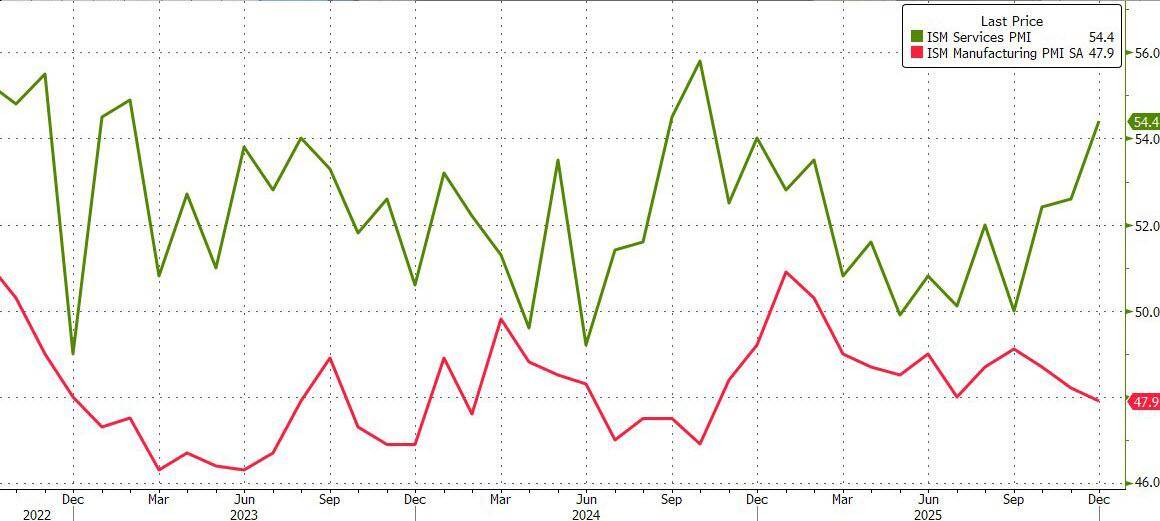
美国12月ISM服务业PMI 54.4创一年多最高,需求稳健,招聘回暖
Sou Hu Cai Jing· 2026-01-08 01:25
Core Insights - The US services sector expanded at its fastest pace in over a year in December, driven by robust demand growth and a rebound in hiring [1] - The ISM services index rose by 1.8 points to 54.4, marking the highest level since October 2024, and exceeded market expectations of 52.2 [1] - The December reading surpassed all forecasts in a survey of economists [1] Industry Performance - In December, 11 industries reported growth, led by retail, finance and insurance, and accommodation and food services; 5 industries contracted, including management and support services [5] - The strong performance of the services sector contrasts sharply with the weakness in manufacturing, which saw the most severe contraction since 2024 [5] Economic Indicators - New orders increased at the fastest rate since September 2024, and the index measuring business activity reached a one-year high [6] - Export orders grew at the fastest pace in over a year, indicating a recovery in demand [6] - Employment in the services sector saw the healthiest growth since February, with expectations of moderate growth in non-farm payrolls and a slight decrease in the unemployment rate [6] Price and Inventory Trends - The ISM services and materials prices index showed the slowest price increase in nine months [6] - Inventory expansion reached its fastest pace since October 2024, although the inventory sentiment index declined for the third consecutive month, indicating fewer firms believe their inventories are excessive [6] - The supplier delivery index fell 2.3 points from a one-year high [6] Sector-Specific Comments - Accommodation and food services reported high price pressures due to government trade and tariff policies, particularly affecting imports from Southeast Asia and South America [7] - The agriculture, forestry, fishing, and hunting sector noted flat overall business performance, with strong demand for value brands but challenges for high-end brands [7] - The finance and insurance sector reported stable business conditions with most contracts being renewed as the new year approaches [7] - The healthcare and social assistance sector experienced a surge in demand for respiratory devices and related supplies due to rising flu cases [7] - The information sector faced the highest annual price increases from major service and data providers in years, pushing costs higher [7] - Public administration expressed ongoing uncertainty and concerns regarding tariffs and their pricing impacts [7] - The transportation and warehousing sector benefited from heightened business activity during the holiday season [7]
补充预算将日本拖向债务深渊
Jing Ji Ri Bao· 2025-12-18 22:09
Group 1 - The Japanese government has passed a supplementary budget for fiscal year 2025, which supports a large-scale economic stimulus plan amounting to 21.3 trillion yen (approximately 135.4 billion USD) [1] - The approved supplementary budget totals 18.3 trillion yen, representing a 31.7% increase from the previous year's budget of 13.9 trillion yen, with over 60% of the spending financed through new bond issuance [1] - Concerns are rising regarding Japan's fiscal health as 11.7 trillion yen of the budget will be covered by issuing new debt, exacerbating the country's debt situation [1] Group 2 - Japanese government bond yields are rising rapidly due to expectations of interest rate hikes by the Bank of Japan and the economic stimulus plan, with the 10-year bond yield reaching 1.975%, the highest since June 2007 [2] - Japan's government debt is approximately 2.5 times its GDP, leading to projected interest payments of about 16.5 trillion yen in 2025, which will account for 1.7% of GDP [2] - Increasing bond yields will significantly raise interest expenses, constraining macroeconomic policy space and eroding national wealth, making fiscal balance difficult to maintain [2] Group 3 - The draft budget for fiscal year 2026 is expected to exceed 120 trillion yen, setting a new record for general account expenditures, indicating a trend of fiscal expansion [3] - The defense budget for fiscal year 2026 may surpass 9 trillion yen, marking a historical high and reflecting Japan's apparent militarization efforts, which could threaten regional peace and stability [3] - If market confidence in the Japanese economy wanes, it could lead to significant capital outflows, resulting in more severe market volatility [3]
多措并举应对美国财政收支风险带来的负面影响
Mei Ri Jing Ji Xin Wen· 2025-12-18 13:19
Core Viewpoint - The article discusses the imbalance in the U.S. fiscal structure exacerbated by the Trump administration's policies, highlighting the negative impacts on both the U.S. and global economies [1][2][3]. Fiscal Revenue and Expenditure - In FY2025, U.S. federal revenue is projected at $5.2 trillion, while expenditures will reach $7.01 trillion, resulting in a budget deficit of approximately $1.8 trillion, marking the sixth consecutive year of deficits exceeding $1 trillion [2]. - Personal income tax remains the primary source of revenue at $2.66 trillion, with a year-on-year growth of 10%. Tariff revenues have surged significantly, indicating a shift towards reliance on tariffs rather than personal income taxes [2]. - Major expenditures are concentrated in mandatory spending areas such as social security, Medicare, and Medicaid, with interest payments on debt surpassing $1 trillion [2]. Economic and Trade Impacts - The adjustment in fiscal policy is causing severe macroeconomic and consumer rights losses in the U.S. High tariffs are increasing costs for importers, contributing to inflationary pressures and potentially harming the international competitiveness of U.S. manufacturing [3]. - The reliance on tariffs to cover fiscal shortfalls is leading to efficiency losses, negatively affecting the majority of American residents, with the overall economic cost of tariff policies likely exceeding fiscal benefits [3]. - The U.S. education department's budget is set to drastically reduce from $268 billion in FY2024 to $34 billion in FY2025, significantly impacting public schools and vulnerable groups [3]. Global Supply Chain and Trade Dynamics - The "Great America Act," signed by Trump, is expected to increase the U.S. fiscal deficit by approximately $3.4 trillion over the next decade, leading to significant changes in fiscal structure and global supply chain dynamics [4]. - The trend towards regionalization and localization in global supply chains is being reinforced by U.S. policies, which may increase business adjustment costs and fragment global trade [4]. U.S.-China Economic Relations - The sustainability of U.S. debt is becoming increasingly problematic, with interest payments projected to account for about 3.4% of GDP in FY2025, while actual GDP growth remains around 2%, indicating difficulties in servicing debt [5]. - If the U.S. fiscal situation does not improve, the risk of debt default could threaten the safety of Chinese-held U.S. dollar assets [6]. - Tariff increases are raising costs for Chinese goods entering the U.S. market, leading to a decline in bilateral trade, with Chinese exports to the U.S. down 17% and imports down 12% in the first ten months of 2025 [6]. Strategic Responses - To mitigate negative impacts, strategies should include maintaining global supply chain stability and engaging in tax competition, while also enhancing domestic production capabilities and exploring regional cooperation [7][8]. - Building an open economy driven by domestic demand is essential, with a focus on government investment in future industries and strategic sectors, as well as enhancing the role of the RMB in international trade [8]. - Improving fiscal management and preventing financial risks through tax system reforms and optimizing foreign exchange reserves are critical for ensuring fiscal sustainability [8].
非农数据反复 + 政策迷雾:Wmax 前瞻美国经济与美联储路径
Sou Hu Cai Jing· 2025-12-17 08:49
Core Insights - The U.S. job market presents a complex picture with November non-farm data exceeding expectations but revealing underlying concerns [2][3] - Wmax's analysis indicates a divergence in employment data, with a notable increase in non-farm employment but rising unemployment rates and stagnant wage growth [3][6] Employment Data Analysis - November saw an addition of 64,000 non-farm jobs, surpassing the expected 50,000, providing a temporary boost to the labor market [3] - The unemployment rate rose to 4.6%, higher than the anticipated 4.4%, marking the highest level since September 2021 [3] - Average hourly wage growth was recorded at 3.5% year-over-year and 0.1% month-over-month, both below market expectations and indicating weak employment quality and income growth [3] Data Revision and Trends - October's non-farm employment figures were revised down to a decrease of 105,000, the largest drop since late 2020, significantly exceeding the expected decline of 25,000 [6] - The revisions were influenced by over 150,000 federal employees accepting buyouts, reflecting the impact of government downsizing [6] - Retail sales in October showed no growth, attributed to weak auto sales, further confirming the negative effects of employment fluctuations on consumer spending [6] Data Collection Adjustments - The release of employment data was affected by a government shutdown, leading to extended data collection periods which improved collection rates [7] - Collection rates reached 80.2% for September and over 73% for October and November, the highest in five years [7] - Wmax highlights the trade-off between data accuracy and timeliness, echoing concerns from former Labor Statistics officials regarding the implications of delayed data [7] Federal Reserve Policy Implications - Following the employment and retail sales data release, market expectations for interest rate cuts increased, with the probability of a January rate cut rising from 22% to 31% [10] - The market anticipates two rate cuts in 2026, with an expected total easing of 58 basis points for the year [10] - The Federal Reserve faces a dilemma between implementing easing measures to prevent economic slowdown and managing inflation risks [12] Future Economic Outlook - Wmax emphasizes the need for investors to consider multiple factors beyond single-month data to gauge economic trends accurately [13] - Key variables include the trend of data revisions, adjustments in statistical methods, and real demand changes at the industry level [13] - The upcoming months will clarify the U.S. economic landscape as annual data revisions and Federal Reserve meetings unfold, impacting global financial markets [13]

邢善萍在西安市未央区调研信访和基层治理工作
Shan Xi Ri Bao· 2025-12-11 00:29
Group 1 - The core viewpoint emphasizes the importance of implementing the spirit of the 20th Central Committee's Fourth Plenary Session and key directives from General Secretary Xi Jinping, focusing on improving grassroots governance and addressing public grievances effectively [1] - The need for a comprehensive approach to legalize and enhance the effectiveness of petition work, particularly in key areas such as urban renovation, property registration, and labor and social security [1] - The promotion of the "Fengqiao Experience" in modern governance, which includes establishing mechanisms for regular communication with the public, collecting public sentiment, and resolving demands to control the increase in petitions at the source [1] Group 2 - The emphasis on the role of government in leading the construction of the urban-rural integration factor trading market platform, aiming to enhance the scale, marketization, convenience, and standardization of operations [2] - The platform is designed to facilitate equal exchange and two-way flow of various factors between urban and rural areas, thereby supporting integrated development and comprehensive rural revitalization [2]