
智能医疗装备

Search documents
拉爆了!沪指10年新高,突破4100点!超3900只个股上涨,放量成交超3万亿!后市怎么看?
雪球· 2026-01-09 07:57
Market Overview - The A-share market continues to rise, with the Shanghai Composite Index achieving a 16-day consecutive increase, reaching 4100 points for the first time in 10 years [1][2]. Trading Performance - As of the market close, the Shanghai Composite Index rose by 0.92%, the Shenzhen Component Index by 1.15%, the ChiNext Index by 0.77%, and the North Star 50 Index by 1.05% [2]. - The total trading volume in the Shanghai, Shenzhen, and Beijing markets reached 31,523 billion yuan, an increase of 3,261 billion yuan from the previous day, with over 3,900 stocks in these markets showing gains [3]. Sector Performance - Leading sectors include AI applications, commercial aerospace, military equipment, controllable nuclear fusion, small metals, medical services, oil and gas extraction and services, computing power leasing, and retail, which saw significant gains [3]. - Underperforming sectors include insurance, airport and shipping, glyphosate, photovoltaics, brain-machine interfaces, and banking [3]. Robotics Sector - The humanoid robot sector is particularly active, with Fenglong Co., Ltd. achieving an 11-day consecutive limit-up, surpassing the previous record of 10 days [4][7]. - Fenglong's stock closed at 51.06 yuan per share, with a market capitalization of 11.157 billion yuan, and a static P/E ratio of 2,208.41 times, significantly higher than the industry average [10][8]. AI Applications - The AI application sector is experiencing a surge, with companies like Kunlun Wanwei and others reaching limit-up levels [11]. - The global leading AI company MINIMAX-WP listed in Hong Kong, with its stock price increasing by over 80% shortly after opening [13][14]. - The penetration of AI applications in consumer sectors is rapidly advancing, with significant growth expected in areas such as surgical robots and intelligent diagnostic systems [15]. Financing and Market Sentiment - As of January 8, the financing balance on the Shanghai Stock Exchange reached 1,306 billion yuan, an increase of 77.92 billion yuan from the previous day, indicating a positive market sentiment [17]. - Analysts suggest that the first half of 2026 may see a window for interest rate cuts, which could further enhance liquidity and support market growth [20][21].



“人工智能+制造”重磅部署 五大行业迎转型路线图
2 1 Shi Ji Jing Ji Bao Dao· 2026-01-08 23:30
Core Viewpoint - The "Artificial Intelligence + Manufacturing" initiative aims to enhance the integration of AI technologies within China's manufacturing sector, targeting significant advancements by 2027, including the establishment of a secure supply of core AI technologies and a leading position in industry scale and empowerment levels [1][3][14]. Group 1: Key Objectives and Measures - By 2027, China aims to achieve a secure and reliable supply of key AI technologies, with industry scale and empowerment levels ranking among the world's top [3][14]. - The initiative outlines seven key tasks, including innovation foundation, intelligence upgrade, product breakthroughs, entity cultivation, ecosystem expansion, safety protection, and international cooperation, with 21 specific measures to promote "dual empowerment" of AI technology and manufacturing applications [1][4][16]. Group 2: Industry-Specific Pathways - The initiative customizes transformation pathways for five major industries: raw materials, equipment manufacturing, consumer goods, electronic information, and software and IT services, moving away from a one-size-fits-all approach [7][17]. - For the raw materials sector, the focus is on enhancing the intelligent level of the steel industry through the development of dynamic models covering the entire production process [17][18]. - In the automotive sector, the initiative emphasizes the intelligent upgrade of the entire supply chain, including the creation of automotive models for real-time optimization [18]. Group 3: Support for Enterprises - The initiative encourages local governments to provide support such as "computing power vouchers" and "model vouchers" to lower the application costs of AI technologies for enterprises, particularly small and medium-sized enterprises (SMEs) [11][21]. - It aims to cultivate a tiered support mechanism for enterprises, fostering both large enterprises and specialized SMEs to create a collaborative ecosystem [21][22]. Group 4: Technological Advancements - The initiative promotes the iteration of intelligent equipment and the upgrade of smart terminals, including the development of new-generation AI numerical control systems and intelligent medical equipment [10][20]. - It also focuses on the integration of AI technologies into major technical equipment development, such as large aircraft and ships, and the commercialization of new terminal technologies like AR/VR devices [20]. Group 5: Overall Impact and Future Directions - The initiative is seen as a critical step for China's manufacturing sector to transition from scale advantages to quality, efficiency, and intelligence advantages, requiring continuous exploration and collaboration among government, industry, academia, and research [4][15]. - The ultimate goal is to enable AI not only as a tool for efficiency but also as a catalyst for disruptive innovation in manufacturing, facilitating the transition from "Made in China" to "Intelligent Manufacturing in China" [3][14].
八部门:加快人工智能赋能工业母机、工业机器人
3 6 Ke· 2026-01-07 10:15
Core Viewpoint - The Ministry of Industry and Information Technology, along with seven other departments, has issued the "Implementation Opinions on the Special Action of 'Artificial Intelligence + Manufacturing'" to accelerate the integration of artificial intelligence in various industrial sectors [1] Group 1: AI in Manufacturing - The initiative aims to enhance the capabilities of industrial mother machines and robots through AI, focusing on the development of next-generation AI numerical control systems that improve autonomous decision-making, analysis, and execution [1] - There is a push to accelerate the development of surgical robots and intelligent diagnostic systems, promoting innovation in smart medical equipment and its clinical application [1] Group 2: AI in Major Equipment - The plan encourages the integration of AI technologies in the research, development, manufacturing, and operation of major technical equipment such as large aircraft and ships [1] - The development of intelligent low-altitude equipment, including drones, is also a focus area [1] Group 3: Smart Vehicles - The initiative includes conducting tests and safety assessments for smart connected vehicles equipped with autonomous driving features, with a structured approach to product access and road testing trials [1]

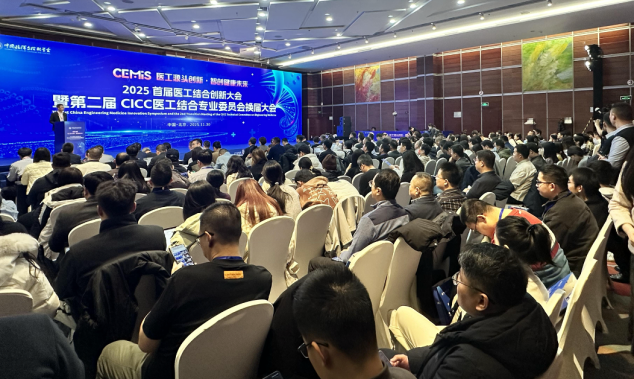
首届医工结合创新大会在京举办
Yang Shi Wang· 2025-12-03 08:17
Core Insights - The first Medical-Engineering Integration Innovation Conference will be held on November 30, 2025, in Beijing, focusing on the theme "Source Innovation in Medical Engineering, Smartly Creating a Healthy Future" [1][3] - The conference aims to shift from traditional academic exchanges to actionable outcomes in the field of medical-engineering integration, emphasizing the importance of collaboration and practical applications [3] Group 1 - The conference is organized by the China Command and Control Society (CICC) and aims to gather experts in the medical-engineering integration field to share cutting-edge achievements [1] - A key component of the conference is the "Medical-Engineering Integration Open Space: Source Innovation Matching Salon," which promotes a decentralized, demand-driven approach to discussions, allowing participants to propose topics and engage in targeted discussions [3] - The salon successfully facilitated 38 substantial cooperation intentions, highlighting its effectiveness in bridging clinical needs, engineering responses, and industrial resources [3] Group 2 - The conference emphasizes the industry consensus that "medical-engineering integration is a necessary path for a healthy China," outlining practical pathways such as clinical demand-driven approaches, differentiated breakthroughs in traditional Chinese medicine, and talent mechanisms [3] - The event aims to create a closed-loop system that connects clinical needs with engineering technology responses and industrial resource implementation, moving from academic discussions to fundamental breakthroughs [3]
五部门联合发文促进和规范“人工智能+医疗卫生”应用发展
Zhong Guo Zheng Quan Bao· 2025-11-04 23:32
Core Insights - The National Health Commission and five other departments have jointly issued implementation opinions to promote and regulate the application of "Artificial Intelligence + Healthcare" [1] - By 2027, the goal is to establish high-quality health industry data sets and trusted data spaces, along with the widespread application of intelligent decision-making and patient service systems in healthcare institutions [1] Group 1: Clinical Diagnosis - The implementation opinions emphasize the promotion of intelligent diagnostic services in medical imaging, supporting the collective development of AI-assisted diagnosis and report generation in provincial hospitals [2] - There is a focus on enhancing diagnostic efficiency and report quality by expanding AI-assisted diagnosis from single diseases to multiple diseases affecting single organs [2] - High-level hospitals are encouraged to gather and develop high-quality medical imaging data for AI model research and upgrades [2] Group 2: Health Industry Development - The implementation opinions support collaboration between medical equipment manufacturers and healthcare institutions to advance intelligent medical equipment development [2] - Key areas for intelligent upgrades include medical imaging, diagnostic testing, treatment, monitoring, and life support equipment [2] - There is encouragement for the application of domestically produced intelligent medical equipment in healthcare institutions, particularly for innovative tasks in AI medical devices [2]
五部门联合发文 促进和规范“人工智能+医疗卫生”应用发展
Zhong Guo Zheng Quan Bao· 2025-11-04 20:19
Core Viewpoint - The National Health Commission and five other departments have jointly issued implementation opinions to promote and regulate the application of "Artificial Intelligence + Healthcare," aiming for significant advancements in medical imaging and intelligent healthcare services by 2027 [1][2]. Group 1: Implementation Goals - By 2027, a number of high-quality health industry data sets and credible data spaces will be established, along with the development of specialized clinical models and intelligent applications [1]. - The implementation opinions emphasize the widespread application of intelligent auxiliary decision-making in grassroots diagnosis, specialized clinical treatment, and patient services within healthcare institutions [1]. Group 2: Key Application Areas - The opinions outline 24 key applications across eight areas, including grassroots applications, clinical diagnosis, patient services, and traditional Chinese medicine [1]. - There is a focus on enhancing infrastructure, enriching medical data supply, optimizing AI algorithms, strengthening pilot base construction, and supporting technology talent and standards [1]. Group 3: Clinical Diagnosis and Health Industry - The promotion of intelligent diagnostic services in medical imaging is highlighted, with support for centralized provincial efforts in AI-assisted diagnosis, report generation, and treatment recommendations [2]. - The opinions encourage collaboration between medical equipment manufacturers and healthcare institutions to drive intelligent upgrades in medical devices, particularly in imaging, diagnostics, treatment, and monitoring [2].
国家卫健委等:提升智能医疗装备创新能力
Jing Ji Guan Cha Wang· 2025-11-04 02:59
Core Viewpoint - The National Health Commission and other departments have issued implementation opinions to promote and regulate the application development of "Artificial Intelligence + Healthcare" [1] Group 1: Policy Support - The implementation opinions support medical equipment manufacturers to collaborate with medical institutions and research institutes for the development of intelligent medical equipment [1] - Focus areas for intelligent upgrades include medical imaging, diagnostic testing, treatment, monitoring, and life support [1] - Encouragement for joint applications to participate in innovative tasks for AI medical devices [1] Group 2: Domestic Equipment Promotion - Support for the first application of domestic intelligent medical equipment in medical institutions [1] - Promotion of intelligent medical equipment that is at the forefront of technological innovation and clinical application levels nationwide [1]
【新华解读】机械行业两年目标:营收年均增速3.5%左右 推动产业数智升级
Xin Hua Cai Jing· 2025-09-29 14:57
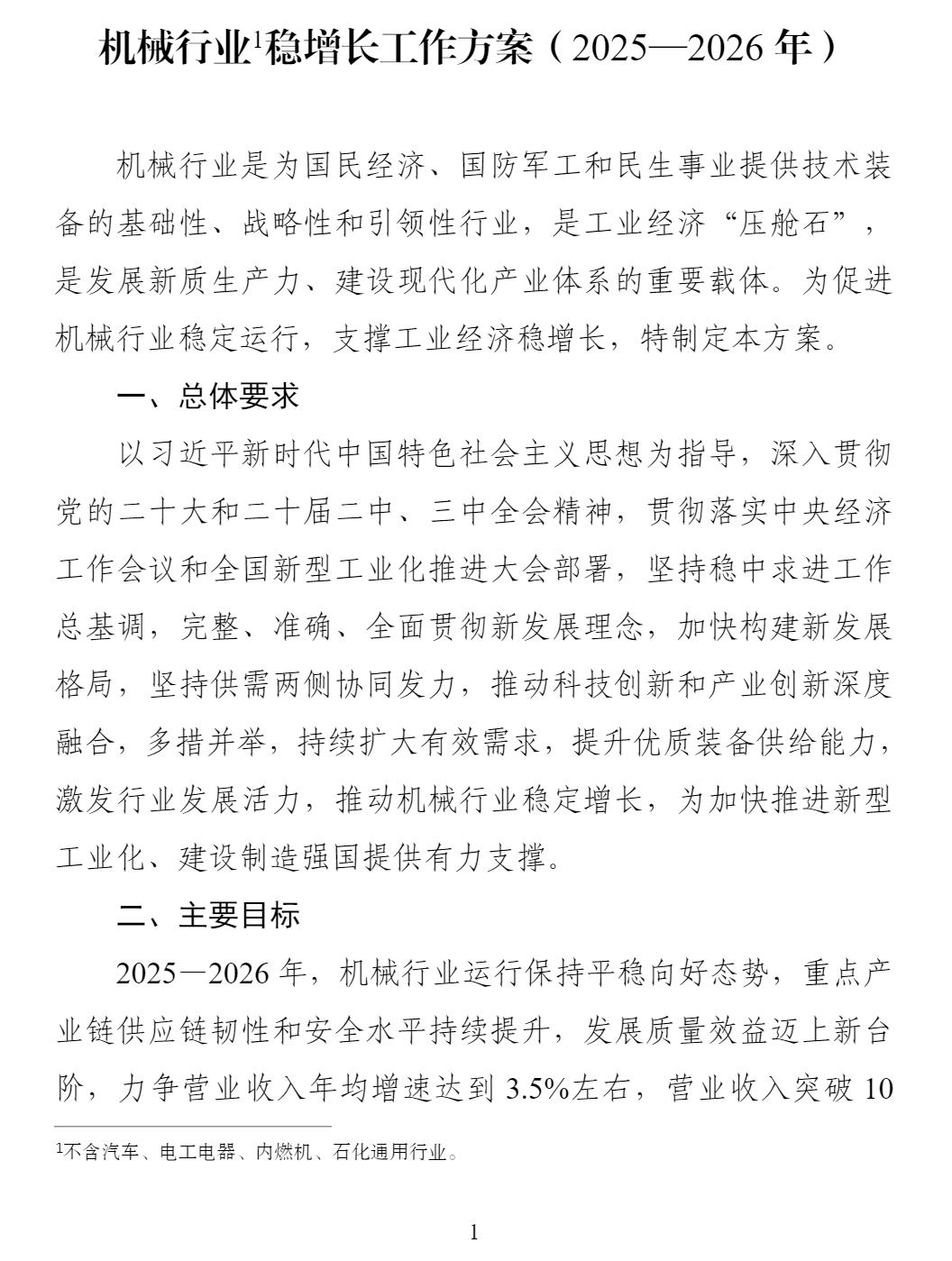
Core Viewpoint - The "Mechanical Industry Stabilization and Growth Work Plan (2025-2026)" aims for an average revenue growth rate of approximately 3.5% and to exceed 10 trillion yuan in revenue by 2026, promoting the integration of artificial intelligence and the mechanical industry [1][2][3] Group 1: Industry Goals and Challenges - The mechanical industry is a foundational and strategic sector for the national economy, facing challenges such as external shocks, insufficient domestic demand, and irrational competition [2][3] - The work plan sets a target for the mechanical industry to maintain a stable and positive operational trend, with a focus on enhancing supply chain resilience and safety, and improving quality and efficiency [2][3] Group 2: Key Highlights of the Work Plan - The work plan emphasizes three main highlights: increased efforts in cultivating new productive forces, addressing external risks, and creating a favorable industrial ecosystem [3][4] - Specific tasks include tapping into existing market potential, fostering new demand, expanding effective investment, promoting digital transformation, and enhancing open cooperation [4][5] Group 3: Opportunities in Intelligent Equipment - The mechanical industry is experiencing a steady increase in revenue, with a focus on technological innovation and improved cash flow [5][6] - The work plan aims to accelerate the application of intelligent equipment such as smart industrial mother machines and robots, leveraging breakthroughs in artificial intelligence [6] - Analysts predict that the overall prosperity of the mechanical industry will rise by 2025, with growth in sectors like semiconductor equipment, engineering machinery, and lithium battery equipment [6]
六部门印发“机械行业稳增长方案”:2025—2026年机械行业力争营业收入年均增速达到3.5%左右
Zhi Tong Cai Jing· 2025-09-29 07:39
Core Viewpoint - The Ministry of Industry and Information Technology, along with five other departments, has released the "Mechanical Industry Steady Growth Work Plan (2025-2026)", aiming for stable growth in the mechanical industry with an average annual revenue growth rate of approximately 3.5%, targeting a revenue exceeding 10 trillion yuan by 2026 [1][6][7]. Summary by Sections Overall Requirements - The plan is guided by Xi Jinping's thoughts and aims to support industrial economic stability through a comprehensive approach that integrates supply and demand, promotes technological and industrial innovation, and enhances the quality of equipment supply [5]. Main Goals - The mechanical industry is expected to maintain a stable and positive operational trend, with resilience and safety in key supply chains continuously improving. The plan aims for an average annual revenue growth rate of around 3.5% and a revenue target of over 10 trillion yuan by 2026 [6][7]. Work Measures - **Expanding Effective Demand**: The plan emphasizes activating existing demand, promoting new demand, and stabilizing foreign trade. It includes initiatives for updating old equipment and promoting advanced agricultural machinery and medical equipment [8][9][10]. - **Investment Expansion**: It encourages significant investment in major projects and infrastructure, particularly in agricultural machinery, engineering machinery, and medical equipment [10]. - **Digital Transformation**: The plan promotes the digital transformation of industries, supporting smart manufacturing and the integration of new technologies [11]. - **Open Cooperation**: It encourages enterprises to explore international markets and participate in global trade, enhancing their competitiveness [12][14]. Enhancing Quality Equipment Supply - The plan focuses on integrating technological and industrial innovation, improving the resilience of supply chains, and enhancing the quality of equipment supply through various initiatives [15][16]. Stimulating Industry Growth - The plan aims to create a favorable environment for industry development, support the growth of world-class equipment enterprises, and enhance the competitiveness of small and medium-sized enterprises [21][22][24]. Guarantee Measures - **Coordination and Policy Support**: The plan emphasizes the importance of coordinated efforts among various departments and the implementation of supportive policies to ensure the mechanical industry's stable operation [25][26]. - **Monitoring Operations**: It includes establishing a risk warning mechanism for the economic operation of the mechanical industry and regular monitoring of economic performance [26][27].
六部门:发展一批智能农机、智能医疗装备、服务和特种机器人等智能民生装备
Zheng Quan Shi Bao Wang· 2025-09-29 07:28
Core Viewpoint - The Ministry of Industry and Information Technology, along with five other departments, has released the "Mechanical Industry Stabilization and Growth Work Plan (2025-2026)", focusing on the development of intelligent equipment and systems [1] Group 1: Development Focus - Emphasis on the innovation and development of intelligent equipment, including general large models and industry-specific models [1] - Integration of emerging technologies such as artificial intelligence, quantum technology, advanced materials, and Beidou navigation with equipment innovation [1] Group 2: Strategic Objectives - Targeting national defense and strategic needs, the plan aims to break through in areas such as industrial mother machines, intelligent instruments, intelligent detection equipment, and mining safety equipment [1] - Development of intelligent equipment for improving quality of life, including smart agricultural machinery, medical equipment, service robots, and emergency safety equipment [1] Group 3: Global Trends and User Needs - Addressing global technological innovation trends and future industry demands, the plan focuses on high-end equipment like intelligent robots [1] - Encouragement for equipment companies to focus on personalized user needs and enhance smart service functions such as data acquisition, interconnectivity, and autonomous execution [1] Group 4: Ecosystem and Innovation Mechanism - Promotion of collaboration between equipment companies and industry interconnection service providers to create an interconnected equipment ecosystem while ensuring data security [1] - Improvement of the intelligent manufacturing system solution mechanism to drive innovation breakthroughs in processes, equipment, and software [1]