
房地产中介

Search documents
广州市房地产中介协会发倡议书:抵制“返佣”行为
Zheng Quan Shi Bao Wang· 2025-10-21 10:34
(原标题:广州市房地产中介协会发倡议书:抵制"返佣"行为) 人民财讯10月21日电,广州市房地产中介协会10月21日发布《关于提高房地产中介服务水平、抵制"返 佣"行为的倡议书》。其中提出,坚持依法依规经营,杜绝承诺返佣行为。严格遵守《房地产经纪管理 办法》《广州市房地产中介服务管理条例》等法律法规及行业规范,机构开展房地产中介业务应依法办 理《房地产中介服务机构备案证书》,并为本机构的从业人员办理《房地产中介从业人员信用信息 卡》。坚决抵制任何形式的返佣等不正当竞争行为,将竞争焦点置于提升服务质量、增强专业能力、优 化消费者体验上。 ...
果然财经|贝壳隐藏二手成交价,楼市开启蒙眼厮杀大战?
Qi Lu Wan Bao· 2025-10-21 03:19
Core Viewpoint - Beike's decision to hide second-hand housing transaction prices has raised concerns about transparency in the real estate market, potentially leading to a "guessing game" for buyers and sellers, and altering the dynamics of price negotiations [2][12][15] Group 1: Impact on Market Dynamics - The removal of visible transaction prices may lead to increased information asymmetry, allowing sellers to set higher prices without a clear benchmark, which could result in inflated asking prices and flexible commission negotiations for intermediaries [11][12] - Beike's historical commitment to transparency has been compromised, which may erode customer trust and lead to a decline in transaction frequency as buyers and sellers become more hesitant [11][14] - The change is seen as a response to market pressures, including the rise of "zero commission" models that have disrupted traditional commission structures, prompting Beike to adapt its pricing strategy [14][15] Group 2: Historical Context and Recent Developments - Beike's move to hide transaction prices is not unprecedented; similar actions were taken in cities like Shenzhen and later in other major cities, indicating a broader trend in response to market conditions [3][14] - The decision aligns with recent initiatives from real estate associations aimed at stabilizing market expectations and preventing panic selling among homeowners [14][15] - The shift may also be a strategic maneuver to counteract negative market sentiment and protect property values, as publicized low transaction prices have been linked to increased seller anxiety [12][15] Group 3: Stakeholder Reactions - Real estate agents express mixed feelings; while some believe it will not significantly impact their operations, others worry about the long-term implications for market trust and competition [10][11] - Buyers are increasingly reliant on informal channels for price information, leading to a more fragmented and uncertain purchasing process [12][14] - There are calls for greater transparency in the market, with suggestions for government involvement to provide reliable transaction data to buyers and sellers [14][15]


深圳上周二手房录得量达1696套 创近半年来单周新高
Shen Zhen Shang Bao· 2025-10-20 23:15
Core Insights - Shenzhen's second-hand housing market recorded a weekly transaction volume of 1,696 units, marking a 39.1% increase compared to the previous week, reaching a six-month high for weekly transactions [1] - New housing transactions also saw significant growth, with 883 units sold, representing a 100.7% week-on-week increase [1] Market Performance - The second-hand housing volume in Shenzhen for the week of October 13-19, 2025, reached 1,696 units, indicating a robust recovery in the market [1] - The new housing market (including pre-sale and current sales) experienced a post-holiday rebound, with a total of 883 units sold [1] Regional Analysis - The Longgang district led the second-hand housing market with a remarkable increase, recording 502 units sold, outperforming other regions [1] - Within Longgang, the Shuanglong area stood out with 222 units sold, achieving the highest transaction volume among all districts [1] Market Activity - According to data from the Le Youjia Research Center, the number of signed contracts for second-hand residential properties reached a daily high since April 21, with a 28% increase compared to the previous Sunday [1] - Viewing activity for second-hand properties also peaked, significantly surpassing the interest seen during the National Day holiday [1] - The overall trading activity in Shenzhen's real estate market is currently at a high level for the second half of the year, with delayed purchasing demand being released following the National Day holiday [1]
我爱我家:截至2025年10月10日,公司股东总户数为74662户
Zheng Quan Ri Bao Wang· 2025-10-20 14:14
Core Viewpoint - I Love My Home (000560) reported that as of October 10, 2025, the total number of shareholders is 74,662 [1] Summary by Category - Company Information - The total number of shareholders for I Love My Home is 74,662 as of the specified date [1]

9月项目开盘去化率同比上涨,居民中长贷同比多增
SINOLINK SECURITIES· 2025-10-19 11:38
Investment Rating - The report suggests a low valuation in the real estate sector, recommending to accumulate real estate stocks on dips [5]. Core Viewpoints - The real estate market is experiencing a downturn, with A-share real estate down by 2.3% and Hong Kong real estate down by 2.8% in the week of October 11-17 [1]. - The land market's premium rate is at a low level, with an average premium rate of 3% for residential land transactions in 300 cities [1]. - New housing sales in 47 cities totaled 402 million square meters, showing a week-on-week increase of 165% but a year-on-year decrease of 20% [2]. - The average opening sales rate for projects in September increased by 10 percentage points year-on-year to 39% [3]. - The new long-term loans for residents in September increased by 250 billion yuan, indicating a rebound in financing [4]. Summary by Sections Market Performance - A-share real estate sector ranked 15th with a decline of 2.3%, while Hong Kong real estate ranked 8th with a decline of 2.8% [1][17]. - The property service and management index in Hong Kong fell by 2.4%, while the Hang Seng China Enterprises Index dropped by 3.7% [22]. Land Market - In the week of October 11-17, 2025, the total area of residential land sold in 300 cities was 859 million square meters, a week-on-week increase of 26% but a year-on-year decrease of 46% [25]. - The cumulative area of residential land sold from the beginning of 2025 to now is 32,117 million square meters, down 10.2% year-on-year [25]. New Housing Sales - In the week of October 11-17, 2025, new housing sales in 47 cities totaled 402 million square meters, with a week-on-week increase of 165% but a year-on-year decrease of 20% [32]. - Sales in first-tier cities increased by 182% week-on-week but decreased by 31% year-on-year [35]. Second-hand Housing Sales - In the same week, second-hand housing sales in 22 cities totaled 266 million square meters, with a week-on-week increase of 182% but a year-on-year decrease of 18% [41]. - First-tier cities saw a week-on-week increase of 181% but a year-on-year decrease of 21% [41]. Financing Trends - The new long-term loans for residents in September amounted to 250 billion yuan, reflecting a year-on-year increase of 200 billion yuan [4][14]. - The cumulative new long-term loans from January to September decreased by 13.6% year-on-year, but the decline has narrowed compared to previous months [15].



天津小王总房产漫谈与研判
Sou Hu Cai Jing· 2025-10-19 02:11
Market Overview - The real estate market has transitioned from a "supply-demand imbalance" to a "value-oriented" phase, emphasizing careful selection of properties [1] - There is a clear market differentiation: properties in core cities with quality locations, educational resources, and convenient transportation maintain strong resilience, while suburban areas with oversupply face challenges [1] Policy Implications - The policy stance of "housing is for living, not for speculation" remains unchanged, but measures such as "recognizing houses, not loans," lowering down payments, and relaxing interest rates are gradually releasing reasonable demand [1] Investment Strategy - Future real estate investments should focus on the dual attributes of "self-occupation and value preservation" [1] - Buyers are encouraged to assess their needs and repayment capabilities rationally to avoid excessive leverage [1] - For clients looking to upgrade, the current low-interest rate environment presents an opportunity for strategic property exchanges [1] Rental Market Trends - The rental market is gaining attention due to population mobility and changing living concepts, with increasing demand for long-term and quality rental housing [1] - Professional institutional management is expected to become a trend in the rental market [1] Professional Commitment - The industry emphasizes the importance of integrity and professional empowerment to build long-term trust with clients [1] - The belief is that while the real estate market may not always rise, professionalism and responsibility will always hold value [1]
惠州5房企、5中介机构违法违规被通报!
Nan Fang Du Shi Bao· 2025-10-18 12:43
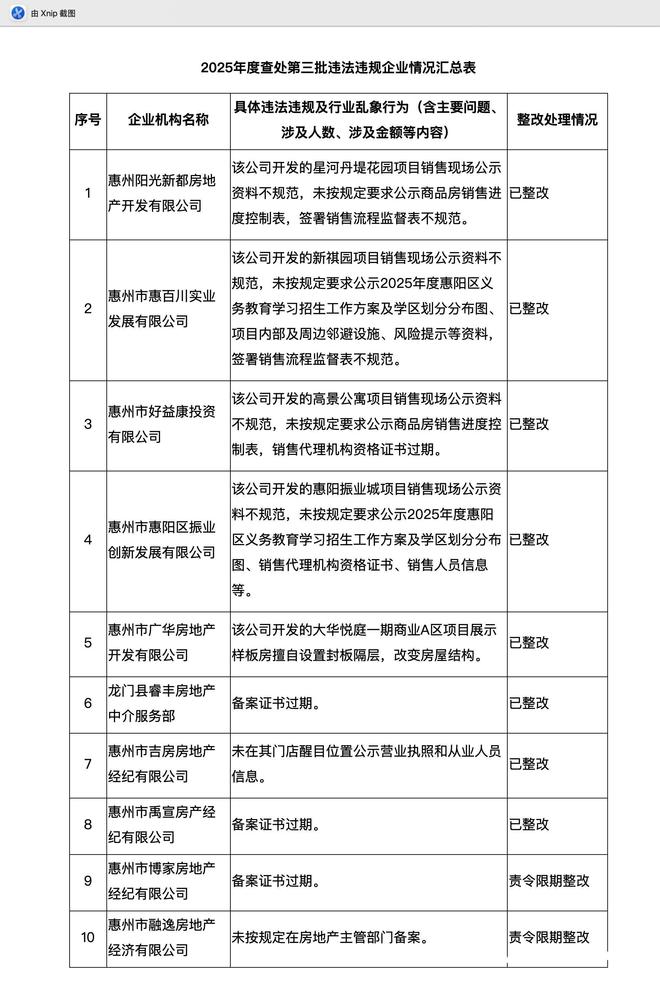
近期,惠州市住建局在官网发布《关于2025年度查处第三批违法违规房地产开发企业、中介机构名单的 公告》(下称"公告")。对2025年度第三批惠州各县(区)住建部门组织查处的房地产开发企业、中介 机构违法违规及行业乱象行为进行公告。 此次,惠州住建局通报10家违法违规企业中,包括开发企业5家,中介机构5家,整改处理情况显示,有 8家被通报的企业已经整改,2家企业被责令限期整改。 | 序号 | 企业机构名称 | 具体违法违规及行业乱象行为(含主要问题、 | 整改处理情况 | | --- | --- | --- | --- | | | | 涉及人数、涉及金额等内容) | | | | 惠州阳光新都房地 | 该公司开发的星河丹堤花园项目销售现场公示 | | | 1 | 产开发有限公司 | 资料不规范,未按规定要求公示商品房销售进 已整改 | | | | | 度控制表,签署销售流程监督表不规范。 | | | | | 该公司开发的新祺园项目销售现场公示资料不 规范,未按规定要求公示2025年度惠阳区义 | | | 2 | 惠州市惠百川实业 | 务教育学习招生工作方案及学区划分分布图、 | 已整改 | | | 发展有限公司 ...
香港置业:截至10月16日香港住宅物业录得51353宗注册 创4年同期新高
Zhi Tong Cai Jing· 2025-10-17 08:54
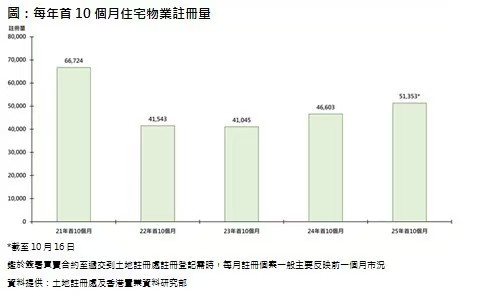
Core Viewpoint - The Hong Kong property market has benefited from interest rate cuts and rising rents, leading to increased willingness among "rent-to-buy" users and long-term investors to enter the market. The first ten months of this year saw a significant increase in residential property registrations, reaching a four-year high [1]. Summary by Category Overall Market Performance - In the first ten months of this year (up to October 16), Hong Kong recorded 51,353 residential property registrations, a 10.2% increase from 46,603 registrations during the same period last year, marking the highest number for this timeframe in four years [1][4]. Registration by Price Segment - Residential properties priced at HKD 5 million or below recorded 24,645 registrations, up 16.9% from 21,080 last year, making it the most registered category and showing the most significant growth. This increase is attributed to the adjustment in the stamp duty threshold in February [3][4]. - Properties priced between HKD 5 million and HKD 10 million saw 19,182 registrations, a 6.3% increase from 18,052 last year [4]. - Properties priced over HKD 10 million recorded 7,526 registrations, a slight increase of 0.7% from 7,471 last year [4]. Performance by District - The New Territories recorded the highest number of registrations at 26,419, a 15% increase from 22,966 last year [5]. - The Hong Kong Island district saw a significant increase of 21.6%, with 9,850 registrations compared to 8,100 last year, marking the highest growth among the three districts [5]. - In contrast, the Kowloon district experienced a decline, with 15,084 registrations, down 2.9% from 15,537 last year [5].
中原地产:CCL连升2周共1.41% 八大指数齐升 全部收复今年内跌幅
Zhi Tong Cai Jing· 2025-10-17 08:29
Core Insights - The Central Plains City Leading Index (CCL) reached 141.92 points, marking a week-on-week increase of 1.18%, the highest in 68 weeks since June 2024, following the first week after the interest rate cut on September 18 [1] - All eight major indices have risen, marking the first time since July 2025 that all indices have recovered from their declines this year, with a cumulative increase of 1.41% over two weeks [1] - The CCL is projected to reach 143.02 points in Q4, only 1.10 points or 0.78% away from the current level [1] Price Trends - The CCL has increased by 3.11%, with the CCL Mass up by 3.90%, CCL for small units up by 3.64%, and CCL for large units up by 0.53% [1] - Price increases were observed across various regions, with Hong Kong Island up by 4.26%, Kowloon by 5.22%, New Territories East by 5.53%, and New Territories West by 0.36% [1] Historical Context - Since May, the CCL has risen 5.00% from a low of 135.16 points, and 5.21% from a low of 134.89 points before the 2025 budget announcement [2] - The index is down 25.83% from its historical high of 191.34 points in August 2021 [2] Recent Developments - The CCL Mass index reported 143.52 points, with a week-on-week increase of 1.06%, and the CCL for small units at 141.99 points, up 1.03% [3] - The CCL for large units reached 141.59 points, marking a 1.97% increase and the highest in 35 weeks since February 2025 [3] - Regional indices showed significant increases, with Hong Kong Island CCL Mass at 144.48 points (up 0.43%), Kowloon at 140.80 points (up 2.02%), New Territories East at 156.59 points (up 0.10%), and New Territories West at 128.82 points (up 1.05%) [3]
美联:香港第三季居屋及公屋第二市场成交量环比回落约26.6% 创7季新低
智通财经网· 2025-10-16 08:26
Core Insights - The transaction volume in Hong Kong's second-hand market for subsidized housing and public housing in Q3 recorded 691 transactions, a decrease of approximately 26.6% from 941 transactions in Q2, marking a seven-quarter low [1] Market Performance - The second-hand market for subsidized housing accounted for 520 transactions (approximately 75.3%) in Q3, with the highest transaction volume in Tin Shui Wai's Tin Shing Court, recording 18 transactions at an average price of about HKD 3.57 million [1] - The public housing segment recorded 171 transactions (approximately 24.7%) in Q3, with the highest volume in Sham Shui Po's Lee Cheng Uk Village, which had 13 transactions at an average price of about HKD 1.71 million [1] Future Outlook - Analysts expect a significant increase in transactions in the second-hand market in Q4, driven by the recent approvals sent to successful applicants of the "White Form Secondary Market Scheme 2024," potentially surpassing 1,000 transactions [1]