
香港住宅物业

Search documents
中原地产:CCL按周微升0.01% 连升5周 近5年来首见
智通财经网· 2026-02-27 08:52
Group 1 - The Central Plains City Leading Index (CCL) recently reported at 149.41 points, showing a slight weekly increase of 0.01%, reflecting the market conditions following the Lunar New Year and recent property sales activities [1] - The CCL has risen for five consecutive weeks, totaling a 3.3% increase, marking the first such occurrence since May 2021, indicating a seasonal market upturn in Hong Kong's property prices [1] - The CCL is expected to reach a target level of 156 points, which is 6.59 points or 4.41% away from the current level, suggesting a continued upward trend in Hong Kong property prices [1] Group 2 - Since the interest rate cuts by local banks last year, the CCL has increased by 10.54% from its low of 135.16 points in May 2022, indicating a recovery in property prices [2] - The CCL has shown various increases across different categories, with the CCL Mass rising by 3.77%, and the CCL for large units increasing by 3.91%, while the overall CCL has temporarily increased by 3.68% in 2026 [2] - The impact of the proposed increase in stamp duty on residential properties, announced in the budget on February 25, will be reflected in the CCL starting from late March 2026 [2]
豪宅印花税上调的香港楼市
3 6 Ke· 2026-02-27 02:11
Group 1 - The Hong Kong government announced an increase in stamp duty for residential property transactions over HKD 100 million from 4.25% to 6.5%, effective February 26 [1] - This measure is expected to impact approximately 0.3% of residential property transactions and generate around HKD 1 billion in tax revenue annually [1] - The market response has been relatively calm, with some buyers of luxury properties not significantly affected by the increased tax burden [1] Group 2 - Prior to the stamp duty adjustment, international investment banks had already begun raising their forecasts for Hong Kong property prices, with Goldman Sachs increasing its 2026 price growth estimate from 5% to 12% [2] - Morgan Stanley also raised its forecast for 2023 property price growth from 5%-7% to 10%-15%, anticipating further increases in 2027 [2] - The chairman of Midland Realty noted that the market has entered a recovery phase, predicting a 10% increase in property prices for 2026 [2] Group 3 - Data from the Hong Kong Land Registry indicated a total of 80,702 property transactions in 2025, the highest in four years, with residential transactions totaling HKD 519.83 billion, reflecting year-on-year increases of 18.3% and 14.4% respectively [4] - In January 2026, the private residential price index reached 301.4, marking a 19-month high, with a month-on-month increase of 0.5% [6] - The rental index also reached a new high of 201.1 in January, with a month-on-month increase of nearly 0.3% and a year-on-year increase of 4.3% [7] Group 4 - The government aims to achieve revenue generation while minimizing the impact on the market through targeted tax increases on ultra-luxury properties [9] - The transition from "removing cooling measures" to "increasing taxes" reflects a complete cycle change in the Hong Kong property market [10]
香港置业:1月香港住宅物业注册6137宗 创7个月次高
智通财经网· 2026-02-03 13:09
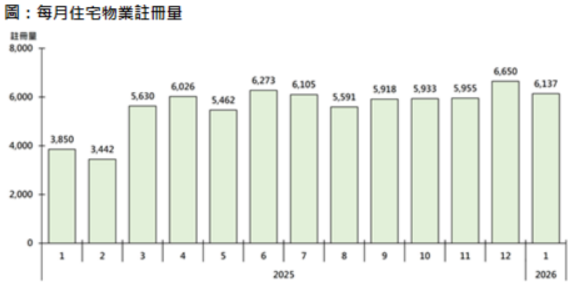
Core Viewpoint - The residential property registration in Hong Kong for January shows a decrease compared to December but a significant year-on-year increase, indicating a sustained high level of activity in the market [1][4]. Group 1: Registration Volume - In January, there were 6,137 registrations for residential properties, a decrease of approximately 7.7% from December's 6,650 registrations, but still the second highest in seven months [1]. - Compared to January of the previous year, when there were 3,850 registrations, the number has increased by nearly 60% [4]. Group 2: Regional Performance - In the Hong Kong Island region, there were 1,085 registrations, up about 58.9% from 683 registrations in the same month last year [5]. - The Kowloon region saw 2,278 registrations, an increase of approximately 84.6% from 1,234 registrations year-on-year, driven by a more than 2.3 times increase in first-hand registrations [5]. - The New Territories recorded the highest number of registrations at 2,774, which is a 43.5% increase from 1,933 registrations in the same month last year [5]. Group 3: Registration by Price Segment - For properties priced at HKD 5 million or below, there were 2,764 registrations, a 35.8% increase from 2,035 registrations in the same month last year [5]. - Properties priced between HKD 5 million and HKD 10 million recorded 2,388 registrations, up 82.6% from 1,308 registrations year-on-year [5]. - For properties over HKD 10 million, there were 985 registrations, reflecting a 94.3% increase from 507 registrations in the same month last year, marking the most significant growth across all price categories [5].

惠誉:香港住宅市场有望维持温和复苏态势 商业地产或继续承压
Zhi Tong Cai Jing· 2026-01-21 08:15
Group 1: Residential Property Market - The Hong Kong residential property market is expected to maintain a moderate recovery, but the rebound will be limited [1] - Factors contributing to the rise in residential property prices and transaction volumes include a low interest rate environment, a strong stock market leading to a wealth effect, and improved rental yields [1] - New immigration policies, including talent programs, have boosted demand, with new home sales projected to reach the highest level in over a decade by 2025 [1] - Continuous promotional policies from developers and a cautious market outlook indicate that the residential market rebound is unlikely to provide significant or lasting boosts to fiscal revenue [1] Group 2: Commercial Real Estate Market - The commercial real estate sector is expected to remain under pressure, with office rental rates significantly below pre-pandemic levels [1] - Recent leasing activity in traditional core business districts has increased due to strong capital market performance, but high vacancy rates and structural headwinds will continue to limit short-term acquisition intentions for commercial land [1] - Developers may adopt a selective strategy in acquiring new residential land due to a cautious macro outlook, which could negatively impact government land sale revenue [1] Group 3: Banking Sector - The Hong Kong banking sector is expected to maintain a prudent approach, focusing on asset quality and credit standards rather than pursuing loan growth, despite a rebound in residential mortgage activity [2] - The banking sector's funding, liquidity, and capital positions remain robust, but it is not expected to provide significant support for market activity [2] - The quality of residential mortgage assets is stable, but the weak commercial real estate sector may continue to face pressure [2] Group 4: Government Revenue and Fiscal Flexibility - Hong Kong's fiscal flexibility will continue to be constrained by declining real estate-related revenues, although short-term stock trading stamp duties may offset some impacts [2] - As of the fiscal year ending March 2025, property stamp duties and land revenues accounted for approximately 5% of total government revenue, down from over 6% five years ago, and less than 1% of GDP [2] - The government has decided to suspend new commercial land auctions in response to high office vacancy rates and weak market demand, which will further limit real estate-related revenues below historical levels [2]
香港楼市量价齐升 内地客买入金额创新高
Zheng Quan Shi Bao· 2026-01-13 15:40
Core Viewpoint - The Hong Kong real estate market experienced a significant turnaround in 2025, with a notable increase in both transaction volume and prices, largely driven by mainland Chinese buyers [1] Group 1: Mainland Buyers' Impact - In 2025, mainland buyers purchased residential properties in Hong Kong totaling HKD 138 billion, setting a new historical record [1] - The easing of property restrictions and talent introduction plans have stimulated demand, leading to a year-on-year increase in transaction volume by 14.1% to 13,900 transactions [1] - Nearly 60% of the funds from mainland buyers are directed towards new properties, indicating a strong preference for first-hand real estate [1] Group 2: Luxury Property Trends - High-value properties, particularly those priced above HKD 50 million, are increasingly favored by mainland clients, who accounted for nearly 70% of such purchases [4] - The luxury market is expected to thrive in 2026, with a projected 50% increase in first-hand luxury property transactions and a 60% rise in second-hand luxury transactions [4] - Factors supporting this demand include the scarcity and high value retention of luxury properties, as well as the influx of skilled professionals and families relocating to Hong Kong [4] Group 3: Broader Market Dynamics - Major mainland tech companies, such as Alibaba and JD.com, have invested over HKD 10 billion in acquiring office spaces in core areas of Hong Kong [5] - A report from Morgan Stanley indicates that since March 2025, Hong Kong residential prices have rebounded by over 4%, with an expected further increase of about 5% by the end of 2026 [5] - Multiple factors, including a resilient stock market, pent-up demand, anticipated interest rate declines, rising rents, and sustained interest from mainland buyers, are supporting the ongoing recovery of the Hong Kong residential market [5]
普缙:料2026年香港住宅交投续旺价稳 工商物业调整压力未减
智通财经网· 2025-12-30 06:06
Group 1: Residential Property Market - The report by普缙集团 indicates that Hong Kong's residential property prices are expected to remain stable in 2026, with slight increases in some popular areas [1] - The residential leasing market is anticipated to remain robust due to the continuous influx of non-local students and professionals, with rental prices likely approaching historical highs [1] - In 2025, the residential property market benefited from policy adjustments, a low-interest environment, and ongoing purchases by mainland buyers, leading to a significant increase in transaction volume, with nearly 57,000 transactions, a year-on-year growth of approximately 7.3% [1] - Transactions for first-hand and second-hand residential properties were recorded at 18,800 and 38,100 respectively, indicating a gradual release of market purchasing power [1] - Over 20% of overall residential transactions were attributed to mainland buyers, with some new developments seeing this figure rise to 30% [1] Group 2: Non-Residential Property Market - The report highlights a weak overall performance in the non-residential property market in 2025, with commercial buildings, office spaces, and industrial buildings experiencing price declines of approximately 8.8%, 11.1%, and 12.3% respectively [2] - Rental prices also decreased in tandem, with Grade A, B, and C office buildings seeing price reductions of about 9.9%, 15.3%, and 11.3% respectively, while the market vacancy rate remains high [2] - Although demand from financial and professional services has stabilized rental prices for some premium office spaces in core areas, non-core areas continue to face rental pressure [2] - The industrial and warehouse market has been impacted by global trade uncertainties and a decline in local logistics demand, with rental prices dropping approximately 4.2% in the first ten months of 2025 [2] - The report notes that the Hong Kong government is actively optimizing measures for the reconstruction and renovation of industrial buildings, but the industrial market is expected to require more time for adjustment [2] - Overall rental prices for retail shops fell by about 4% in the first ten months of 2025, with stable vacancy rates in core areas, while non-core areas continue to experience rental pressure due to changing consumer patterns [2]
中原:料全年香港差估署楼价指数升3.5% 明年楼价升幅料跑赢租金
智通财经网· 2025-12-29 05:59
Core Insights - The Hong Kong property market is experiencing a significant upward trend, with the private residential price index rising for six consecutive months, marking the longest increase in over four years, with a cumulative increase of approximately 3.77% [1] - The rental index has also seen a continuous rise for 12 months, with a monthly increase of 0.2%, reaching a historical high of 200.7 points, and an annual increase of about 4.26% [1] - Economic indicators in Hong Kong are positive, with increased tourism and exports contributing to a favorable economic environment, which is expected to support the property market [1] Property Price Index - The private residential price index is reported at 297.3 points for November 2025, reflecting a month-on-month increase of 0.92% [1] - The forecast for the entire year of 2025 suggests a potential increase of 3.5% in the property price index [2] - There remains a 25% gap between current property prices and historical highs, indicating potential for further price appreciation [2] Rental Market - The rental index has increased for 12 consecutive months, with a notable annual increase of 4.26% [1] - The rental market is benefiting from various talent policies, contributing to the sustained rise in rental prices [2] - The trend of simultaneous increases in both property prices and rental rates is a rare occurrence in recent years [2]
香港楼市按下“加速键”?多重利好推动市场回暖
Sou Hu Cai Jing· 2025-11-29 17:15
Core Insights - The Hong Kong real estate market is experiencing a significant rebound, driven by a combination of favorable policies, declining interest rates, and an influx of talent, leading to increased demand and sales activity [8][9][16]. Market Performance - The sales data indicates a strong market performance, with several new developments selling out quickly, such as the Kai Tak project achieving a 37-fold oversubscription and the Wan Chai project generating over 5.6 billion HKD in sales within two hours [3][4]. - The private residential price index in Hong Kong rose to 292.5 in September, marking a 14-month high and reflecting a continuous increase for four consecutive months [4]. Luxury Market Dynamics - The luxury segment has seen remarkable growth, with 66 transactions exceeding 50 million HKD in October, doubling from 33 in September and reaching a one-year high [6]. - Year-to-date, there have been 322 luxury transactions, the second-highest in the past seven years, indicating a robust recovery in this segment [6]. Future Projections - Multiple institutions forecast a positive outlook for the Hong Kong real estate market, with Morgan Stanley predicting a 4-5 year upward cycle and UBS indicating a critical turning point for residential properties [6]. - According to Huatai Securities, the number of private residential sale agreements is expected to increase by 19.4% and 7.5% in 2024 and 2025, respectively [6][7]. Policy Changes - The Hong Kong government has implemented several measures to stimulate the housing market, including the removal of additional stamp duties and a reduction in the buyer's stamp duty for local buyers from 7.5% to 1.5% [9][11]. - A significant reduction in stamp duty for properties priced at 4 million HKD or below is set to take effect in February 2025, further lowering entry barriers for first-time buyers [11]. Interest Rate Trends - The decline in mortgage rates has been a crucial factor in boosting housing demand, with the one-month HIBOR dropping to around 2.63%, significantly lower than the 5.5% level at the beginning of the year [12][15]. - This reduction in borrowing costs has encouraged many renters to transition to homeownership, as evidenced by increased sales activity [15]. Talent Influx - The introduction of relaxed talent policies has led to a surge in applications for residency, with over 190,000 applications received and a 73.68% approval rate, contributing to increased housing demand [16]. - The influx of talent is expected to support both rental and property investment markets, as new residents tend to have strong purchasing power [17]. Investment Trends - The current market conditions have attracted capital from mainland China, with Mandarin-speaking buyers accounting for 24% of total residential transactions, reflecting a 20% increase year-on-year [20]. - The Hong Kong real estate market is viewed as a safe haven for investors seeking stability amid geopolitical uncertainties, further driving demand [20]. Comparative Market Analysis - In contrast to the recovery in Hong Kong, the real estate markets in mainland China's first-tier cities remain relatively subdued, highlighting a divergence in market trends [21][24]. - The structural differences between the Hong Kong and mainland markets suggest that the recovery in Hong Kong may not be easily replicated in mainland cities, which face different economic challenges [25].

香港楼市,杀回来了
吴晓波频道· 2025-11-26 00:30
Core Viewpoint - Morgan Stanley believes that the Hong Kong property market, after seven years of stagnation, is expected to enter a rising cycle lasting 4 to 5 years; UBS sees the Hong Kong residential property market at a turning point, anticipating a similar upward trend over the next 3 to 5 years [2][9]. Market Recovery - The Hong Kong property market is experiencing a resurgence, with significant buyer interest and rapid sales in various projects, such as the Kai Tak project selling 56 units in one day with a subscription rate of 37 times [3][5]. - The private residential price index in Hong Kong rose to 292.5 in September, marking the highest level in 14 months and the fourth consecutive month of increase [6]. - In October, the number of first-hand transactions exceeded 1,700, maintaining over 1,000 transactions for the ninth consecutive month, with luxury properties seeing a notable increase in sales [8]. Factors Behind the Recovery - The Hong Kong government has implemented several policies since early last year, including the elimination of additional stamp duties on residential property transactions, significantly reducing costs for local and mainland buyers [13][17]. - Mortgage rates have decreased, with the one-month HIBOR dropping to around 2.63%, leading to lower mortgage rates compared to earlier in the year [18][21]. - A talent policy has attracted a significant influx of people to Hong Kong, increasing potential homebuyers and driving up rental prices, with the rental index reaching a new high in September [22][24]. - The sustained rise in the Hong Kong stock market and the "asset scarcity" in mainland China have led to increased investment in Hong Kong real estate, with mainland buyers accounting for 24% of total transactions [25][26]. Comparative Analysis - The recovery in the Hong Kong property market differs from the debt crisis seen in mainland cities, as Hong Kong's developers maintain stable balance sheets and low mortgage default rates [29][30]. - The article suggests that while both markets are undergoing adjustments, their paths and underlying issues are distinct, with Hong Kong's market being more resilient due to its unique characteristics [30].

中原地产十大屋苑周末录16宗成交 料11月香港楼市交投持续正面发展
智通财经网· 2025-11-17 02:18
Core Insights - The Hong Kong property market is experiencing a surge in transactions, with significant increases in both new and secondary market sales due to favorable market conditions and interest rate cuts [1][2] Group 1: Market Performance - Central Plains Real Estate reported 16 transactions in its top ten estates over the weekend, a 60% increase from the previous week's 10 transactions [1] - Midland Realty recorded 17 transactions in its top ten secondary estates, a 70% increase year-on-year, maintaining double-digit activity for five consecutive weekends [1] - The total transactions in the top 15 estates reached 20, marking an increase of approximately 66.7% compared to the previous week [1] Group 2: Buyer Sentiment - The market is filled with positive news, leading to increased buyer confidence, with many buyers accelerating their purchasing decisions due to fears of rising prices [1] - There is a notable presence of first-time buyers, investors, and large-scale buyers in the market, indicating a robust demand for both new and secondary properties [1] - The ongoing effects of interest rate cuts are driving buyer interest, with expectations for continued price increases in the secondary market [1] Group 3: Regional Performance - In the Hong Kong Island area, three estates recorded one transaction each, a 100% increase from the previous week [2] - The Kowloon area saw a total of five transactions across four estates, a decrease of approximately 28.6% week-on-week [2] - The New Territories experienced a significant surge, with ten transactions across three estates, reflecting a 400% increase from the previous week [2]