
期货交易

Search documents
ICE农产品期货主力合约收盘表现分化,咖啡期货跌1.84%
Mei Ri Jing Ji Xin Wen· 2025-12-08 22:33
Core Viewpoint - The Intercontinental Exchange (ICE) agricultural futures showed mixed performance on December 8, with fluctuations in various commodity prices [1] Group 1: Sugar Futures - Raw sugar futures increased by 0.20%, closing at 14.83 cents per pound [1] Group 2: Cotton Futures - Cotton futures decreased by 0.30%, closing at 63.74 cents per pound [1] Group 3: Cocoa Futures - Cocoa futures rose by 0.21%, closing at $5708.00 per ton [1] Group 4: Coffee Futures - Coffee futures fell by 1.84%, closing at 367.95 cents per pound [1]


ICE农产品期货主力合约收盘多数下跌,咖啡期货跌1.63%
Mei Ri Jing Ji Xin Wen· 2025-12-05 23:29
Group 1 - The Intercontinental Exchange (ICE) agricultural futures saw a majority decline in closing prices on December 5, with raw sugar futures dropping by 0.40% to 14.82 cents per pound [1] - Cotton futures decreased by 0.20%, closing at 63.95 cents per pound [1] - Cocoa futures experienced an increase of 3.79%, reaching $5694.00 per ton [1] - Coffee futures fell by 1.63%, ending at 374.30 cents per pound [1]
LME行政总裁张柏廉:时机成熟会考虑增设人民币为结算货币
Shang Hai Zheng Quan Bao· 2025-12-05 19:08
Core Insights - The London Metal Exchange (LME) is focusing on enhancing its services for the Chinese market, which accounts for 30% of its trading volume, and is considering the introduction of the renminbi as a settlement currency in the future [2][3][4] Group 1: Market Strategy and Developments - LME has suspended non-USD denominated metal options trading to modernize its options market, as all actual trades are currently conducted in USD [3][4] - The exchange is actively working to improve the liquidity of its options market by introducing electronic trading and optimizing collateral services for renminbi [3][4] - A roadmap for the development of the options market has been released, aiming to enhance liquidity, transparency, and market participation by introducing electronic trading for monthly contracts by the end of 2026 [4] Group 2: Sustainability Initiatives - LME is exploring pricing mechanisms for "green metals" and has launched a roadmap for sustainable metal premiums, focusing on responsible sourcing and carbon footprint standards [5][6] - The exchange has implemented new regulations requiring aluminum producers to upload carbon emission data to facilitate compliance with the EU's Carbon Border Adjustment Mechanism (CBAM) [6] Group 3: Market Observations and Trends - LME does not predict metal price trends but acknowledges the growing demand for copper in sectors like electric vehicles and AI data centers, which is attracting investor interest [8] - The exchange has noted the successful introduction of physical settlement contracts for lithium by the Guangzhou Futures Exchange, which LME is not currently pursuing due to the unique advantages of the region [8][9]


上海国际能源交易中心:调整原油等期货交易保证金比例和涨跌停板幅度
Di Yi Cai Jing· 2025-12-05 11:21
(文章来源:第一财经) 上海国际能源交易中心发布通知,自2025年12月9日(星期二)收盘结算时起,交易保证金比例和涨跌 停板幅度调整如下: 原油、低硫燃料油期货合约的涨跌停板幅度调整为7%,套保持仓交易保证金比例 调整为8%,一般持仓交易保证金比例调整为9%。 ...
美CFTC历史性放行!现货加密货币“破冰”登陆期货交易所
智通财经网· 2025-12-04 23:15
Group 1 - The CFTC has announced that listed spot crypto products will be allowed to trade on registered futures exchanges, indicating a move by the Trump administration to embrace the digital asset industry [1] - CFTC Acting Chair Carolyn Pham stated that this is the first time spot crypto products can be traded on CFTC-registered exchanges, which have historically provided customer protection and market integrity [1] - The announcement comes amid ongoing discussions in Congress regarding legislation to grant the CFTC direct regulatory authority over non-security crypto assets, although the Senate has yet to vote on the House-passed bill [1] Group 2 - Bitnomial Inc. plans to launch a leveraged retail spot crypto exchange on December 8, operating under CFTC regulation, which aims to provide a similar regulatory framework as that for perpetual contracts, futures, and options [1] - Bitnomial's founder, Luke Houlston, emphasized that leveraged spot crypto trading can now occur within a regulated environment, enhancing capital efficiency and mitigating counterparty risk [1] - CFTC and SEC have been in contention over who should be the primary regulatory body for digital assets, but both Pham and SEC Chair Paul Atkins have committed to coordinating regulatory rules [1][2] Group 3 - SEC Chair Paul Atkins acknowledged the significance of cryptocurrencies, stating they are now a top priority [2] - A consumer organization, Better Markets, expressed concerns that the CFTC's announcement raises more questions than it answers, particularly regarding which crypto products are approved for trading and which exchanges qualify [2] - The announcement may lead to confusion among investors, especially as it suggests that these products will be available to retail investors [2]
ICE农产品期货主力合约收盘多数下跌,棉花期货跌0.65%
Mei Ri Jing Ji Xin Wen· 2025-12-04 22:23
每经AI快讯,当地时间12月4日,洲际交易所(ICE)农产品期货主力合约收盘多数下跌,原糖期货跌 0.13%报14.91美分/磅,棉花期货跌0.65%报64.04美分/磅,可可期货跌0.15%报5496.00美元/吨,咖啡期 货涨1.70%报378.80美分/磅。 ...
ICE农产品期货主力合约收盘多数下跌,原糖期货跌0.40%
Mei Ri Jing Ji Xin Wen· 2025-12-03 22:38
Core Viewpoint - The Intercontinental Exchange (ICE) agricultural futures saw a majority of contracts decline, indicating a bearish trend in the agricultural commodities market [1] Group 1: Sugar Futures - Raw sugar futures fell by 0.40%, closing at 14.92 cents per pound [1] Group 2: Cotton Futures - Cotton futures decreased by 0.19%, ending at 64.45 cents per pound [1] Group 3: Cocoa Futures - Cocoa futures experienced an increase of 1.04%, closing at $5,512.00 per ton [1] Group 4: Coffee Futures - Coffee futures dropped by 0.19%, finishing at 372.75 cents per pound [1]
GTC泽汇资本:零售力量推升贵金属交易需求
Xin Lang Cai Jing· 2025-12-03 11:29
Group 1 - Retail investment remains a key driver for the expansion of overall trading volume in the precious metals market, with CME Group reporting an average daily trading volume of 33.1 million contracts in November, marking a 10% increase year-over-year and the second highest in history [1][3] - The preference for smaller contracts has significantly driven the surge in trading volume, with the overall average daily trading volume in the metals sector increasing by 52% last month, and micro gold futures reaching an average daily volume of 476,000 contracts, a substantial increase of 235% compared to last year [1][3] Group 2 - Silver futures have seen notable growth, with an average daily trading volume of 108,000 contracts, up 22% year-over-year, and micro silver futures experiencing a remarkable 238% increase in volume [2][4] - The strong trading activity in silver is closely linked to its price surge, with November silver futures rising by 18.6%, achieving the best monthly performance since 2020, and breaking the $55 per ounce mark for the first time [2][4] - As of December, silver prices have continued to rise, reaching $59.275 per ounce, with a year-to-date increase exceeding 100% [2][4] - Despite potential volatility near record highs, strong demand and tightening supply structures provide robust support for silver's long-term trend, with some institutional investors viewing silver as having a valuation advantage over gold [2][4] - The long-term gold-silver ratio is approximately 68, while the current ratio stands at 74, indicating potential for further silver price appreciation if the ratio returns to its historical average [2][4]


美国叒拔网线:交易所“过热”宕机,15万亿谁在颤抖?
Xin Lang Cai Jing· 2025-12-03 09:10
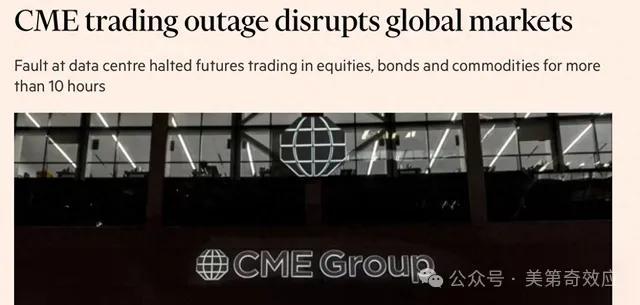
Core Insights - On November 28, 2025, the Chicago Mercantile Exchange (CME) and its subsidiary, the Chicago Board of Trade (CBOT), experienced a significant technical failure that halted futures and options trading for 11 hours, impacting a nominal value of over $15 trillion in contracts [4][5][11] - The official explanation for the outage was attributed to overheating at a third-party data center operated by CyrusOne, raising skepticism given the cold weather conditions in Chicago at that time [4][11] - The outage coincided with the expiration of key options, leading to substantial financial losses for institutions forced to close positions at unfavorable prices, amounting to over $1 billion [4][5] Group 1 - The CME's outage affected major contracts, including S&P 500 futures and oil futures, with an estimated nominal value of over $15 trillion unable to be traded [4] - On the same day, there was a notable surge in silver prices, which raised concerns about potential physical delivery demands that could exacerbate market conditions [7][9] - A significant player reportedly sought to deliver 400 million ounces of silver, equivalent to half of the global annual production, raising questions about the CME's capacity to fulfill such demands [9][10] Group 2 - The timing of the technical failure, just before a critical delivery date, suggests possible strategic motivations behind the outage, as it allowed the CME to avoid potential market disruptions [11][13] - The incident reflects deeper tensions within the financial system, particularly regarding the handling of physical deliveries and the competitive pressures on the U.S. dollar [14] - The appointment of Kevin Hassett as the next head of the Federal Reserve, known for his support of aggressive monetary easing, adds another layer of complexity to the current financial landscape [17]
法则会褪色 真金粹新火
Qi Huo Ri Bao Wang· 2025-12-03 02:52
Group 1 - The article discusses the evolution of trading strategies and the impact of market changes on traditional trading rules established by the author of "The Wall Street Ghost" [2][3][4] - It highlights the shift from a simpler market structure to a more complex environment dominated by algorithmic trading and high-frequency trading, which has altered the timing and validation of trades [2][6] - The author introduces a new "credit limit" system to adapt to modern market conditions, allowing positions to oscillate near the cost line without immediate liquidation [3][5] Group 2 - The article emphasizes the dangers of adding positions in volatile markets, contrasting past successful strategies with current risks associated with high leverage and rapid market movements [4][5] - It outlines a new approach to position sizing and adding to positions, focusing on independent entry reasons and market depth rather than simply relying on existing profits [5][6] - The concept of "giant volume" has changed, with the author noting that much of the volume in today's market is generated by algorithmic trading and does not necessarily indicate genuine market sentiment [6][7] Group 3 - The article concludes with a reflection on the importance of maintaining rituals in trading, which provide a sense of stability amid the uncertainties of the market [8][9] - It suggests that while trading rules may evolve, the underlying principles of risk management, discipline, and humility remain timeless and essential for traders [9][10]