白色家电

Search documents
海尔智家跌2.02%,成交额9.45亿元,主力资金净流出8157.14万元
Xin Lang Cai Jing· 2025-09-18 06:00
Core Viewpoint - Haier Smart Home's stock has experienced a decline of 4.63% year-to-date, with a recent drop of 2.02% on September 18, 2023, indicating potential market challenges and investor sentiment concerns [1]. Financial Performance - For the first half of 2025, Haier Smart Home reported revenue of 156.49 billion yuan, a year-on-year increase of 15.39%, and a net profit attributable to shareholders of 12.03 billion yuan, up 15.48% year-on-year [2]. - Cumulative cash dividends since the A-share listing amount to 46.155 billion yuan, with 21.766 billion yuan distributed over the past three years [3]. Shareholder Structure - As of June 30, 2025, the number of shareholders increased to 207,500, reflecting a growth of 9.97% [2]. - The top ten circulating shareholders include Hong Kong Central Clearing Limited, holding 450 million shares, a decrease of 131 million shares from the previous period, while Huaxia SSE 50 ETF increased its holdings by 4.9454 million shares [3]. Market Activity - On September 18, 2023, Haier Smart Home's stock price was 26.24 yuan per share, with a trading volume of 9.45 billion yuan and a turnover rate of 0.57%, leading to a total market capitalization of 246.208 billion yuan [1]. - The stock has seen a recent net outflow of 81.5714 million yuan in principal funds, with significant selling pressure observed [1].

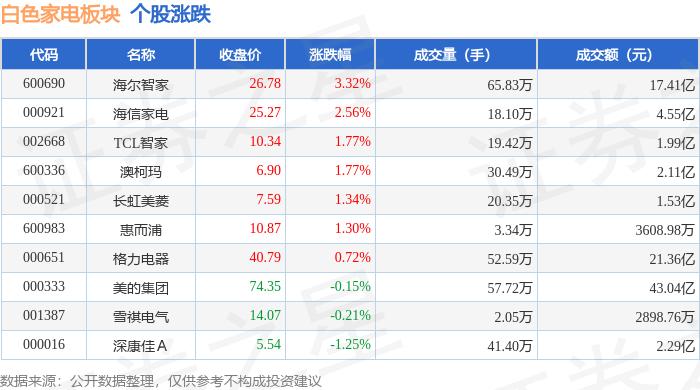
白色家电板块9月17日涨0.74%,海尔智家领涨,主力资金净流出1.87亿元
Zheng Xing Xing Ye Ri Bao· 2025-09-17 08:42
从资金流向上来看,当日白色家电板块主力资金净流出1.87亿元,游资资金净流出1.21亿元,散户资金 净流入3.08亿元。白色家电板块个股资金流向见下表: 以上内容为证券之星据公开信息整理,由AI算法生成(网信算备310104345710301240019号),不构成投资建议。 证券之星消息,9月17日白色家电板块较上一交易日上涨0.74%,海尔智家领涨。当日上证指数报收于 3876.34,上涨0.37%。深证成指报收于13215.46,上涨1.16%。白色家电板块个股涨跌见下表: | 代码 | 名称 | 收盘价 | 涨跌幅 | 成交量(手) | 成交额(元) | | --- | --- | --- | --- | --- | --- | | 600690 | 海尔智家 | 26.78 | 3.32% | 65.83万 | 17.41亿 | | 000921 | 海信家电 | 25.27 | 2.56% | 18.10万 | 4.55 Z | | 002668 | TCL智家 | 10.34 | 1.77% | 19.42万 | 2666T | | 600336 | 澳柯玛 | 6.90 | 1.77% | 3 ...

白色家电板块9月16日跌0.78%,格力电器领跌,主力资金净流出7.89亿元
Zheng Xing Xing Ye Ri Bao· 2025-09-16 08:46
Market Overview - On September 16, the white goods sector declined by 0.78% compared to the previous trading day, with Gree Electric Appliances leading the decline [1] - The Shanghai Composite Index closed at 3861.87, up 0.04%, while the Shenzhen Component Index closed at 13063.97, up 0.45% [1] Individual Stock Performance - Notable gainers in the white goods sector included: - Xueqi Electric (Code: 001387) with a closing price of 14.10, up 1.73% on a trading volume of 32,800 shares and a turnover of 45.95 million yuan [1] - Changhong Meiling (Code: 000521) closed at 7.49, up 1.49% with a trading volume of 141,100 shares and a turnover of 105 million yuan [1] - Aucma (Code: 600336) closed at 6.78, up 1.35% with a trading volume of 131,900 shares and a turnover of 89.09 million yuan [1] - Major decliners included: - Gree Electric (Code: 000651) closed at 40.50, down 1.07% with a trading volume of 555,700 shares and a turnover of 2.257 billion yuan [1] - Midea Group (Code: 000333) closed at 74.46, down 0.94% with a trading volume of 456,000 shares and a turnover of 3.396 billion yuan [1] Capital Flow Analysis - The white goods sector experienced a net outflow of 789 million yuan from institutional investors, while retail investors saw a net inflow of 572 million yuan [1] - Specific stock capital flows included: - Haier Smart Home (Code: 600690) had a net inflow of 26.03 million yuan from institutional investors, but a net outflow of 33.99 million yuan from retail investors [2] - Changhong Meiling (Code: 000521) saw a net inflow of 17.75 million yuan from institutional investors, but a net outflow of 13.20 million yuan from retail investors [2] - Gree Electric (Code: 000651) had a significant net outflow of 370 million yuan from institutional investors, while retail investors contributed a net inflow of 237 million yuan [2]



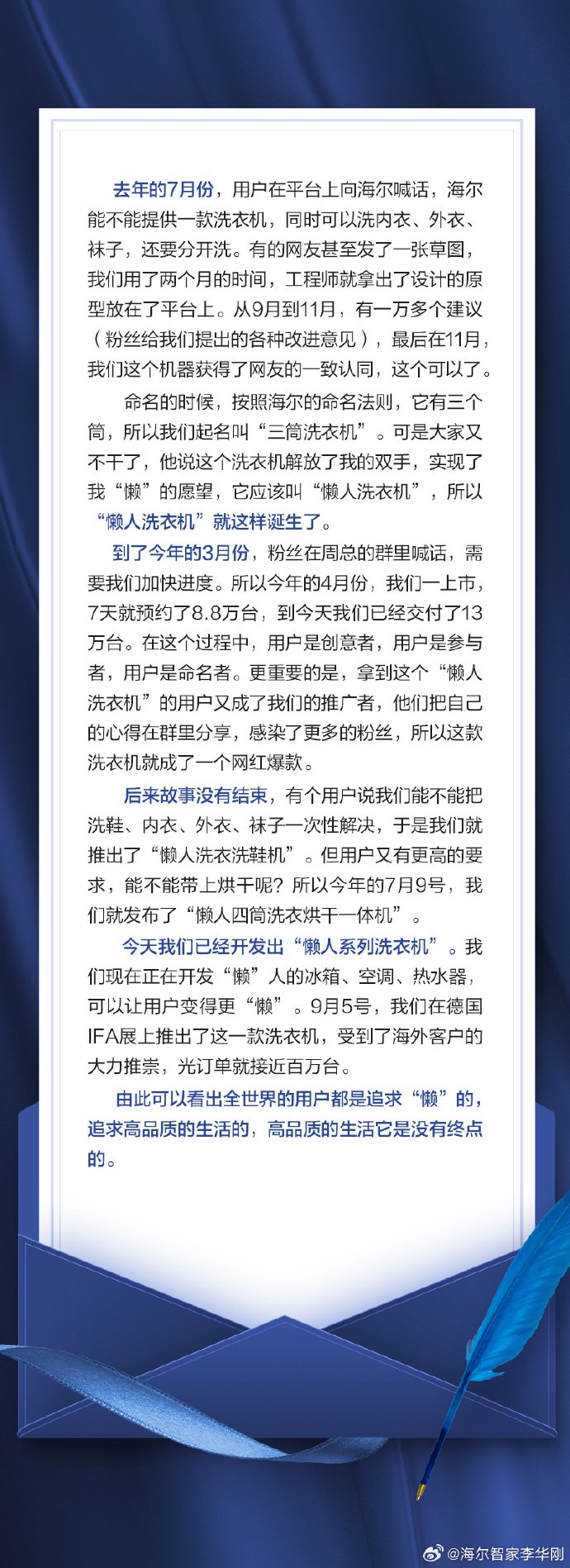
海尔智家董事长李华刚谈懒人洗衣机系列:“懒”对高品质生活的一种向往
Xin Lang Ke Ji· 2025-09-16 01:37
Core Insights - Haier Smart Home's Chairman and President Li Huagang shared the story behind the creation of the "Lazy Washing Machine," emphasizing the company's commitment to innovation and user interaction in product development [1][2] - The concept of "laziness" reflects a global consumer desire for high-quality living, indicating a trend where customers seek convenience and efficiency in their daily lives [2][3] - The "Lazy Washing Machine" has become a viral product, leading to the development of additional products like the "Lazy Washing and Drying Machine" and plans for other appliances aimed at enhancing user convenience [3] Product Development - The "Lazy Washing Machine" was designed based on user feedback, evolving into a series of products including the "Lazy Family" and "Lazy Series Washing Machines" [1][3] - The company has expanded its product line to include a "Lazy Washing and Drying Machine," which was launched on July 9, and is currently developing other appliances such as refrigerators, air conditioners, and water heaters [3] - At the IFA exhibition in Germany on September 5, the new washing machine received significant acclaim, with orders nearing one million units, showcasing strong international demand [3]
【闲聊杂谈】行业研究框架之地图
Xin Lang Cai Jing· 2025-09-15 10:06
Core Concept - The article presents a comprehensive framework for industry research, focusing on the industry lifecycle, business models, market size, and competitive landscape, providing investors with essential tools for informed decision-making [2][4][21] Industry Lifecycle - Industries can be categorized into four stages based on revenue: introduction, growth, maturity, and decline, reflecting changes in customer demographics and market dynamics [4][5] - The introduction phase features innovative products with uncertain market potential, while the growth phase sees an increase in user adoption and revenue [4][5] - In the maturity phase, revenue growth slows as new customer acquisition diminishes, leading to increased competition and potential market share consolidation [5][6] - The decline phase is characterized by stagnant user growth and the emergence of substitutes, where only companies with significant scale or cost advantages can maintain competitiveness [5][6] Research Focus by Lifecycle Stage - In the introduction phase, the primary concern is the feasibility of the business model, assessing real demand and sustainable profitability [7][10] - For the growth phase, the focus shifts to estimating market size and potential growth over the next 3-5 years to ensure sufficient growth opportunities [7][14] - In the maturity phase, evaluating the industry's competitive advantages and potential for new market opportunities becomes crucial [8][15] - During the decline phase, research should pivot towards substitutes and alternative investment opportunities [8][19] Market Size and Concentration - Market size is typically measured by sales revenue, with larger markets being essential for the emergence of significant companies [13][14] - Different market size metrics are relevant at various lifecycle stages: Total Addressable Market (TAM) in the introduction phase, Serviceable Available Market (SAM) and Serviceable Obtainable Market (SOM) in the growth and maturity phases [13][14] - Industry concentration levels impact profitability, with higher concentration often leading to better profit margins [20] Competitive Landscape - The competitive landscape is critical in determining future profitability, with horizontal competition (among peers) and vertical relationships (upstream and downstream) both influencing market dynamics [19][20] - Understanding market share and industry concentration helps gauge profitability potential, with high concentration indicating better profit prospects [20] - The ability to maintain a competitive edge through unique advantages, such as brand strength or cost leadership, is vital for long-term success [15][16]
白色家电板块9月15日跌0.5%,澳柯玛领跌,主力资金净流出4.13亿元
Zheng Xing Xing Ye Ri Bao· 2025-09-15 08:42
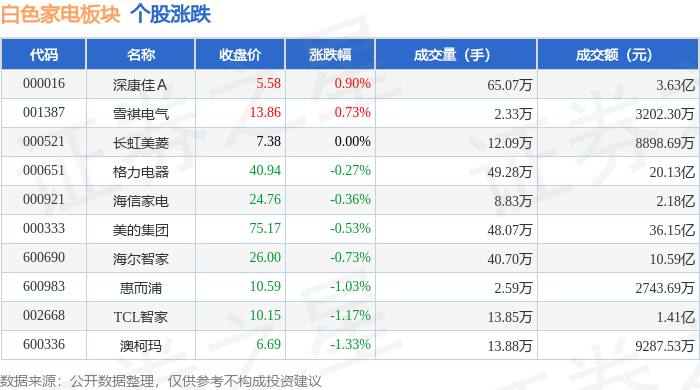
Market Overview - The white goods sector experienced a decline of 0.5% on September 15, with Aucma leading the drop [1] - The Shanghai Composite Index closed at 3860.5, down 0.26%, while the Shenzhen Component Index rose by 0.63% to 13005.77 [1] Individual Stock Performance - Major stocks in the white goods sector showed varied performance, with Gree Electric down by 0.27% and Midea Group down by 0.53% [1] - Aucma saw the largest decline at 1.33%, while Snow Qi Electric and Changhong Meiling had slight increases of 0.73% and 0.00% respectively [1] Trading Volume and Capital Flow - The total net outflow of main funds in the white goods sector was 413 million yuan, while retail investors saw a net inflow of 432 million yuan [1] - The trading volume for Gree Electric reached 20.13 billion yuan, indicating significant investor interest despite the decline [1] Fund Flow Analysis - Snow Qi Electric had a net inflow of 2.33% from retail investors, while Aucma and Hisense Home Appliances experienced significant net outflows from main funds [2] - Retail investors contributed positively to the capital flow in several stocks, with notable inflows in Deep Kangjia A and Haier Smart Home [2]


9月15日禾盛新材(002290)涨停分析:业绩增长、科技投资驱动
Sou Hu Cai Jing· 2025-09-15 07:42
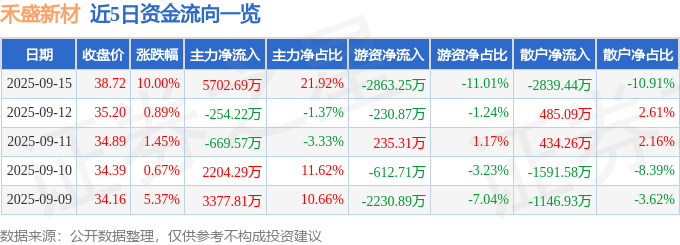
Core Viewpoint - He Sheng New Materials experienced a limit-up on September 15, closing at 38.72 yuan, driven by strong performance growth, strategic investments, management confidence, and sector momentum [1]. Financial Performance - The company reported a 58.31% year-on-year increase in net profit for the first half of 2025, with a 57.4% increase in net profit after deducting non-recurring items [1]. - Export revenue grew by 13.65%, and gross margin improved by 8.49 percentage points [1]. Strategic Investments - He Sheng New Materials made a strategic investment of 250 million yuan in Shanghai Yizhi Electronic Technology, focusing on high-end server processor chip design [1]. - The company also entered the artificial intelligence chip and large model application fields through its stake in Shanghai Haixi Technology, enhancing expectations for business diversification [1]. Management Confidence - Company director Wu Haifeng announced a plan to increase his shareholding by 10 to 20 million yuan, signaling management's confidence in the company's future [1]. Market Dynamics - On the same day, the white goods and electronic technology sectors showed active performance, creating a market resonance effect [1]. - The net inflow of main funds was 57.03 million yuan, accounting for 21.92% of the total trading volume [2]. Recent Fund Flow Overview - The recent fund flow data indicates a significant net inflow of main funds on September 15, with a 10% increase in stock price [2]. - The previous trading days showed fluctuations in fund flows, with varying net inflows and outflows from main, retail, and speculative funds [2]. Sector Performance - The white goods concept rose by 0.23%, while the computing integrated machine concept increased by 0.21% on the same day [4].

白色家电板块9月12日跌1.49%,长虹美菱领跌,主力资金净流出10.2亿元
Zheng Xing Xing Ye Ri Bao· 2025-09-12 08:31
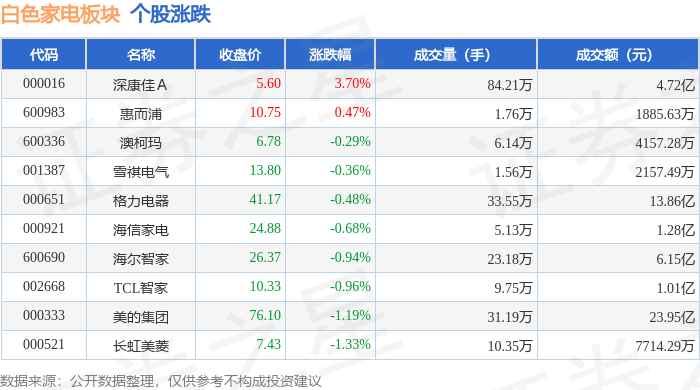
Market Overview - The white goods sector experienced a decline of 1.49% on September 12, with Changhong Meiling leading the drop [1] - The Shanghai Composite Index closed at 3883.69, up 0.22%, while the Shenzhen Component Index closed at 12996.38, up 0.13% [1] Stock Performance - Key stocks in the white goods sector showed varied performance, with the following notable changes: - Deep Kangjia A rose by 3.70% to close at 5.60 [1] - Gree Electric fell by 1.19% to 76.10 [1] - Midea Group decreased by 1.19% to 76.10 [1] - Haier Smart Home dropped by 0.94% to 26.37 [1] - TCL Smart Home fell by 0.96% to 10.33 [1] Capital Flow - The white goods sector saw a net outflow of 1.02 billion yuan from main funds, while retail investors contributed a net inflow of 558 million yuan [1] - The following stocks had significant capital flow: - TCL Smart Home had a main fund net inflow of 15.30 million yuan, but a retail net outflow of 16.51 million yuan [2] - Deep Kangjia A experienced a main fund net inflow of 13.81 million yuan, with a retail net outflow of 41.07 million yuan [2] - Haier Smart Home had a main fund net outflow of 1.44 billion yuan, but a retail net inflow of 1.41 billion yuan [2]
行业投资策略报告:红利为正,新品类为奇-20250911
CAITONG SECURITIES· 2025-09-11 10:29
Core Insights - The home appliance industry shows steady revenue growth with a net profit margin stability, with 1H2025 revenue and net profit reaching 868.5 billion and 70.3 billion yuan, respectively, representing year-on-year increases of 8.4% and 12.9% [5][11][15] - The white goods sector demonstrates robust growth, particularly in domestic sales, with significant increases in air conditioning, refrigerators, and washing machines, while export growth has slowed [5][27][35] - The small appliance sector, especially cleaning appliances, has seen rapid growth, with revenues increasing by 28.4% year-on-year, while traditional small appliances face challenges [5][45][47] Industry Overview - The overall revenue and net profit of the home appliance sector increased, with a gross margin of 24.1% and a net profit margin of 8.1% in 1H2025, showing a slight decline in gross margin but an increase in net profit margin compared to the previous year [5][11][12] - The operating cash flow improved significantly, reaching 93.7 billion yuan, a year-on-year increase of 51.1% [11][12] White Goods Sector - The white goods sector's revenue and net profit for 2Q2025 increased by 13.8% and 5.9% year-on-year, respectively, although growth rates have slowed compared to 1Q2025 [35][37] - Domestic sales for air conditioning, refrigerators, and washing machines showed notable growth, with air conditioning sales reaching 39.2 million units, up 12% year-on-year [27][28][32] Small Appliances Sector - The cleaning appliance segment has experienced rapid growth, with key players like Ecovacs and Roborock showing year-on-year revenue increases of 37.6% and 73.8%, respectively [45][46] - Traditional small appliances are under pressure, with a slight decline in revenue, highlighting a shift in consumer preference towards cleaning appliances [45][47] Black Goods Sector - The black goods sector reported stable revenue growth of 1.8% in 2Q2025, but net profit declined by 9.0%, indicating pressure on profitability [53] - Haier Vision led the sector with revenue and net profit growth of 8.6% and 36.8%, respectively, outperforming competitors [53] Investment Recommendations - The report suggests focusing on companies with strong domestic and overseas sales growth, particularly in the cleaning appliance category and those with robust supply chains and manufacturing capabilities [5][21][45] - Key companies to watch include Midea Group, Haier Smart Home, Gree Electric, and Ecovacs in the small appliance sector [5][17]


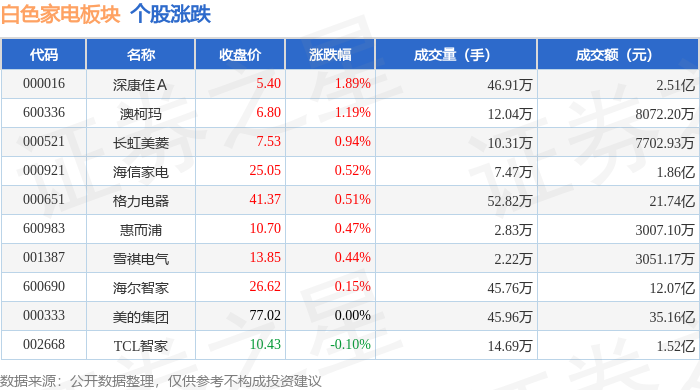
白色家电板块9月11日涨0.19%,深康佳A领涨,主力资金净流入4203.17万元
Zheng Xing Xing Ye Ri Bao· 2025-09-11 08:43
Market Overview - On September 11, the white goods sector rose by 0.19% compared to the previous trading day, with Shenzhen Konka A leading the gains [1] - The Shanghai Composite Index closed at 3875.31, up 1.65%, while the Shenzhen Component Index closed at 12979.89, up 3.36% [1] Stock Performance - Key stocks in the white goods sector showed varied performance: - Shenzhen Konka A: Closed at 5.40, up 1.89% with a trading volume of 469,100 shares and a turnover of 251 million [1] - Aucma: Closed at 6.80, up 1.19% with a trading volume of 120,400 shares and a turnover of 80.72 million [1] - Changhong Meiling: Closed at 7.53, up 0.94% with a trading volume of 103,100 shares and a turnover of 77.03 million [1] - Hisense Home Appliances: Closed at 25.05, up 0.52% with a trading volume of 74,700 shares and a turnover of 186 million [1] - Gree Electric Appliances: Closed at 41.37, up 0.51% with a trading volume of 528,200 shares and a turnover of 2.174 billion [1] - Whirlpool: Closed at 10.70, up 0.47% with a trading volume of 28,300 shares and a turnover of 30.07 million [1] - Midea Group: Closed at 77.02, unchanged with a trading volume of 459,600 shares and a turnover of 3.516 billion [1] Capital Flow - The white goods sector experienced a net inflow of 42.03 million from main funds, while retail funds saw a net inflow of 12.8 million [1] - Notable capital flows for specific companies include: - Haier Smart Home: Main funds net inflow of 10.4 million, retail funds net outflow of 64.02 million [2] - Shenzhen Konka A: Main funds net inflow of 31.45 million, retail funds net outflow of 22.25 million [2] - Midea Group: Main funds net inflow of 20.70 million, retail funds net inflow of 71.68 million [2]