装备制造

Search documents
2025年中国经济的韧性、温度与担当
Qi Huo Ri Bao Wang· 2026-01-23 01:33
Economic Overview - In 2025, China's GDP reached 140.19 trillion yuan, achieving a year-on-year growth of 5.0%, successfully meeting annual expectations [3] - The growth occurred amidst global economic challenges, with major economies like the US, Eurozone, and Japan experiencing lower growth rates [3] - China's service sector contributed 61.4% to economic growth, highlighting the ongoing optimization of the industrial structure [3] Structural Optimization - New productive forces are becoming the core driver of China's economic growth, with significant increases in value-added from equipment manufacturing (9.2%) and high-tech manufacturing (9.4%) [4] - The digital economy is thriving, with online retail sales of physical goods growing by 5.2%, accounting for 26.1% of total retail sales [4] - High-tech product exports increased by 13.2%, indicating a successful transition from "Made in China" to "Created in China" [4] Policy Coordination - The Chinese government has implemented proactive macroeconomic policies to stimulate market vitality, including a moderately loose monetary policy [5][6] - Despite a 3.8% decline in fixed asset investment, investment in high-tech industries and livelihood sectors remained stable [5] Living Standards - In 2025, the per capita disposable income reached 43,377 yuan, reflecting a nominal growth of 5.0%, which aligns with economic growth [7] - The average urban unemployment rate was 5.2%, indicating stable employment conditions [7] - The Engel coefficient decreased to 29.3%, suggesting an improvement in living standards [7] Domestic and External Demand - Retail sales of consumer goods reached 50.12 trillion yuan, growing by 3.7%, with service retail showing robust growth [8] - Total import and export volume was 45.47 trillion yuan, with exports growing by 6.1% and imports by 0.5% [8] - Private enterprises accounted for 57.3% of total trade, reflecting a diversification in trade [8] Global Positioning - China's economic performance in 2025 is significant amid global economic disparities, providing a stabilizing force in international trade [10] - The country is committed to high-level opening up and reform, enhancing its competitive edge and creating new growth opportunities for global enterprises [10] Future Outlook - Despite external shocks and internal challenges, China's economic fundamentals remain strong, with ongoing technological innovation driving industrial upgrades [11] - The manufacturing PMI rose to 50.1, indicating a return to expansion, suggesting a buildup of internal economic momentum [11] - China's economy is positioned as a reliable stabilizer in the global landscape, contributing to global growth amidst uncertainties [11]


上海电气扣非逾两亿时隔四年转正 年投超50亿研发形成三大核心优势
Chang Jiang Shang Bao· 2026-01-23 01:27
Core Viewpoint - Shanghai Electric is expected to achieve a significant turnaround in its financial performance, projecting a net profit of 1.1 billion to 1.32 billion yuan for 2025, marking a substantial increase compared to previous years [1][5]. Financial Performance - The company anticipates a net profit increase of 348 million to 568 million yuan, representing a growth rate of 46.28% to 75.53% year-on-year [5]. - For the first three quarters of 2025, the company expects a non-net profit exceeding 200 million yuan, ending four consecutive years of losses [1][5]. - Shanghai Electric's contract liabilities reached 65.984 billion yuan as of September 2025, an increase of 21.777 billion yuan year-on-year [2][9]. Business Focus and Strategy - The company is concentrating on three main business areas: smart energy, intelligent manufacturing, and digital integration, with a global operational footprint [3][10]. - Shanghai Electric is committed to optimizing its industrial structure to enhance profitability and has positioned itself as a leading provider of industrial-grade green intelligent system solutions [10]. Competitive Advantages - Shanghai Electric boasts three core competitive advantages: extreme manufacturing capabilities supported by process technology, the ability to realize first-of-a-kind equipment through integrated innovation, and comprehensive solution capabilities through industrial and energy synergy [11]. - The company has invested over 5 billion yuan in R&D annually from 2021 to 2024, with a total exceeding 4 billion yuan in the first three quarters of 2025, indicating a strong commitment to innovation [4][12]. Historical Context - The company faced significant losses in previous years, with net profits of -9.988 billion yuan in 2021 and -3.566 billion yuan in 2022, primarily due to asset impairment and credit losses [6][7]. - After two years of substantial losses, Shanghai Electric returned to profitability in 2023 and continued to grow in 2024, indicating a positive trend in its financial recovery [8].

“十四五”交卷成绩单沉甸甸
Su Zhou Ri Bao· 2026-01-23 00:26
"十四五"规划收官,苏州如期兑现五年之约,向全市人民交出了一份沉甸甸的"成绩单"。 产业"作业"稳扎稳打。锚定"十四五"规划提出的制造业增加值占比40%左右的目标,苏州坚持产业 立市,产业结构加快转型,工业投资年均增长8.1%,2025年突破2250亿元,占固定资产投资比重提高 10.2个百分点,成为拉动投资增长的第一动力。当下,苏州已形成电子信息、装备制造、新材料3个万 亿级产业,获批6个国家先进制造业集群、4个国家级中小企业特色产业集群,制造业增加值占GDP比重 保持在40%以上。高新技术产业、工业战略性新兴产业产值占规上工业总产值比重分别达到56.2%和 49%,分别提高5.3个和4.1个百分点。 平安法治建设持续发力,"十四五"规划提出的公众安全感98%的目标,被99%以上的实际成效超 越,苏州获评首批全国法治政府示范城市等多项荣誉。 创新"作业"超额完成。"十四五"规划提出,R&D支出占GDP比重达4%左右。五年来,苏州坚持长 期主义,保持创新投入刚性增长,年度全社会研发投入、技术合同成交额双双突破"千亿"大关,R&D 支出占GDP比重从3.69%稳步提升至4.2%以上,超额完成目标任务。 ...
中经评论:16年规模第一,中国制造当更强
Jing Ji Ri Bao· 2026-01-23 00:09
Core Viewpoint - China's manufacturing sector is expected to maintain its position as the world's largest for 16 consecutive years, with a complete industrial system and a focus on high-end, intelligent, and green transformation [1][2][3] Group 1: Manufacturing Scale - China's manufacturing value added has been the highest globally since 2010, currently accounting for nearly 30% of global manufacturing, making it a key driver of global manufacturing growth [1] - Among 504 major industrial products worldwide, China leads in the production of most, including basic materials like steel and cement, as well as high-end equipment like industrial robots and electric vehicles [1] Group 2: Industrial System Completeness - China is the only country with a complete industrial classification covering all industrial categories, ensuring a stable and efficient production chain that can quickly respond to diverse global market demands [2] Group 3: High-end Manufacturing - High-end manufacturing is crucial for addressing weaknesses in core technologies and enhancing the quality and technical level of Chinese manufacturing, with significant growth expected in equipment and high-tech manufacturing sectors by 2025 [2] Group 4: Intelligent Manufacturing - Intelligent manufacturing, driven by AI, big data, and industrial internet technologies, allows China to compete on equal footing with developed countries, leveraging its advantages in new information technologies [3] Group 5: Green Manufacturing - Green manufacturing focuses on low-carbon technologies and circular economies, with projections indicating that by 2025, China's production of new energy vehicles will exceed 16 million units, maintaining its global leadership [3]
中经评论:经济发展新旧动能加快转换
Jing Ji Ri Bao· 2026-01-23 00:09
Group 1 - The core viewpoint emphasizes that the transition from old to new economic drivers is a complex process characterized by coexistence and mutual stimulation, leading to profound adjustments in industrial layout, employment structure, and regional economic patterns [1][5]. - By 2025, China's economy is projected to exceed 140 trillion yuan, showcasing resilience and a significant transformation towards a more advanced economic structure [1]. - High-tech manufacturing is expected to account for 17.1% of the industrial added value, with equipment manufacturing reaching 36.8%, both significantly outpacing the average industrial growth rate [1]. Group 2 - The consumer market is shifting from goods consumption to service consumption, with service retail expected to grow by 5.5% in 2025, outpacing goods retail growth by 1.7 percentage points [2]. - Investment in fixed assets is anticipated to decline by 3.8% in 2025, yet the investment structure is optimizing, focusing on technological innovation and upgrading industries [2]. - New consumption trends are emerging, with a focus on green and intelligent durable goods, driven by policies encouraging the replacement of old products [2]. Group 3 - The acceleration of the transition from old to new economic drivers is driven by policy guidance, market demand, and technological innovation, supported by China's large-scale market and complete industrial system [3]. - Future characteristics of this transition include integration across industries, enhanced resilience through diverse economic structures, and increased openness to global markets [4].
一个老工业城市的破旧立新
Shan Xi Ri Bao· 2026-01-22 23:44
Group 1: Industry Transformation and Achievements - Shaanxi Automobile Group's commercial vehicle division delivered its 1,000th new energy vehicle, with a heat dissipation efficiency improvement of over 50% and a fast charging capability that charges from 20% to 80% in 20 minutes [1] - In the previous year, Shaanxi Automobile's overall sales increased by 15%, with new energy vehicle sales rising by 66% and overall vehicle exports growing by 104% [1] - Baoji, as the only provincial-level industrial transformation demonstration zone in Shaanxi, shared its transformation experiences at a national training session, highlighting its commitment to industrial restructuring and development [1] Group 2: Policy and Support Mechanisms - Baoji established an industrial development leadership group led by key city officials and implemented a dual responsibility system for 24 key industrial chains, enhancing policy and talent support for industrial development [6] - The city has introduced a comprehensive policy package to support industrial transformation, including a 1 billion yuan fund for high-quality manufacturing development and a 6.3 billion yuan industrial guidance fund [6] - Over 440 graduates from top universities have been recruited to strengthen the talent pool for industrial development in Baoji [6] Group 3: Key Industries and Growth - Baoji Titanium Group is the largest and most comprehensive titanium and titanium alloy R&D and manufacturing enterprise in China, with a projected titanium product output of over 40,000 tons in 2024, making it the world's largest [8] - The automotive industry in Baoji has seen significant growth, with 86 enterprises in the automotive and parts sector and a total output value exceeding 60 billion yuan [10] - The city is transitioning from being the "largest titanium production base" to becoming a global hub for high-end titanium materials and technology [8] Group 4: Innovation and Emerging Industries - The new flow meter production line at Micron Sensor Co., Ltd. is expected to produce 60,000 units annually, generating a maximum output value of 300 million yuan, making it the largest flow meter manufacturing and testing base in Northwest China [11] - Baoji has implemented 812 provincial-level new product development projects, with emerging industries generating an annual output value exceeding 30 billion yuan [12] - The city has established 7 national-level enterprise technology centers and 71 provincial-level centers, positioning itself as a leader in technological innovation within the province [12]
优环境筑巢引凤 强集群百舸争流
Xin Lang Cai Jing· 2026-01-22 22:14
Core Viewpoint - Anshun High-tech Zone is continuously optimizing the business environment by implementing precise investment attraction strategies, enhancing technological innovation, and enforcing policies that reduce operational costs, thereby promoting the development of leading industrial clusters such as equipment manufacturing and specialty food [1] Group 1 - The zone has achieved a dual growth in the number of industrial enterprises above designated size and their output value over the past two years [1] - The development momentum of the Anshun High-tech Zone is continuously strengthening [1]
经济发展新旧动能加快转换
Jing Ji Ri Bao· 2026-01-22 21:59
Group 1 - The core viewpoint emphasizes that the transition from old to new economic drivers is a complex process characterized by coexistence and mutual stimulation, leading to profound adjustments in industrial layout, employment structure, and regional economic patterns [1][4] - By 2025, China's economy is projected to exceed 140 trillion yuan, showcasing resilience and a significant transformation towards a more advanced economic structure [1] - The high-tech manufacturing sector is expected to account for 17.1% of the industrial added value, with equipment manufacturing reaching 36.8%, both significantly outpacing the average industrial growth rate [1] Group 2 - The consumer market is shifting from goods consumption to service consumption, with service retail expected to grow by 5.5%, outpacing goods retail by 1.7 percentage points [2] - Investment in fixed assets is anticipated to decline by 3.8% in 2025, influenced by a decrease in real estate investment, yet the investment structure is optimizing towards technology innovation and industrial upgrades [2] - The transition is driven by policy guidance, market demand, and technological innovation, with China's large-scale market providing ample application scenarios and a complete industrial system fostering innovation [3] Group 3 - Future characteristics of the transition include integration across industries, resilience in economic structure, and a higher level of openness to global markets, which will introduce external resources for new economic drivers [4] - The process of transitioning will not be a simple linear replacement but rather a complex interplay of old and new, with emerging industries experiencing growth opportunities while traditional sectors face transformation challenges [4]
内蒙古4家工匠学院获全国总工会重点支持
Nei Meng Gu Ri Bao· 2026-01-22 12:26
Core Viewpoint - Four craft colleges in Inner Mongolia have been selected for the National Federation of Trade Unions' 2025 key support list, receiving a one-time subsidy of 1 million yuan each to enhance the training of skilled workers [1] Group 1: Selected Craft Colleges - The four selected craft colleges are: Yili Group Inner Mongolia Modern Dairy Craft College, Inner Mongolia First Machinery Group New Era Craft College, Ordos City Ordos Vocational College, and Huadian Coal Industry Group "Smart Chain" Craft College [1] - Each college will receive a subsidy of 1 million yuan to strengthen the skills training infrastructure for industrial workers [1] Group 2: Training and Development Focus - The selected colleges focus on regional industrial development needs and align with the goals of cultivating skilled craftsmen [1] - They have developed distinctive curricula and equipped themselves with highly qualified teaching staff, achieving significant results in promoting regional economic characteristics and industry advantages [1] Group 3: Broader Initiatives and Goals - The Inner Mongolia Federation of Trade Unions is advancing the reform of the industrial worker training system, establishing a "1+22+N" skill training framework [1] - By 2025, three new craft colleges will be added, and over 20,000 skilled talents are expected to be trained across 31 craft colleges in Inner Mongolia [1]
如何成为「领航级智能工厂」?6大核心要素!
Xin Lang Cai Jing· 2026-01-22 10:09
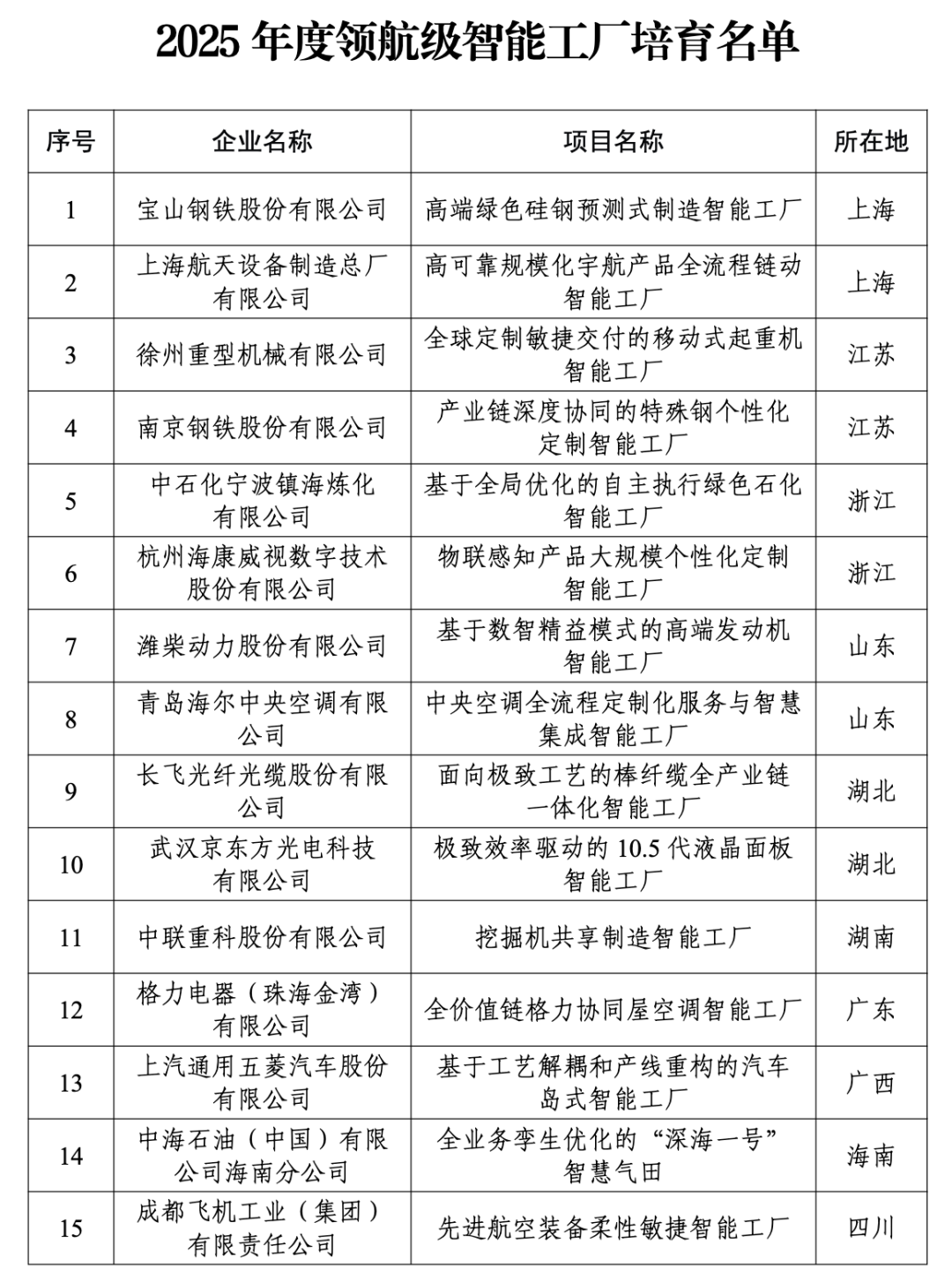
Core Viewpoint - The announcement of the first batch of 15 leading smart factories marks a significant leap in China's manufacturing sector from digitization and networking to a new stage characterized by deep applications of artificial intelligence, representing the highest level of intelligent manufacturing in the country [1][3][21]. Group 1: Overview of Leading Smart Factories - The first batch of leading smart factories includes companies from key industries such as equipment manufacturing, raw materials, and electronic information, showcasing the breadth and depth of China's intelligent manufacturing development [1][19]. - The 15 selected factories are distributed across 10 provinces and regions, including Shanghai, Jiangsu, Zhejiang, Shandong, and Hubei, reflecting a "multi-point breakthrough and full coverage" layout [2][20]. Group 2: Characteristics of Leading Smart Factories - Leading smart factories integrate advanced manufacturing technologies, next-generation information technologies, and lean management concepts, taking on the responsibility of exploring future manufacturing models [3][21]. - To qualify as a leading smart factory, six key elements are required: industry leadership, AI technology application leadership, innovative smart manufacturing model leadership, performance leadership, replication leadership, and nurturing plan leadership [6][24]. Group 3: Case Studies of Selected Companies - Changfei Fiber Optic has become a benchmark in the electronic information sector by integrating AI algorithms throughout its production process, achieving a drawing speed of 3,500 meters per minute with micro-level precision control [9][27]. - Weichai Power has implemented a digital and intelligent management system that reduces customer maintenance costs by an average of 30% through remote diagnostics and alerts for every engine sold [30]. - Baosteel is innovating with an AI-driven predictive manufacturing model that anticipates market demand, optimizing the entire supply chain and production process, with plans to establish 1,200 AI scenarios and 25 benchmark production lines by 2027 [14][34]. Group 4: Future Directions and Strategic Goals - The development of leading smart factories aligns with national strategies to promote intelligent, green, and service-oriented manufacturing, aiming to enhance China's position in the global supply chain [34][35]. - The exploration of future manufacturing models focuses on achieving high customization, complex production, and maintaining high efficiency, low costs, and high quality [28][36].