
经济动能转换

Search documents
为何说未来的竞争是创新力的竞争,从经济学家盘和林的新作中Get动能转换的钥匙
Sou Hu Cai Jing· 2026-01-24 03:57
Core Insights - The book "Transformation of Economic Dynamics: From Scale Economy to Innovation-Driven" by Professor Pan Helin analyzes the internal mechanisms that have propelled China's economic growth over the past 40 years through reform and opening up, emphasizing the necessity of transitioning to an innovation-driven model for high-quality development [1][8] Group 1: Scale Economy as a Foundation - The first part of the book outlines how scale economy has been the core driving force behind China's economic miracle post-reform, with population size providing absolute advantages on both demand and supply sides [2] - A large population creates a vast market, enabling rapid sales growth for products that meet consumer needs, while abundant labor has allowed China to establish a complete industrial system, making it the "world's factory" [2] - Capitalization and moderate financial leverage have accelerated scale expansion, with financial reforms providing necessary capital for enterprises to grow, particularly after the housing market reform in 1998 [3] Group 2: Challenges of Scale-Driven Model - The book highlights the diminishing returns of relying excessively on scale expansion, with issues such as overcapacity and intense competition leading to price wars and low profitability in certain industries [4] - High debt levels and financial risks are associated with scale expansion, as rising leverage ratios in non-financial enterprises and households pose significant challenges [4] - The decline of demographic dividends and rising factor costs are weakening traditional comparative advantages, prompting some industries to relocate to lower-cost regions [5] Group 3: Transition to Innovation-Driven Growth - The book argues that transitioning to an innovation-driven model is essential for overcoming growth bottlenecks and establishing new development dynamics [6] - Emphasizing technological innovation as a core focus, the book advocates for increased R&D investment, aiming for a research and development expenditure intensity of 2.65% in 2023 [6] - The need for upgrading industrial foundations and modernizing supply chains is highlighted, with a call for China to achieve technological breakthroughs to maintain a competitive edge in global markets [6] Group 4: Optimizing the Innovation Ecosystem - The book stresses the importance of creating a conducive environment for innovation through financial support and regulatory frameworks that encourage new technologies and business models [7] - Leveraging the vast domestic market of 1.4 billion people is seen as a unique advantage for driving innovation and growth, with measures to stimulate domestic demand being crucial [7] - The transformation from "Made in China" to "Created in China" is essential for positioning the country favorably in global divisions of labor [6][7] Group 5: Conclusion on Economic Dynamics - The insights from the book suggest that the transformation of economic dynamics is not a complete rejection of past advantages but rather a sustainable approach to infuse new vigor into the economy through innovation [8] - The future of China's economy hinges on successfully igniting the engine of innovation to navigate the new global technological revolution and achieve a historic leap from a major economic power to a strong economic power [8]

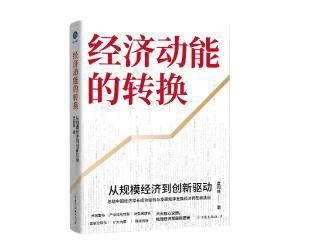
经济学家盘和林出新书了,一书读懂中国经济“换挡提速”的密码
Sou Hu Cai Jing· 2026-01-22 07:06
Core Viewpoint - The book "Economic Dynamics Transformation: From Scale Economy to Innovation-Driven" by Professor Pan Helin provides a clear narrative on how China's economy has evolved and the necessity for a shift towards innovation-driven growth, avoiding both exaggerated claims and abstract theories [1][2]. Group 1: Historical Context and Economic Dynamics - The book begins by discussing the importance of institutional reforms since 1978, emphasizing that the reform was fundamentally about stimulating individual initiative and economic dynamism [2]. - The author uses the example of Xiaogang Village to illustrate how stable property rights incentivized farmers to invest and take risks, thereby revitalizing agricultural production and the broader economy [2]. - The narrative highlights that past growth was driven by a restructuring of incentives, allowing individual creativity to flourish, rather than being solely propelled by administrative directives [2]. Group 2: Old Logic of Economic Growth - The first part of the book outlines six key components of China's previous growth model: distribution system, scale economy, real estate economy, financial leverage, globalization, and network economy [3]. - These components are interrelated and collectively contributed to China's rapid economic growth, with scale economies providing unique advantages in a large market and real estate driving urbanization [3]. - The author argues that understanding these six components is crucial for assessing which advantages will continue to play a role in China's economic future and which mechanisms are nearing their limits [3]. Group 3: Challenges and the Need for Transition - The book discusses six major challenges facing the Chinese economy, including common prosperity, involution, post-urbanization, financial risks, de-globalization, and technological competition [4]. - Common prosperity is framed as essential for long-term stability, as widening income gaps could lead to structural risks [4]. - The author identifies involution as a symptom of a "stock era," where diminishing returns on effort signal the limitations of the old growth model [4]. Group 4: Future Directions for Economic Growth - The latter part of the book proposes a new logic for China's economy, focusing on building a more comprehensive domestic market and enhancing economic efficiency through technological innovation [6]. - The author emphasizes the importance of domestic demand in light of changing international conditions and the limitations of the old growth model [6]. - Innovation is highlighted as the key to improving total factor productivity and transitioning away from reliance on factor accumulation, with a focus on creating an environment that encourages risk-taking and rewards innovation [6][7].
从小切口里追寻“依然‘北上广’”的破局之道
Nan Fang Du Shi Bao· 2026-01-21 03:07
Core Viewpoint - The discussion around Guangzhou's future has intensified, particularly in light of its economic changes and the need for a strategic shift to maintain its status among top cities like Beijing and Shanghai [2]. Economic Structure and Historical Context - From the early 1990s to around 2010, Guangzhou's rise to prominence was largely driven by three key sectors: automotive, real estate, and foreign trade [4]. - The automotive market in Guangzhou saw a significant increase in production and sales, growing from 2 million to over 20 million vehicles annually, with Japanese joint ventures becoming particularly successful [5]. - The real estate boom led to the emergence of major local developers, while the post-WTO era provided a boost to traditional trade, forming the backbone of Guangzhou's economy during its peak [5]. Current Challenges and Path Dependency - The existing economic structure reveals vulnerabilities, particularly due to a lack of local private enterprises in technology-driven manufacturing, which has hindered the emergence of significant tech companies in Guangzhou [6]. - The reliance on real estate and traditional commerce has left the city unprepared for shifts in the automotive market, highlighting a path dependency that has stifled innovation [6]. Resilience and Adaptation - Despite previous challenges, Guangzhou has shown resilience and adaptability, particularly in urban renewal efforts, such as the successful transformation of Tianhe Xian Village, which has become a model for city updates [8]. - The rise of new energy vehicle companies like Xpeng and other tech firms is beginning to fill the gap in the local tech ecosystem, indicating a shift towards a more diversified economic base [8][9]. Future Directions and Recommendations - The city's economic scale now requires a comprehensive approach to industrial transformation, emphasizing the need for internal mechanisms to foster long-term growth and innovation [11]. - Specific proposals have been made to enhance digital transformation in professional markets and to establish national-level quality control centers for emerging sectors like cell therapy [12]. - Continuous small-scale improvements and a commitment to long-term strategies are essential for Guangzhou to realize its potential and maintain its competitive edge [13]. Potential Breakthroughs - Future advancements in deep-sea technology and the emergence of new entrepreneurial talents among the city's 1.6 million university students could signal a new era for Guangzhou [15].

读懂中国经济“换挡提速”的密码
Zhong Guo Jing Ji Wang· 2026-01-19 01:53
Core Insights - The book "Economic Dynamics of Transition: From Scale Economy to Innovation-Driven" by Professor Pan Helin provides a clear narrative on how China's economy has evolved and the necessity for a shift towards innovation-driven growth [3][4] - It emphasizes the importance of historical context in understanding the current economic landscape and future directions [3] Group 1: Historical Context and Economic Growth - The book begins by discussing the significance of the 1978 reform, highlighting it as a transformative institutional change aimed at stimulating individual initiative [4] - It uses the example of Xiaogang Village to illustrate how stable property rights incentivized farmers to invest and take risks, thereby revitalizing the agricultural sector and the broader economy [4] - The narrative continues through various reform milestones, indicating that the core principle has been to reward those willing and able to contribute, which has unleashed the creativity of millions [4] Group 2: Old Logic of Economic Growth - The first part of the book outlines six key components of China's previous growth model: distribution system, scale economy, real estate economy, financial leverage, globalization, and digital economy [5] - These elements are interrelated and have collectively driven China's rapid economic expansion, with scale economies providing unique advantages in a large market [5] - The author argues that understanding these components is crucial for assessing which advantages will continue to play a role in future growth and which mechanisms are nearing their limits [5] Group 3: Challenges and the Need for Transition - The middle section addresses six new challenges facing the economy, including common prosperity, involution, post-urbanization, financial risks, de-globalization, and technological competition [6] - Common prosperity is framed as essential for long-term stability, as widening income gaps could lead to structural risks [6] - The author identifies involution as a symptom of a slowing economy, where competition yields diminishing returns, signaling the inadequacy of the old growth logic [6] Group 4: Future Directions for Economic Growth - The latter part of the book proposes a new growth logic focused on building a more robust domestic market and enhancing economic efficiency through technological innovation [7] - It emphasizes the importance of domestic demand in light of changing international conditions and the limitations of the old growth model [7] - Innovation is highlighted as the key to improving total factor productivity and moving away from reliance on factor accumulation, with institutional frameworks being crucial for fostering a conducive environment for innovation [7] Group 5: Value of the Book - The book is praised for clearly articulating past successes and the necessity for transformation, providing a solid analytical framework for future growth [8] - It avoids exaggeration and complex jargon, instead relying on straightforward institutional logic and real-world examples to build a foundational understanding of the Chinese economy [8]
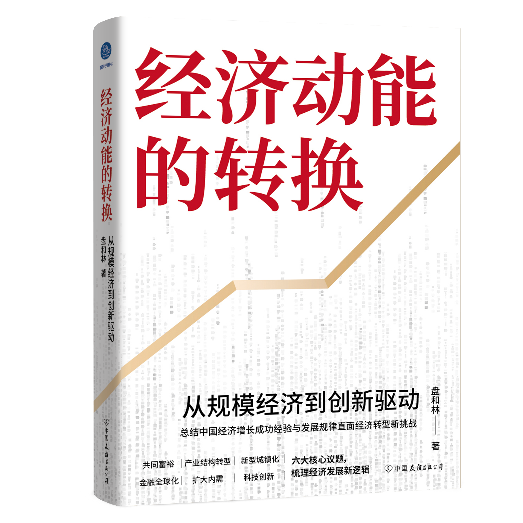
解码中国经济转型的底层逻辑《经济动能的转换:从规模经济到创新驱动》| 商业高研院
Xin Lang Cai Jing· 2026-01-15 13:17
Core Viewpoint - The book "Economic Dynamics Transformation: From Scale Economy to Innovation-Driven" by Professor Pan Helin provides a comprehensive analysis of China's economic evolution over 47 years, utilizing a three-dimensional framework of "Old Logic - New Challenges - New Logic" to dissect the transition from a weak economy to a global powerhouse [2][6]. Group 1: Old Economic Logic - The first part of the book reviews the old logic of China's economic growth, identifying six interrelated factors: distribution system reform, scale economy, land finance, financial leverage, globalization, and the internet economy, which collectively fueled rapid growth over the past four decades [2][3]. Group 2: New Challenges - The middle section highlights the deep-seated contradictions that have emerged alongside the growth miracle, such as the imbalance in the distribution system, urbanization bottlenecks, and external pressures from de-globalization and intensified technological competition, which pose significant challenges to economic transformation [2][3][4]. Group 3: New Economic Logic - The final part introduces six new logics for future economic development, emphasizing that the transformation of economic dynamics is not a complete rejection of the old logic but an iterative upgrade based on historical lessons. Key proposals include optimizing the redistribution system to address wealth disparity and enhancing labor compensation through industrial upgrades and vocational education [3][4]. Group 4: Practical Solutions - The book suggests practical solutions to structural contradictions, such as establishing labor-capital negotiation mechanisms through industry associations to combat irrational competition and promoting a "city cluster + unified market" approach for urbanization [4][5]. Group 5: Financial Globalization and Innovation - It advocates for a shift in China's financial sector from a focus on "monetization and capitalization" to "global capital competition," enhancing the influence of the RMB in global distribution systems. Additionally, it emphasizes the importance of a dual mechanism of market-driven incentives and government guidance to foster innovation [4][5]. Group 6: Overall Significance - The book is noted for its clear logical structure and rigorous economic analysis, making it a valuable resource for understanding China's economic transformation. It balances historical depth with practical relevance, providing insights for policymakers, entrepreneurs, and investors [5][6][7].
21社论丨需完善“投资于人”的财政保障机制
2 1 Shi Ji Jing Ji Bao Dao· 2025-11-05 23:06
Group 1 - The core idea emphasizes the importance of "investment in people" as a strategic approach to drive economic transformation and enhance human capital, which is crucial for sustainable development in China [1][2][4] - "Investment in people" is seen as a key factor in shifting the global industrial competition from capital-intensive to talent-intensive, highlighting the need for a comprehensive human resource development system [1][2] - The strategy includes reforming education systems to focus on innovation, integrating higher education with research, and aligning vocational education with industry needs to cultivate high-quality talent [2][3] Group 2 - "Investment in people" is also critical for stimulating consumer demand and activating the internal market, as it leads to the creation of new consumption scenarios and products [2][3] - To enhance residents' consumption capacity, a systematic policy approach is required, focusing on employment promotion, income increase, and stabilizing expectations [3] - The need for a long-term mechanism to ensure stable and sustainable investment in public services and social welfare is highlighted, with an emphasis on optimizing fiscal expenditure towards basic needs [4]
前三季度给力!全国GDP超101.5万亿,四川近5万亿,那河南、广东呢
Sou Hu Cai Jing· 2025-10-22 05:47
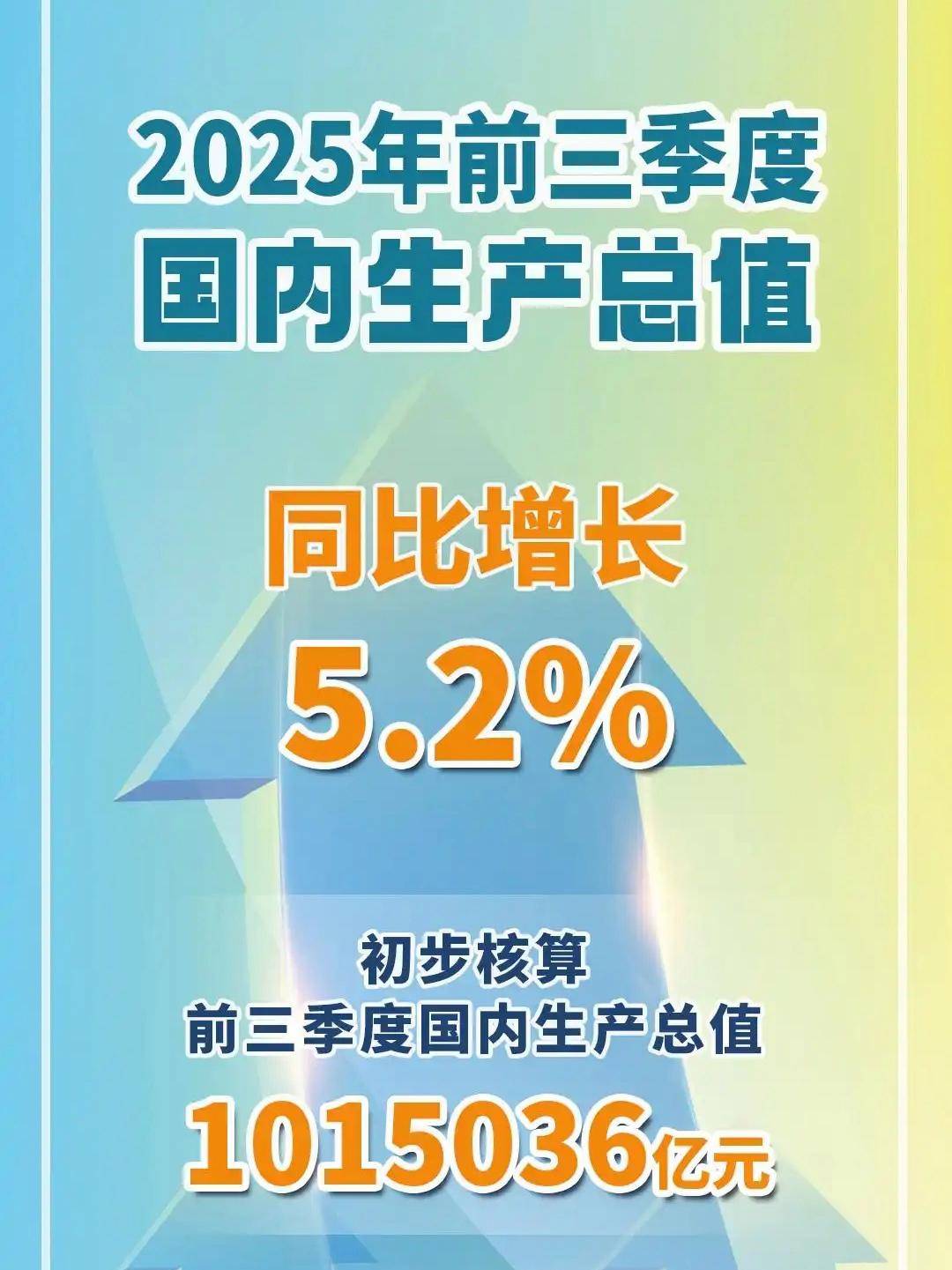
Economic Overview - China's GDP exceeded 101.5 trillion yuan in the first three quarters of 2025, with a year-on-year growth of 5.2%, reflecting the deep resilience of the economy under multiple pressures [1] - The contribution of social retail sales to GDP was nearly 65%, with significant performance in upgraded consumption categories such as smart home appliances and cultural tourism services [1] Industry Insights - The manufacturing sector is supported by the upgrade and cultivation of new driving forces, with a more than 30% year-on-year increase in new energy vehicle production and double-digit growth in strategic emerging industries like integrated circuits and industrial robots [1] - The clean energy industry in Sichuan province saw an 18% increase in added value, driven by the second-largest hydropower station and resources in vanadium-titanium, contributing over 60 billion yuan to industrial added value [4] Trade and Export - Exports of "new three items" such as electric passenger cars, lithium batteries, and solar cells increased by 21% year-on-year, playing a crucial role in stabilizing foreign trade [1] Policy Impact - The issuance of new special bonds reached 2.8 trillion yuan in the third quarter, focusing on technology innovation and modern infrastructure, effectively activating market expectations [2] Regional Economic Performance - Sichuan province's GDP approached 5 trillion yuan with a nominal growth rate of 4.93%, supported by the construction of the Chengdu-Chongqing economic circle and the emergence of major industrial clusters [4] - The tourism sector in Sichuan experienced explosive growth, with summer tourism routes generating over 750 billion yuan in revenue, significantly boosting the restaurant and accommodation industries [4] Future Outlook - The economic growth data indicates a dynamic balance between new and old driving forces under the framework of innovation-driven, industry collaboration, and regional balance [7] - High-quality economic development is anticipated for the entire year as policy tools are further opened in the fourth quarter [7]
收评:沪指涨1.45%突破3800点大关,科创50指数暴涨超8%,芯片股爆发
Zheng Quan Shi Bao Wang· 2025-08-22 07:55
Core Viewpoint - The A-share market is experiencing a strong upward trend, driven by institutional reforms, optimized capital structure, and economic momentum transformation, marking a new phase of a "slow bull" market [1] Market Performance - Major stock indices in the two markets surged, with the Shanghai Composite Index rising over 1% to surpass 3800 points, reaching a 10-year high; the Sci-Tech 50 Index soared over 8%, hitting a 3.5-year high [1] - As of the market close, the Shanghai Composite Index rose 1.45% to 3825.76 points, the Shenzhen Component Index increased by 2.07% to 12166.06 points, the ChiNext Index climbed 3.36% to 2682.55 points, and the Sci-Tech 50 Index gained 8.59% to 1247.86 points, with a total transaction volume of 25.793 billion yuan [1] Sector Performance - On the sector front, agriculture, banking, food and beverage, and oil sectors declined, while the semiconductor sector experienced a significant surge; brokerage and insurance sectors also saw gains, with stocks related to chips, computing power, and the AI industry being particularly active [1] Investment Outlook - Huaxi Securities indicates that the current A-share market is at a new starting point for a "slow bull" market, driven by supply-side governance, demand-side policy support, and an improved investor return mechanism [1] - The initiation of "deposit migration" among residents is expected to provide ample potential incremental funds, forming a positive feedback mechanism; long-term capital from insurance funds, social security, pensions, and potential stabilization funds is continuously entering the market, optimizing the investor structure [1] - The direction of the "slow bull" market will align with national strategies, focusing on new momentum and new technologies, supported by segments of large finance and new consumption [1]