城市轨道交通

Search documents
市民建议上海地铁推出月票制度,票务制度如何兼顾成本与服务?
Yang Guang Wang· 2025-11-25 11:28
Core Viewpoint - The introduction of a monthly ticket system for the Shanghai subway has gained significant public interest, particularly among frequent commuters, as it could reduce transportation costs for various groups including office workers and students [1][2]. Group 1: Current Situation and Public Demand - A Shanghai resident highlighted the high monthly commuting costs of 220 to 240 yuan, advocating for a fixed-interval monthly ticket to alleviate financial burdens [2]. - The Shanghai Shentong Metro Group has acknowledged the public's suggestions and is exploring options for fixed-interval monthly tickets and subsidies for low-income groups [1][2]. - Other cities, such as Beijing, have similar discount systems but lack a monthly ticket option, indicating a broader demand for such a service across urban transit systems [2]. Group 2: Existing Ticketing Models - Harbin's subway has successfully implemented a limited-time electronic monthly ticket priced at 130 yuan, which allows unlimited rides within 30 days, showing a positive reception among commuters [3]. - The effectiveness of Harbin's electronic monthly ticket is evident, as it provides significant savings for frequent riders, with potential savings ranging from 20 to 220 yuan depending on the fare structure [3]. Group 3: Challenges in Implementing Monthly Tickets - The financial sustainability of subway operations is a concern, as many systems rely on government subsidies to remain profitable, making it difficult to introduce a monthly ticket without increasing financial strain [4]. - Experts warn that implementing a monthly ticket could exacerbate the financial imbalance between revenue and operational costs, potentially leading to long-term sustainability issues for subway operators [5]. - There is a call for differentiated ticketing strategies that could attract off-peak travelers while providing benefits to commuters, suggesting that a well-designed monthly ticket system could enhance operational efficiency [5].
今早北京地铁昌平线因故障出现延误,部分车站临停超半小时
Xin Jing Bao· 2025-11-25 02:59
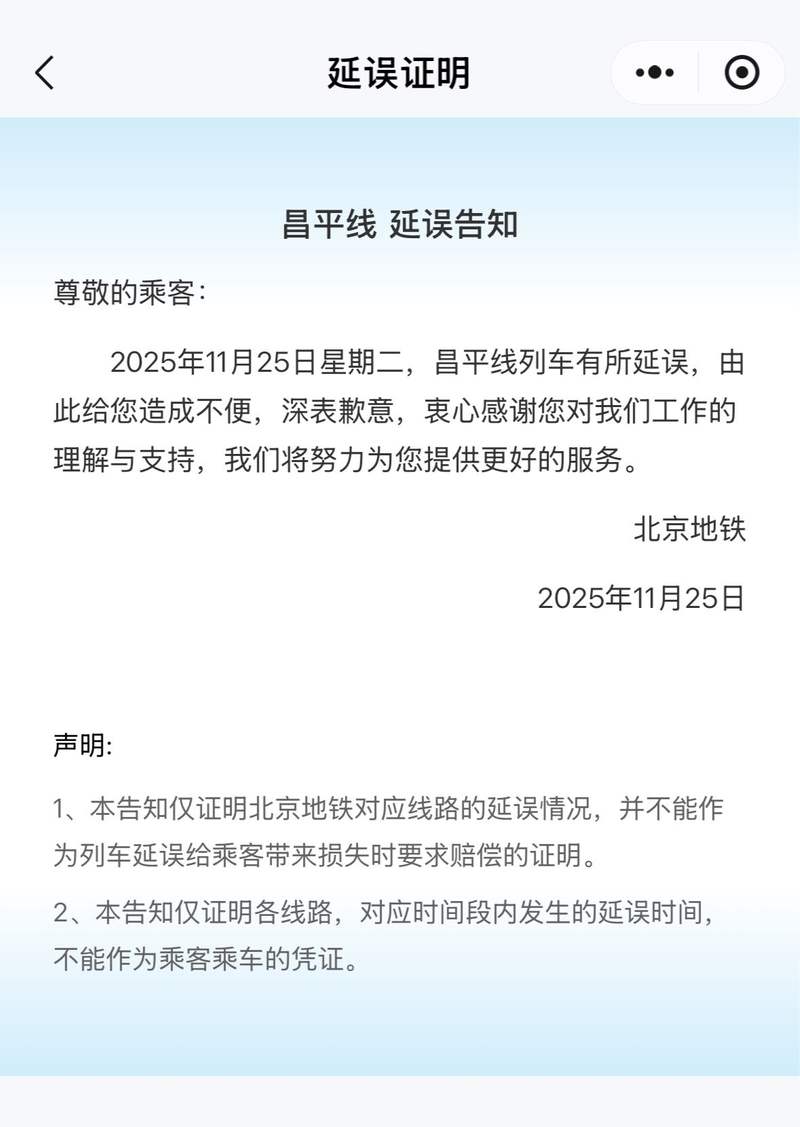
新京报讯(记者裴剑飞)今天(11月25日)早高峰时段,北京地铁昌平线列车因故障频繁临时停车,造成明显延 误。北京地铁在评论区回应网友称,很抱歉给乘客出行带来不愉快,已记录此情况及时反馈至责任单位。 记者了解到,昌平线部分区段出现信号故障,导致全线行驶都受到影响。列车在各站走走停停,一些站点列车临 停时间达到30分钟以上,特别是沙河站等大客流站点,车站内外排队拥堵严重。 北京地铁小程序上发布的昌平线延误证明。北京地铁小程序截图 记者通过北京地铁小程序查询发现,北京地铁已就今早昌平线的情况发布延误证明:尊敬的乘客,2025年11月25 日星期二,昌平线列车有所延误,由此给您造成不便,深表歉意,衷心感谢您对我们工作的理解与支持,我们将 努力为您提供更好的服务。 ...

“上车后请往车厢中部走”
Hang Zhou Ri Bao· 2025-11-25 02:36
Core Points - The "Civilized Riding Day" of Hangzhou Metro celebrates its 10th anniversary, promoting the initiative of "boarding from the inside, being courteous" [1] - The campaign aims to alleviate congestion at train doors during peak hours by encouraging long-distance passengers to move towards the middle of the carriage [1] - A series of immersive activities and feedback collection points are set up at major stations to engage passengers and promote civilized behavior [1] Group 1 - The Hangzhou Metro has implemented a "Civilized Riding Four Steps" initiative, which includes queuing, moving bags forward, and maintaining silence while traveling [1] - The event features a themed art exhibition titled "Childlike Heart Paints Civilized Metro Accompanying Me," showcasing over 600 submissions from children depicting scenes of courteous behavior [2] - The "Rainbow Classroom" has been launched, where metro staff educate passengers on security checks and waiting etiquette through interactive games [2] Group 2 - The Hangzhou Metro Group emphasizes its role as a window to urban civilization, continuously promoting civilized behavior since the first initiative in 2015 [2]
自行车能上地铁了!深圳4条地铁线试点“人车同行”骑行友好服务
Sou Hu Cai Jing· 2025-11-24 15:10
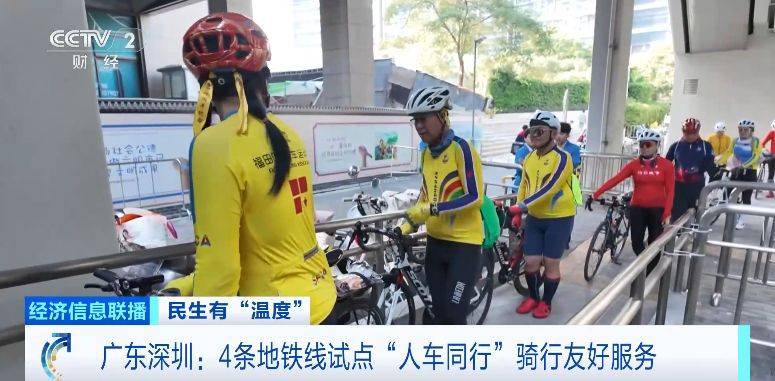
(央视财经《经济信息联播》)每逢节假日和周末,广东深圳城市的绿道上满是骑行爱好者的身影。然而,如 何将自行车安全便捷地从家门口带到绿道起点,这是困扰不少骑行爱好者的难题。为了解决这个问题,近日深 圳市轨道交通部门在4条地铁线试点推出了"轨道+骑行"的模式。 骑行爱好者 黄晓云:非常舒服,我们以前想都不敢想。市区内不好骑,现在地铁提供给我们方便,我们感到 无限快乐。 11月15日起,深圳地铁2号线、8号线、6号线及6号线支线,试点开通周末骑行友好服务。骑友提前预约,即可 享受35元票价,人车同行。 深圳地铁工作人员 曹蓉:乘客个人是要提前1个工作日,拨打深圳地铁的客服热线进行预约。如果团体出行, 需要提前3个工作日预约,乘客出行当天,凭预约凭证,到指定车站的客服中心购买轨道加骑行车票。 下午2点多,深圳地铁6号线红山站外,10多位骑友相约前往光明欢乐田园、左岸科技公园等热门绿道,开启惬 意骑行时光。这次,他们选择了"轨道+骑行"的方式。 深铁集团规划设计中心副总经理 戴子文:后阶段还会推出"轨道+骑行+驿站"的延展服务,我们围绕着轨道站 点出入口可以布局骑行者的补给,以及轨道物流方面的需求。 转载请注明央视财经 ...
年内迎来修建爆发期 谁是地铁里程“增长之王”?
Mei Ri Jing Ji Xin Wen· 2025-11-24 12:55
Core Insights - The article highlights a significant surge in urban rail transit construction across multiple cities in China, with cities like Guangzhou, Chengdu, and Hangzhou leading the way in expanding their metro systems [1][2][3] Group 1: Urban Rail Transit Developments - Chengdu's Metro Line 13 Phase 1 is set to open soon, contributing to the city's total metro operational mileage exceeding 750 kilometers by the end of the year, with a daily passenger volume of over 6 million [1] - Guangzhou has reached a milestone of over 700 kilometers of metro lines, with five lines currently under construction and the successful acceptance of the Guangqing intercity railway southern extension [2][4] - Hangzhou is making progress on its Metro Phase IV project, with multiple lines under construction and plans for Phase V advancing steadily [1][2] Group 2: Growth Leaders in Metro Mileage - Guangzhou and Ningbo are tied for the most new metro mileage added this year, each with 67.2 kilometers, while Tianjin and Chengdu follow closely [3] - Shenzhen is also on track to expand its metro system significantly, with six new lines totaling 39.48 kilometers expected to be operational by year-end, aiming to reach 634.6 kilometers in total [6] Group 3: Future Prospects and Challenges - The construction of intercity and suburban railways is becoming a focus for major cities, with Guangzhou's new lines comprising nearly half of its new projects being intercity railways [6][8] - Cities like Chengdu and Shenzhen are also planning to enhance their suburban rail networks, indicating a shift towards a more integrated transportation system [7][8] - However, cities like Ningbo are facing challenges in advancing their new construction plans due to insufficient passenger flow and regulatory requirements [11]
轨道交通大干快上的时代结束了
经济观察报· 2025-11-23 07:33
Core Viewpoint - The article highlights that the era of rapid expansion in urban rail transit is coming to an end, as evidenced by the obstacles faced in the approval of Ningbo's fourth metro line plan. It emphasizes the need for urban rail transit to adopt new models for sustainable development in the changing economic landscape [1][5]. Group 1: Current Situation of Urban Rail Transit - As of the end of 2024, there are 58 cities in mainland China operating urban rail transit, with a total of 361 lines and 12,160 kilometers of operational mileage, including 9,306 kilometers of metro lines. This is a significant increase from 26 cities, 116 lines, and 3,618 kilometers of operational mileage a decade ago [3]. - Ningbo's current metro passenger flow intensity is 0.45 million passengers per kilometer per day, which is below the national standard of 0.7 million passengers per kilometer per day set by the State Council [4]. Group 2: Policy and Regulatory Changes - The response from Ningbo's Development and Reform Commission indicates that the conditions for submitting the fourth phase construction plan are not yet mature, reflecting a tightening of approval for rail transit planning [2][3]. - The State Council's 2018 guidelines require cities to meet specific criteria, including a GDP of over 300 billion yuan, fiscal revenue of over 30 billion yuan, and a resident population of over 3 million, along with a minimum initial passenger flow intensity [4]. Group 3: Challenges and Future Directions - The article points out that many cities are facing challenges with existing rail lines not meeting expected passenger flow, leading to increased operational pressure and costs [4][5]. - The traditional model of relying on real estate development for funding urban rail projects is becoming unsustainable, necessitating a more pragmatic approach to planning and operation, focusing on financial sustainability and realistic passenger flow estimates [5].
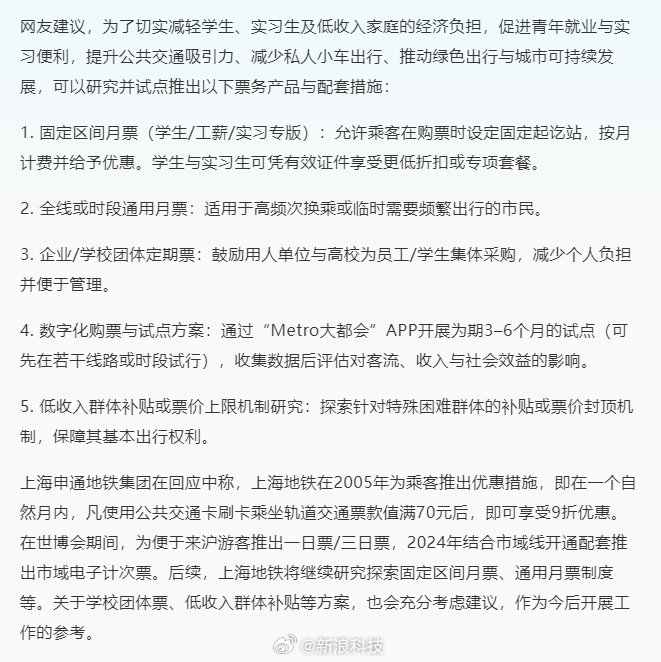
网友建议上海地铁推月票制度,申通回应将研究探索
Xin Lang Ke Ji· 2025-11-23 06:39
Core Viewpoint - The Shanghai Metro is considering the introduction of a monthly ticket system in response to public suggestions, particularly to alleviate the commuting costs for fixed-route commuters and low-income groups [1] Group 1: Monthly Ticket System - A netizen suggested the implementation of a monthly ticket system for the Shanghai Metro, highlighting the current fare structure based on distance traveled [1] - The Shanghai Shentong Metro Group has indicated that it will continue to explore options for fixed-route monthly tickets and general monthly ticket systems [1] Group 2: Target Groups - The suggestion emphasizes the need to consider the commuting burdens faced by students, interns, and low-income individuals, who often have stable travel frequencies and limited incomes [1] - The current fare system significantly impacts these groups, as transportation costs constitute a high proportion of their living and educational expenses, affecting their quality of life and opportunities for employment and study [1]

爆发期再临,谁是地铁增长之王?
Mei Ri Jing Ji Xin Wen· 2025-11-20 14:08
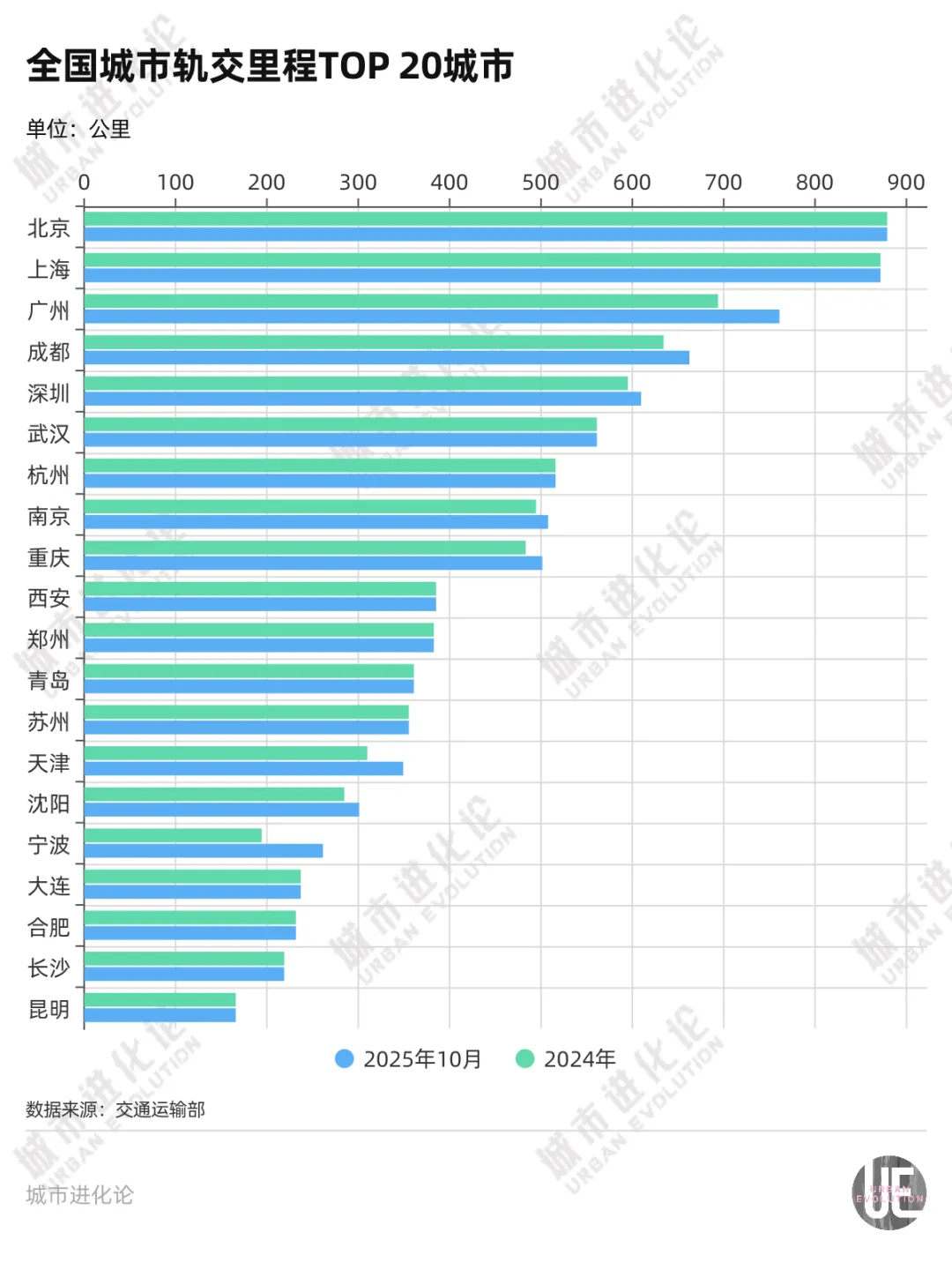
Core Insights - The article highlights the significant progress in urban rail transit construction across several cities in China, particularly Guangzhou, Chengdu, and Hangzhou, marking 2023 as a year of explosive growth in metro construction [2][4][22] Summary by Sections Urban Rail Transit Developments - Chengdu's Metro Line 13 Phase I is set to officially open, contributing to a total operational mileage of over 750 kilometers by the end of the year, with a daily passenger volume exceeding 6 million [1] - Guangzhou has seen the completion of the main structures for two stations on Metro Line 8 North Extension, with five metro lines currently under construction [1] - Hangzhou is advancing its Metro Phase IV project, with multiple lines under construction and the planning of Phase V progressing steadily [2] Growth Statistics - Guangzhou has surpassed the 700-kilometer mark in metro mileage, filling the gap after Shanghai and Beijing crossed the 800-kilometer threshold [4] - Shenzhen has entered the 600-kilometer era with simultaneous openings of multiple lines, while Nanjing and Chongqing have also achieved significant milestones, joining the 500-kilometer club [4][8] Key Players in Growth - Guangzhou and Ningbo are tied for the most new mileage added this year, each with 67.2 kilometers, followed by Tianjin and Chengdu [7] - Guangzhou's metro system is experiencing a historic year with multiple new lines opening, driven by the need for improved transportation for events like the National Games [8] Challenges and Delays - Some cities, such as Ningbo, are facing obstacles in their metro construction applications, highlighting the complexities of urban rail development [3][15] - The approval process for new metro plans has been slow, with cities like Guangzhou and Wuhan awaiting new planning approvals due to previous investment completion rates not meeting required thresholds [16][19] Future Outlook - The construction of suburban and intercity railways is becoming a focus for major cities, with Guangzhou's new lines comprising nearly half of these types of projects [11][12] - The development of city rail systems is seen as essential for urbanization and the establishment of multi-layered transportation networks, with significant room for growth in suburban rail systems [14][22]
过去五年北京开通19条(段)地铁新线,城轨运营总里程全国第一
Xin Jing Bao· 2025-11-20 08:03
Core Insights - Beijing has significantly expanded its transportation infrastructure over the past five years, with the opening of 19 new subway lines totaling 180 kilometers, contributing to a total rail network of 1,244 kilometers, the largest in the country [1][2] - The city has implemented measures to optimize bus lanes, enhancing the efficiency of road network resource utilization [1] - A comprehensive transportation system has been established, integrating rail transit as the backbone, supported by surface public transport and various travel modes [1] Group 1: Rail Transportation - The total operational mileage of urban rail transit in Beijing is now the highest in the nation, with 1,244 kilometers of track [1] - Cross-line operations have been achieved between Line 1 and the Batong Line, as well as between the Fangshan Line and Line 9, improving connectivity [1] - The city has introduced night service on eight lines during major holidays, ensuring coverage for key transport hubs [1] Group 2: Bus and Road Infrastructure - 90% of rail stations are within 50 meters of bus transfer points, indicating a deep integration of bus and rail services [1] - Over the past five years, the urban road network has expanded by 140 kilometers, reaching a total of 6,296 kilometers [2] - The total length of highways has increased by approximately 200 kilometers, exceeding 22,000 kilometers, supporting urban development and industrial growth [2] Group 3: Non-Motorized Transport - The city has developed 22 slow-moving corridors and improved pedestrian spaces, enhancing connectivity for non-motorized transport [2] - A campaign for "civilized riding and orderly parking" has been launched, focusing on the management of non-motorized vehicle parking around key areas [2] - Systematic improvements have been made at 103 rail stations and 40 surrounding areas to maintain order in non-motorized vehicle parking [2]
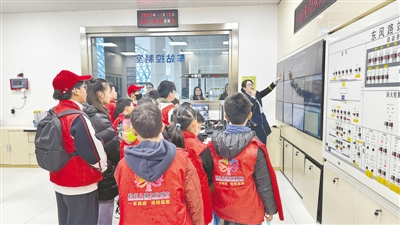
探索城市轨道“童”享低碳生活
Zheng Zhou Ri Bao· 2025-11-20 00:52
Group 1 - The event themed "Dare to be Climate Responsible, Illuminate Children's Future" was organized by the Zhengzhou Women's Federation to promote low-carbon lifestyles and child-friendly urban public transport [2] - Over 20 members of the Children's Friendly Observation Group explored the Zhengzhou Metro Line 8, focusing on understanding the low-carbon and convenient travel options provided by the metro system [2] - The event included a visit to the control room of the East Wind Road Station, where children learned about the core functions of metro operations and emergency response processes [2][3] Group 2 - Safety in travel was emphasized, with staff providing systematic explanations of metro safety knowledge tailored to children's travel characteristics through simulations and demonstrations [3] - The group visited the Zaozhuang Station, which is actively creating a child-friendly themed station with features like a playful photo wall and a reading area [3] - The event concluded with a "Waste to Treasure" handmade activity, where participants created space-themed crafts using recycled materials [3]