地铁线路

Search documents
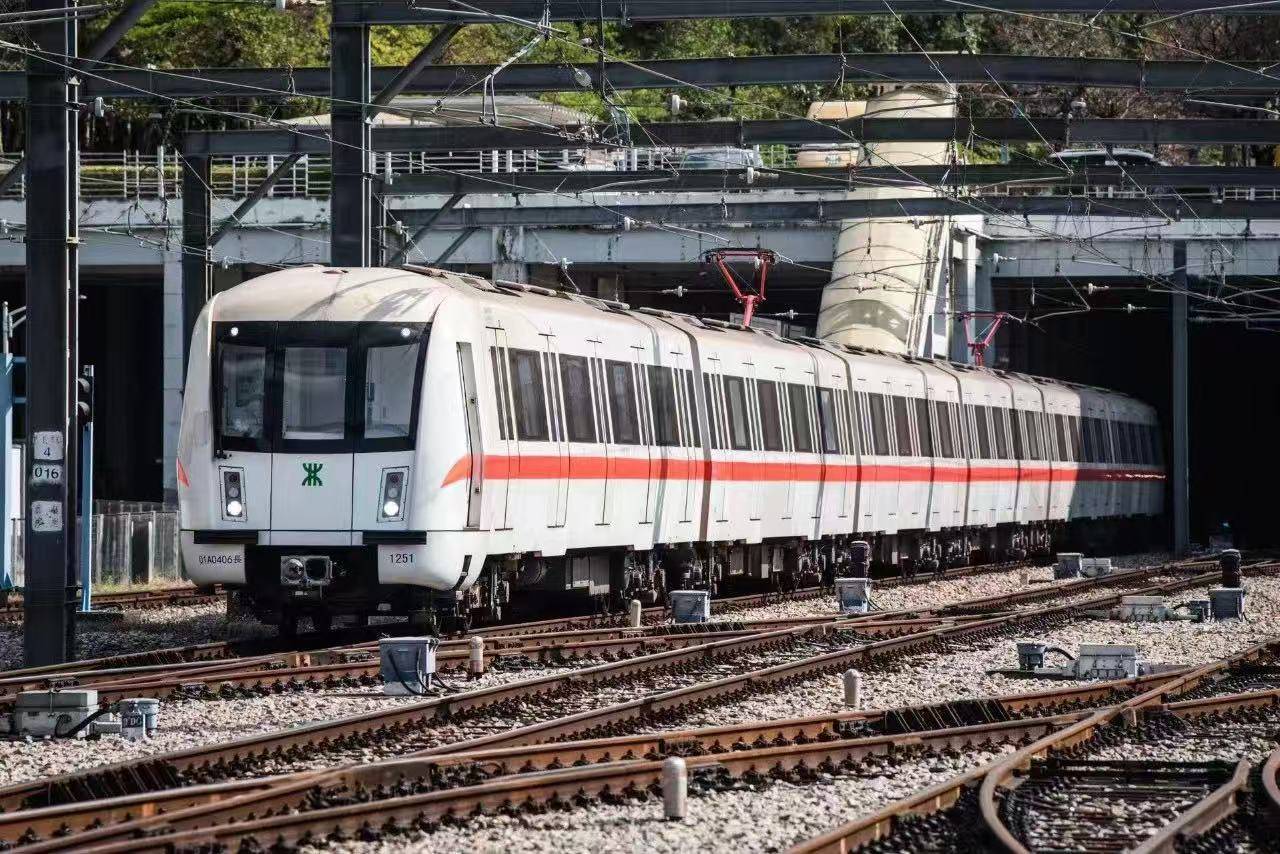
深圳、佛山……多个城市面临地铁审批收紧
Sou Hu Cai Jing· 2026-01-21 06:58
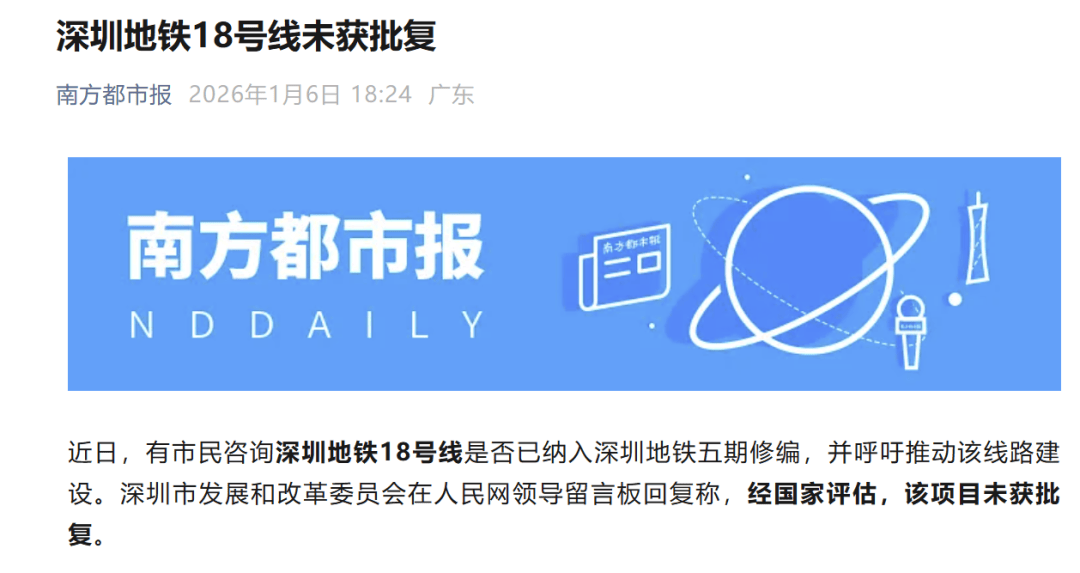
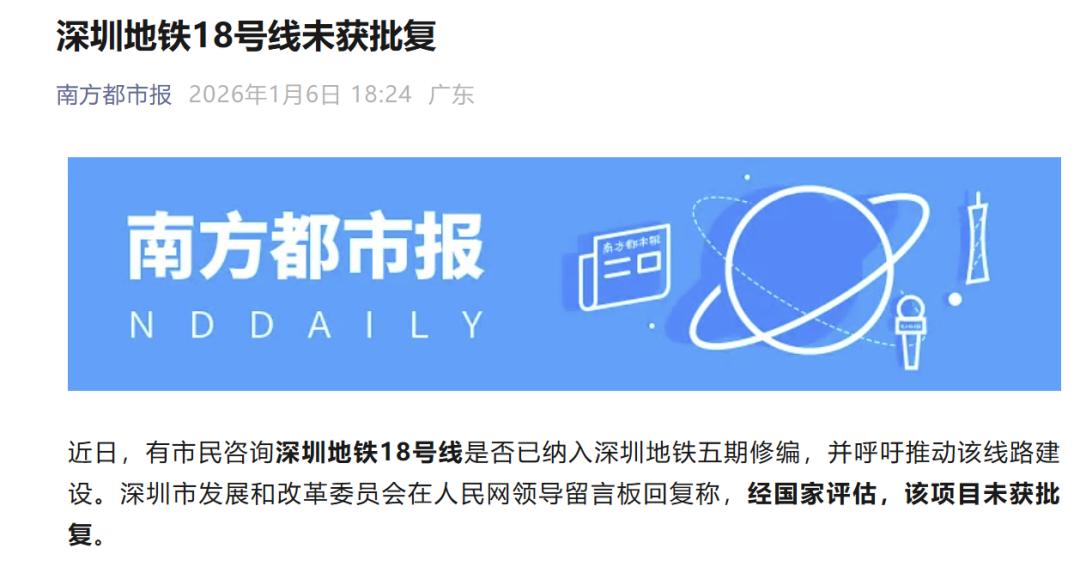
Core Viewpoint - The recent tightening of subway approvals in Shenzhen and Foshan signals a broader trend across China, indicating a shift from "scale expansion" to "efficiency prioritization" in urban rail transit projects [1][8]. Group 1: Shenzhen and Foshan Developments - Shenzhen's subway line 18, a crucial 63-kilometer line connecting five districts, has not received approval from the National Development and Reform Commission (NDRC) [2][5]. - The construction of Shenzhen's 14th line extension to Huizhou has been paused due to Huizhou not meeting national requirements for urban rail transit [4]. - Foshan's subway lines 2 and 11, which were previously approved, now require re-evaluation under current policies, highlighting the retrospective nature of the approval process [5][8]. Group 2: National Trends in Subway Approvals - The tightening of subway approvals is not isolated to Shenzhen and Foshan but reflects a nationwide trend, with many cities facing challenges in their subway planning and construction [8][10]. - Ningbo, for instance, was informed that its fourth-phase subway planning could not proceed due to insufficient passenger flow, with current metrics showing a daily passenger intensity of 0.46 per kilometer, below the required threshold of 0.7 [8][10]. Group 3: Financial and Operational Challenges - Many cities are experiencing financial difficulties due to the high costs associated with subway construction and operation, with 26 out of 28 cities reporting losses in 2024 after accounting for government subsidies [11][13]. - The average construction cost for a subway line exceeds 600 million yuan per kilometer, and operational expenses often surpass ticket revenue, necessitating reliance on government funding [11][13]. Group 4: Policy Implications and Future Outlook - The approval process for new subway projects is becoming increasingly stringent, with new criteria focusing on fiscal capacity, population density, and actual passenger demand to prevent resource wastage and debt risks [19][18]. - The era of rapid subway expansion is coming to an end, with future approvals emphasizing the need for alignment between demand and efficiency rather than mere mileage [19][18].

中国多个城市,地铁审批收紧了?
3 6 Ke· 2026-01-21 02:41
Group 1 - The recent official responses from Shenzhen and Foshan regarding subway approvals indicate a tightening of approval processes for new subway projects [1][2] - Shenzhen's subway line 18, a crucial 63-kilometer line connecting five districts, has not received approval despite its significance for urban development [2][5] - The construction of Shenzhen's 14th line extension to Huizhou has been paused due to Huizhou not meeting national requirements for urban rail transit [5] Group 2 - Foshan's subway lines 2 and 11, previously approved in 2021, now require re-evaluation under current policies, highlighting the retrospective nature of the approval process [5][7] - The tightening of subway approvals is not isolated to Shenzhen and Foshan but reflects a nationwide trend towards prioritizing efficiency over expansion in urban rail projects [7][9] - In 2025, cities like Ningbo and Luoyang faced similar issues, with Ningbo's fourth-phase planning being denied due to insufficient passenger flow, and Luoyang's second phase not meeting application criteria [7][9] Group 3 - The financial burden of subway construction and operation is significant, with 26 out of 28 cities reporting losses in 2024, indicating a reliance on government subsidies [9][13] - National data shows that only 18 out of 54 cities meet the minimum passenger flow requirement of 0.7 passengers per kilometer per day, leading to concerns about resource wastage [9][13] - The approval criteria for new subway projects have become stricter, requiring cities to meet thresholds for public finance, GDP, and population, alongside passenger flow metrics [13][14] Group 4 - The shift in subway project approvals signifies the end of the rapid expansion era, with future approvals focusing on matching demand and efficiency rather than mere construction [13][14] - Cities are encouraged to optimize existing subway operations and improve passenger flow rather than solely pursuing rankings based on subway mileage [14]
成都立体交通网激活高质量发展新动能
Xin Lang Cai Jing· 2026-01-19 18:11
Core Insights - Chengdu's rail transit system has achieved an 800-meter coverage commuting ratio of 35%, ranking second among major cities in China, reflecting a 1% increase from the previous year, which translates to millions of new convenient commuting experiences for residents [8][9][10] Transportation Development - The Chengdu rail network has expanded to over 750 kilometers, evolving from a basic structure to a comprehensive transportation network that supports multi-polar collaboration and enhances urban commuting efficiency [9][10] - New lines, such as Line 27 and Line 30, connect key industrial zones and serve over 150,000 residents, significantly reducing commuting times and improving access to employment opportunities [9][10] - The upcoming cross-city rail line, the Ziyang Line, is expected to enhance regional connectivity, with 80% of peak commuters traveling across city borders, contributing to a "one-hour commuting circle" [10] Tourism and Economic Impact - Chengdu's efficient transportation network has bolstered its tourism sector, with Southeast Asian visitors significantly contributing to the influx of tourists, particularly to attractions like Xiling Snow Mountain [11][12] - The city has established direct flights to Southeast Asian countries, creating a "4-hour cross-border tourism circle," which enhances the attractiveness of Chengdu as a travel destination [12] - Competitive pricing for travel packages and seamless transportation options have made Chengdu an appealing choice for international tourists, with significant cost savings compared to other destinations [12] Urban Integration and Infrastructure - Recent infrastructure developments, including the opening of three new highways, have improved connectivity within the Chengdu metropolitan area, facilitating regional economic integration and cultural exchange [13][14] - The "big channel + micro-circulation" strategy aims to create a robust transportation network that supports both industrial and tourism growth, enhancing the overall quality of urban life [13][14]
从交通基础的网络完善到城市更新的品质升级,从医疗服务的普惠到教育事业的走心
Nan Jing Ri Bao· 2026-01-08 03:42
Group 1: Urban Development and Infrastructure - The opening of the elevated main line of National Highway 312 between Ningzhen and Qixianghe has improved connectivity between the two areas, reducing travel time by nearly 20 minutes for residents [1] - Nanjing has been selected as one of the first pilot cities for urban renewal during the 14th Five-Year Plan, launching 48 urban renewal pilot projects, enhancing the quality of urban life [2][3] - The city has implemented micro-transformation plans to alleviate traffic congestion, resulting in a 30% decrease in congestion index and a 20% increase in average vehicle speed on key road segments [3] Group 2: Transportation Enhancements - The newly opened 2-kilometer dual six-lane expressway has significantly reduced travel time from 90 minutes to 40 minutes for drivers traveling to Zhenjiang [5] - Nanjing's urban rail transit system has expanded to 524.4 kilometers, adding 129.7 kilometers since the end of the 13th Five-Year Plan, enhancing commuting convenience for residents [6] - The introduction of the "Little Blue Whale" micro-circulation bus brand has improved access to public transportation, addressing the "last mile" issue for residents [6] Group 3: Social Services and Welfare - Nanjing has implemented a high-quality, inclusive elderly care service strategy, achieving 100% coverage of district-level elderly service centers and over 1,400 community care centers [9] - The city has introduced a "zero out-of-pocket" policy for hospitalization expenses related to childbirth, significantly reducing financial burdens for families [10] - The establishment of "Ninghai Shiguangli," an all-age dining facility, exemplifies the city's commitment to enhancing elderly care services [7][8] Group 4: Education Improvements - Nanjing has launched 24 educational projects during the 14th Five-Year Plan, including the installation of air conditioning in all ordinary classrooms, improving the learning environment for students [11][12] - The city has added approximately 120,000 new compulsory education seats and over 40,000 high school seats, facilitating access to quality education [12] - Comprehensive health monitoring and nutritional standards have been established for students, ensuring their well-being and academic performance [12]
年底有多少个城市地铁冲KPI?
3 6 Ke· 2025-12-24 01:44
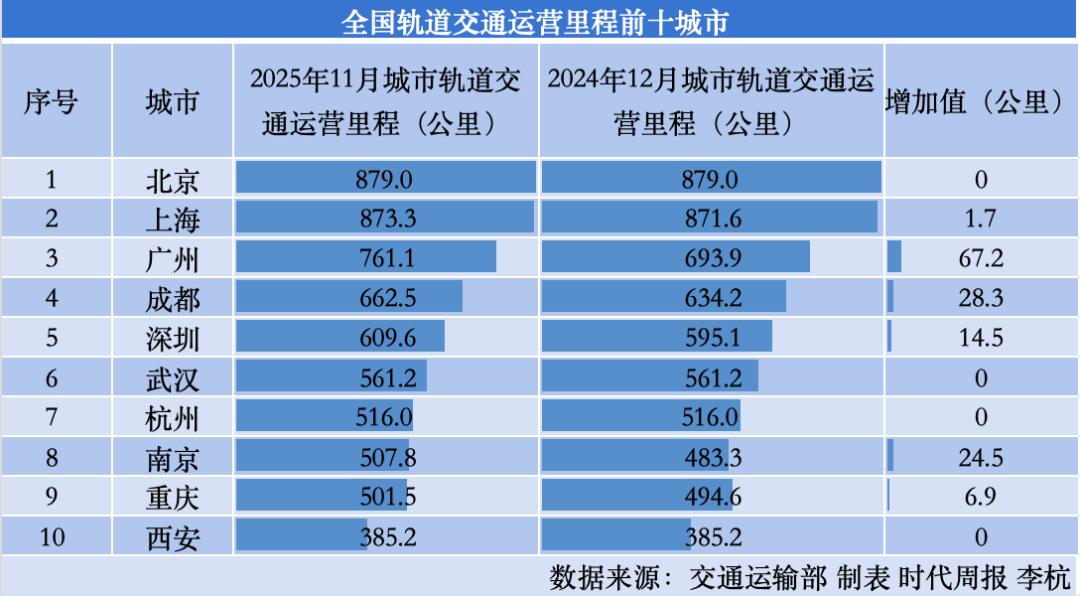
Core Insights - The construction of urban rail transit in China is a significant focus, with 54 cities expected to operate 334 urban rail lines and a total mileage of 11,389.7 kilometers by November 2025 [1] Group 1: Overall Construction Status - As of November 2025, Beijing leads with an operational rail mileage of 879 kilometers, followed by Shanghai, Guangzhou, Chengdu, Shenzhen, Wuhan, Hangzhou, Nanjing, Chongqing, and Xi'an [2][5] - Nanjing has surpassed Chongqing to rank 8th in operational mileage as of the end of 2024 [2][12] Group 2: Upcoming Developments - Several cities are set to open new rail lines in December, which may alter the current rankings. For instance, Nanjing's new lines will increase its operational mileage from 508 kilometers to 525 kilometers, moving it to 7th place [3][13][17] - Shanghai's new line is expected to push its operational mileage over 900 kilometers, while Beijing's new lines will also increase its mileage to 909 kilometers [4][13] Group 3: Key Cities and Their Rankings - Nine cities have operational rail mileage exceeding 500 kilometers, with Beijing and Shanghai exceeding 800 kilometers [5] - Guangzhou has shown significant growth, adding 67.2 kilometers this year, bringing its total to 761.1 kilometers [6][7] - Chengdu and Shenzhen have also crossed the 600-kilometer threshold, with Shenzhen's operational mileage reaching 609.6 kilometers [8] Group 4: Passenger Volume and Efficiency - The passenger intensity, which reflects the average number of passengers per kilometer, indicates the operational efficiency of urban rail systems. Higher values suggest better efficiency, while excessively high values may indicate overcrowding [11] - Beijing and Shanghai lead in passenger volume, with Beijing recording 29 lines and a total of 29,777.7 million passenger trips [9]
年内迎来修建爆发期 谁是地铁里程“增长之王”?
Mei Ri Jing Ji Xin Wen· 2025-11-24 12:55
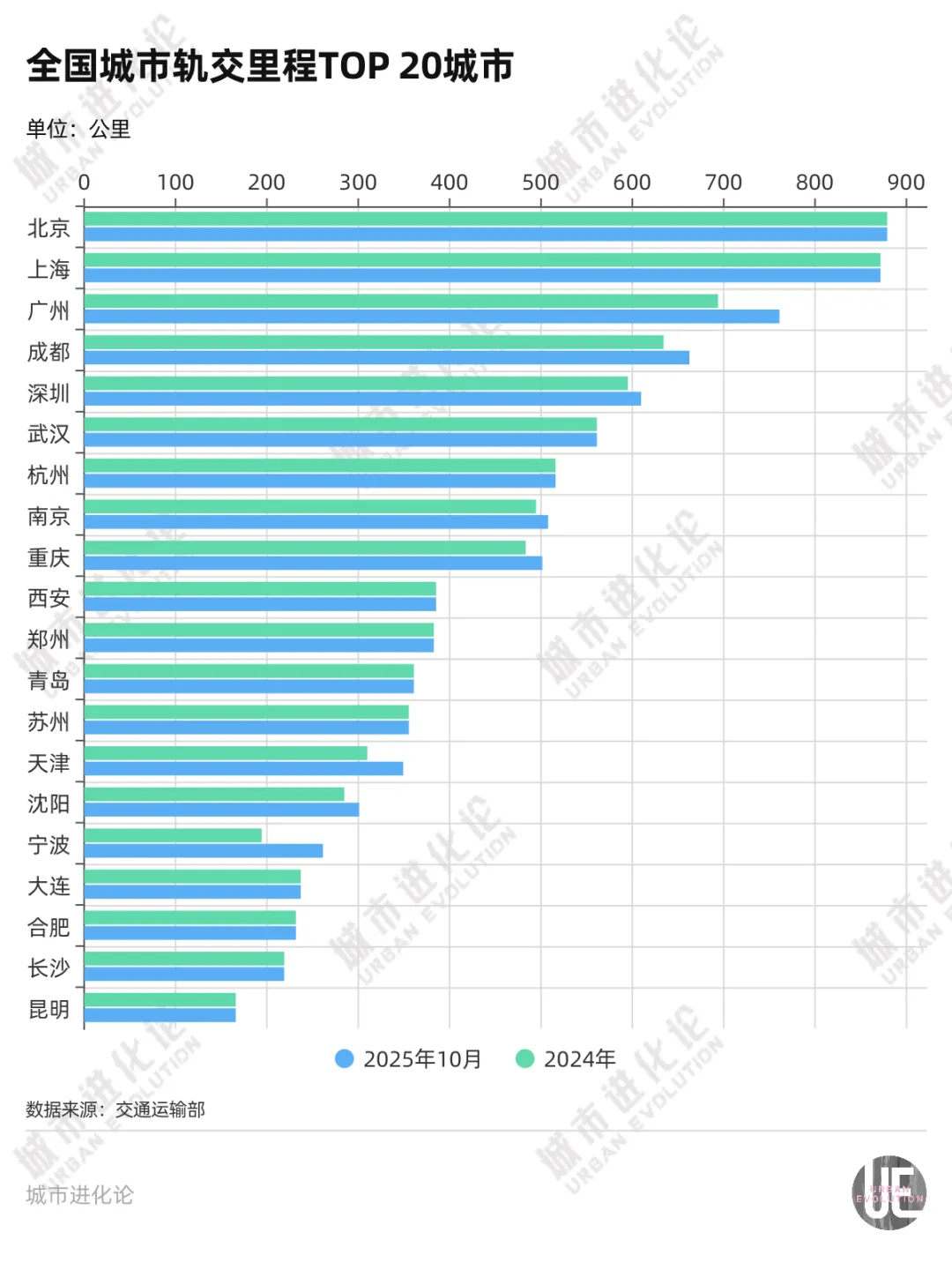
Core Insights - The article highlights a significant surge in urban rail transit construction across multiple cities in China, with cities like Guangzhou, Chengdu, and Hangzhou leading the way in expanding their metro systems [1][2][3] Group 1: Urban Rail Transit Developments - Chengdu's Metro Line 13 Phase 1 is set to open soon, contributing to the city's total metro operational mileage exceeding 750 kilometers by the end of the year, with a daily passenger volume of over 6 million [1] - Guangzhou has reached a milestone of over 700 kilometers of metro lines, with five lines currently under construction and the successful acceptance of the Guangqing intercity railway southern extension [2][4] - Hangzhou is making progress on its Metro Phase IV project, with multiple lines under construction and plans for Phase V advancing steadily [1][2] Group 2: Growth Leaders in Metro Mileage - Guangzhou and Ningbo are tied for the most new metro mileage added this year, each with 67.2 kilometers, while Tianjin and Chengdu follow closely [3] - Shenzhen is also on track to expand its metro system significantly, with six new lines totaling 39.48 kilometers expected to be operational by year-end, aiming to reach 634.6 kilometers in total [6] Group 3: Future Prospects and Challenges - The construction of intercity and suburban railways is becoming a focus for major cities, with Guangzhou's new lines comprising nearly half of its new projects being intercity railways [6][8] - Cities like Chengdu and Shenzhen are also planning to enhance their suburban rail networks, indicating a shift towards a more integrated transportation system [7][8] - However, cities like Ningbo are facing challenges in advancing their new construction plans due to insufficient passenger flow and regulatory requirements [11]
爆发期再临,谁是地铁增长之王?
Mei Ri Jing Ji Xin Wen· 2025-11-20 14:08
Core Insights - The article highlights the significant progress in urban rail transit construction across several cities in China, particularly Guangzhou, Chengdu, and Hangzhou, marking 2023 as a year of explosive growth in metro construction [2][4][22] Summary by Sections Urban Rail Transit Developments - Chengdu's Metro Line 13 Phase I is set to officially open, contributing to a total operational mileage of over 750 kilometers by the end of the year, with a daily passenger volume exceeding 6 million [1] - Guangzhou has seen the completion of the main structures for two stations on Metro Line 8 North Extension, with five metro lines currently under construction [1] - Hangzhou is advancing its Metro Phase IV project, with multiple lines under construction and the planning of Phase V progressing steadily [2] Growth Statistics - Guangzhou has surpassed the 700-kilometer mark in metro mileage, filling the gap after Shanghai and Beijing crossed the 800-kilometer threshold [4] - Shenzhen has entered the 600-kilometer era with simultaneous openings of multiple lines, while Nanjing and Chongqing have also achieved significant milestones, joining the 500-kilometer club [4][8] Key Players in Growth - Guangzhou and Ningbo are tied for the most new mileage added this year, each with 67.2 kilometers, followed by Tianjin and Chengdu [7] - Guangzhou's metro system is experiencing a historic year with multiple new lines opening, driven by the need for improved transportation for events like the National Games [8] Challenges and Delays - Some cities, such as Ningbo, are facing obstacles in their metro construction applications, highlighting the complexities of urban rail development [3][15] - The approval process for new metro plans has been slow, with cities like Guangzhou and Wuhan awaiting new planning approvals due to previous investment completion rates not meeting required thresholds [16][19] Future Outlook - The construction of suburban and intercity railways is becoming a focus for major cities, with Guangzhou's new lines comprising nearly half of these types of projects [11][12] - The development of city rail systems is seen as essential for urbanization and the establishment of multi-layered transportation networks, with significant room for growth in suburban rail systems [14][22]
市“十五五”规划编制和二〇五〇发展战略研究收到八百余条意见建议
Nan Jing Ri Bao· 2025-07-04 02:24
Core Viewpoint - The Nanjing Municipal Development and Reform Commission, in collaboration with Nanjing Media Group, has initiated a public opinion collection activity for the "14th Five-Year Plan" and the 2050 development strategy, receiving over 800 suggestions from citizens [1] Group 1: Urban Development and Infrastructure - Citizens have expressed a strong interest in urban transportation, regional coordination, and industrial development, with suggestions for more public sports facilities and faster metro line construction [2] - There is a call for the integration of modern technology, such as AI, to enhance public safety and smart city management [2] Group 2: Youth and Employment - The planning process emphasizes the importance of addressing the needs of young people, with suggestions for policies to support the delivery industry and improve working conditions for young workers [3][4] - Citizens have requested the creation of high-quality job opportunities and the enhancement of community services to support the aging population [4] Group 3: Tourism and Cultural Resources - Suggestions have been made to leverage Nanjing's rich historical and cultural resources to boost tourism, including seasonal tourism development and educational travel for students [5][6] - There is a proposal to utilize the Yangtze River's cultural tourism resources and develop a comprehensive operational plan to meet the high-quality demands of residents and tourists [6] Group 4: Industrial Development and Regional Coordination - Citizens have highlighted the potential for developing the low-altitude economy and the aviation industry in Nanjing, advocating for an integrated innovation ecosystem [6] - There is a push for enhanced coordination within the Nanjing metropolitan area, including seamless public transport integration and equal social security benefits for residents [6]

广州:13号线二期东段等5段地铁力争十五运会前开通
Nan Fang Ri Bao Wang Luo Ban· 2025-06-11 08:43
Core Viewpoint - Guangzhou is enhancing urban quality through 291 projects, leveraging the upcoming 15th National Games and the Special Olympics to improve various urban aspects, with 173 projects completed and the rest expected by August 31 [1] Group 1: Urban Quality Improvement Projects - Guangzhou is focusing on 8 categories of urban quality improvement projects, including roads, gardens, rivers, and street lighting [1] - 30 venues are being developed with 17 exquisite street areas around them, with 7 completed, enhancing the environment and accessibility [2] - The city is transforming key areas like the Pearl River banks and the Guangzhou Tower, creating running paths and improving night lighting [3] Group 2: Transportation Infrastructure Development - Guangzhou plans to enhance its transportation network with new rail lines and improved road connections before the National Games [4] - The city has built 120 kilometers of new high-speed roads, increasing the total to 1268 kilometers, facilitating intercity travel [4] - The non-motorized vehicle lane mileage is set to reach 2966 kilometers by the end of 2024, marking a 144% increase since 2020 [5] Group 3: Accessibility and Environmental Enhancements - The city is implementing shared lanes for vehicles and non-motorized traffic, improving accessibility for special groups [6] - 59 traffic quality improvement projects are underway, focusing on enhancing the visual and functional aspects of major transport routes [6]
完成固定资产投资146.88亿元!深铁集团亮出一季度“成绩单”
Sou Hu Cai Jing· 2025-04-29 14:30
Group 1 - The core achievement of the Shenzhen Metro Group in Q1 is a fixed asset investment of 14.688 billion yuan, representing a 14% increase compared to the same period last year, successfully meeting the initial annual target [1][3] - The total investment in ongoing projects exceeds 700 billion yuan, with a total of 598.7 kilometers of rail construction planned for the year, including multiple metro lines and intercity railways [3][6] - The operational mileage of the Shenzhen urban rail transit network has reached 595.1 kilometers, with 18 lines, achieving a "1 kilometer metro rate" of 97%, facilitating a convenient "one-hour living circle" for residents [5][6] Group 2 - In Q1, the operating revenue of the Shenzhen Metro Group was 3.132 billion yuan, with significant performance in various business sectors, including real estate development [6][7] - The company delivered 954 housing units in Q1, with a total sales revenue of 3.422 billion yuan, indicating strong market confidence and demand [6][7] - The metro system's passenger traffic in the first three months exceeded 747 million, with a public transport share of 68.3%, reflecting a 7.7% year-on-year increase in daily passenger flow [4][6]