酒店餐饮

Search documents
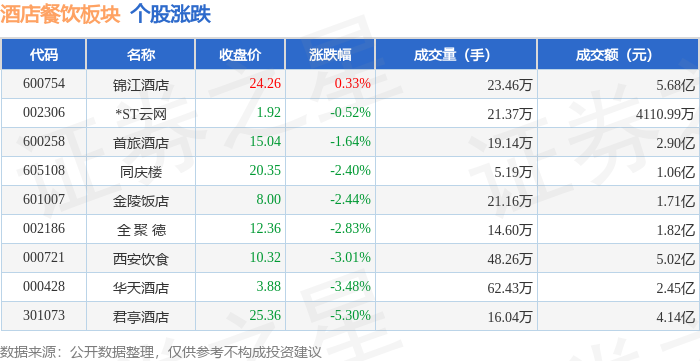
酒店餐饮板块9月17日跌1.62%,君亭酒店领跌,主力资金净流出2.11亿元
Zheng Xing Xing Ye Ri Bao· 2025-09-17 08:45
Market Overview - The hotel and catering sector experienced a decline of 1.62% on September 17, with Junting Hotel leading the drop [1] - The Shanghai Composite Index closed at 3876.34, up 0.37%, while the Shenzhen Component Index closed at 13215.46, up 1.16% [1] Individual Stock Performance - Jinjiang Hotels closed at 24.26, with a slight increase of 0.33% and a trading volume of 234,600 shares, totaling a transaction value of 568 million yuan [1] - ST Yunwang closed at 1.92, down 0.52%, with a trading volume of 213,700 shares and a transaction value of 41.11 million yuan [1] - Shoulv Hotels closed at 15.04, down 1.64%, with a trading volume of 191,400 shares and a transaction value of 290 million yuan [1] - Tongqinglou closed at 20.35, down 2.40%, with a trading volume of 151,900 shares and a transaction value of 106 million yuan [1] - Jinling Hotel closed at 8.00, down 2.44%, with a trading volume of 211,600 shares and a transaction value of 171 million yuan [1] - Quanjude closed at 12.36, down 2.83%, with a trading volume of 146,000 shares and a transaction value of 182 million yuan [1] - Xi'an Catering closed at 10.32, down 3.01%, with a trading volume of 482,600 shares and a transaction value of 502 million yuan [1] - Huatian Hotel closed at 3.88, down 3.48%, with a trading volume of 624,300 shares and a transaction value of 245 million yuan [1] - Junlin Hotel closed at 25.36, down 5.30%, with a trading volume of 160,400 shares and a transaction value of 414 million yuan [1] Capital Flow Analysis - The hotel and catering sector saw a net outflow of 211 million yuan from main funds, while retail investors contributed a net inflow of 151 million yuan [1] - The detailed capital flow for individual stocks indicates that Jinjiang Hotels had a net inflow of 2.526 million yuan from main funds, while it faced a net outflow of 800,140 yuan from retail investors [2] - ST Yunwang experienced a net outflow of 2.608 million yuan from main funds, with a net inflow of 971,300 yuan from retail investors [2] - Tongqinglou had a net outflow of 4.278 million yuan from main funds, but a net inflow of 607,620 yuan from retail investors [2] - Jinling Hotel faced a significant net outflow of 20.608 million yuan from main funds, with a small net inflow of 218,210 yuan from retail investors [2] - Quanjude had a net outflow of 22.918 million yuan from main funds, while retail investors contributed a net inflow of 2.914 million yuan [2] - Shoulv Hotels saw a net outflow of 34.115 million yuan from main funds, with a net inflow of 1.640 million yuan from retail investors [2] - Xi'an Catering had a net outflow of 45.444 million yuan from main funds, but a net inflow of 4.596 million yuan from retail investors [2] - Junting Hotel experienced a net outflow of 69.421 million yuan from main funds, while retail investors contributed a net inflow of 4.838 million yuan [2]


酒店餐饮板块9月16日涨0.62%,华天酒店领涨,主力资金净流出5569.34万元
Zheng Xing Xing Ye Ri Bao· 2025-09-16 08:46
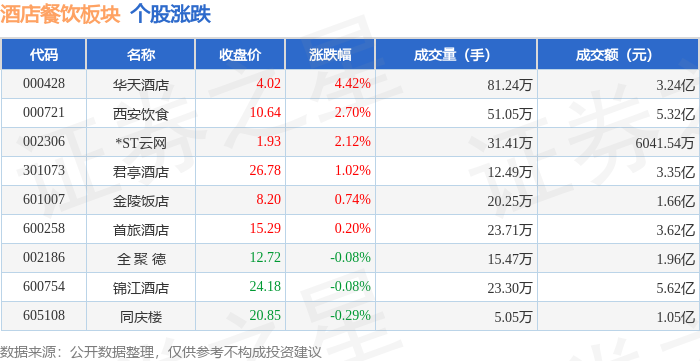
Market Overview - The hotel and catering sector increased by 0.62% on September 16, with Huazhong Hotel leading the gains [1] - The Shanghai Composite Index closed at 3861.87, up 0.04%, while the Shenzhen Component Index closed at 13063.97, up 0.45% [1] Individual Stock Performance - Huazhong Hotel (000428) closed at 4.02, up 4.42% with a trading volume of 812,400 shares and a turnover of 324 million yuan [1] - Xian Catering (000721) closed at 10.64, up 2.70% with a trading volume of 510,500 shares and a turnover of 532 million yuan [1] - ST Yunwang (002306) closed at 1.93, up 2.12% with a trading volume of 314,100 shares and a turnover of 60.41 million yuan [1] - Junting Hotel (301073) closed at 26.78, up 1.02% with a trading volume of 124,900 shares and a turnover of 335 million yuan [1] - Jinling Hotel (601007) closed at 8.20, up 0.74% with a trading volume of 202,500 shares and a turnover of 166 million yuan [1] - Shoulv Hotel (600258) closed at 15.29, up 0.20% with a trading volume of 237,100 shares and a turnover of 362 million yuan [1] - Quanjude (002186) closed at 12.72, down 0.08% with a trading volume of 154,700 shares and a turnover of 1.967 million yuan [1] - Jinjiang Hotel (600754) closed at 24.18, down 0.08% with a trading volume of 233,000 shares and a turnover of 562 million yuan [1] - Tongqinglou (605108) closed at 20.85, down 0.29% with a trading volume of 50,500 shares and a turnover of 10.5 million yuan [1] Capital Flow Analysis - The hotel and catering sector experienced a net outflow of 55.69 million yuan from institutional investors, while retail investors saw a net inflow of 53.57 million yuan [1] - The detailed capital flow for individual stocks indicates varying levels of institutional and retail investor activity [2] - Xian Catering had a net inflow of 19.72 million yuan from institutional investors, while retail investors had a net outflow of 9.43 million yuan [2] - ST Yunwang saw a net inflow of 6.99 million yuan from institutional investors, with retail investors also experiencing a net outflow [2] - Jinjiang Hotel had a net outflow of 3.82 million yuan from institutional investors, but retail investors had a net inflow of 7.56 million yuan [2] - Overall, the capital flow indicates a mixed sentiment among different types of investors within the hotel and catering sector [2]


酒店餐饮板块9月15日涨1.7%,锦江酒店领涨,主力资金净流入6426.97万元
Zheng Xing Xing Ye Ri Bao· 2025-09-15 08:42
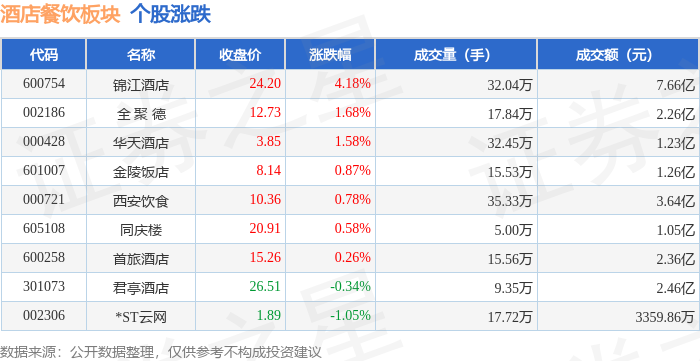
Market Overview - The hotel and catering sector increased by 1.7% on September 15, with Jinjiang Hotels leading the gains [1] - The Shanghai Composite Index closed at 3860.5, down 0.26%, while the Shenzhen Component Index closed at 13005.77, up 0.63% [1] Stock Performance - Jinjiang Hotels (600754) closed at 24.20, up 4.18% with a trading volume of 320,400 shares and a transaction value of 766 million [1] - Quanjude (002186) closed at 12.73, up 1.68% with a trading volume of 178,400 shares and a transaction value of 226 million [1] - Huazhong Hotel (000428) closed at 3.85, up 1.58% with a trading volume of 324,500 shares and a transaction value of 123 million [1] - Other notable performances include Jining Hotel (601007) up 0.87%, and Xian Catering (000721) up 0.78% [1] Capital Flow - The hotel and catering sector saw a net inflow of 64.27 million from institutional investors, while retail investors experienced a net outflow of 97.65 million [1] - Jinjiang Hotels had a significant net inflow of 93.03 million from institutional investors, representing 12.14% of its total trading volume [2] - Quanjude and Huazhong Hotel also saw net inflows from institutional and speculative investors, although retail investors withdrew funds [2]

因这类食品安全违法行为,中国供销集团庐山北斗星国际饭店被罚
Qi Lu Wan Bao· 2025-09-15 02:51
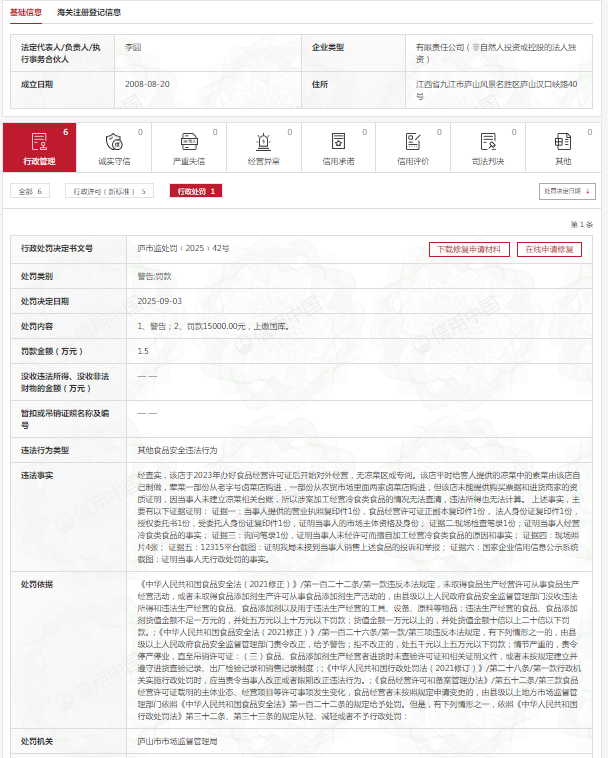
Core Viewpoint - China Supply and Marketing Group Lushan Beidouxing International Hotel Co., Ltd. has been penalized for food safety violations, specifically for operating without proper documentation for cold food processing [1][4]. Group 1: Company Information - The company, established in 2008, has a registered capital of 182 million RMB and is wholly owned by Zhonghe Lian Investment Co., Ltd. [4]. - The legal representative of the company is Li Yuan [4]. Group 2: Violation Details - The hotel began operations after obtaining a food business license in 2023 but lacked a designated area for cold dishes [2][3]. - The establishment provided cold dishes made in-house and sourced some meat dishes from local markets, but failed to provide purchase receipts and supplier qualifications [2][3]. - The lack of a proper record-keeping system for cold dishes made it impossible to ascertain the extent of the violations or calculate illegal gains [2][3]. Group 3: Penalty Imposed - The Lushan Market Supervision Administration issued a warning and imposed a fine of 15,000 RMB, which is to be paid into the national treasury [4]. - The administrative penalty decision number is 市监处罚﹝2025﹞42号 [4].
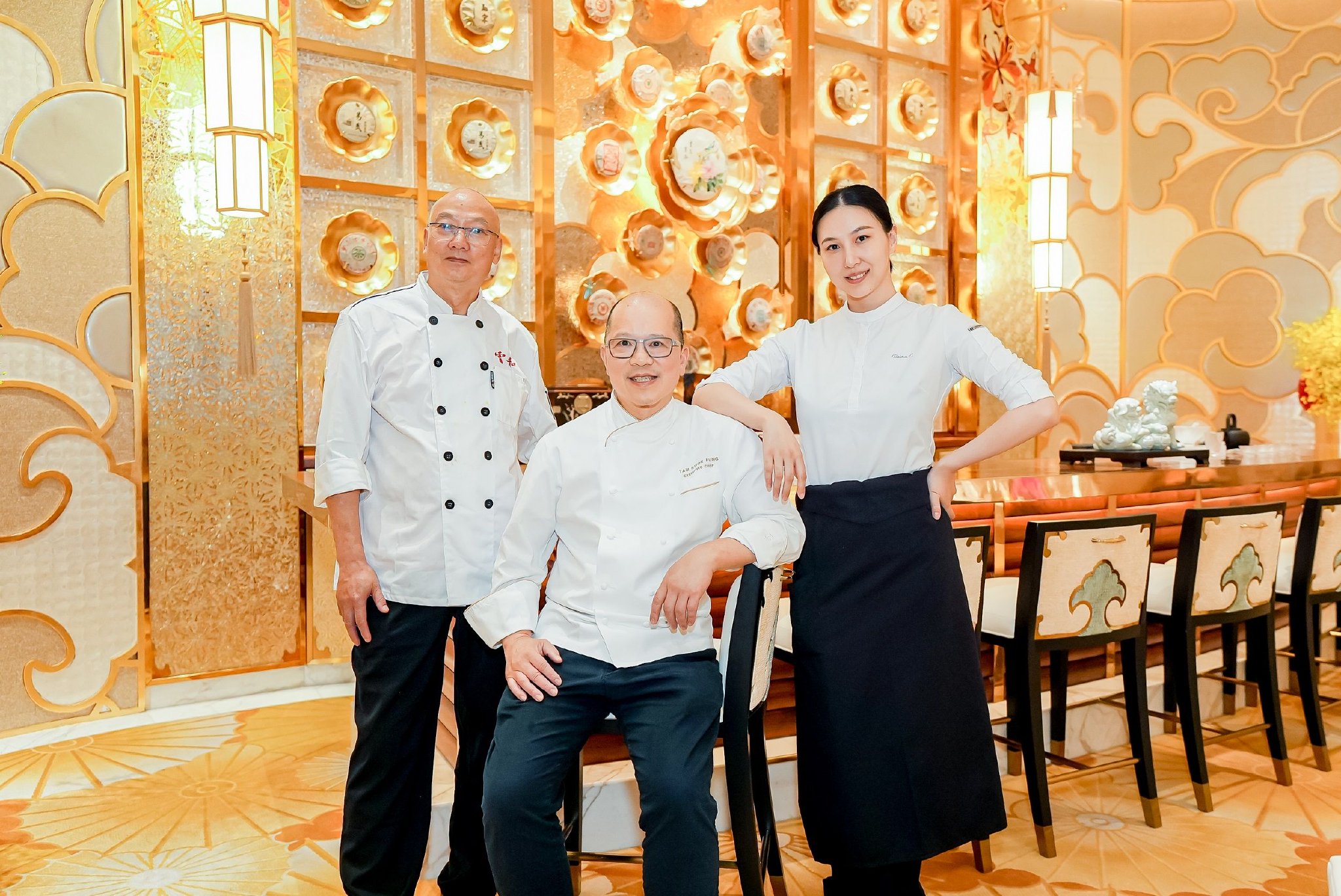
三厨六手·拿手好蟹:揭开永利澳门的美食之道
Xin Lang Cai Jing· 2025-09-14 14:10
Core Insights - The article discusses the second "2025 Fine Dining Investment Forum" held in Shanghai, focusing on exploring new investment opportunities in the fine dining sector by looking inward to domestic market potential and outward to international markets [1] - The forum highlighted the importance of enhancing brand building and quality improvement while also promoting Chinese culinary culture abroad [1][18] - Macau is identified as a leading indicator for fine dining development, blending traditional Cantonese cuisine with Western culinary techniques and standards [1][18] Group 1: Event Overview - The "Fine Dining Investment Forum - Macau Station" featured renowned chefs and industry experts collaborating on a themed dinner, showcasing seasonal ingredients like crabs [1][3] - The event attracted 15 investors from various culinary backgrounds, with their restaurants collectively holding over 30 accolades from prestigious dining guides [3][5] Group 2: Culinary Innovation - Chefs focused on creating unique dishes that balance traditional flavors with innovative presentations, using seasonal ingredients to enhance the dining experience [5][7] - The dinner featured a variety of dishes, including crab-based creations and a signature noodle dish made with spinach noodles, emphasizing precision in preparation [11][12] Group 3: Market Trends and Insights - The article notes a trend towards younger consumers seeking unique dining experiences, emphasizing the importance of social media appeal and innovative flavors [29][30] - Macau's dining market is characterized by high international tourist traffic, necessitating a blend of local and global culinary offerings to meet diverse consumer demands [28][30] Group 4: Strategic Initiatives - The article outlines Wynn Macau's commitment to culinary excellence through rigorous ingredient selection and innovative dining experiences, positioning itself as a leader in the fine dining sector [17][19] - Wynn Macau actively promotes local culinary talent and engages in cross-cultural culinary collaborations to enhance the dining landscape [19][22]

万联证券社服行业25年中季报综述:营收利润双提升 旅游景区边际向好
Zhi Tong Cai Jing· 2025-09-12 08:48
Core Viewpoint - The social services sector has shown growth in both revenue and profit in the first half of 2025, with total revenue reaching 95.436 billion yuan, a year-on-year increase of 5.44%, and net profit attributable to shareholders totaling 4.870 billion yuan, up 1.13% year-on-year [2][5]. Group 1: Social Services Sector - In the first half of 2025, the social services sector's total revenue was 95.436 billion yuan, ranking 9th among primary industries in Shenwan, while net profit was 4.870 billion yuan, ranking 16th [2]. - The tourism and scenic spots sector achieved revenue of 16.610 billion yuan, a year-on-year increase of 4.39%, but net profit decreased by 4.30% to 1.041 billion yuan [3]. Group 2: Tourism and Scenic Spots - The recovery in resident travel demand and supportive policies have contributed to the revenue rebound in the tourism and scenic spots sector [3]. - The introduction of policies such as a 240-hour visa-free entry and immediate tax refunds for outbound tourists has boosted inbound tourism [3]. Group 3: Hotel and Catering Sector - The hotel and catering sector reported revenue of 14.056 billion yuan, a decline of 3.40%, with net profit dropping significantly by 40.36% to 0.708 billion yuan [4]. - The weak consumer demand has pressured profits in this sector, but there is potential for recovery if the consumption environment improves in the second half of the year [4]. Group 4: Investment Recommendations - To support stable economic growth, boosting consumption and expanding domestic demand are seen as core strategies [5]. - The potential in lower-tier markets is expected to strengthen the consumption base, while overseas expansion may create new growth opportunities [5]. - The implementation of visa-free policies and the establishment of duty-free shops are anticipated to further stimulate the tourism market [5].
酒店餐饮板块9月12日跌1.41%,君亭酒店领跌,主力资金净流出1.26亿元
Zheng Xing Xing Ye Ri Bao· 2025-09-12 08:38
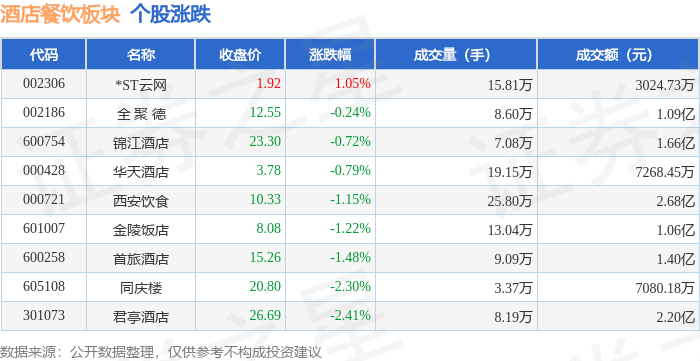
Market Overview - The hotel and catering sector experienced a decline of 1.41% on September 12, with Junting Hotel leading the drop [1] - The Shanghai Composite Index closed at 3883.69, up 0.22%, while the Shenzhen Component Index closed at 12996.38, up 0.13% [1] Individual Stock Performance - ST Yunwang (002306) closed at 1.92, with an increase of 1.05% and a trading volume of 158,100 shares, totaling 13.02 million yuan [1] - Quanjude (002186) closed at 12.55, down 0.24%, with a trading volume of 86,000 shares, totaling 109 million yuan [1] - Jinjiang Hotel (600754) closed at 23.30, down 0.72%, with a trading volume of 70,800 shares, totaling 166 million yuan [1] - Huatian Hotel (000428) closed at 3.78, down 0.79%, with a trading volume of 191,500 shares, totaling 72.68 million yuan [1] - Xianyin Food (000721) closed at 10.33, down 1.15%, with a trading volume of 258,000 shares, totaling 268 million yuan [1] - Jinling Hotel (601007) closed at 8.08, down 1.22%, with a trading volume of 130,400 shares, totaling 10.6 million yuan [1] - Shoulv Hotel (600258) closed at 15.26, down 1.48%, with a trading volume of 90,900 shares, totaling 140 million yuan [1] - Tongqinglou (605108) closed at 20.80, down 2.30%, with a trading volume of 33,700 shares, totaling 7.08 million yuan [1] - Junting Hotel (301073) closed at 26.69, down 2.41%, with a trading volume of 81,900 shares, totaling 220 million yuan [1] Capital Flow Analysis - The hotel and catering sector saw a net outflow of 126 million yuan from main funds, while retail investors contributed a net inflow of 141 million yuan [1] - The following stocks experienced significant capital flow changes: - Huatian Hotel: Main funds net inflow of 1.49 million yuan, retail net inflow of 5.79 million yuan [2] - ST Yunwang: Main funds net outflow of 589,300 yuan, retail net outflow of 69,400 yuan [2] - Jinling Hotel: Main funds net outflow of 6.63 million yuan, retail net inflow of 9.41 million yuan [2] - Quanjude: Main funds net outflow of 7.99 million yuan, retail net inflow of 12.60 million yuan [2] - Jinjiang Hotel: Main funds net outflow of 25.17 million yuan, retail net inflow of 32.34 million yuan [2] - Junting Hotel: Main funds net outflow of 51.94 million yuan, retail net inflow of 30.58 million yuan [2]
万联晨会-20250912
Wanlian Securities· 2025-09-12 01:08
Core Insights - The A-share market experienced significant gains, with the Shanghai Composite Index rising by 1.65% to 3,875.31 points, the Shenzhen Component Index increasing by 3.36% to 12,979.89 points, and the ChiNext Index climbing by 5.15% to 3,053.75 points. The total trading volume reached 2.44 trillion RMB, with net purchases from southbound funds amounting to 18.99 billion HKD. Over 4,000 stocks saw price increases, and all 31 Shenwan first-level industries reported gains, particularly in the communication, electronics, and computer sectors [2][7][5]. Market Performance - Domestic market indices showed strong performance, with the Shanghai Composite Index closing at 3,875.31 points (+1.65%), the Shenzhen Component Index at 12,979.89 points (+3.36%), and the ChiNext Index at 3,053.75 points (+5.15%). The total trading volume in the A-share market was 2.44 trillion RMB [5][7]. - Internationally, major indices also saw positive movement, with the Dow Jones up 1.36% to 46,108.00 points, the S&P 500 rising 0.85% to 6,587.47 points, and the Nasdaq increasing by 0.72% to 22,043.07 points [5][7]. Important News - The State Council has approved a two-year pilot program for market-oriented allocation of factors in ten regions, including Beijing's sub-center and the Guangdong-Hong Kong-Macau Greater Bay Area. This initiative aims to explore market-oriented talent allocation and facilitate cross-border capital flows [3][7]. Industry Analysis - The social services sector reported a revenue increase of 5.44% year-on-year, totaling 95.436 billion RMB, with a net profit of 4.870 billion RMB, reflecting a 1.13% increase. The tourism and scenic area segment achieved revenues of 16.610 billion RMB (+4.39%) but saw a net profit decline of 4.30% [12][13]. - The hotel and catering sector faced challenges, with revenues declining by 3.40% to 14.056 billion RMB and net profits dropping by 40.36% to 0.708 billion RMB. The overall weak consumer demand impacted profitability, although there is potential for recovery if the consumption environment improves [13]. Equipment Industry Insights - In July, excavator sales reached 17,138 units, marking a 25.2% year-on-year increase, while loader sales totaled 9,000 units, up 7.41%. The domestic market showed resilience, driven by infrastructure investments and equipment upgrades [15][16][17]. - The engineering machinery industry is experiencing a recovery, supported by both domestic demand and robust export growth, particularly in countries involved in the Belt and Road Initiative. The sector is transitioning towards smart, green, and high-end manufacturing [17].
夜经济升腾烟火气
Xin Hua Wang· 2025-09-11 23:47
Group 1 - The Alding Art and Cultural Community in Baotou, Inner Mongolia, has been attracting an average of 300 visitors daily since its soft opening earlier this year, particularly busy in the evenings [1] - The community offers a blend of tea dining and cultural products, serving as a cultural station for citizens' nighttime leisure [1] - There are currently 16 such urban book houses in the Kunlun District, emphasizing the importance of spaces that allow for relaxation and contemplation in the night economy [1] Group 2 - The Baotou Meiyue Marriott Hotel has successfully expanded its outdoor dining options, increasing the variety of food offerings from over 30 to more than 70, with a daily footfall of around 200 and an average spending of 50 yuan per customer [2] - The hotel has seen a 100% year-on-year increase in sales at its lobby bar, aided by the introduction of a night dining bar [2] - The Hongde Hotel in Baotou focuses on a barbecue concept, appealing to younger consumers by combining camping-style dining with traditional Sichuan cuisine [2] Group 3 - From January to July this year, the Kunlun District achieved a retail sales volume of 14.982 billion yuan, reflecting a year-on-year growth of 9.3%, which is 1.3 percentage points higher than the city average [3] - The retail sales growth rate for key enterprises increased by 16.4%, showing a slight acceleration compared to the previous month [3] - The night economy is recognized as a vital driver for enhancing consumer spending, promoting employment, and facilitating income growth, with plans for further development to boost urban commercial competitiveness [3]
9/11财经夜宵:得知基金净值排名及选基策略,赶紧告知大家
Sou Hu Cai Jing· 2025-09-11 15:53
Group 1 - The article provides a ranking of open-end funds based on their net asset value growth as of September 11, 2025, highlighting the top 10 funds with significant increases [2][4]. - The top-performing funds include Huatai-PB Quality Growth Mixed C, Huatai-PB Quality Growth Mixed A, and Zhongjia Core Intelligent Manufacturing Mixed C, among others, with notable net value increases [2][4]. - The article also mentions that a total of 28,679 funds have updated their net values, indicating a comprehensive overview of the fund market [3]. Group 2 - The analysis indicates that the Shanghai Composite Index opened lower but rebounded strongly, with a trading volume of 2.46 trillion, reflecting a positive market sentiment [6]. - Leading sectors include communication equipment, components, and semiconductors, which saw gains exceeding 6%, while tourism, hotel catering, oil, and pharmaceuticals lagged behind [6]. - The fund with the fastest net value growth is identified as Huatai-PB Quality Growth Mixed C, suggesting a strong performance in the current market environment [6].