算力租赁

Search documents
午评:创业板指半日跌1.46%,稀有金属、算力租赁板块集体爆发
Xin Lang Cai Jing· 2026-02-27 03:33
A股三大指数早盘集体下挫,截至午盘,沪指跌0.17%,深成指跌0.68%,创业板指跌1.46%,北证50指 数跌0.74%,沪深京三市半日成交额15966亿元,较上日缩量532亿元。全市场超2300只个股上涨。 板块 题材上,小金属、算力租赁、云计算、煤炭开采加工、跨境支付、钢铁、光伏设备、AI应用、旅游及 酒店板块涨幅居前;造纸、PCB、CPO、存储芯片、电池、光刻机、PET铜箔板块跌幅居前。盘面上, 受涨价催化影响,钨、稀土等稀有金属板块集体爆发,中钨高新、章源钨业、中稀有色多股创历史新 高。中国AI Token的调用量首超美国,反映云计算需求旺盛,算力租赁板块盘中大幅拉升,云天励飞、 城地香江多股收获涨停。太空光伏方向同样走高,钧达股份、双良节能双双封板,机构认为"算力上 天"已成共识。此外,煤炭、跨境支付、电力等板块均有异动。另一方面,隔夜英伟达创去年4月16日以 来最大单日跌幅,CPO、PCB等算力硬件股多数回调,新易盛、中际旭创、胜宏科技盘中跌超5%。 ...

未知机构:主要指数表现上证综指008科创50012-20260227
未知机构· 2026-02-27 02:20
主要指数表现 上证综指:-0.08% 科创 50:+0.12% 上证 50:-0.76% 创业板指:-0.39% 沪深 300:-0.17% 中证 500:+0.40% 市场成交概况 总成交额(人民币万亿元):1.65 日环比增长:+7.8% 市场走势与板块表现 在连续两日上涨后,A 股早盘出现回调。 春节假期后市场成交 主要指数表现 上证综指:-0.08% 科创 50:+0.12% 上证 50:-0.76% 创业板指:-0.39% 沪深 300:-0.17% 中证 500:+0.40% 市场成交概况 总成交额(人民币万亿元):1.65 日环比增长:+7.8% 市场走势与板块表现 在连续两日上涨后,A 股早盘出现回调。 宁德时代下挫近 5%,市场部分担忧锂原料成本压力。 另一方面,房地产板块在昨日上海购房政策松绑刺激上涨后今日回调。 此外,算力租赁业务重获市场信心推动 AIDC 板块强势上行。 而消费与保险板块今日表现逊于其他行业。 资金流向 春节假期后市场成交量持续呈上升趋势。 受英伟达业绩超预期提振,人工智能产业链全线走强,核心受益标的普遍录得可观涨幅。 PCB 板块连续第三日上攻,东山精密(002463 ...
算力租赁概念涨势扩大 润泽科技涨停
Mei Ri Jing Ji Xin Wen· 2026-02-26 05:29
Group 1 - The core viewpoint of the news is the significant rise in the computing power leasing sector, with multiple companies experiencing substantial stock price increases [1] - Runze Technology reached a 20% limit up, indicating strong market interest and investor confidence in the company [1] - Other companies in the sector, such as Zhongbei Communication and Huasheng Tiancai, also hit their price limits, showcasing a broader trend of growth within the computing power leasing industry [1] Group 2 - Companies like Aofei Data and Maixinlin saw stock increases of over 10%, further emphasizing the positive momentum in the market [1] - Additional firms, including Guanghuan Xinwang, Hengrun Co., Hongjing Technology, and Runjian Co., also experienced stock price increases, indicating widespread enthusiasm in the sector [1]




市场放量上行,A500ETF易方达(159361)、沪深300ETF易方达(510310)标的指数延续涨势
Mei Ri Jing Ji Xin Wen· 2026-02-25 14:38
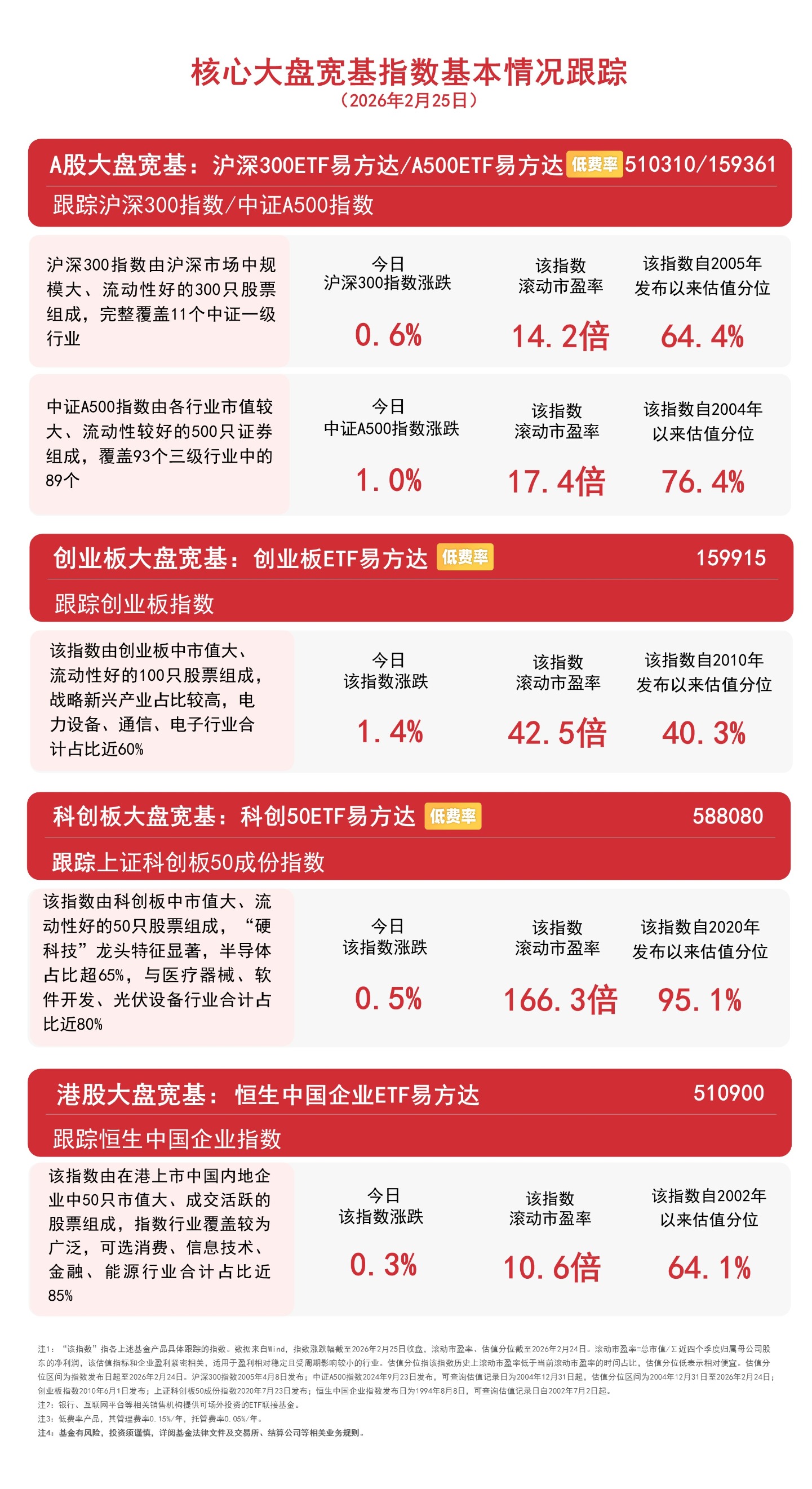
2月24日,A股三大指数延续涨势,上证指数涨0.72%,全市场成交额近2.5万亿元,较昨日放量超2600亿元,超3700只个股收红。板块题材上,小金属、磷 化工、钢铁、稀土永磁、电池、PCB、房地产、PET铜箔、港口航运板块涨幅居前,影视院线、银行、算力租赁、游戏板块跌幅居前;港股高开震荡,盘面 热点轮动较快,非银金融板块活跃。 截至收盘,中证A500指数上涨1%,沪深300指数上涨0.6%,创业板指数上涨1.4%,上证科创板50成份指数上涨0.5%,恒生中国企业指数上涨0.3%。 | 沪深300指数由沪深市场中规 | 令日 | 该指数 | | --- | --- | --- | | 模大、流动性好的300只股票 | 沪深300指数涨跌 | 滚动市盈率 | | 组成,完整覆盖11个中证一级 行业 | 0. 6% | 14.2倍 | | 中证A500指数由各行业市值较 | マ日 | 该指数 | | 大、流动性较好的500只证券 | 中证A500指数涨跌 | 滚动市盈率 | | 组成,覆盖93个三级行业中的 | | | | 89个 | 1.0% | 17.4倍 | 跟踪上证科创板50成份指数 该指数由科创板中市值 ...

AI催生巨量Token消耗 算力租赁供不应求
Mei Ri Jing Ji Xin Wen· 2026-02-24 12:37
Group 1: AI and Token Consumption - The AI industry is experiencing a surge in token consumption, driven by major internet platforms investing heavily to transition users from traditional search to chatbots, thereby increasing reasoning volume and accelerating token consumption [1][4] - By December 2025, ByteDance's Doubao model is expected to reach a daily token usage of over 50 trillion, a tenfold increase from the previous year, while Google's platforms are projected to handle 1.3 trillion tokens monthly, up from 97 billion a year prior [4] - The rising demand for tokens is leading cloud service providers to increase their prices, with Amazon and Google announcing price hikes for their machine learning services in early 2026 [4][5] Group 2: Power and Cooling Solutions - The demand for AI computing power is escalating, but stricter policies on data center energy consumption are pushing the industry towards more efficient cooling solutions, such as liquid cooling, which can achieve a Power Usage Effectiveness (PUE) of 1.1 to 1.2 compared to traditional air cooling systems [1][11] - Companies like 算想科技 are transitioning to liquid cooling solutions, with expectations that the share of liquid-cooled servers will rise from 5% to 60-70% in the coming years due to technological advancements that reduce costs [12] - The first commercial immersion liquid cooling project using silicon-based cooling fluids has been launched, demonstrating the reliability and economic viability of these materials in real-world conditions [13] Group 3: Market Dynamics and Trends - The AI computing power rental market is experiencing significant growth, with many AI companies shifting from building their own computing power to renting it due to rising hardware prices [6][7] - Industry leaders are investing heavily in AI cloud infrastructure, as evidenced by NVIDIA's $2 billion investment in CoreWeave to enhance AI computing capabilities [8] - The market is witnessing structural contradictions, with traditional computing power rental models still dominant, but a shift towards edge computing and inference power is becoming more pronounced as AI applications expand [9][10]
算力租赁板块短线跳水,浙数文化、网宿科技、人民网跌超9%
Mei Ri Jing Ji Xin Wen· 2026-02-24 11:20
Core Viewpoint - The computing power leasing sector experienced a sharp decline on February 24, with several companies seeing significant drops in their stock prices [1] Group 1: Company Performance - Zhejiang Shuju Culture, Wangsu Science and Technology, and People’s Daily all fell by over 9% [1] - Aofei Data, Tongniu Information, and Qingyun Technology also reported notable declines, leading the market in losses [1]


算力租赁概念震荡下挫
Di Yi Cai Jing· 2026-02-24 11:15
Group 1 - Major declines observed in the stock prices of several companies, including Dawi Technology, which hit the daily limit down, and Guanghuan Xinwang and Yuntian Lifeng, both dropping over 10% [1] - Other companies experiencing significant declines include Aofei Data, Wangsu Technology, Dataport, Qingyun Technology, Yunsai Zhili, Dongfang Guoxin, Yakang Co., and Hang Steel, all of which are among the top losers [1]


【东吴周视点】节前震荡蓄力,节后行情可期(第342期)
Xin Lang Cai Jing· 2026-02-14 01:48
Market Overview - The market indices experienced narrow fluctuations this week, with trading volumes dropping below 2 trillion yuan on Wednesday and Friday. AI safety, film industry, and computing power leasing sectors led the gains, while traditional consumer sectors like liquor showed weakness. The Shanghai Composite Index rose by 0.41%, the ChiNext Index increased by 1.22%, and the CSI 300 Index gained 0.36% [3]. Policy Developments - On February 12, the National Development and Reform Commission, the Financial Regulatory Bureau, and the Civil Aviation Administration of China released implementation opinions to promote the high-quality development of low-altitude insurance. By 2027, a mandatory insurance system for unmanned aerial vehicles is expected to be established, with a comprehensive policy framework for low-altitude insurance by 2030. This sector is seen as a significant investment opportunity, with projections of a trillion-yuan market emerging [6][6]. - The Peking University Institute of Modern Optics announced the successful development of a high-performance quantum key distribution chip and an optical microcavity frequency comb light source chip. This development supports the establishment of a large-scale quantum key distribution network, which is expected to drive growth in the global Ethernet optical module market due to strong demand from AI infrastructure [6][6]. Technical Analysis - The Shanghai Composite Index has been fluctuating within the 4050-4150 point range but fell below the 4100 point support level on Friday. The MACD indicator shows increasing bearish momentum, suggesting a potential test of the lower support at 4050 points in the near term [7]. Market Outlook - The market is expected to maintain a cautious stance with structural rotation of hotspots as investors await post-holiday liquidity and risk appetite recovery. The upcoming events, including the annual lending surge and the Two Sessions, are anticipated to support a gradual structural bull market. The historical data indicates a high probability of positive performance for the A-share market around the Spring Festival, with a notable 80% chance of gains in the five days before and after the holiday [11][12]. - The market is characterized by strong index resilience and stock differentiation, with funds gradually positioning for post-holiday expectations. High expectation companies are gaining recognition from investors, and the structural recovery is expected to continue [13]. Sector Performance - The robotics sector is highlighted, with Tesla's third-generation humanoid robot set to launch in Q1 2026, aiming for a production target of one million units annually. This sector has shown significant stock price increases, with notable gains among various companies [15][16].
云赛智联受益算力租赁景气度提升,股价近期表现活跃
Jing Ji Guan Cha Wang· 2026-02-13 06:43
机构观点 市场对云赛智联情绪偏积极,主要基于算力行业高景气和公司业务布局。有分析指出,股价在技术回调 后呈现反弹态势,当前站上短期均线,RSI指标处于中性偏强区域。机构预测方面,19家机构平均预期 2025年净利润同比增长16.60%,2026年增速有望进一步提升至25.42%。不过,需关注净利润下滑风险 (2025年三季报归母净利润同比减少8.05%)以及筹码分散等因素。整体舆情中性,机构调研频率较低, 但长期成长性受关注。 经济观察网近期,云赛智联(600602)在算力租赁行业景气度提升的背景下受到市场关注。公司作为上 海市大数据中心资源平台总集成商,成功中标上海超级计算中心市公共算力服务平台建设项目,并投资 建设松江大数据中心二期项目,服务于市级智能算力集群建设。行业方面,AI算力需求爆发式增长, 政策支持力度加大,工信部推进算力调度互联互通,地方政府推出"算力券"政策,市场预测2026年国内 算力租赁潜在收入规模有望达2600亿元。此外,公司计划于2026年3月28日披露2025年年度报告。 股票近期走势 云赛智联股价近期表现活跃,近5个交易日累计上涨10.90%,区间振幅达12.18%。具体来看,2 ...

科技板块热点频现,科信技术股价表现强劲
Jing Ji Guan Cha Wang· 2026-02-13 05:58
Group 1 - The technology sector has seen concentrated hotspots around computing power infrastructure, AI hardware, and the price logic of minor metals in the past week from February 6 to February 13, 2026 [1] - UCloud announced a price increase for all cloud products starting March 1, marking a shift in the computing power leasing industry from a price war to a value war, which has led to a strong rise in related concepts [1] - Demand for liquid-cooled servers has surged, with the US leader Vertiv reporting better-than-expected earnings and a 252% year-on-year increase in orders, boosting related sectors in the A-share market [1] - The CPO (Co-Packaged Optics) technology is accelerating, with Lumentum receiving orders worth hundreds of millions of dollars and expected revenue of approximately $50 million in Q4 2026 [1] - Prices for tungsten concentrate rose by 25.19% week-on-week to 671,000 yuan per ton, while nickel ore supply contracted by 71%, and the price of rare earth oxide neodymium praseodymium reached 800,000 yuan per ton, up 28.8% month-on-month, improving the supply-demand dynamics and boosting sector sentiment [1] - The State-owned Assets Supervision and Administration Commission emphasized the synergy between computing power investment and electricity, providing policy support for AI infrastructure construction [1] Group 2 - Kexin Technology (300565) has shown strong stock performance in the past week, with a price increase of 5.54% as of February 13, closing at 13.14 yuan, outperforming the market (Shanghai Composite Index fell 0.71% during the same period) [2] - Technical indicators show a bullish trend, with the MACD histogram turning positive and the KDJ indicator's J line breaking above 100, indicating a short-term resistance level at 13.33 yuan [2] - Despite a net outflow of 5.49 million yuan from major funds on that day, retail investor activity was high, with trading volume increasing to 578 million yuan, suggesting strong interest in the stock [2] - The communication equipment sector fell by 0.62% during the same period, but Kexin Technology's performance was relatively outstanding, likely influenced by the spillover effects of computing power and 5G hotspots [2]