AI大模型

Search documents
4000点才是牛市的起点
Datayes· 2026-01-05 11:40
Market Overview - The Shanghai Composite Index (SHCI) has strongly reclaimed the 4000-point mark, closing up 1.38% on January 5, 2026, with a total trading volume exceeding 25.67 billion yuan, an increase of 5.02 billion yuan from the previous day [12][29]. - A total of 128 stocks hit the daily limit up, with over 4100 stocks rising across the market [12][29]. Key Sectors - The technology sector, particularly the brain-computer interface (BCI) and domestic chip industries, saw significant gains. Notably, stocks like Sanbo Brain Science and Meihao Medical surged to their daily limits [12][13]. - The BCI sector led the market rally, with nearly 30 stocks within this category hitting the limit up, driven by announcements from Neuralink regarding large-scale production of BCI devices by 2026 [12][13]. - The domestic chip sector also performed well, with storage chips leading the charge. Longxin's prospectus indicated expected revenues of 55-58 billion yuan for 2025, with net profits projected between 2-3.5 billion yuan [12][13]. Investment Trends - The market sentiment is buoyed by the anticipated growth in AI applications, the "going out" trend, and policies aimed at reducing internal competition [9]. - Goldman Sachs has recommended a high allocation to A-shares and Hong Kong stocks in 2026, predicting annual growth of 15% to 20% for the Chinese stock market in 2026 and 2027 [9]. Performance Metrics - The SHCI achieved a record of 12 consecutive daily gains from December 17, 2025, to January 5, 2026, marking the longest streak since March 1992 [1][2]. - The market's strong performance is reflected in the significant increase in trading volume and the number of stocks hitting their daily limits, indicating robust investor interest [12][29]. Sector Analysis - The aerospace sector continued its strong momentum, with stocks like Leike Defense achieving multiple consecutive gains, supported by government announcements regarding military advancements [12][13]. - The AI large model sector also saw a rise, with companies like Nansheng Co. and Liou Co. recording consecutive gains, fueled by partnerships and investments in AI technologies [12][13].




2025年AI大模型资料汇编
Sou Hu Cai Jing· 2025-12-24 10:45
Group 1: Core Insights - The AI large model industry is undergoing a structural transformation in 2025, shifting competition from mere capability to sustainability across four dimensions: technological paradigms, market structure, application forms, and global governance [1] - Significant breakthroughs in technology include a shift from RLHF to RLVR training paradigms, enabling models to achieve leaps in reasoning capabilities through self-verification [1] - The mixed expert (MoE) architecture is making a strong comeback, balancing parameter scale and computational costs through sparse activation modes, thus achieving extreme cost-effectiveness [1] Group 2: Market Dynamics - The market is experiencing a dual tension of centralization and democratization, with Google’s Gemini 3 ending OpenAI's long-standing lead, while Chinese models achieve competitive advantages through cost-effectiveness [2] - The market is concentrating towards leading players, with top startups like Anthropic receiving significant funding, while second and third-tier players face elimination [2] - Open-source models, led by Chinese firms, are approaching the performance of closed-source products, creating a counterbalance in the market [2] Group 3: Application Evolution - Applications are evolving into a new stage of deep integration, transitioning from general chat assistants to specialized tools and autonomous agents embedded in professional workflows [2] - The rise of "AI-native application layers" is transforming software development, with developers shifting roles from coders to system designers and AI trainers [2] - Deployment models are trending towards "cloud + edge collaboration," with local deployments gaining traction due to privacy compliance needs [2] Group 4: Global Governance - Global governance is entering a phase of differentiated competition, with the EU prioritizing safety through strict regulations, the US focusing on industry self-regulation, and China advocating a balanced approach to development and safety [3] - The regulatory competition is driven by the struggle for technological standard-setting authority, emerging as a new battleground in tech competition [3] - The societal impact of AI is beginning to show through employment structure adjustments and educational model transformations, with human-AI collaboration becoming a new trend [3] Group 5: Future Outlook - The AI large model industry is transitioning from a scale competition to a new phase emphasizing efficiency, depth, and integration [3] - Future winners will need to navigate the complex interactions of four forces: technological efficiency, scenario integration, ecological positioning, and compliance adaptation [3] - Key opportunities include "cloud + edge collaboration," parallel tracks of open-source and closed-source development, and the evolution of the agent ecosystem [3]


智谱、MiniMax争夺“大模型第一股”:高增长之下各有难题
3 6 Ke· 2025-12-23 12:44
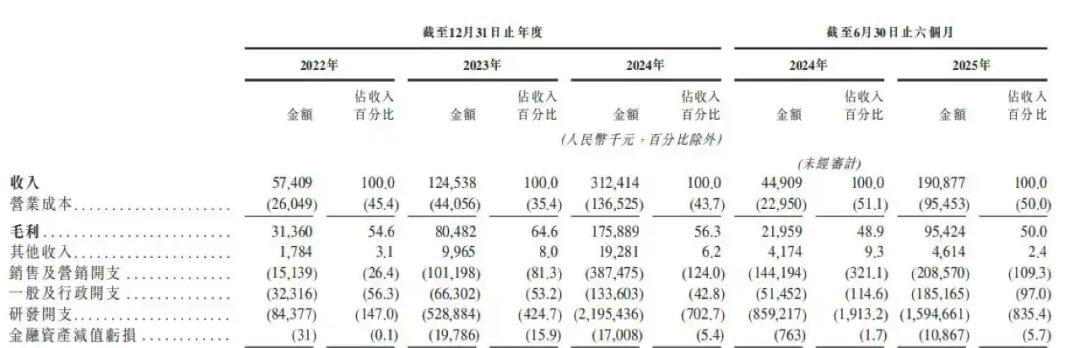
Core Insights - The AI large model industry is at a critical juncture for capital value realization, with Beijing Zhiyu Huazhang Technology Co., Ltd. (Zhiyu) and Shanghai Xiyu Technology Co., Ltd. (MiniMax) both filing for IPOs on the Hong Kong Stock Exchange within 48 hours of each other [1][2][6] Company Paths - Zhiyu focuses on B-end and G-end services, while MiniMax is centered on C-end subscriptions, indicating a divergence in their development strategies [3][7] - The competition between these two companies serves as a test of the feasibility of their respective business paths as the industry transitions from technical exploration to commercialization [4] Financial Performance - Zhiyu's revenue projections show a compound annual growth rate (CAGR) of over 130%, with revenues expected to grow from 57.4 million RMB in 2022 to 3.12 billion RMB in 2024 [8][10] - MiniMax's revenue is projected to increase from 3.5 million USD in 2023 to 30.5 million USD in 2024, reflecting a staggering growth rate of 782% [12][14] Profitability Challenges - Both companies are experiencing significant losses despite revenue growth, with Zhiyu's adjusted net losses projected to reach 2.466 billion RMB in 2024 and MiniMax's net losses expected to be 465 million USD [18][19] - The losses are primarily attributed to high R&D and infrastructure investments, with Zhiyu's cumulative R&D expenditure reaching approximately 4.4 billion RMB [18][20] Market Positioning - Zhiyu's business model emphasizes a high barrier to entry with its foundational model technology, while MiniMax's strategy focuses on rapid commercialization through a multi-modal product approach [25][28] - The capital market's response to these companies will reflect a preference for either long-term technological autonomy or quick commercial potential [28][31] Competitive Landscape - The competition for the title of "AI large model first stock" is intensifying, with both companies having secured substantial funding and high valuations, indicating strong investor interest [27] - The market remains fragmented, with Zhiyu holding a 6.6% market share among independent general-purpose model developers in China [25] Future Considerations - The sustainability of their business models will be crucial for both companies post-IPO, as they navigate the challenges of maintaining growth while managing losses [31][32]
界面新闻揭晓2025年度超级CEO榜单:以远见破局,以实干领航
Xin Lang Cai Jing· 2025-12-16 08:08
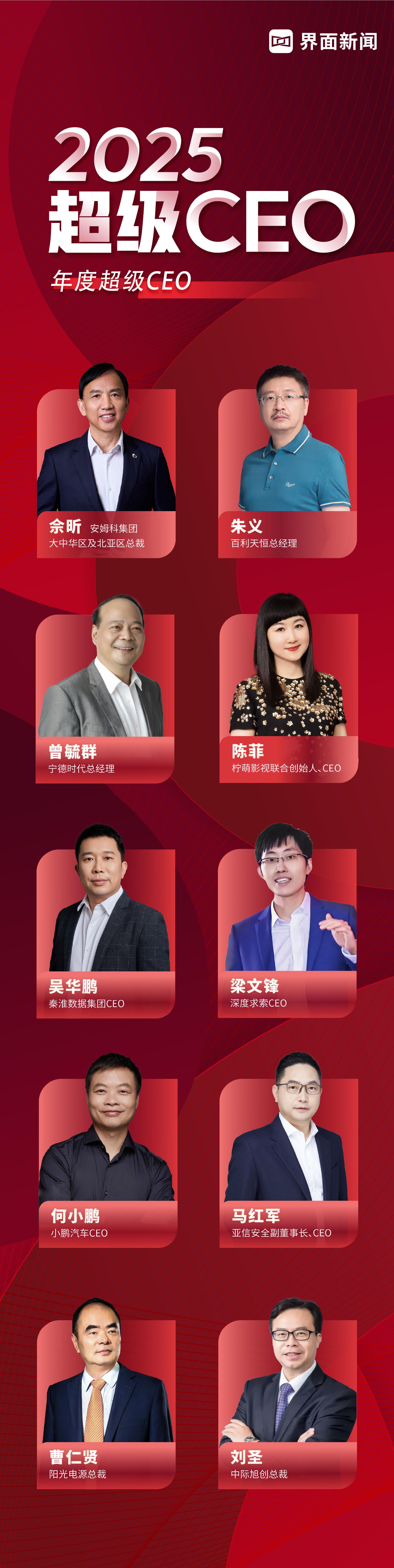
Group 1: Economic Overview - In 2024, China's GDP exceeded 134.9 trillion yuan, growing by 5.0% year-on-year, ranking among the top major economies globally [2] - The economic structure continues to optimize, with the primary, secondary, and tertiary industries accounting for 6.8%, 36.5%, and 56.7% of GDP, respectively [2] - Consumption, investment, and net exports contributed 2.2, 1.3, and 1.5 percentage points to GDP growth, respectively [2] Group 2: Technological Advancements - China has made significant breakthroughs in cutting-edge technologies such as 6G communication, AI large models, and quantum computing [3] - The first international 6G field test network was established in July 2024, demonstrating potential 6G transmission capabilities [3] - China ranks second globally in the number of open-source participants, with rapid growth in the sector [3] Group 3: New Energy and Carbon Neutrality - The new energy sector has become a growth engine, with China accounting for over 60% of global new wind and solar installations in 2024 [4] - The installed capacity of new energy storage exceeded 70 million kilowatts, with leading companies like CATL and BYD holding a 65.5% market share in the global power battery market [4] - Solid-state battery technology has achieved mass production breakthroughs, with energy density exceeding 400 Wh/kg [4] Group 4: Healthcare Sector - The healthcare market is expanding due to aging population and rising health consumption demands, with government spending in the sector reaching 2.03 trillion yuan in 2024 [5] - AI-assisted diagnosis, gene editing, and telemedicine technologies are accelerating breakthroughs and applications in the industry [5] - Leading companies like WuXi AppTec and Mindray are actively pursuing globalization strategies to capture high-end medical equipment and biopharmaceutical markets [5] Group 5: Financial and Consumer Trends - The total assets of China's financial institutions reached 495.59 trillion yuan in 2024, growing by 7.5% year-on-year [6] - The banking sector's total assets were 444.57 trillion yuan, with a growth rate of 6.5% [6] - The rise of new retail and domestic brands is reshaping the consumer market, with companies like Luckin Coffee and Pop Mart leveraging data-driven strategies [6] Group 6: Emerging and Future Industries - Emerging industries such as new energy, aerospace, and quantum technology are driving economic growth and international competitiveness [7] - The low-altitude economy is projected to reach a market size of 1.5 trillion yuan by 2025 and 3.5 trillion yuan by 2035 [7] - The embodied intelligence market is expected to exceed 480 billion yuan in 2024, with potential to surpass one trillion yuan by 2031 [7] Group 7: Super CEO Recognition - The "Super CEO" list highlights leaders across various sectors, including healthcare, new energy, entertainment, and technology, showcasing their exceptional leadership and performance [8] - These CEOs have demonstrated resilience and strategic vision in navigating industry challenges and driving company growth [8]



【11月25日 财经信息差 】行业机会与风险预警全解析
Sou Hu Cai Jing· 2025-11-25 02:19
Group 1 - The Ministry of Industry and Information Technology of China has initiated the creation of national emerging industry development demonstration bases, covering nine major fields including new generation information technology and new energy, with a target of establishing 100 park-type and 1,000 enterprise-type bases by 2035, which will receive policy and resource support [2] - The Federal Reserve officials have signaled a potential interest rate cut in December, with an 82.9% probability of a 25 basis point cut according to CME FedWatch, leading to a 2.69% increase in the Nasdaq and a broad rise in technology stocks [2] - Former President Trump signed an executive order for the AI "Genesis Plan," opening federal scientific data sets, while Amazon plans to invest $50 billion to expand AI and supercomputing infrastructure for the U.S. government, benefiting AI-related companies [2] Group 2 - The European Union has approved a budget of €192.8 billion for 2026, focusing on defense and high-end manufacturing, with €716 million reserved for emergency funds, which will create procurement opportunities for related industries [3] - The Bank of Israel has lowered the benchmark interest rate from 4.5% to 4.25%, allowing businesses in the Middle East to optimize their capital allocation [3] Group 3 - The Nasdaq Golden Dragon China Index rose by 2.82%, with Hesai Technology increasing by over 12%, indicating strong capital interest in Chinese tech companies like Baidu and Alibaba, which will benefit their supply chain partners [4] - Spot gold has surpassed $4,140 per ounce, and WTI crude oil has risen above $59 per barrel, providing profit opportunities for energy and precious metals companies [4] Group 4 - The European Central Bank has warned about the risks of stablecoins diverting retail deposits in the Eurozone, urging companies involved in crypto assets to manage compliance costs [5] - The U.S. pressured the EU to amend digital regulations in exchange for lowering steel and aluminum tariffs, which was rejected, creating tariff volatility risks for related import-export businesses [6] - Bitcoin has surpassed $89,000, and Thailand's Bitkub plans to raise $200 million through a Hong Kong IPO in 2026, highlighting opportunities in the Hong Kong digital asset hub [6]

超半数投资者盈利 权益配置意愿持续升温——上海证券报·个人投资者2025年第四季度调查报告
Shang Hai Zheng Quan Bao· 2025-11-04 19:09
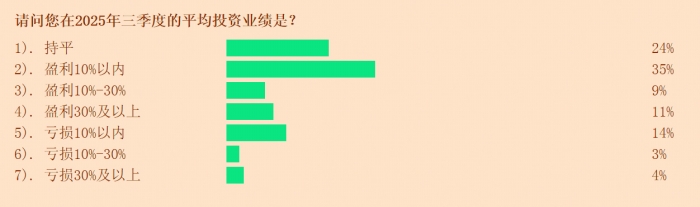
Core Viewpoint - The A-share market experienced a strong rebound in the third quarter, leading to improved investor sentiment and profitability, with over 55% of surveyed investors reporting gains [6][7][24] Market Performance - The Shanghai Composite Index rose from below 3500 points to close at 3882.78 points by September 30, marking a cumulative increase of 12.73% for the quarter [7] - The Shenzhen Component Index and the ChiNext Index saw even larger gains, increasing by 29.25% and 50.4% respectively [7] Investor Sentiment - 55% of investors reported profitability in Q3, an increase of 7 percentage points from Q2 and 13 percentage points from Q1 [7][8] - Over 70% of surveyed investors are optimistic about the A-share market in Q4, with many expecting the Shanghai Composite Index to reach around 3900 points [19][20] Asset Allocation Trends - The proportion of personal financial assets allocated to securities increased to 42.2%, up from 40.87% in Q1 [10] - 38% of investors increased their stock market investments in Q3, while 41% reduced their holdings [9] Sector Focus - The technology sector remains a focal point for investors, with nearly half expecting a style shift in Q4, while 30% believe technology stocks will continue to perform strongly [14][16][18] - The average holding in technology growth stocks rose to 26.64%, significantly higher than other sectors [15] Gold Investment - 67% of investors anticipate further increases in gold prices, with many viewing it as a hedge against geopolitical risks and inflation [12] - The average gold price rose from $3300 to $3800 per ounce during the quarter [12] Hong Kong Market Interest - 24% of investors increased their Hong Kong stock investments in Q3, with a profitability rate of 40% [22] - Investors are optimistic about the long-term potential of the Hong Kong market, with many viewing it as a value opportunity [22][24]
2025投资界「F40中国青年投资人」,正式开启
Sou Hu Cai Jing· 2025-10-24 09:12
Core Insights - The "F40 China Young Investors" initiative by Zero2IPO has been launched for eight consecutive years, aiming to identify outstanding investors under 40 years old with a focus on innovation and future trends [1][3] - Young investors are playing a crucial role in the revaluation of China's technology assets, actively participating in the funding of high-profile projects and companies [1][4] Group 1: Event Overview - The 2025 "F40 China Young Investors" program will start on October 24, 2025, with nominations open until November 15, 2025, and the results to be published on November 28, 2025 [3] - Candidates must be under 40 years old, hold a position of Vice President or higher, and have notable investment cases [3] Group 2: Industry Context - Investment界 (PEdaily.cn), a platform under Qingke Holdings, has a significant influence in the venture capital sector, focusing on high-tech industries such as semiconductors, new energy, and AI [4] - Qingke Holdings, listed on the Hong Kong Stock Exchange, has developed a comprehensive service infrastructure for the entrepreneurial and investment market over the past two decades [5]

2025投资界「F40中国青年投资人」正式开启
投资界· 2025-10-24 07:43
Group 1 - The article highlights the launch of the "F40 China Young Investors" initiative by Qianhai Holdings, aimed at recognizing outstanding investors under 40 years old who demonstrate imagination and foresight in the investment landscape [2] - Young investors are becoming pivotal in China's technology asset revaluation, actively participating in early-stage investments in high-tech projects and contributing to the success of unicorn companies [2] - The initiative will run from October 24, 2025, to November 28, 2025, with a focus on identifying young investors who have made significant contributions to the investment field [2] Group 2 - Investment界, a platform under Qianhai Holdings, has been observing trends in China's venture capital for over a decade, particularly focusing on hard-tech industries such as semiconductors, new energy, and AI [3] - Qianhai Holdings aims to provide comprehensive services for the entrepreneurial and investment sectors, having established itself as a foundational infrastructure in China's investment market since its listing on the Hong Kong Stock Exchange in 2020 [4]
上证报:沪指第三次逼近4000点,这次有何不同?
Xuan Gu Bao· 2025-10-10 00:37
Core Viewpoint - The Shanghai Composite Index has reached a nearly ten-year high, surpassing 3900 points, and is approaching the 4000-point mark, which historically indicates significant market movements [1][2]. Market Trends - The historical context shows that the Shanghai Composite Index has previously crossed the 4000-point threshold twice, in May 2007 and April 2015, both times leading to substantial market peaks within six months [1]. - Current market conditions differ from past instances, with the ongoing economic transformation in China and global monetary easing contributing to a more optimistic market sentiment [2]. Structural Changes - The current market is characterized by a structural rally led by technology companies, contrasting with previous market behaviors where stocks moved in unison [3]. - The shift from a retail-driven market to one dominated by institutional investors has significantly altered market dynamics, leading to a more research-driven investment approach [3][4]. Policy Implications - Recent policy initiatives indicate a strong governmental commitment to stabilizing the stock market, positioning it as a key component in economic revitalization [4][5]. - The elevation of the capital market's role in national strategy reflects a broader recognition of its importance in managing economic expectations and stimulating growth [5].
企业到纳斯达克上市,是先发展强大后上市,还是先上市再发展?
Sou Hu Cai Jing· 2025-08-10 14:15
Group 1: Core Characteristics of NASDAQ Market - NASDAQ is the largest electronic stock trading market globally and is the fastest-growing among major stock markets [1] - The market allows unprofitable companies to list, focusing on growth potential, market space, and technological barriers, particularly valuing tech innovation firms [1][2] - Institutional investors dominate, showing a willingness to pay premiums for long-term growth narratives [1] Group 2: Challenges for Chinese Companies - Chinese companies face unique challenges such as geopolitical risks, stringent audit regulations, and potential valuation discounts [3][4] Group 3: IPO Strategy Analysis - Two main strategies exist: "develop strong before listing" and "list before developing" [5] - The first option is suitable for capital-intensive sectors requiring significant funding for R&D or infrastructure, allowing companies to capitalize on market opportunities [5][6] - The second option is ideal for companies with validated technology and clear profitability paths, leading to higher valuations and reduced risks of stock price drops [8][9] Group 4: Key Decision Factors for NASDAQ Listing - Companies must assess if their business data supports a growth narrative, focusing on revenue growth, gross margins, and customer retention rates [12][13] - The ability to bear compliance costs, estimated at $2-5 million annually, is crucial [14] - Companies should prepare to counter short-selling risks, especially if their business models have flaws [15] - Contingency plans for geopolitical issues, such as potential secondary listings in Hong Kong or Singapore, are recommended [16] Group 5: Practical Recommendations for NASDAQ Pathway - Companies should adopt phased strategies based on their growth stages, from focusing on private financing in early stages to considering IPOs when growth metrics are met [17][18] - The conclusion emphasizes that unless in capital-intensive sectors with high technological barriers, "develop strong before listing" is generally the better choice [18] Group 6: Foundations for Chinese Companies Listing in the U.S. - Essential foundations include robust financial systems compliant with US GAAP, strong corporate governance, risk isolation through compliant VIE structures, and clear investor narratives [19][20]