
Optical Modules

Search documents
剑桥科技-管理层调研:切片业务扩张;2026 年连续波激光器供应落定;LPO、NPO 项目进展顺利
2026-02-10 03:24
Summary of CIG (603083.SS) Management Visit Company Overview - **Company Name**: CIG (603083.SS) - **Industry**: Integrated Optical and Wireless Connectivity Devices (OWCD) - **Founded**: 2005 - **Rank**: Global top 5 in OWCD industry by revenues in 2024 - **Products**: High-speed optical transceivers, wireless and broadband access, carrier Ethernet, edge computing - **Customer Base**: Primarily brand customers (e.g., Cisco) and expanding to cloud service providers (CSPs) - **Affiliates**: US, China, Japan, Malaysia, Europe - **Major Peers**: Innolight, Eoptolink, Accelink, HG Genuine [2][2] Key Industry Insights 1. **SiPh Optical Modules Expansion**: - Management is optimistic about the ramp-up of SiPh optical modules - Secured 25 million CW lasers for 2026, translating to potential production of 5 million 800G or 1.6T optical modules - Anticipates increased demand for 800G in the first half of 2026, followed by 1.6T in the second half - Expects supply to remain tight in 2026-2027, moving towards supply-demand balance by 2028 [3][3] 2. **Investment in New Technologies**: - Committed to investing in new technologies such as LPO, NPO, and CPO - LPO optical module has passed major customer qualifications and is expanding to other customers - NPO is also in progress, with expectations for production to start in 2027 at the earliest [4][4][7] 3. **Competitive Advantages**: - Secured raw material supply (e.g., CW lasers) and advancements in technology (LPO, NPO, CPO) are critical for customer retention - Fast specification migration driven by AI servers reduces customer incentives to switch suppliers - Capability to offer multiple networking solutions and timely local support enhances competitiveness [8][8] Market Outlook - **AI Server Demand**: Anticipated growth in AI server shipments, with AI chips expected to increase by 49% and 31% year-over-year in 2026 and 2027, respectively - **Optical Module Specifications**: Expectation for 800G and above optical module shipments to rise by 101% and 53% year-over-year in 2026 and 2027, respectively, reaching 52 million and 80 million units [1][1] Investment Recommendations - **Buy Ratings**: Landmark, VPEC, Innolight, Eoptolink, TFC Optical with respective price targets [9][9] Conclusion CIG is positioned for growth in the optical module market, driven by advancements in technology and increasing demand from AI infrastructure. The company's strategic investments and competitive advantages are expected to enhance its market position in the coming years.
未知机构:管理层的积极态度与我们对硅光SiPh光模块的乐观看法-20260210
未知机构· 2026-02-10 02:20
Summary of Conference Call Records Industry Overview - The focus is on the silicon photonics (SiPh) optical module industry, which is expected to see significant growth driven by AI server demand and technological advancements in optical modules [1][3]. Key Points and Arguments 1. **Growth Projections for AI Servers**: - Global AI server shipments are projected to grow by 49% in 2026 and 31% in 2027, with ASIC penetration rates increasing to 40% and 50% respectively [1]. 2. **Optical Module Demand**: - Shipments of 800G and above optical modules are expected to increase by 101% in 2026 and 53% in 2027, reaching 52 million and 80 million units respectively, which will enhance SiPh penetration [1]. 3. **Supply Outlook**: - The supply situation for optical modules in 2026 is anticipated to be better than in 2025, which will drive growth for optical module suppliers [1]. 4. **Company Profile - Cambridge**: - Established in 2005, Cambridge is a leading global supplier of optical modules, ranking among the top five in the integrated optics and wireless connectivity device (OWCD) industry based on 2024 revenue [2]. - The company primarily serves brand clients like Cisco and is expanding its reach to cloud service providers (CSPs) [2]. - Its product offerings include high-speed optical transceivers, wireless and broadband access, carrier Ethernet, and edge computing solutions [2]. - Competitors in the optical transceiver space include Innolight, Guangxun Technology, and others [2]. 5. **SiPh Module Expansion**: - Management remains optimistic about the expansion of SiPh optical modules and is closely collaborating with continuous wave (CW) laser suppliers to secure the supply of 25 million CW lasers for 2026 and beyond [3]. - These lasers can be converted into 5 million units of 800G and 1.6T optical modules, with demand for 800G expected to grow in the first half of 2026, followed by 1.6T in the second half [3]. 6. **Investment in New Technologies**: - Continuous investment in new technologies such as linear drive optical modules (LPO), uncooled optical engines (NPO), and co-packaged optics (CPO) is a priority [3][5]. - The LPO has already been certified by major clients and is being expanded to other customers, while NPO development is ongoing [3]. - These technologies are expected to be deployed at scale, with potential mass production starting as early as 2027 [3]. 7. **Competitive Advantages**: - Securing raw material supplies, particularly CW lasers, and keeping up with the latest technologies are critical factors for winning customers [4][5]. - In the rapidly evolving AI server market, customers are less likely to switch or diversify suppliers to ensure they benefit from the latest AI infrastructure [5]. - The company emphasizes its ability to provide various network solutions along with timely local support, enhancing its competitive edge [5].

新易盛(300502.SZ):100G至1.6T高速率光模块产品已在全球头部云和AI厂商规模发货
Ge Long Hui· 2026-02-09 12:54
Core Viewpoint - The company Xinyisheng (300502.SZ) has successfully shipped its 100G to 1.6T high-speed optical module products to leading global cloud and AI companies, with ongoing development of 3.2T and higher-speed products [1] Group 1 - The company has achieved scale shipments of its optical module products to major cloud and AI firms [1] - Development of 3.2T and higher-speed optical module products is progressing smoothly [1] - The company maintains close interaction with its customers during the product development phase [1]

关键AI客户CPO大单,“光模块巨头”Coherent掉队的担忧解除了?
Hua Er Jie Jian Wen· 2026-02-05 13:16
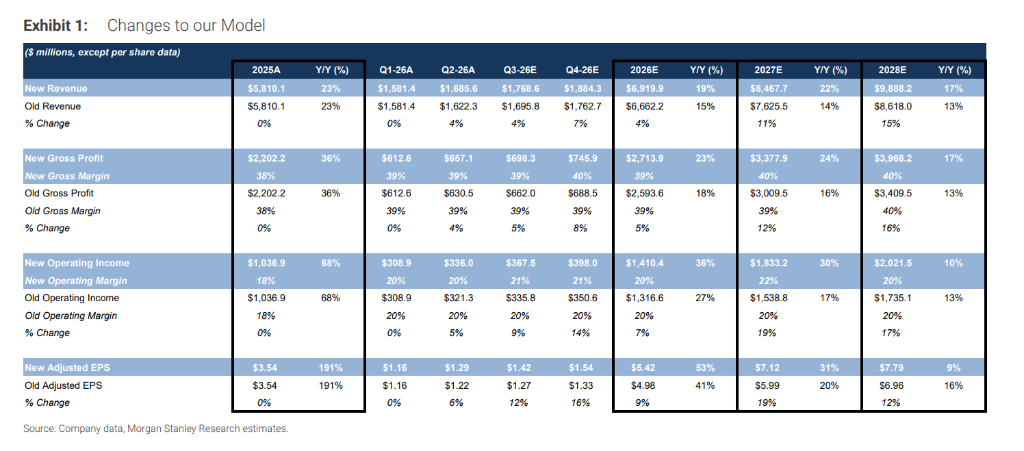
Core Viewpoint - Coherent has demonstrated strong performance in its latest earnings report, exceeding market expectations and providing robust order guidance, alleviating concerns about its position in the AI optical communication race [1] Financial Performance - For Q2 of fiscal year 2026, Coherent reported revenue of $1.686 billion and adjusted EPS of $1.29, both surpassing Wall Street expectations [1][5] - The company’s data center product order shipment ratio exceeded 4 times, indicating strong demand [1][3] - Communication business grew by 44% year-over-year, while data center business grew by 36% [5] Order Visibility and Demand - Coherent's order visibility is unprecedented, with significant demand for 800G and 1.6T optical modules, leading to most of the 2026 capacity being booked [3] - The company is expanding its capacity aggressively, doubling its indium phosphide (InP) production and increasing capacity in Malaysia and Vietnam to meet demand [3] Strategic Developments - Coherent secured a major order for co-packaged optics (CPO) solutions, reinforcing its technological leadership and addressing investor concerns about its competitive position [4] - The company is also seeing increased shipments of EML and silicon photonic transceivers, further solidifying its product portfolio [4] Guidance and Market Reactions - Based on strong order backlog, Coherent raised its Q3 revenue guidance to between $1.7 billion and $1.84 billion, with EPS expected between $1.28 and $1.48 [5] - Analysts from JPMorgan and Morgan Stanley have raised their target prices for Coherent, reflecting confidence in its growth trajectory [1][5] Profitability Concerns - Despite strong revenue growth, there are concerns regarding profit margins, as Coherent's gross margin of 39% met expectations but did not exceed them [6][7] - Analysts suggest that while Coherent has not fully capitalized on pricing power like some competitors, its margins may improve with the ramp-up of higher-margin products [7] Valuation Perspectives - JPMorgan assigns a target price of $245 based on a 30x P/E ratio for 2027 EPS, while Morgan Stanley is more conservative with a target price of $200 based on a 28x P/E ratio [7]

“光模块巨头”Coherent电话会:CPO获超大订单,磷化铟芯片量产突破,1.6T光模块步入爆发期
Hua Er Jie Jian Wen· 2026-02-05 04:09
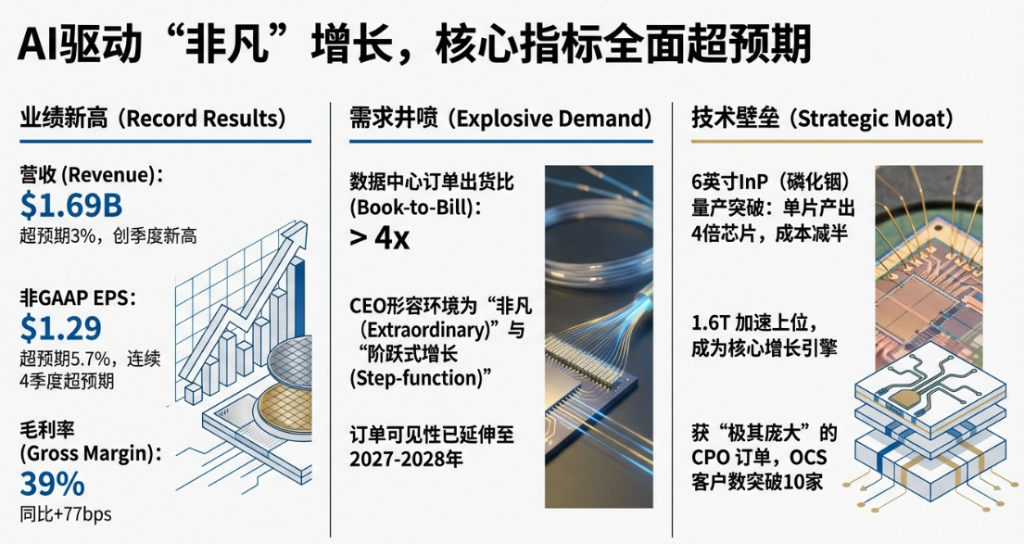
Core Viewpoint - Coherent reported strong financial results for Q2 FY2026, with adjusted EPS of $1.29 and revenue of $1.69 billion, driven by significant demand from AI data centers, although the stock fell 2% post-announcement due to profit-taking pressures [3][11][52]. Financial Performance - Adjusted EPS of $1.29 exceeded market expectations of $1.22, marking a 35% year-over-year increase [11][52]. - Revenue reached $1.69 billion, surpassing expectations and setting a quarterly record, with a year-over-year growth of 22% [11][52]. - Non-GAAP gross margin improved to 39%, reflecting operational efficiencies and cost reductions [52][53]. Demand and Orders - The company experienced a "step-function increase" in orders, particularly in the data center sector, with a book-to-bill ratio exceeding 4 [11][41]. - Demand for 1.6T transceivers is accelerating, with expectations for significant growth in both 800G and 1.6T products throughout 2026 [22][62]. - Most of the 2026 calendar year capacity has been booked, with orders extending into 2027 and even 2028 for some major clients [15][61]. Production and Capacity Expansion - Coherent achieved breakthroughs in 6-inch indium phosphide (InP) production, increasing wafer output by over four times and reducing costs by approximately 50% [6][26]. - The company plans to double its internal InP capacity by the end of this year, with current wafer starts reaching 80% of the target [23][58]. - The strategic shift to 6-inch wafers is expected to enhance supply capabilities and pricing power in the market [27][75]. Product Development and Market Opportunities - Coherent secured a significant CPO (Co-Packaged Optics) order from a leading AI data center client, indicating a shift from concept to substantial deployment [28][45]. - The OCS (Optical Circuit Switching) platform has gained traction, with over 10 clients and a growing backlog, suggesting a market opportunity exceeding $2 billion [32][46]. - The transition from 800G to 1.6T in AI data centers is expected to drive demand for high-bandwidth, low-power interconnect solutions [21][18]. Future Outlook - The company anticipates continued strong revenue growth in the upcoming quarters, driven by robust demand and capacity expansion [36][49]. - Guidance for Q3 FY2026 projects revenue between $1.7 billion and $1.84 billion, with non-GAAP gross margins expected to range from 38.5% to 40.5% [15][60].
CPONPOCPC-可插拔最新产业趋势观瞻
2026-02-05 02:21
Summary of Key Points from Conference Call Industry Overview - The conference discusses the trends in the optical module industry, focusing on technologies such as CPO (Co-Packaged Optics), NPO (Near-Packaged Optics), CPC (Co-Packaged Copper), and their implications for network architecture and cloud service providers [1][2][4][19]. Core Insights and Arguments - **Network Architecture Breakdown**: The network architecture can be divided into two main approaches: Scale Up and Scale Out, further detailed into six specific scenarios, which helps clarify the application of different technologies [3]. - **CPC Technology**: CPC is noted for its ability to reduce losses and is expected to remain relevant until 2030. Major companies are developing 3.2T pluggable module solutions [4][15]. - **NPO vs. CPO**: NPO offers advantages in maintenance and is more accepted by cloud service providers due to its open ecosystem, while CPO faces challenges with packaging yield and maintenance costs [6][11][12]. - **Market Acceptance**: Cloud service providers show low acceptance of CPU technologies, with companies like Google explicitly rejecting them in favor of NPO, which aligns better with their preference for open ecosystems [12][13]. - **Challenges for NVIDIA**: NVIDIA faces challenges in promoting its CPU solutions due to limited CoWoS capacity from TSMC and the need to prove reliability through extensive testing [7][12]. Technical Comparisons - **CPU vs. NPU**: The commercial speed of NPU is faster due to its detachable design and simpler packaging, with expected shipments starting in 2027, while CPU testing is lengthy and slow [8]. - **Performance Metrics**: In terms of bandwidth, power consumption, loss, and latency, both CPU and NPU show similar performance, with CPU having a slight edge in power consumption [9]. - **Cost Considerations**: Currently, NPO is seen as having a cost advantage over CPO due to lower maintenance costs and better yield rates, despite CPO's theoretical lower costs [10][11]. Future Trends and Market Dynamics - **Shift in Supplier Strategies**: Companies like Broadcom are shifting towards supporting NPU technologies, reflecting a broader market trend away from CPU reliance [13][14]. - **Investment Opportunities**: The valuation of optical module companies is currently low, presenting a potential investment opportunity as market misjudgments may lead to undervaluation [21]. - **Technological Advancements**: The rapid development of silicon photonics technology is expected to enhance product margins and market share, with leading companies like Xuchuang making significant advancements [20]. Additional Important Insights - **Industry Consolidation**: The optical module industry is expected to see increased competition and consolidation, with leading firms maintaining high profit margins due to their technological advancements [20]. - **Future of Optical Module Companies**: These companies are transitioning from mere assembly to comprehensive solution providers, requiring capabilities in semiconductor design and advanced packaging [19].

两大龙头股盘中大跌!四个原因
Zhong Guo Zheng Quan Bao· 2026-02-04 05:03
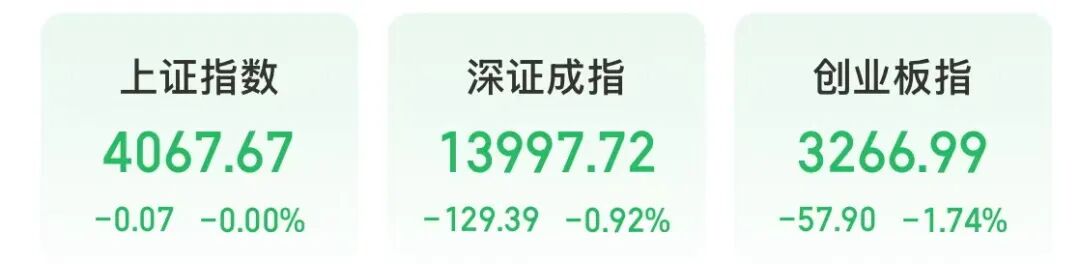
Core Viewpoint - The cyclical market is strengthening, with resource stocks, real estate infrastructure, consumer sectors, and chemicals performing actively, while AI hardware and application sectors are experiencing significant declines [2] Group 1: AI Hardware Sector Performance - Leading stocks in the AI hardware sector, including Zhongji Xuchuang (300308) and Xinyi Sheng (300502), opened with continuous declines, with both stocks dropping over 10% at one point during the trading session [2] - By the close of the morning session, Zhongji Xuchuang and Xinyi Sheng had fallen by 5.24% and 5.66%, respectively [2] - Other leading hardware stocks in the sector, such as Shenghong Technology (300476), Industrial Fulian (601138), and Yingweike (002837), also experienced declines due to the negative sentiment [2] Group 2: Reasons for Decline - Concerns regarding the impact of CPO (Co-Packaged Optics) technology on the optical module industry have emerged, as this innovation could significantly enhance transmission speeds while reducing size and power consumption [5] - Market expectations for Zhongji Xuchuang and Xinyi Sheng are perceived to be low, as their performance forecasts for 2025 indicate substantial growth, with Zhongji Xuchuang projecting a net profit of 9.8 billion to 11.8 billion yuan (approximately $1.4 billion to $1.7 billion), representing a year-on-year increase of 89.5% to 128.17% [6] - Xinyi Sheng anticipates a net profit of 9.4 billion to 9.9 billion yuan (approximately $1.3 billion to $1.4 billion), reflecting a year-on-year growth of 231.24% to 248.86% [6] - Historical trends indicate that stocks that become the largest holdings in mutual funds often experience subsequent declines, as seen with Zhongji Xuchuang, which recently replaced Ningde Times as the top holding [7] - The decline in U.S. stocks such as Nvidia and Broadcom has also negatively affected sentiment towards A-share computing hardware stocks [7] Group 3: Broader Market Impact - The AI application sector also faced significant declines, with various related concepts and stocks, including Sora concept and Zhi Pu AI, experiencing notable drops [8] - Specific stocks like Zhi De Mai (300785), Tianlong Group (300063), and Blue Focus (300058) saw declines of 11.56%, 10.95%, and 10.02%, respectively [8]

【公告全知道】光模块+机器人+算力租赁+商业航天+AI智能体!公司参股企业产品覆盖1.6T 超速、800G 及400G系列硅光模块等
财联社· 2026-02-02 15:32
Group 1 - The article highlights significant announcements related to the stock market, including "suspensions and resumption of trading, shareholding changes, investment wins, acquisitions, performance reports, unlocks, and high transfers" [1] - The company has investments in sectors such as optical modules, robotics, computing power leasing, commercial aerospace, and AI intelligence, with products covering 1.6T ultra-speed, 800G, and 400G series silicon optical modules [1] - Another company focuses on optical communication, commercial aerospace, and domestic chips, with chip inductors already applied in AI server power modules [1] Group 2 - The company plans to invest over 100 million in purchasing computing power equipment, indicating a strong commitment to the fields of computing power leasing, cloud computing, and AIGC [1]

2025年报业绩预告开箱(六):百亿巨亏连环爆,AI与创新药继续领跑
市值风云· 2026-02-02 11:59
Performance Highlights - New Yi Sheng (300502.SZ) expects net profit between 9.4 billion and 9.9 billion CNY, a year-on-year increase of 231.24% to 248.86% due to rising demand for high-speed optical modules driven by global computing power investments[4] - Han's Chip (688256.SH) anticipates net profit between 1.85 billion and 2.15 billion CNY, turning from a loss of 450 million CNY last year, benefiting from the growing demand for AI computing power[5] - Zhongji Xuchuang (300308.SZ) projects net profit between 9.8 billion and 11.8 billion CNY, a year-on-year growth of 89.50% to 128.17%, driven by strong customer investment in computing infrastructure[6] - Runze Technology (300442.SZ) expects net profit between 5 billion and 5.3 billion CNY, a year-on-year increase of 179.28% to 196.03%, largely due to non-recurring gains from public REITs issuance[10] Underperformance Highlights - Great Wall Motors (601633.SH) forecasts net profit of 9.912 billion CNY, a year-on-year decline of 21.71% due to increased marketing expenses and competitive pressures[36] - GAC Group (601238.SH) expects a net loss between 8 billion and 9 billion CNY, turning from a profit of 824 million CNY last year, impacted by fierce competition and increased asset impairment provisions[39] - Xiexin Integrated (002506.SZ) anticipates a net loss between 890 million and 1.29 billion CNY, shifting from a profit of 68 million CNY last year due to structural supply-demand issues in the photovoltaic industry[41] - Baile Tianheng (688506.SH) projects a net loss of around 1.1 billion CNY, down from a profit of 3.708 billion CNY last year, primarily due to increased R&D expenses[42] Industry Trends - Technology-driven sectors like AI and innovative pharmaceuticals are leading growth, with companies like New Yi Sheng and Han's Chip benefiting from strong demand and technological advancements[69] - Cost control is becoming a critical competitive advantage, particularly in the energy and manufacturing sectors, as seen with companies like Datang Power (601991.SH) benefiting from lower coal prices[70] - Traditional cyclical industries such as real estate and agriculture are facing significant downward pressure, with companies like Vanke (000002.SZ) and Tianbang Foods (002124.SZ) experiencing substantial losses due to market adjustments[72]





未知机构:西部通信海外算力整体观点更新继续强call海外算力和强确定-20260202
未知机构· 2026-02-02 02:05
Summary of Conference Call Records Company and Industry Overview - **Industry Focus**: Overseas computing power and optical modules - **Key Companies Mentioned**: 西部通信 (West Communication), 中际旭创 (Inspur), 新易盛 (NewEase), 英维克 (Invec), 福晶科技 (Fujing Technology), 长飞光纤 (Changfei Fiber), 亨通光电 (Hengtong Optic), 中天科技 (ZTE Technology) Core Insights and Arguments 1. **Optical Module Demand**: Strong demand and material shortages expected in H1 2026, with leading companies showcasing supply chain advantages. The release of previous performance forecast suppression is alleviating, and market pressures are easing, allowing funds to enter early in a strong industry trend [1] 2. **Future Catalysts**: Attention is shifting to clearer industry guidance for 2027, anticipated post the OFC conference in March, and new technology trends (NPO/CPO) that will promote scale-up scenarios. The short-term performance realization will depend on upstream supply chain material and capacity resolution [1] 3. **Liquid Cooling Solutions**: 2026 is projected to be the first year of significant liquid cooling adoption, with NV, Meta, and Google leading commercial applications. The estimated value of liquid cooling solutions for ASIC chips is substantial, with potential market size reaching $21 billion [2] 4. **Market Share Potential**: Domestic leaders in liquid cooling solutions for ASIC chips are expected to capture over 20% market share, with overseas orders potentially yielding double the profit margins compared to domestic ones [2] 5. **Price Increases in Key Components**: Recommendations include focusing on core price-increasing products in communication, particularly SGGG crystals and Faraday rotators. Global supply reductions are creating significant gaps, with domestic manufacturers poised to increase their market share [3] 6. **Data Center Fiber Pricing**: Continuous price increases for fiber optic cables are noted, with domestic operators expecting both volume and price increases. Manufacturers are adopting "same-day effective" pricing due to raw material price volatility, indicating a cautious expansion approach [3] Additional Important Insights - **Performance Realization Timing**: The performance realization for leading optical module companies is expected to be highest in H1 2026, with H2 2026 anticipated to see accelerated performance due to easing material supply [1] - **Investment Recommendations**: Strong buy recommendations for 中际旭创 and 新易盛 based on anticipated strong alpha in H1 2026, and 英维克 is expected to see significant acceleration in Q2 2026, with potential for valuation premium in 2027 [2] - **Domestic Production Capabilities**: 福晶科技 has achieved self-sufficiency in SGGG crystal materials, which could alleviate expansion bottlenecks and significantly enhance market share [3]
