
信息传输

Search documents
权威数读丨一周“靓”数
Xin Hua Wang· 2025-08-16 02:29
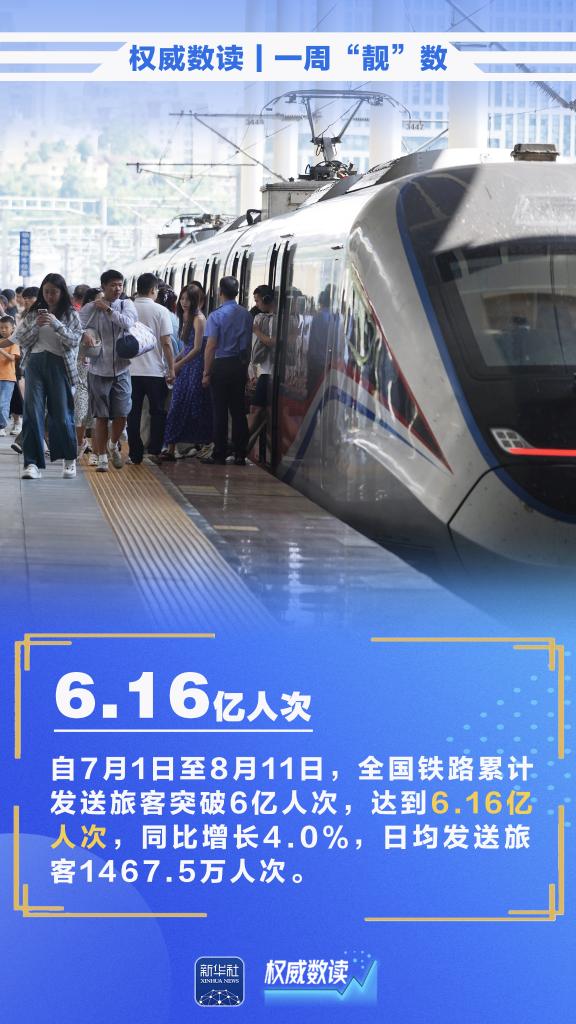
Key Points - From July 1 to August 11, the total number of railway passengers exceeded 600 million, reaching 616 million, with a year-on-year increase of 4.0% and an average daily passenger count of 14.675 million [3] - In the first seven months, the express delivery business volume reached 112.05 billion pieces, showing a year-on-year growth of 18.7% [5] - In July, the industrial added value of large-scale enterprises increased by 5.7% year-on-year and 0.38% month-on-month, with the equipment manufacturing sector growing by 8.4% and high-tech manufacturing by 9.3% [8] - The service production index in July grew by 5.8% year-on-year, with significant increases in information transmission, software, IT services (11.9%), finance (8.7%), and leasing and business services (8.0%) [15] - By June 2025, the total number of 5G base stations is expected to increase fivefold compared to 2020, reaching 4.55 million, while the number of broadband users is projected to grow 34 times to 226 million [13] - In the first half of the year, 13.278 million new business entities were established, including 4.62 million new enterprises and 8.629 million new individual businesses [21] - Under the "Two New" policy, from April 2024 to July 2025, the amount spent on machinery and equipment is expected to grow by 7.3%, with sales of household appliances and audiovisual equipment increasing by 44.5% and 22.8% respectively, and new energy vehicle sales rising by 81.7% [23] - Recently, 188 billion yuan in investment subsidies for equipment upgrades has been fully allocated [19]

冠通期货2025年7月宏观经济数据
Guan Tong Qi Huo· 2025-08-15 10:53
Report Summary 1. Report Industry Investment Rating There is no information about the industry investment rating in the provided content. 2. Core View In July 2025, under the strong leadership of the Party Central Committee with Comrade Xi Jinping as the core, the national economy maintained a steady - advancing development trend, with sustained growth in production and demand, overall stable employment and prices, the cultivation and expansion of new - quality productive forces, and new achievements in high - quality development [3]. 3. Summary by Relevant Catalogs Industry - In July, the national above - scale industrial added value increased by 5.7% year - on - year and 0.38% month - on - month. From January to July, it increased by 6.3% year - on - year. The manufacturing PMI was 49.3%, and the enterprise production and operation activity expectation index was 52.6%. From January to June, the total profit of above - scale industrial enterprises was 34365 billion yuan, a year - on - year decrease of 1.8% [3]. Service - In July, the national service industry production index increased by 5.8% year - on - year. From January to July, it increased by 5.9% year - on - year. The service industry business activity index was 50.0%, and the service industry business activity expectation index was 56.6%. Some industries were in the high - level boom range [4]. Consumption - In July, the total retail sales of consumer goods were 38780 billion yuan, a year - on - year increase of 3.7% and a month - on - month decrease of 0.14%. From January to July, the total retail sales of consumer goods were 284238 billion yuan, a year - on - year increase of 4.8%. The national online retail sales were 86835 billion yuan, a year - on - year increase of 9.2%. The service retail sales from January to July increased by 5.2% year - on - year [5]. Investment - From January to July, the national fixed - asset investment (excluding rural households) was 288229 billion yuan, a year - on - year increase of 1.6%. Excluding real estate development investment, it increased by 5.3%. Infrastructure investment increased by 3.2%, manufacturing investment increased by 6.2%, and real estate development investment decreased by 12.0% [6]. Import and Export - In July, the total value of goods imports and exports was 39102 billion yuan, a year - on - year increase of 6.7%. From January to July, the total value of goods imports and exports was 256969 billion yuan, a year - on - year increase of 3.5%. Exports increased by 7.3%, and imports decreased by 1.6% [7]. Price - In July, the national consumer price (CPI) was flat year - on - year and increased by 0.4% month - on - month. The core CPI increased by 0.8% year - on - year. The national industrial producer price index (PPI) decreased by 3.6% year - on - year and 0.2% month - on - month [8]. Employment - From January to July, the average national urban surveyed unemployment rate was 5.2%. In July, it was 5.2%, up 0.2 percentage points from the previous month and the same as the same month last year [9].
权威数读|7月份国民经济:保持稳中有进
Xin Hua She· 2025-08-15 07:16
国家统计局15日发布数据显示,7月份,生产需求持续增长,就业物价总体稳定,新质生产力培育壮大,高质量发展取得新成效,国民经济保 持稳中有进发展态势。 同比分别增长24.2%、Z4.U%、17.1% 权威数读 新华社 RER 务业较快增长 : 14 现代服务业增势良好 今日肥タルナナセ粘目レゼピ 00/ 当前次。 1日文 | 1 | 2 信息传输、软件和信息技术服务业 金融业,租赁和商务服务业生产指数 同比分别增长11.9%、8.7%、8.0% 新华社 > 仪顾到读 市场销售继续增1 服务零售增长较快 扣除食品和能源价格后的 核心CPl同比上涨0.8% 涨幅比上月扩大0.1个百分点 权履受赎 美物雄州口增长加快 员易结构继续优化 权威数读 新华社 AX 货物进出口总额 39102亿元 同比增长6.7% 权威数读 新华社 AX 足民消费价格同比持平 核心CPI连续回升 全国居民消费价格(CPI) 同比持平 环比上涨0.4% sh all 社会消费品零售总额38780亿元 同比增长3.7% 限额以上单位粮油食品类、日用品类 体育娱乐用品类、金银珠宝类商品零售额 分别增长8.6%、8.2%、13.7%、8.2% 一权 ...
国家统计局:7月份我国服务业生产指数保持较快增长
Xin Hua Cai Jing· 2025-08-15 06:36
Core Viewpoint - In July, the service industry production index grew by 5.8% year-on-year, supported by macro policy effects, contributing significantly to stable economic performance [1]. Group 1: Service Industry Performance - The service industry added value increased by 5.5% year-on-year in the first half of the year, contributing 60.2% to economic growth, highlighting its importance as a growth driver [1]. - The modern service sector experienced rapid growth, with the information transmission, software, and IT services production index rising by 11.9%, significantly outpacing the overall service industry growth [2]. - The rental and business services production index grew by 8% year-on-year, maintaining a strong growth trajectory [2]. Group 2: Emerging Services and Digital Transformation - New service sectors are emerging, with rapid advancements in artificial intelligence and humanoid robots enhancing productivity in scientific research and technical services [2]. - From January to June, the revenue of information services and R&D services saw double-digit growth, indicating a robust expansion in these areas [2]. - The digital transformation is accelerating, with cultural and sports digital services growing rapidly, as evidenced by a more than 10% increase in transaction volume for leading cultural and sports service platforms from January to July [2]. Group 3: Tourism and Financial Services - The tourism and travel-related services showed increased activity, with the transportation, warehousing, and postal services production index rising by 5.5% year-on-year, reflecting a 0.4 percentage point acceleration from the previous month [2]. - Railway passenger volume increased by 6.6% year-on-year, and international flight passenger volume grew by 15.7%, indicating a rebound in travel demand [2]. - The financial services sector also saw robust growth, with the financial industry production index increasing by 8.7% year-on-year, up 1.4 percentage points from the previous month [3]. Group 4: Future Outlook - The service industry is expected to continue its growth due to favorable conditions such as industrial upgrades increasing demand for R&D services and changes in consumer spending patterns boosting demand for leisure services [3]. - The business activity expectation index for the service industry was 56.6% in July, indicating a positive outlook among service sector enterprises [3]. - The government aims to implement policies to support the service industry's development, ensuring sustained growth and high-quality economic development [3].
刚刚,重磅来了!5.7%,3.7%,6.7%!
Zhong Guo Ji Jin Bao· 2025-08-15 06:12
Economic Overview - In July, the national economy maintained a steady and progressive development trend, with industrial added value increasing by 5.7% year-on-year and retail sales of consumer goods reaching 38,780 billion yuan, up 3.7% year-on-year [1][2][10] Industrial Production - The industrial added value for July increased by 5.7% year-on-year and 0.38% month-on-month, with mining, manufacturing, and electricity sectors growing by 5.0%, 6.2%, and 3.3% respectively [3] - High-tech manufacturing and equipment manufacturing saw significant growth, with increases of 9.3% and 8.4% year-on-year, respectively [3] - The manufacturing purchasing managers' index was recorded at 49.3, indicating a slight contraction in manufacturing activity [3] Service Sector - The service sector production index rose by 5.8% year-on-year in July, with notable growth in information transmission, finance, and business services [4] - The business activity index for the service sector was at 50.0, indicating stability, while the business activity expectation index was at 56.6, suggesting positive future expectations [4] Retail Sales - Retail sales of consumer goods totaled 38,780 billion yuan in July, marking a 3.7% year-on-year increase, with urban and rural retail sales growing by 3.6% and 3.9%, respectively [5] - Online retail sales reached 86,835 billion yuan, up 9.2% year-on-year, with physical goods accounting for 24.9% of total retail sales [5] Fixed Asset Investment - Fixed asset investment (excluding rural households) reached 288,229 billion yuan from January to July, growing by 1.6% year-on-year, with manufacturing investment increasing by 6.2% [6] - Infrastructure investment grew by 3.2%, while real estate development investment saw a decline of 12.0% [6] Trade and Exports - In July, the total value of goods imports and exports was 39,102 billion yuan, up 6.7% year-on-year, with exports increasing by 8.0% and imports by 4.8% [7] - From January to July, the total value of goods imports and exports was 256,969 billion yuan, a 3.5% increase year-on-year [7] Employment and Prices - The urban survey unemployment rate was stable at 5.2% in July, with a slight seasonal increase [8] - The Consumer Price Index (CPI) remained flat year-on-year in July, with core CPI rising by 0.8% [9]

刚刚,重磅经济数据出炉!
Zheng Quan Shi Bao· 2025-08-15 06:11
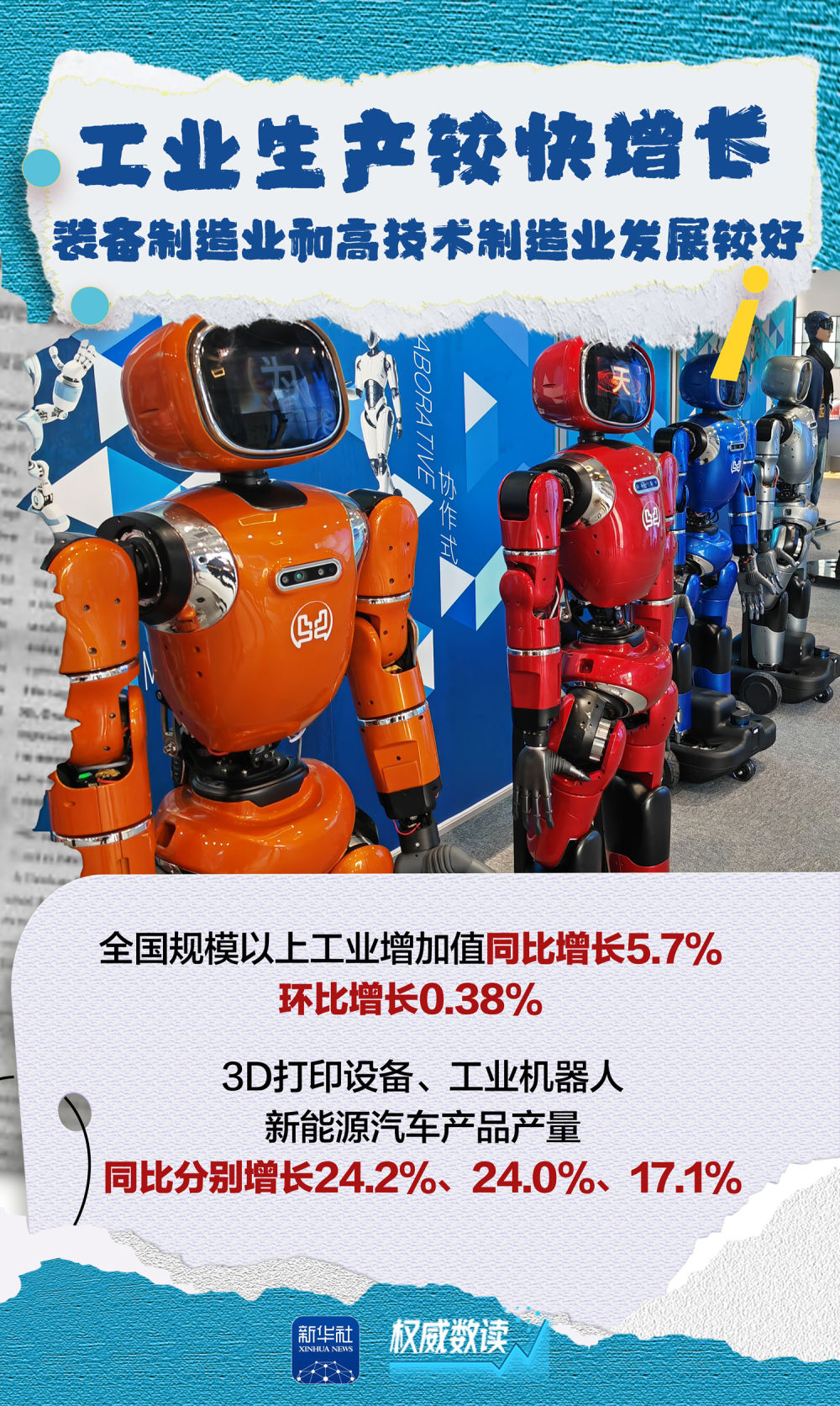
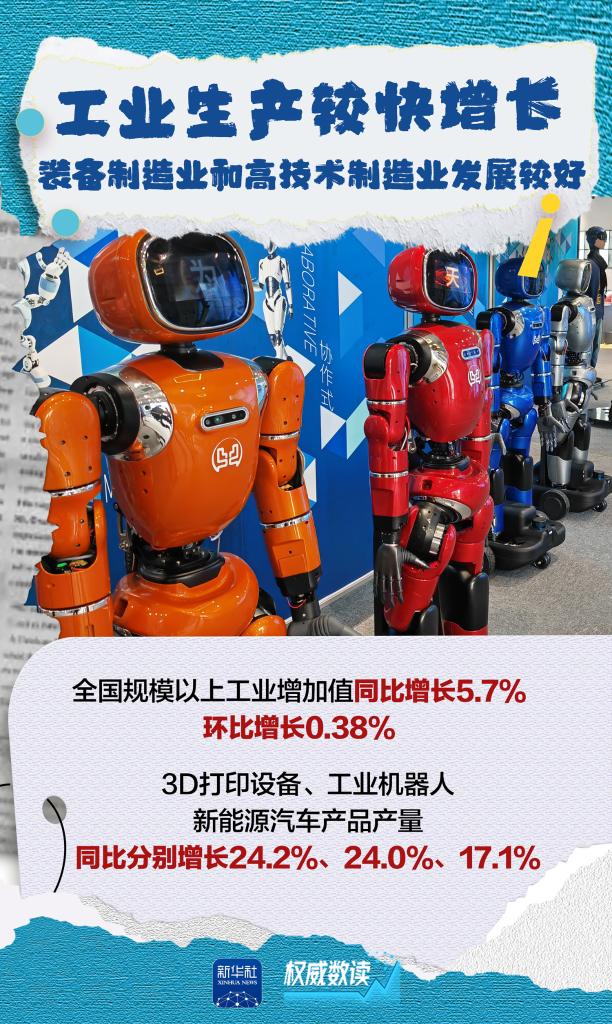
7月份国民经济保持稳中有进发展态势。 据国家统计局消息,7月份,在以习近平同志为核心的党中央坚强领导下,各地区各部门认真贯彻落实 党中央、国务院决策部署,坚持稳中求进工作总基调,完整准确全面贯彻新发展理念,加快构建新发展 格局,加紧实施更加积极有为的宏观政策,纵深推进全国统一大市场建设,国民经济保持稳中有进发展 态势,生产需求持续增长,就业物价总体稳定,新质生产力培育壮大,高质量发展取得新成效。 一、工业生产较快增长,装备制造业和高技术制造业发展较好 7月份,全国规模以上工业增加值同比增长5.7%,环比增长0.38%。分三大门类看,采矿业增加值同比 增长5.0%,制造业增长6.2%,电力、热力、燃气及水生产和供应业增长3.3%。装备制造业增加值同比 增长8.4%,高技术制造业增加值增长9.3%,分别快于全部规模以上工业增加值2.7和3.6个百分点。分经 济类型看,国有控股企业增加值同比增长5.4%;股份制企业增长6.5%,外商及港澳台投资企业增长 2.8%;私营企业增长5.0%。分产品看,3D打印设备、工业机器人、新能源汽车产品产量同比分别增长 24.2%、24.0%、17.1%。1—7月份,全国规模以上工业 ...
权威数读丨7月份国民经济:保持稳中有进
Xin Hua Wang· 2025-08-15 06:01
Economic Overview - The national economy is maintaining a steady and progressive development trend, with continuous growth in production demand, stable employment and prices, and significant advancements in new productive forces [1] Industrial Production - The industrial added value of large-scale enterprises increased by 5.7% year-on-year and 0.38% month-on-month [2] - Key sectors such as 3D printing equipment, industrial robots, and new energy vehicles saw production increases of 24.2%, 24.0%, and 17.1% respectively [2] Service Sector Growth - The service industry is experiencing rapid growth, with the national service production index rising by 5.8% year-on-year [5] - Specific sectors like information transmission, software and IT services, finance, and leasing and business services reported year-on-year growth rates of 11.9%, 8.7%, and 8.0% respectively [5] Retail Sales - The total retail sales of consumer goods reached 38,780 billion yuan, marking a year-on-year increase of 3.7% [7] - Retail sales in categories such as grain and oil, daily necessities, sports and entertainment products, and gold and silver jewelry grew by 8.6%, 8.2%, 13.7%, and 8.2% respectively [7] Fixed Asset Investment - Fixed asset investment (excluding rural households) totaled 288,229 billion yuan from January to July, reflecting a year-on-year growth of 1.6% [8] Trade Performance - The total import and export value of goods reached 39,102 billion yuan, with a year-on-year increase of 6.7% [9]
刚刚,重要经济数据公布
天天基金网· 2025-08-15 05:02
Core Viewpoint - In July, under the strong leadership of the Central Committee of the Communist Party of China, the national economy maintained a steady and progressive development trend, with continuous growth in production demand, stable employment and prices, and new achievements in high-quality development [1]. Group 1: Industrial Production - In July, the industrial added value above designated size increased by 5.7% year-on-year and 0.38% month-on-month. The mining industry grew by 5.0%, manufacturing by 6.2%, and electricity, heat, gas, and water production and supply by 3.3% [2]. - The equipment manufacturing industry saw an 8.4% year-on-year increase, while high-tech manufacturing grew by 9.3%, outperforming the overall industrial growth by 2.7 and 3.6 percentage points respectively [2]. - The manufacturing purchasing manager index was at 49.3%, and the business activity expectation index was at 52.6% [2]. Group 2: Service Sector - The national service production index increased by 5.8% year-on-year in July, with significant growth in information transmission, software and IT services (11.9%), finance (8.7%), and leasing and business services (8.0%) [3]. - The business activity index for the service sector was at 50.0%, while the business activity expectation index was at 56.6% [3]. Group 3: Market Sales - In July, the total retail sales of consumer goods reached 38,780 billion yuan, a year-on-year increase of 3.7% [4]. - Online retail sales amounted to 86,835 billion yuan, growing by 9.2% year-on-year, with physical goods online retail sales at 70,790 billion yuan, a 6.3% increase [4]. - The sales of essential and some upgraded consumer goods showed strong growth, with significant increases in categories such as home appliances and furniture [4]. Group 4: Fixed Asset Investment - From January to July, fixed asset investment (excluding rural households) reached 288,229 billion yuan, a year-on-year increase of 1.6% [5]. - Manufacturing investment grew by 6.2%, while real estate development investment decreased by 12.0% [5]. - High-tech industries such as aerospace and information services saw substantial investment growth, with increases of 33.9% and 32.8% respectively [5]. Group 5: Trade and Employment - In July, the total value of goods imports and exports reached 39,102 billion yuan, a year-on-year increase of 6.7% [6]. - The average urban survey unemployment rate from January to July was 5.2%, with a slight increase in July compared to the previous month [7]. Group 6: Consumer Prices - In July, the national consumer price index (CPI) remained flat year-on-year, with a month-on-month increase of 0.4% [8]. - Core CPI, excluding food and energy prices, rose by 0.8% year-on-year, indicating a slight increase in inflationary pressure [8].

【数据发布】7月份国民经济保持稳中有进发展态势
中汽协会数据· 2025-08-15 04:07
Core Viewpoint - In July, the national economy maintained a steady and progressive development trend, with continuous growth in production and demand, overall stability in employment and prices, and significant achievements in high-quality development [2][11]. Group 1: Industrial Production - In July, the industrial added value of large-scale enterprises increased by 5.7% year-on-year and 0.38% month-on-month [3]. - The manufacturing sector grew by 6.2%, with equipment manufacturing and high-tech manufacturing increasing by 8.4% and 9.3%, respectively [3]. - The profit of large-scale industrial enterprises from January to June was 34,365 billion yuan, a year-on-year decrease of 1.8% [3]. Group 2: Service Sector - The service production index increased by 5.8% year-on-year in July, with significant growth in information transmission, software, and financial services [4]. - The business activity index for the service sector was at 50.0%, indicating stable business conditions [4]. Group 3: Market Sales - In July, the total retail sales of consumer goods reached 38,780 billion yuan, a year-on-year increase of 3.7% [5]. - Online retail sales amounted to 86,835 billion yuan, growing by 9.2% year-on-year, with physical goods online retail sales at 70,790 billion yuan [6]. Group 4: Fixed Asset Investment - From January to July, fixed asset investment (excluding rural households) was 288,229 billion yuan, a year-on-year increase of 1.6% [7]. - Manufacturing investment grew by 6.2%, while real estate development investment decreased by 12.0% [7]. Group 5: Trade and Exports - In July, the total value of goods imports and exports reached 39,102 billion yuan, a year-on-year increase of 6.7% [8]. - Exports grew by 8.0%, while imports increased by 4.8% [8]. Group 6: Employment - The urban surveyed unemployment rate in July was 5.2%, with a seasonal increase of 0.2 percentage points from the previous month [9]. - The average weekly working hours for employees were 48.5 hours [9]. Group 7: Consumer Prices - In July, the Consumer Price Index (CPI) remained flat year-on-year, with a month-on-month increase of 0.4% [10]. - The core CPI, excluding food and energy prices, rose by 0.8% year-on-year [11].

杨德龙:七月国民经济平稳增长 牛市趋势越来越明显
Xin Lang Ji Jin· 2025-08-15 03:51
Economic Overview - In July, China's economy showed steady progress with improved economic data, driven by effective policies to stabilize growth [1][4] - The industrial production, consumption, and service sectors all experienced certain improvements, contributing to a stronger capital market [1][4] Industrial Production - In July, the industrial added value for large-scale enterprises grew by 5.7% year-on-year and 0.38% month-on-month [1] - The equipment manufacturing and high-tech manufacturing sectors performed particularly well, with year-on-year growth rates of 8.4% and 9.3%, respectively [1] Service Sector - The service sector production index increased by 5.8% year-on-year in July, with notable growth in information transmission, software, and financial services [2] - Social retail sales reached 38,780 billion yuan, a year-on-year increase of 3.7%, with online retail sales growing by 9.2% [2] Fixed Asset Investment - From January to July, fixed asset investment rose by 1.6% year-on-year, with a 5.3% increase when excluding real estate development investment [3] - Real estate development investment continued to decline, dropping by 12% year-on-year in July [3] Trade Performance - In July, the total value of goods imports and exports grew by 6.7% year-on-year, with exports increasing by 8% and imports by 4.81% [3] - The trade structure is improving, with a notable upgrade in the value-added of export products [3] Consumer Prices - The Consumer Price Index (CPI) remained flat year-on-year in July, with a month-on-month increase of 0.4% [3] - The core CPI, excluding food and energy, rose by 0.8% year-on-year, indicating a need for measures to boost consumption and investment [3] Capital Market Dynamics - The capital market is showing signs of strength, with the Shanghai Composite Index surpassing 3,700 points, indicating increasing investor confidence [1][4] - New stock accounts opened in July approached 2 million, and trading volume has significantly increased, reflecting a growing willingness of outside funds to enter the market [4] Investment Opportunities - Compared to the U.S. stock market, which is at historical highs, A-shares and Hong Kong stocks remain below historical average valuations, presenting a favorable investment opportunity [5] - Investors are encouraged to consider quality stocks or funds to capitalize on the current market conditions for wealth growth [5]