新能源汽车零部件

Search documents
固德电材募资11.76亿闯关创业板,45岁董事长朱国来控制60.55%表决权
Sou Hu Cai Jing· 2025-07-01 01:55
Core Viewpoint - Gude Electric Materials has received approval for its IPO on the ChiNext board, focusing on the development and production of thermal runaway protection components for electric vehicle batteries and high-performance insulation products [3] Company Overview - Gude Electric Materials was established in 2008 and specializes in thermal runaway protection solutions for electric vehicle batteries and electrical insulation products [3] - The company has become a first-tier supplier for several global automotive manufacturers and battery producers, establishing long-term partnerships with industry leaders such as General Motors, Ford, Stellantis, BMW, and CATL [3] IPO Details - The company plans to raise 1.176 billion yuan through its IPO, with allocations including 619 million yuan for the production of 725 million sets of thermal runaway protection components and R&D projects, 257 million yuan for the construction of a production base, and 300 million yuan for working capital [4] Financial Performance - The company’s total assets are projected to grow from 564.53 million yuan in 2022 to 1,083.17 million yuan in 2024, with net profit increasing from 64.23 million yuan to 166.01 million yuan over the same period [5] - The revenue is expected to rise from 475.10 million yuan in 2022 to 908.00 million yuan in 2024, indicating a strong growth trajectory [5] - The company’s return on equity is projected to increase from 22.58% in 2022 to 31.57% in 2024, reflecting improved profitability [5] Shareholding Structure - The controlling shareholder and actual controller of the company is Zhu Guolai, who holds 46.76% of the shares and controls a total of 60.55% of the voting rights through various entities [7] - Zhu Guolai has a significant role in the company's decision-making processes, serving as both the chairman and general manager [7]


固德电材创业板IPO获受理:年入9亿元,客户含宁德时代、宝马
Sou Hu Cai Jing· 2025-07-01 01:44
Core Viewpoint - Gude Electric Materials has initiated its IPO on the ChiNext board, focusing on the development and production of thermal runaway protection components for electric vehicle batteries and high-performance insulation products [3] Company Overview - Gude Electric Materials was established in 2008 and specializes in thermal runaway protection solutions for electric vehicle batteries and electrical insulation products [3] - The company has become a first-tier supplier for several global automotive manufacturers and battery producers, including General Motors, Ford, Stellantis, BMW, and CATL [3] IPO Details - The company aims to raise 1.176 billion yuan through its IPO, with 619 million yuan allocated for the production of 725,000 sets of thermal runaway protection components and R&D projects [4] - Additional funds include 257 million yuan for the construction of a production base for thermal runaway protection materials and 300 million yuan for working capital [4] Financial Performance - From 2022 to 2024, the company's revenue is projected to grow from 475 million yuan to 908 million yuan, with net profit increasing from 64 million yuan to 172 million yuan [5] - For Q1 2025, the company reported a revenue of 240 million yuan, a year-on-year increase of 35.46%, and a net profit of 48 million yuan, up 57.21% year-on-year [6] Sales and Market Presence - The company's foreign sales revenue has shown significant growth, with proportions of 15.50%, 28.82%, and 44.29% of total revenue over the past three years [6] - The company primarily conducts foreign sales in US dollars, indicating a strong international market presence [6]

走过剧烈变化的5年,中国吸引外资正发生质变
第一财经· 2025-06-25 05:01
Core Viewpoint - The article discusses the evolution of foreign investment in China during the "14th Five-Year Plan" period, highlighting a transition from high growth to a decline and then a narrowing of the decline, showcasing resilience amid global economic fluctuations and value chain restructuring [1]. Group 1: Foreign Investment Scale - The foreign investment scale in China has remained high, with actual foreign investment amounting to approximately $600 billion from 2021 to 2024, surpassing 43 trillion yuan [3]. - In 2021, the actual foreign investment reached 1,149.36 billion yuan, a year-on-year increase of 14.9%. In 2022, it was 1,232.68 billion yuan, up 6.3%. However, in 2023, it dropped to 1,133.91 billion yuan, a decrease of 8.0%, and in 2024, it further declined to 826.25 billion yuan, down 27.1% [5][4]. - By the first four months of 2025, actual foreign investment was 320.78 billion yuan, showing a year-on-year decline of 10.9%, but the decline was 16.2 percentage points less than the total decline in 2024 [5]. Group 2: Structural Changes in Foreign Investment - There is a structural transformation in how foreign investment is perceived and utilized in China, with higher expectations for advanced technology and services as the country undergoes economic restructuring [8]. - The competitive strength of Chinese enterprises has increased, leading to a shift from raw materials to more complex manufactured goods in trade with developed countries, indicating a closer alignment in industrial division and technological levels [9]. - Foreign investment is increasingly focused on local R&D and integration with domestic supply chains, transforming China from a global manufacturing base to an innovation hub [9][10]. Group 3: Policy and Future Outlook - The "14th Five-Year Plan" emphasizes attracting foreign investment through various measures, including optimizing foreign investment services and encouraging reinvestment of profits by foreign enterprises [3][6]. - The Chinese government is accelerating the opening of the service sector, with a focus on telecommunications, finance, and healthcare, to enhance foreign investment opportunities [12]. - Looking ahead, the next decade is expected to see significant improvements in China's competitive advantages for attracting foreign investment, with a focus on high-quality development and international cooperation [14][15].
安徽省对共建“一带一路”国家进出口为何创新高
Sou Hu Cai Jing· 2025-06-24 01:21
Core Insights - The province's import and export trade with countries involved in the "Belt and Road" initiative reached 455.7 billion yuan in May, marking a year-on-year growth of 22.8%, the highest growth rate of the year and a historical peak in trade value [1][2] - In the first five months of the year, the province's total trade with "Belt and Road" countries was 2,047 billion yuan, a 16.2% increase compared to the same period last year, accounting for 54.6% of the province's total import and export value [1][2] Trade Performance - Exports of high-tech products to "Belt and Road" countries increased by 27.1% year-on-year in May, while imports of high-tech products surged by 130% to 30.9 billion yuan [1][3] - In the first five months, private enterprises contributed 1,013.4 billion yuan to trade with "Belt and Road" countries, a 27.9% increase, representing 49.5% of the total trade value [2] - Foreign-invested enterprises recorded a trade value of 436.6 billion yuan, up 30.5%, accounting for 21.3% of the total [2] Product Categories - In May, the province exported 213.8 billion yuan worth of electromechanical products to "Belt and Road" countries, a 15.4% increase, making up 71.8% of total exports to these countries [2] - Notable growth was seen in the "new three samples" products, electronic components, and household appliances, with respective increases of 94.2%, 143.7%, and 22.1% [2] Market Focus - The province's trade with Vietnam, Chile, and Brazil in May reached 48.3 billion yuan, 43.5 billion yuan, and 33.3 billion yuan respectively, with growth rates of 155.4%, 109.4%, and 0.6% [4] - Trade with ASEAN countries grew by 38.5% to 119.6 billion yuan, while trade with South America increased by 28.3% to 122.1 billion yuan [4] - The province's efforts to enhance the business environment include 26 measures to optimize services for local import and export enterprises, aiming to facilitate better integration into the "Belt and Road" initiative [4]
友升股份IPO过会 加速新能源汽车轻量化布局
Zheng Quan Ri Bao Wang· 2025-06-20 13:44
Group 1 - The core viewpoint of the news is that YouSheng Aluminum Industry Co., Ltd. has successfully passed the listing review by the Shanghai Stock Exchange, indicating its compliance with issuance and listing conditions, as well as information disclosure requirements [1] - YouSheng specializes in the design, development, production, sales, and service of aluminum alloy automotive components, focusing on lightweight parts for electric vehicles, and has established stable partnerships with several leading global automotive companies [1][2] - The company plans to raise 2.471 billion yuan through its IPO, with funds allocated for a production base project, battery tray production, and working capital [1] Group 2 - The industry outlook for lightweight materials, such as aluminum alloys, is positive, driven by the accelerating transition to lightweight electric vehicles, which is expected to significantly increase market demand [2] - YouSheng's financial performance is projected to grow, with revenues of approximately 2.35 billion yuan, 2.91 billion yuan, and 3.95 billion yuan from 2022 to 2024, and a net profit of 233 million yuan, 321 million yuan, and 405 million yuan for the same period [2] - The rapid development of the electric vehicle market is anticipated to continue driving growth for component manufacturers, providing more orders and profit opportunities [2] Group 3 - YouSheng's future development strategy includes expanding its influence in the electric vehicle parts sector by targeting high-end clients and enhancing its position in the industry chain [3] - The company aims to increase R&D investment and focus on new product development, continuously investing in new products, processes, and technologies to improve product performance and production efficiency [3]
扬中经开区以更优营商环境交好“半年成绩单”
Xin Hua Ri Bao· 2025-06-17 19:54
Group 1 - The core viewpoint of the articles highlights the rapid development and investment in advanced manufacturing and technology-driven projects in the Yangzhong Economic Development Zone, focusing on the automotive and electrical industries [1][2][3] - Jiangsu Yule Technology Co., Ltd. has invested 300 million yuan in a new project for lightweight materials for electric vehicles, achieving significant milestones in project approval and construction timelines [1] - The Yangzhong Economic Development Zone has streamlined project approval processes, reducing the number of required documents to 14 and the investment project registration time to one working day [1] - Jiangsu Yinen Electric Group has invested 70 million yuan in technological upgrades and established a smart manufacturing workshop, emphasizing the importance of technological empowerment in traditional industries [2] - The Yangzhong Economic Development Zone aims to promote intelligent manufacturing and green development, with seven companies recognized as advanced smart factories in Jiangsu Province [2] Group 2 - The Yangzhong Economic Development Zone is actively engaging in talent development through collaborations with educational institutions and has established a dedicated service center for skilled talent, providing comprehensive support [3] - The region has approximately 7,000 skilled workers, with a significant portion being young talents, indicating a focus on nurturing the next generation of skilled professionals [3]
联合动力IPO:理想、小米难撑“护城河” “卖铲人”如何破解现金流困局?
Xi Niu Cai Jing· 2025-06-10 06:59
Core Viewpoint - Suzhou Huichuan United Power System Co., Ltd. (referred to as "United Power") is experiencing rapid growth in the capital market, driven by its association with major clients like Li Auto and Xiaomi, despite showing signs of financial weaknesses as it prepares for its IPO [2][6]. Company Overview - United Power was established in 2016, spun off from the industrial control leader Huichuan Technology, and focuses on the development, production, and sales of electric motors, electronic controls, power supplies, and powertrains for electric vehicles [6]. - The company reported revenues of 50.27 billion, 93.65 billion, and 161.78 billion yuan for the years 2022, 2023, and 2024, respectively, with an average annual growth rate of nearly 80% [6]. Financial Performance - In 2023, United Power achieved a net profit of 1.86 billion yuan, a year-on-year increase of 203.19%, and is projected to reach 9.36 billion yuan in net profit for 2024, representing a growth of 403.55% [6]. - The company's revenue heavily relies on its top five clients, which accounted for 71.73%, 76.03%, and 67.81% of total revenue during the reporting period [6]. Client Dependency - Li Auto contributed nearly 50% of the revenue from the top five clients, while Xiaomi accounted for 7.94% [6]. - As of 2024, United Power's accounts receivable balance was 56.84 billion yuan, a year-on-year increase of 57.83%, which is lower than the revenue growth rate for the same period [6]. Cash Flow Concerns - The high accounts receivable levels indicate potential collection risks, as seen in the case of former key client WM Motor, which faced bankruptcy and left United Power with 215 million yuan in bad debt [10]. - Prior to its IPO application, United Power's operating cash flow was negative until it turned positive just before the filing [11]. Sales Trends - Sales data for Li Auto and Xiaomi in the first five months of 2025 showed a decline, raising concerns about the impact on United Power's cash flow and overall performance [11]. - In the first quarter of 2025, United Power's revenue and net profit growth rates were 49.81% and 91.04%, respectively, both significantly lower than the previous year's figures [11].

当“造车人”邂逅“追光者” 六安开发区如何跑出“智造”加速度?
Zhong Guo Xin Wen Wang· 2025-06-09 01:42
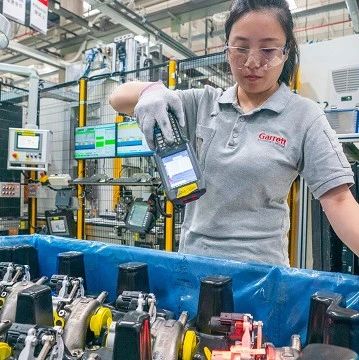
Core Insights - The article highlights the industrial transformation driven by innovation in the Liu'an Economic and Technological Development Zone, showcasing the growth of high-tech manufacturing and the emergence of new industries in the region [1][10]. Group 1: Innovation-Driven Industrial Engine - Liu'an Economic and Technological Development Zone is experiencing significant industrial expansion, particularly in the new energy vehicle (NEV) parts manufacturing sector, with companies like Anhui Kaisting Technology Co., Ltd. leading the way [3][5]. - The company has adopted advanced equipment and technology to optimize processes, achieving precision control of automotive parts within millimeter-level tolerances, which is critical for the NEV industry [5][6]. - A testing base for high-end NEV parts has been established, equipped with over 40 testing instruments, significantly reducing testing cycles and costs for local companies [8][6]. Group 2: Industry Growth and Economic Impact - By 2024, the Liu'an Development Zone aims to consolidate its position as a key growth area, with 47 NEV supporting enterprises and a 40% increase in output value for new generation information technology companies [8]. - The new materials and equipment manufacturing industries have achieved output values exceeding 5 billion and 10 billion respectively, marking a significant milestone in the region's industrial development [8]. Group 3: Service Innovation and Institutional Breakthroughs - Liu'an Development Zone has established a comprehensive service system to support enterprise development, including innovative recruitment initiatives like "Union Chairman Live Streaming Job Fair" to connect employers and job seekers [17][18]. - The zone has also implemented financial reforms, introducing "Landing Loans" to assist new enterprises in overcoming initial financing challenges, thereby supporting businesses throughout their lifecycle [20].
2025最新三线城市排名出炉:乌鲁木齐第1,赣州第9,江门第20
Sou Hu Cai Jing· 2025-06-08 14:10
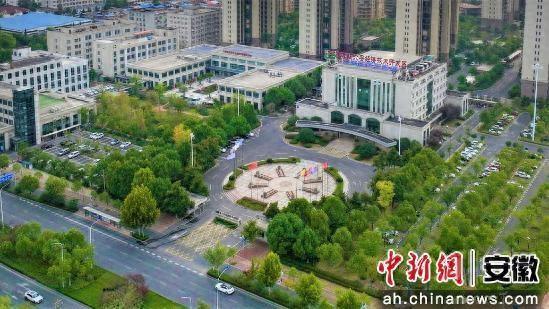
Core Insights - The article highlights the rapid urbanization process in China over the past 40 years, emphasizing the rise of third-tier cities and their evolving competitive landscape [1][3]. Group 1: City Rankings and Characteristics - The top 10 third-tier cities in 2025 are Urumqi, Lanzhou, Zhongshan, Yancheng, Haikou, Yangzhou, Jining, Huzhou, Ganzhou, and Handan, showcasing a diverse distribution across 18 provinces [1][3]. - Urumqi's position as the leading city reflects the deepening of China's western opening strategy, leveraging its status as an international land port with 21 China-Europe Railway Express routes [5][6]. Group 2: Economic and Industrial Development - Urumqi's competitive edge includes a 30% reduction in customs clearance time, attracting major logistics companies like JD.com and SF Express to establish distribution centers [5][6]. - Ganzhou is transitioning from a raw material exporter to a hub for rare earth processing, with advancements in extraction technology increasing resource utilization from 35% to 80% [7][9]. - Jiangmen exemplifies the integration of traditional manufacturing with new technologies, such as the development of hydrogen-powered trams and smart factories, significantly enhancing production efficiency [11]. Group 3: Sector-Specific Growth - Urumqi's economic model includes processing foreign agricultural products for domestic distribution and exporting processed goods, such as furniture made from Russian timber [5][6]. - Ganzhou's rare earth industry is projected to exceed 200 billion yuan in output by 2024, demonstrating the potential for technological innovation to overcome resource dependency [9][13]. - Jiangmen's manufacturing sector is bolstered by overseas Chinese investments, with a significant portion of its projects funded by diaspora capital [11][13]. Group 4: Tourism and Consumer Trends - Yangzhou's designation as a "World Food City" is expected to attract over 80 million tourists in 2024, indicating a strong potential for tourism-driven economic growth [5][11]. - Haikou's duty-free shopping sector has seen a 40% annual increase in sales, positioning it as a key player in consumer market recovery [5][11]. Group 5: Strategic Implications - The article concludes that as first and second-tier cities face saturation, third-tier cities like Urumqi, Ganzhou, and Jiangmen are seizing historical opportunities through differentiated strategies that leverage local strengths [13].
2025年中国新能源汽车零部件行业相关政策、产业链、发展现状、重点企业分析及未来趋势研判:新能源汽车行业高速增长,为零部件产业增长带来强劲动力[图]
Chan Ye Xin Xi Wang· 2025-06-05 01:29
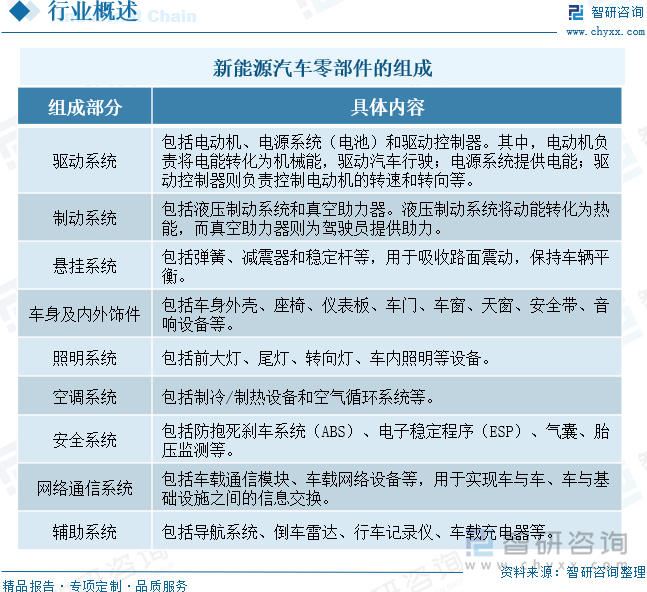
Core Viewpoint - The rapid development of China's new energy vehicle (NEV) components industry is driven by domestic economic growth, the fast expansion of the vehicle market, supportive national policies, and increased global sourcing efforts, with projected revenue reaching approximately 1.903 trillion yuan in 2024 [1][14]. Industry Overview - NEV components are essential units that make up various parts of new energy vehicles, playing a critical role in vehicle performance, safety, and reliability [3][12]. - The main components include the drive system, brake system, suspension system, body and interior/exterior parts, lighting system, air conditioning system, safety system, network communication system, and auxiliary systems, with the "three electric systems" (battery, motor, and electronic control) being the core [3][4]. Policy Support - The Chinese government has introduced multiple policies to support the NEV components industry, aligning with the "dual carbon" strategy to promote sustainable development [5][7]. - Key policies include the promotion of new power batteries and critical materials, as well as the establishment of standards for key components and intelligent network technologies [5][7]. Industry Chain - The NEV components industry chain consists of upstream raw material supply, midstream production, and downstream manufacturers, including vehicle manufacturers and repair shops [8]. Cost Structure - The cost structure of NEV components shows significant characteristics of electrification and intelligence, with the battery system accounting for 30% to 45% of the total vehicle cost [10][12]. - The electric drive system constitutes about 10% to 15% of the total cost, while the body and chassis account for 15% to 25% [10]. Market Growth - The production of NEVs in China has grown from 340,500 units in 2015 to an estimated 12.888 million units in 2024, with a compound annual growth rate (CAGR) of 49.74% [12]. - In the first quarter of 2025, NEV production and sales reached 3.182 million and 3.075 million units, respectively, marking year-on-year growth of 50.4% and 47.1% [12]. Key Enterprises - Major players in the NEV components industry include CATL, BYD, and others, with CATL projected to generate 253 billion yuan in revenue from battery systems in 2024 [23]. - BYD is also a significant player, with projected revenue of 617.4 billion yuan from its automotive and related products in 2024 [25]. Development Trends - The industry is experiencing a shift towards high-tech areas, with advancements in solid-state batteries and intelligent driving technologies [27][28]. - Regional industrial clusters are reshaping the components industry landscape, enhancing supply chain resilience and reducing logistics costs [28][29].