
广告营销

Search documents
三大指数本周强势上扬 卖空比例大幅回落预示市场拐点
Xin Lang Cai Jing· 2025-11-28 08:42
Market Overview - The Hong Kong stock market indices collectively rose this week, with the Hang Seng Index increasing by 2.53% to close at 25,858.89 points, the Hang Seng Tech Index up by 3.77% to 5,599.11 points, and the China Enterprises Index rising by 2.36% to 9,130.18 points [2][4]. Market Sentiment - Investor sentiment in the Hong Kong market has significantly improved, with short-selling amounts dropping from HKD 58.805 billion on November 20 to HKD 36.639 billion on November 27, a decrease of 37.7%, marking a three-month low [4]. - The number of stocks involved in short-selling decreased from 840 to 795, indicating a notable reduction in bearish sentiment and a gradual formation of a bullish atmosphere [4]. - Factors driving this sentiment include expectations of a Federal Reserve rate cut in December, ongoing growth stabilization policies in mainland China, and attractive valuations in the Hong Kong market [4]. Individual Stock Performance - Hesai Technology (02525.HK) led the market with a weekly increase of over 25%, driven by its inclusion in the Hang Seng Composite Index and achieving a milestone of over 2 million units delivered in the global lidar market [5]. - Clover Biopharmaceuticals (02197.HK) rose over 9% due to seasonal factors, with expectations of increased demand for its respiratory syncytial virus vaccine and quadrivalent seasonal flu vaccine as flu season peaks [5]. - ZTE Corporation (00763.HK) saw a 10.71% increase after announcing the successful application of its self-developed "Han域" M1 chip in a new vehicle model, marking a significant breakthrough in the domestic automotive chip sector [6]. Sector Performance - Gold stocks outperformed the market, with notable gains from companies such as Zhenfeng Gold (01815.HK) up 12.56% and China Gold International (02090.HK) up 5.17%, supported by rising international gold prices and expectations of a Federal Reserve rate cut [7][8]. - The robotics sector also showed strong performance, with GAC Group (02238.HK) rising 16.62% and other robotics companies like Yujian (02432.HK) and UBTECH (09880.HK) also experiencing significant gains [9][10]. - Conversely, pharmaceutical stocks weakened, with WuXi AppTec (02359.HK) down 3.80% and other biotech firms also declining, although some analysts believe the CXO industry is stabilizing [11][12]. - Real estate stocks continued to show weakness, with China Overseas Land (00688.HK) down 2.85%, despite positive policy signals aimed at promoting healthy industry development [13]. Notable Company Developments - Pop Mart (09992.HK) rose nearly 3% after its IP Labubu made a debut at the Macy's Thanksgiving Day Parade, generating significant social media buzz [14]. - Minda Technology (01860.HK) increased by over 5% following a report of a 27.6% year-on-year revenue growth to USD 532 million for the three months ending September 30, 2025, with strong expectations for AI-driven growth in its advertising services [14].


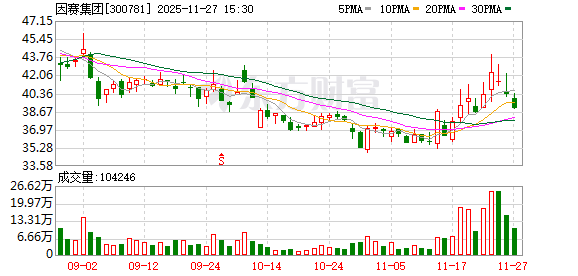
因赛集团:公司子公司影行天下涉及根据需求为部分客户匹配附带的直播电商或直播线索服务
Mei Ri Jing Ji Xin Wen· 2025-11-27 13:12
Group 1 - The company has a subsidiary named Yingxing Tianxia, which is involved in providing live e-commerce services based on customer demand [2] - The company confirmed on the investor interaction platform that it matches clients with live e-commerce or live lead services [2] - This indicates the company's engagement in the growing live e-commerce sector [2]

蓝色光标11月27日现1笔大宗交易 总成交金额200.22万元 溢价率为-13.31%
Xin Lang Cai Jing· 2025-11-27 09:22
Core Viewpoint - BlueFocus Media Group experienced a decline of 3.11% in stock price, closing at 10.59 yuan, with a significant block trade executed [1] Trading Activity - On November 27, a block trade occurred involving 218,100 shares, totaling a transaction value of 2,002,200 yuan, with a discount rate of -13.31% [1] - The buyer was Guoyuan Securities Co., Ltd. from Shanghai, while the seller was Shenwan Hongyuan Securities Co., Ltd. from Anhui [1] Recent Performance - Over the past three months, BlueFocus has recorded three block trades with a cumulative transaction value of 22,126,100 yuan [1] - In the last five trading days, the stock has increased by 16.37%, although there has been a net outflow of 1.082 billion yuan in principal funds [1]

广告营销板块11月27日跌1.28%,遥望科技领跌,主力资金净流出18.75亿元
Zheng Xing Xing Ye Ri Bao· 2025-11-27 09:13
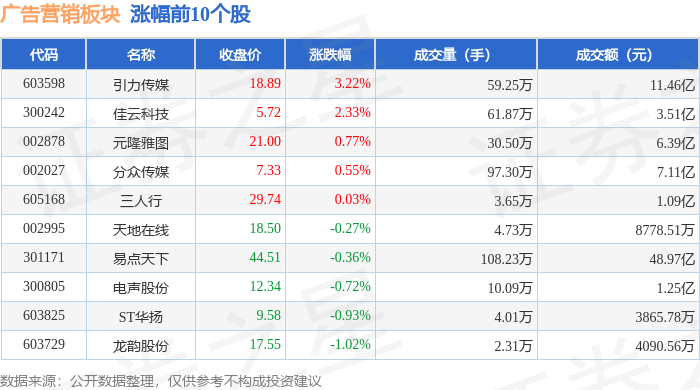
Core Insights - The advertising and marketing sector experienced a decline of 1.28% on November 27, with Yaowang Technology leading the drop [1][2] - The Shanghai Composite Index closed at 3875.26, up 0.29%, while the Shenzhen Component Index closed at 12875.19, down 0.25% [1] Stock Performance - Notable gainers in the advertising marketing sector included: - Yili Media (603598) with a closing price of 18.89, up 3.22% and a trading volume of 592,500 shares, totaling 1.146 billion yuan [1] - Jiayun Technology (300242) closed at 5.72, up 2.33% with a trading volume of 618,700 shares, totaling 351 million yuan [1] - Major decliners included: - Yaowang Technology (002291) which closed at 7.74, down 8.29% with a trading volume of 2,953,000 shares, totaling 2.454 billion yuan [2] - Xuan Ya International (300612) closed at 18.97, down 5.15% with a trading volume of 456,900 shares, totaling 888 million yuan [2] Capital Flow - The advertising marketing sector saw a net outflow of 1.875 billion yuan from institutional investors, while retail investors contributed a net inflow of 1.766 billion yuan [2][3] - Specific stock capital flows indicated: - Yili Media had a net inflow of 140 million yuan from institutional investors, while retail investors saw a net outflow of 83.44 million yuan [3] - Jiayun Technology experienced a net inflow of 62.78 million yuan from institutional investors, but a net outflow of 68.25 million yuan from retail investors [3]


暴涨1942%!被罗永浩设下大限的华与华兄弟,竟干出过这三个奇迹
Sou Hu Cai Jing· 2025-11-26 19:16
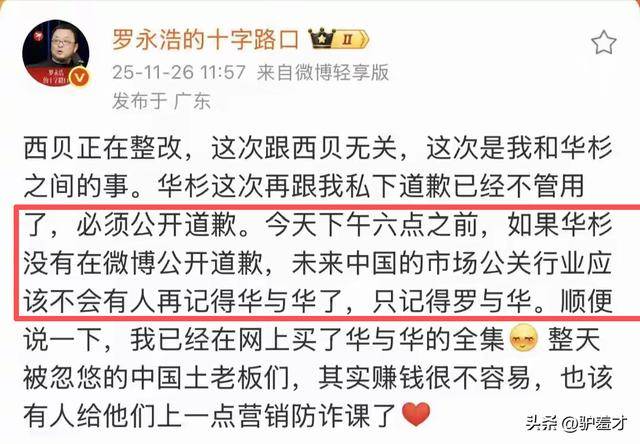
Core Viewpoint - The article discusses the ongoing public relations conflict between Luo Yonghao and the marketing firm Hua Yu Hua, highlighting the potential impact on the firm's reputation and future in the industry due to Luo's ultimatum for a public apology [1][45][51]. Group 1: Company Background - Hua Yu Hua has been a leading player in the brand consulting industry for over 20 years, with notable clients including "Xue Wang," "New Oriental," "Hai Di Lao," and "Zu Li Jian" [2][4]. - The firm charges high consulting fees, with individual company fees reaching up to 6 million [4]. - The founders, brothers Hua Shan and Hua Nan, have achieved significant recognition, with Hua Shan winning the China Outstanding Marketing Gold Award three times [6][10]. Group 2: Company Achievements - The company has been instrumental in the success of various brands, including the explosive growth of Tianqi toothpaste, which became a well-known trademark with annual sales reaching 1 billion [35][37]. - In 2021, the firm helped launch Read Culture, which saw its stock price surge by nearly 20 times on its first day of trading, setting multiple records in the A-share market [8][43]. Group 3: Current Conflict - The conflict began when Luo Yonghao set a deadline for Hua Yu Hua to publicly apologize, threatening to expose damaging information if they failed to comply [1][48]. - The situation escalated after Hua Shan publicly supported a controversial figure, leading to backlash and further scrutiny of Hua Yu Hua's marketing strategies [45][49]. - As of the article's publication, Hua Yu Hua had not issued an apology, leaving the outcome of the conflict uncertain [51].
易点天下20251125
2025-11-26 14:15
Summary of 易点天下 Conference Call Company Overview - 易点天下 has over a decade of experience in overseas advertising services, accumulating extensive marketing data with clients spanning cross-border e-commerce, gaming, and entertainment industries. Cross-border e-commerce is the primary category, with partnerships including major brands like Alibaba, Shein, and Huawei [2][3] Core Business Insights - In 2023, 易点天下 restarted its programmatic advertising business, which has become a major revenue source by 2025, accounting for a significant percentage of total income. Revenue growth exceeded 50% in the first three quarters of the year, although short-term media subsidies have led to weak profit growth, similar to the development paths of companies like AppLovin [2][4][5] - The company leverages AI algorithms to optimize advertising ROI, making it attractive for brand owners to allocate budgets to these platforms, achieving rapid growth that can even surpass traditional media advertising effectiveness [2][6] Future Strategies - 易点天下 plans to focus on the e-commerce sector, utilizing accumulated customer data to train vertical AI model algorithms, enhancing platform ROI. The company is increasing media subsidies to onboard more media with direct SDK purchases, improving data feedback and differentiation in competition [2][7] - The overall development plan spans 2-3 years, with the company expected to remain in a spending phase until 2026, with profit release anticipated in 2027 and beyond. However, the market can foresee potential profit release through current revenue growth, with projected programmatic advertising revenue around 2 billion RMB in 2025 [2][8] Competitive Advantages - 易点天下 possesses two core advantages in programmatic advertising for e-commerce: a substantial data accumulation from major media operations and the ability to control budget allocation for e-commerce clients, allowing for flexible resource optimization [2][9] Challenges and Responses - The company faces challenges in the traffic domain, where the app media market is largely occupied by competitors. To address this, 易点天下 is implementing strategies such as subsidizing high-cost-performance media and focusing on AI-enabled mid-tail media to gain competitive advantages [2][10] Financial Projections - For 2025, 易点天下 anticipates programmatic advertising revenue of approximately 2 billion RMB, with a gross margin of around 18% and a net profit of over 200 million RMB after deductions. Daily consumption is expected to reach 1 million USD, with aspirations to increase this to 4-6 million USD in the following year [2][11] AI Applications - The company is actively expanding its AI applications, including collaborations with Alibaba Cloud to promote AI-driven content overseas, aiming to reduce production costs and enhance efficiency. Plans also include binding with AI content production teams to explore overseas markets through advertising monetization [2][12] Long-term Profit Outlook - Despite short-term profit pressures due to media subsidies, long-term profit release is expected as these subsidies decrease and programmatic advertising continues to grow. Projections suggest that if programmatic advertising revenue exceeds 3 billion RMB in 2026, net profits could reach over 600 million RMB, indicating significant potential for overall profit growth [2][13][14]
天下秀:关于补缴税款及滞纳金的公告
Zheng Quan Ri Bao Zhi Sheng· 2025-11-26 12:45
Core Points - The company, Tianxiaxiu, announced that it and its subsidiaries conducted a self-examination of tax-related matters, resulting in the identification of tax payments and late fees totaling 24.5157 million yuan [1] Group 1 - The self-examination revealed a misunderstanding of tax policy applicability conditions, leading to the need for tax payment and late fees [1] - As of the announcement date, the company has completed the payment of the identified tax and late fees as required [1] - The tax matter does not involve any administrative penalties [1]

汇量科技(01860):港股公司信息更新报告:Q3经调整利润高增,看好AI赋能深化驱动成长
KAIYUAN SECURITIES· 2025-11-26 09:43
Investment Rating - The investment rating for the company is "Buy" (maintained) [1][3] Core Insights - The company has shown significant growth in adjusted profits, driven by AI empowerment, with a revenue increase of 39% year-on-year for the first three quarters of 2025, reaching $1.47 billion [3] - The adjusted net profit for Q3 2025 was $0.24 billion, reflecting a year-on-year increase of 126% and a quarter-on-quarter increase of 51% [3] - The company is expected to continue releasing performance driven by AI, with adjusted net profit forecasts for 2025-2027 revised to $0.26 billion, $1.65 billion, and $2.25 billion respectively [3] Financial Performance Summary - For Q3 2025, the company achieved revenue of $5.32 billion, a year-on-year increase of 28% and a quarter-on-quarter increase of 7% [3] - The gross margin for the first three quarters of 2025 was 21.24%, with adjusted net margin at 5.71%, an increase of 2.73 percentage points year-on-year [3] - The advertising technology business generated $5.27 billion in revenue for Q3 2025, with a year-on-year growth of 27.8% [4] AI Empowerment and Growth Strategy - The company has been actively integrating AI into various advertising service segments, enhancing service competitiveness and driving continuous growth [5] - Since May 2023, the company has launched four AI-based smart bidding products, significantly optimizing advertising effectiveness [4][5] - The revenue from smart bidding products accounted for over 80% of Mintegral's total revenue in Q3 2025 [4]
广告营销板块11月26日跌0.65%,宣亚国际领跌,主力资金净流出16.52亿元
Zheng Xing Xing Ye Ri Bao· 2025-11-26 09:12
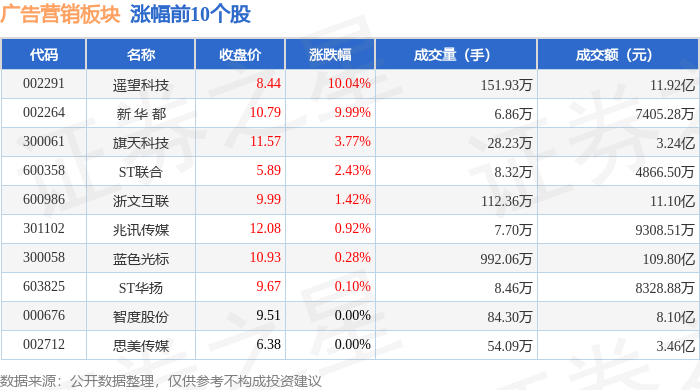
Market Overview - The advertising and marketing sector experienced a decline of 0.65% on November 26, with Xuan Ya International leading the drop [1] - The Shanghai Composite Index closed at 3864.18, down 0.15%, while the Shenzhen Component Index closed at 12907.83, up 1.02% [1] Stock Performance - Notable gainers in the advertising marketing sector included: - Yao Wang Technology (002291) with a closing price of 8.44, up 10.04% and a trading volume of 1.5193 million shares, totaling 1.192 billion yuan [1] - Xin Hua Du (002264) closed at 10.79, up 9.99% with a trading volume of 68,600 shares, totaling 74.0528 million yuan [1] - Major decliners included: - Xuan Ya International (300612) closed at 20.00, down 5.44% with a trading volume of 658,300 shares, totaling 1.406 billion yuan [2] - Fu Shi Holdings (300071) closed at 6.93, down 4.55% with a trading volume of 1.9716 million shares, totaling 1.397 billion yuan [2] Capital Flow - The advertising marketing sector saw a net outflow of 1.652 billion yuan from institutional investors, while retail investors contributed a net inflow of 1.967 billion yuan [2][3] - Specific stock capital flows included: - Yao Wang Technology (002291) had a net inflow of 19.11 million yuan from institutional investors, while retail investors had a net outflow of 31.34 million yuan [3] - Fen Zhong Media (002027) saw a net inflow of 22.03 million yuan from institutional investors and a net outflow of 11 million yuan from retail investors [3]


天下秀补缴税款及滞纳金2451.57万元
智通财经网· 2025-11-26 08:33
Core Viewpoint - The company, Tianxiaxiu (600556.SH), has conducted a self-inspection of its tax-related operations, resulting in the identification of tax payments and late fees totaling 24.5157 million yuan that need to be repaid due to misunderstandings regarding tax policy applicability [1] Tax Payment and Financial Impact - The company has completed the payment of the identified tax and late fees as of the announcement date, and this tax matter does not involve any administrative penalties [1] - The repayment of tax and late fees will be recorded in the subsidiary's financial results for the year 2025, which is expected to reduce the company's net profit for 2025 by approximately 23.8413 million yuan, accounting for 46.30% of the most recent audited net profit attributable to shareholders of the listed company [1]