
支付

Search documents
长期支付牌照再增1家
21世纪经济报道· 2025-12-08 08:17
Core Viewpoint - The article discusses the recent issuance of a long-term payment license to Chuanhua Payment Co., Ltd. by the People's Bank of China, highlighting its significance in the payment industry and the regulatory changes that support the growth of non-bank payment institutions [1][3][4]. Company Overview - Chuanhua Payment was established in April 2015 and has a history of compliance, initially created to assist in risk management for Zhejiang Yishi Enterprise Management Service Co., Ltd. [3]. - The company has transitioned from being a "risk disposal derived institution" to a recognized player in the payment industry, having obtained various payment qualifications before the recent regulatory changes [3][4]. Regulatory Changes - The People's Bank of China has shifted to a long-term license model for payment institutions, eliminating the previous five-year renewal cycle, which reduces uncertainty and preparation pressure for these companies [4][5]. - The first batch of institutions to receive long-term licenses included 13 companies, with some institutions exiting the market due to compliance issues and strategic adjustments [5]. Market Dynamics - The third quarter of 2025 saw significant growth in non-cash payment transactions, with 1,685.08 billion transactions amounting to 150.336 trillion yuan, indicating a recovery in consumer spending and digital payment acceleration [7]. - Electronic payment transactions were particularly strong, with 775.54 billion transactions worth 82.297 trillion yuan, showcasing the dominance of online payment methods [7][8]. Industry Trends - The rise of industry chain payments is a new highlight, with companies like China Telecom's Yipay reporting substantial growth in transaction volumes and partnerships [8][9]. - The integration of payment services with the real economy is deepening, as seen in initiatives that combine communication, consumption, and lifestyle services [9]. Future Outlook - The payment industry is expected to continue evolving, with QR code payments leading the small-value transaction market, while card payment services will remain essential in B2B and cross-border transactions despite ongoing pressures [10].


中国公司全球化周报|微信支付落地中东卡塔尔/美团Keeta正式上线巴西圣保罗
3 6 Ke· 2025-12-08 07:06
Key Points - 36Kr will cover the global stories of Chinese brands at CES 2026, following its previous coverage at IFA and GITEX GLOBAL in 2025 [2] - WeChat Pay has officially launched in Qatar through QNB, marking the first bank in the GCC to support this payment method, enhancing digital payment options for retailers [3] - Meituan Keeta has officially launched in eight cities in São Paulo, Brazil, as part of a five-year investment plan of 5.6 billion Brazilian Reais [3] - Shopee and Shein are the top overseas shopping platforms for Brazilian consumers, with 96% of them engaging in international shopping in the past year [4] - dLocal has introduced a new payment method combining biometrics with Pix payments in Brazil, allowing users to confirm payments via facial recognition or fingerprint scanning [4] - JD.com has acquired 85.2% of German retail group CECONOMY, aiming to accelerate localization in the European market [5] - Cainiao's eHub in Hong Kong has achieved 80% automation in its operations, becoming the most digitized air cargo hub in the region [5] - MAISEAT has launched a global app to enhance the cross-border ticket purchasing experience for users, supporting multiple languages and payment methods [6] - WuXi Biologics has signed a strategic cooperation memorandum to establish the first integrated CRDMO center in the Middle East [7] - Changan Automobile plans to launch its electric vehicle brands Avatr and Nevo in Europe within the next two years [7] - China Power Construction has signed multiple overseas projects in renewable energy and infrastructure across various countries [7] - UniXAI has completed a total of 300 million yuan in financing, achieving significant growth in robot deliveries [8] - Daimeng Robotics has secured new strategic financing to enhance its product development and global market expansion [8] - Suisheng Technology has raised millions in seed funding to develop AI recording hardware, with plans to launch its first product in 2026 [9] - The AI glasses market is seeing new entrants, with major players like Li Auto and Alibaba launching their products [10] - Over one-third of mobile marketers are currently investing in short drama advertisements, indicating a shift in global strategy among Chinese app developers [10]




传化支付长期牌照落地,支付行业开启 “提质竞速” 新周期
2 1 Shi Ji Jing Ji Bao Dao· 2025-12-08 03:58
Core Viewpoint - The People's Bank of China has issued a long-term payment license to Chuanhua Payment, marking it as the 14th payment institution to receive such a license, which allows for the operation of both Class I and Class II stored value accounts [1][3]. Group 1: Company Overview - Chuanhua Payment was established in April 2015 and has a history of compliance, initially created to assist in the risk management of Zhejiang Yishi Enterprise Management Service Co., Ltd. [3]. - The company has transitioned ownership, with its 100% stake sold for 315 million yuan to Shanghai Xunhui Information Technology Co., Ltd., reflecting the market's recognition of the value of payment licenses [3][4]. - The acquisition by Shanghai Xunhui is part of its strategy to enhance its global licensing matrix, allowing it to integrate cross-border funds and domestic scenarios effectively [4]. Group 2: Regulatory Changes - The new regulatory framework, effective from May 1, 2024, will replace the previous five-year renewal system with a long-term validity for payment licenses, aligning more closely with banking regulations [5]. - The first batch of long-term licenses included 13 payment institutions, with some institutions exiting the market due to compliance issues and strategic adjustments, highlighting a regulatory "survival of the fittest" approach [5]. Group 3: Industry Trends - In the third quarter, non-cash payment transactions in China reached 1,685.08 billion, with a total amount of 150.336 trillion yuan, indicating significant growth compared to the previous year [7]. - Electronic payment transactions were particularly strong, with 775.54 billion transactions amounting to 82.297 trillion yuan, showcasing the dominance of online payment methods [7][8]. - The rise of industry chain payments is noted as a new highlight, with companies like China Telecom's Yipay reporting substantial growth in transaction volumes and partnerships [8][9]. Group 4: Market Dynamics - The payment industry is experiencing structural differentiation, with traditional card payment methods declining while digital payment methods, especially QR code payments, continue to grow [9][10]. - The forecast indicates that QR code payments will maintain their dominance in the offline small payment market, while card payments will still hold importance in B2B and cross-border transactions despite ongoing pressures [10].

消费者吐槽“被套路”,免密支付如何平衡便捷与安全?
Xin Hua Wang· 2025-12-07 23:56
Core Viewpoint - The rise of automatic payment systems, while enhancing convenience, has led to consumer complaints regarding hidden fees and security risks associated with these services [1][2]. Group 1: Consumer Concerns - Consumers express frustration over automatic payment deductions, with reports of unauthorized charges and difficulty in disabling the feature [1]. - A specific case highlighted a consumer who was charged 17.9 yuan without clear consent, illustrating the lack of transparency in the authorization process [1]. - There are concerns about the potential for fraud, as demonstrated by a case where a consumer's account was hacked, leading to 162 unauthorized transactions totaling 80,868 yuan [1]. Group 2: Industry Response - The China Payment and Clearing Association has called for improved management of automatic payment authorizations to ensure user rights and informed consent [2]. - Analysts emphasize that while automatic payments can enhance transaction efficiency, they also require better risk management and user awareness to prevent disputes over unauthorized charges [2][3]. - Recommendations include making the option to disable automatic payments more accessible and implementing stronger fraud detection measures [2]. Group 3: Regulatory and Security Recommendations - There is a need for stricter regulatory oversight on risk management practices related to automatic payments, as current compliance is deemed insufficient [3]. - Consumers are advised to regularly review their authorization lists and prioritize using automatic payment features only with trusted applications [3]. - Collaboration between platforms and users is essential to achieve a balance between convenience and security in automatic payment systems [3].
科技周报|任正非最新发声;“支付宝崩了”登上热搜
Di Yi Cai Jing· 2025-12-07 04:01
Group 1: AI Development Insights - Ren Zhengfei emphasizes the importance of "application" over mere "invention" in AI development, suggesting that the current focus should be on practical applications that solve real-world problems [2] - He predicts a future of "excess computing power," indicating that the industry may be overheating and that the demand for AI solutions may not follow a linear structure [2] Group 2: Payment System Stability - Alipay experienced significant payment issues, affecting multiple platforms and leading to user concerns about transaction security [3] - The incident highlights the challenges in maintaining stability for major payment systems, which are critical for consumer trust and market order [3] Group 3: Aerospace and Rocket Technology - The Zhuque-3 rocket's first flight successfully completed its mission, but the recovery of its first stage failed, raising questions about the reliability of recovery technology in commercial spaceflight [4] - The focus for the domestic commercial aerospace industry should be on launching more satellites rather than solely on recovery technology [4] Group 4: Smartphone Market Dynamics - OnePlus launched the Ace 6T smartphone, integrating a self-developed gaming kernel into the SoC, marking a significant step in chip self-research for Chinese manufacturers [5] - The rising storage prices have pressured the pricing strategy for new products, indicating challenges in the supply chain [5] Group 5: Spatial Intelligence Services - Qianxun Position reported that its spatial intelligence service's monthly call volume surpassed one trillion, reflecting the growing demand for AI-driven spatial services across various devices [6][7] - This surge indicates a significant interaction frequency between AI agents and the real world, emphasizing the importance of spatial intelligence as a foundational infrastructure for AI [7] Group 6: Robotics Market Changes - Chinese brands have overtaken iRobot in the global vacuum cleaner market, with iRobot facing financial difficulties and a significant drop in market position [9] - iRobot's revenue for the first three quarters of 2025 was $375 million, a 26.47% decrease year-on-year, highlighting the competitive pressures in the robotics industry [9] Group 7: AI Implementation in Enterprises - The "2025 Feishu AI Efficiency Pioneer National Competition" showcased that ordinary employees from various industries are effectively using AI to solve practical problems, indicating a shift in digital transformation [11] - The competition reflects the potential for AI tools to empower frontline workers to innovate and create tailored solutions for their businesses [11] Group 8: Drone Technology Launch - Yingstone Innovation launched its first panoramic drone, the Antigravity A1, featuring advanced imaging capabilities but received a lukewarm market response [12] - The company's financials show a significant increase in R&D investment, which has impacted profitability despite revenue growth [12] Group 9: E-sports Industry Growth - The Chinese e-sports industry is projected to reach a scale of 29.33 billion yuan by 2025, with a year-on-year growth of 6.4% [13] - Live streaming remains the largest revenue source, accounting for 80.8% of total income, indicating the sector's reliance on this model for growth [13]
央行公布新一批支付牌照续展信息
Jin Rong Shi Bao· 2025-12-06 03:43
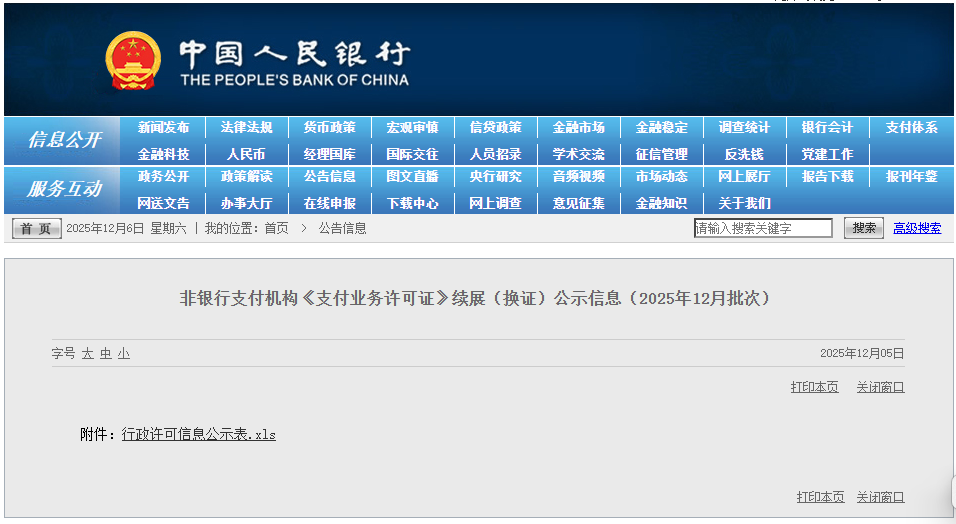
Core Viewpoint - The People's Bank of China has announced the renewal of the payment business license for non-bank payment institutions, with a focus on the long-term validity of licenses for companies like Transfar Pay [1][2]. Group 1: License Renewal - On December 5, the People's Bank of China published information regarding the renewal of payment business licenses for non-bank payment institutions, specifically for the batch of December 2025 [1]. - Transfar Pay, which obtained its payment license in December 2015, has received a "long-term valid" payment license, allowing it to operate both Class I and Class II stored value account services [3]. Group 2: Corporate Transactions - On March 31, 2025, Transfar Zhiliang (002010) approved a resolution to transfer 100% of its subsidiary Transfar Pay's shares to Shanghai Sunrate Information Technology Co., Ltd. for a price of 315 million yuan [3]. - Shanghai Sunrate, established in 2016, is a cross-border payment company that provides secure and efficient global payment and treasury management solutions for businesses in over 190 countries and regions [3].

支付机构业绩分化加剧,海外布局抢滩新增长
Guo Ji Jin Rong Bao· 2025-12-05 16:08
Core Insights - The performance of payment institutions in China shows significant divergence, with leading wallet providers experiencing strong profit recovery while domestic acquiring institutions face challenges [1][2][4] - Cross-border payment services have emerged as a key growth driver for many payment institutions amid intense competition and declining domestic business growth [1][5][7] Group 1: Performance Overview - Major wallet providers like WeChat Pay have reported high growth in profits due to increased commercial payment activities and consumer loan services [2] - The total transaction volume for non-bank payment institutions reached 85.28 trillion yuan in Q3, with a transaction count of 3,380.19 billion [2] - Companies like Lakala and JiaLian Pay reported declines in revenue and net profit, with Lakala's revenue down 7.32% to 4.068 billion yuan and net profit down 33.90% to 339 million yuan [2][3] Group 2: Cross-Border Payment Growth - Cross-border payment volumes have significantly increased, with Lakala reporting a 71.91% growth in merchant scale and a 77.56% increase in transaction amounts [5] - YiPay's cross-border payment transactions exceeded 270 billion yuan, marking a growth of over 35% [5] - Companies like Newland and Highsun Technology have also reported substantial growth in their overseas payment services, with Newland's overseas payment device revenue increasing by over 26% [5][6] Group 3: Challenges and Market Dynamics - The overall performance of payment institutions is under pressure due to stricter compliance regulations, leading to a decline in transaction volumes and profitability [4][7] - Increased competition in domestic payment fees has resulted in reduced profit margins for many institutions, with traditional card payment services facing significant declines [4][7] - The need for payment institutions to diversify their revenue streams and enhance their overseas service capabilities is becoming increasingly critical [6][7]

支付机构业绩分化加剧 海外布局抢滩新增长
Guo Ji Jin Rong Bao· 2025-12-05 16:08
Core Insights - The performance of payment institutions in the third quarter shows a significant divergence, with leading wallet providers experiencing strong profit recovery, while domestic acquiring institutions face challenges with declining revenues and profits [1][2][3]. Group 1: Performance Overview - Major wallet institutions like WeChat Pay have benefited from the growth in the domestic non-bank payment sector, leading to a recovery in profits [1]. - In contrast, companies like Lakala and JiaLian Pay reported declines in both revenue and net profit for the first three quarters, with Lakala's revenue down 7.32% to 4.068 billion yuan and net profit down 33.90% to 339 million yuan [2][3]. - The overall transaction volume for non-bank payment institutions increased, with 3.38 trillion transactions amounting to 85.28 trillion yuan in Q3, compared to 3.33 trillion transactions and 82.11 trillion yuan in Q2 [2]. Group 2: Cross-Border Payment Growth - Cross-border payment services have emerged as a key growth driver for many payment institutions, with significant increases in transaction volumes and merchant numbers [1][6]. - Lakala reported a 602 billion yuan cross-border payment volume, with merchant scale and transaction amounts growing by 71.91% and 77.56% respectively [6]. - Newland's overseas payment device revenue grew over 26%, indicating successful expansion into emerging markets [6]. Group 3: Challenges and Market Dynamics - The overall performance of payment institutions is under pressure due to stricter compliance regulations, leading to a decline in transaction volumes and increased operational costs [4][5]. - Analysts highlight that the decline in traditional card acquiring business is a core issue, compounded by intensified competition and a shrinking profit margin [4][5]. - The need for diversification in revenue streams and the slow development of new technology services are also noted as significant challenges for many institutions [5]. Group 4: Strategic Recommendations - Experts suggest that payment institutions should focus on overseas expansion as a necessary strategy to counteract domestic growth stagnation, with cross-border payment services expected to offer higher profit margins [7][8]. - Institutions are advised to pay close attention to local regulations and market characteristics when entering new regions, emphasizing the importance of compliance and local partnerships [7][8]. - The potential risks associated with overseas operations, including regulatory compliance and geopolitical factors, must be carefully managed to ensure sustainable growth [8].
嘉联支付被罚141万元:违反商户管理规定 违反清算管理规定
Xin Lang Cai Jing· 2025-12-05 13:30
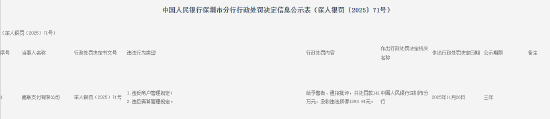
12月5日金融一线消息,据中国人民银行深圳市分行行政处罚决定信息公示表显示,嘉联支付有限公司 因违反商户管理规定、违反清算管理规定,被给予警告、通报批评,并处罚款141万元,没收违法所得 1293.91元。 | | 中国人民银行保增市分行在改处罚决定信息公示表《深入提罚〔2025〕71号》 | | | | --- | --- | --- | --- | | 《国人假日(20053)11年) | | | | | 使命之間求 安廷 | 行建处罚史图书文章 语法行为实日 行政处罚为官 | | 作出行管处罚走变频频 卡进行政策划大航回财 公司相談 管法 北体 | | 展职员材用禁以用 | 區人銀行 (2005) 71号 | 1. 连折机户管理规定! ■ 用它使其面積投出 = | 40万参直 - 退快批评 - 共徒罚款HL 中国人民银行城 昨天20:58 11,月00日 三球 万元 金零油进货量1281 H元= 行 | 12月5日金融一线消息,据中国人民银行深圳市分行行政处罚决定信息公示表显示,嘉联支付有限公司 因违反商户管理规定、违反清算管理规定,被给予警告、通报批评,并处罚款141万元,没收违法所得 1293.91 ...
七部门发布《关于防范涉虚拟货币等非法活动的风险提示》
智通财经网· 2025-12-05 12:31
Core Viewpoint - The Chinese Internet Finance Association and six other departments issued a risk warning regarding virtual currencies and related illegal activities, emphasizing that member units must not engage in or provide services for virtual currency and real-world asset token issuance and trading within China [1][2]. Group 1: Nature of Virtual Currencies and Related Activities - Virtual currencies are not issued by monetary authorities and do not have the same legal status as legal tender in China, making them illegal for circulation [2]. - Certain virtual currencies, such as π coins, lack substantial technological innovation and clear commercial applications, leading to significant fraud and market manipulation risks [2]. - Stablecoins currently do not meet customer identification and anti-money laundering requirements, posing risks of being used for money laundering and fraudulent fundraising [2]. - The tokenization of real-world assets carries multiple risks, including false asset risks and speculative trading risks, with no approved activities in this area by Chinese financial authorities [2]. Group 2: Prohibitions on Financial Institutions - Member units are prohibited from participating in the issuance and trading of virtual currencies and real-world asset tokens within China [4]. - Banks and payment institutions must not provide any financial services or credit support to virtual currency mining enterprises and projects [4]. - Securities, fund, and futures institutions are also barred from offering services related to the issuance and trading of virtual currencies and real-world asset tokens [4]. Group 3: Public Awareness and Precautions - The public is urged to be vigilant against various forms of virtual currency and real-world asset token activities, which are often associated with speculation and fraud [5]. - Individuals should enhance their risk awareness and avoid participating in virtual currency and real-world asset token activities to protect their finances [5][6]. - Any suspicious activities related to virtual currencies should be reported to regulatory authorities, and individuals should refrain from engaging with promotional materials that suggest historical returns or speculative prospects [6].