养殖业

Search documents
温氏股份猪价下跌三季度净利降65% 财务改善有息负债少49亿拟加倍分红
Chang Jiang Shang Bao· 2025-10-24 00:12
Core Viewpoint - The aquaculture industry remains under pressure, with leading company Wens Foodstuff Group experiencing significant declines in performance due to falling product prices and ongoing low market conditions [1][5]. Financial Performance - For the first three quarters of 2025, Wens Foodstuff Group reported revenue of 75.888 billion yuan, a slight decrease of 0.03% year-on-year; net profit attributable to shareholders was 5.256 billion yuan, down 18.29% year-on-year; and net profit excluding non-recurring items was 4.889 billion yuan, down 24.60% year-on-year [1][5]. - In Q3 2025, the company achieved a net profit of 1.781 billion yuan, reflecting a dramatic decline of approximately 65% year-on-year [2]. - The company's operating cash flow also saw a significant decline, with a net cash flow of 8.199 billion yuan for the first three quarters, down 34.79% year-on-year [3][12]. Price and Sales Dynamics - The decline in net profit is primarily attributed to falling prices of main products, particularly pork, despite an increase in sales volume [7][9]. - In Q3 2025, Wens sold 3.2457 million pigs and 3.3253 million pigs in August and September, respectively, marking year-on-year increases of 37.88% and 32.46%. However, the average selling price for pork dropped significantly, with prices of 13.90 yuan/kg and 13.18 yuan/kg in August and September, down 32.03% and 30.81% year-on-year [7]. Cost Management - The company managed to reduce management expenses by over 900 million yuan, with management expenses totaling 2.811 billion yuan for the first three quarters, a decrease of approximately 24.41% year-on-year [11][12]. - Sales expenses increased slightly to 715 million yuan, up 8.83% year-on-year [11]. Financial Health - Wens Foodstuff Group's financial condition improved, with a debt-to-asset ratio of 49.41% as of September 30, 2025, down 3.73 percentage points from the beginning of the year [3][13]. - Interest-bearing debt decreased significantly to 15.253 billion yuan, down over 4.9 billion yuan from the end of the previous year [3][13]. - The company proposed a cash dividend of approximately 2 billion yuan for the first three quarters, doubling the amount from the previous year [4][13]. Market Performance - Despite the financial improvements, Wens Foodstuff Group's stock performance has been below expectations, with a price increase of only 9.75% from the beginning of 2025 to October 23, 2025 [14].

四川达州市培育新农人带旺乡村产业 新农人更是“兴农人”
Ren Min Ri Bao· 2025-10-23 21:57
Core Insights - The article highlights the success of local agricultural initiatives in Dazhou, Sichuan, particularly focusing on the cultivation of the old courtyard black chicken and the innovative approaches taken by local farmers to enhance income and community development [2][3]. Group 1: Agricultural Development - The old courtyard black chicken has become a significant source of income for local farmers, with one entrepreneur achieving annual sales exceeding 30 million yuan [2]. - A development model called "Five Unifications and Individual Farming" has been implemented, benefiting over 300 households with an average annual income increase of over 4,000 yuan [2]. - The establishment of various agricultural research platforms has led to the development of over 10 organic tea products, with market demand outstripping supply [2]. Group 2: Talent and Innovation - Dazhou is actively cultivating new farmers, with over 1,200 individuals working to boost local industries and improve the livelihoods of their communities [2]. - The "One Village, One CEO" initiative in Dazhu County aims to attract talented individuals to lead rural development, with successful candidates receiving up to 10% of village collective income [3]. - The integration of agriculture with cultural and tourism development is being promoted, as seen in the collaboration between Guozi Village and a technology company to revitalize local resources and attract tourists [3].
温氏股份(300498):主营业务稳健运营,成本持续改善:——温氏股份(300498):2025三季报点评报告
Guohai Securities· 2025-10-23 13:35
Investment Rating - The report maintains a "Buy" rating for the company [1][8]. Core Insights - The company's main business operates steadily, with continuous cost improvements. In the first three quarters of 2025, the company achieved operating revenue of 758.17 billion yuan, a year-on-year increase of 0.53%, while the net profit attributable to shareholders was 52.56 billion yuan, a year-on-year decrease of 17.98% [4][6]. - The decline in net profit is primarily due to the decrease in the prices of main products, which has reduced the operating profit of the breeding industry. By the end of the third quarter, the company's debt ratio decreased to 49.41%, indicating improved financial stability and risk resistance [6][8]. Summary by Sections Financial Performance - In Q3 2025, the company reported operating revenue of 259.42 billion yuan, a year-on-year decrease of 9.49%, and a net profit of 17.81 billion yuan, down 64.94% year-on-year [4][6]. - The company has seen a significant reduction in breeding costs, with piglet production costs dropping to around 260 yuan per head and a meat pig market rate of approximately 93% [6]. Earnings Forecast - The company is expected to achieve revenues of 969.72 billion yuan, 1,017.67 billion yuan, and 1,112.12 billion yuan for the years 2025, 2026, and 2027, respectively. The net profit attributable to shareholders is projected to be 50.06 billion yuan, 90.97 billion yuan, and 179.73 billion yuan for the same years [6][8]. - The corresponding price-to-earnings ratios (PE) are expected to be 24, 13, and 7 times for 2025, 2026, and 2027, respectively, indicating a favorable long-term outlook for the company [6][8].
圣农发展(002299):主营业务稳步发展,渠道结构不断优化:——圣农发展(002299):2025三季报点评报告
Guohai Securities· 2025-10-23 13:35
Investment Rating - The investment rating for the company is "Buy" (maintained) [1] Core Insights - The company's main business is steadily growing, with a revenue of 14.706 billion yuan for the first three quarters of 2025, representing a year-on-year increase of 6.86%. The net profit attributable to the parent company reached 1.159 billion yuan, a significant year-on-year increase of 202.82% [4][6] - In the third quarter alone, the company achieved a revenue of 5.849 billion yuan, up 18.77% year-on-year, while the net profit attributable to the parent company was 249 million yuan, down 11.40% year-on-year [4][6] - The company is optimizing its cost structure through the use of its self-developed breed "Shengze 901Plus," which has improved key indicators such as feed-to-meat ratio, leading to a continuous decline in costs [6] - The company is implementing a full-channel strategy, with significant growth in retail channels (over 30% year-on-year) and export channels (over 40% year-on-year) [6] Summary by Sections Financial Performance - For the first three quarters of 2025, the company reported a revenue of 14.706 billion yuan and a net profit of 1.159 billion yuan, with a notable increase in revenue and profit compared to the previous year [4][6] - The third quarter's revenue was 5.849 billion yuan, with a year-on-year growth of 18.77%, while the net profit was 249 million yuan, reflecting a decrease compared to the same period last year [4][6] Business Strategy - The company is focusing on optimizing its channel structure, with a clear division into three major channels: large B channel, retail C-end channel, and distribution channel [6] - The C-end retail channel has seen a growth of over 30% year-on-year, while the export channel has grown by over 40%, indicating a successful strategy in expanding market share [6] Profitability Forecast - The company is expected to achieve revenues of 20.028 billion yuan, 22.337 billion yuan, and 25.214 billion yuan for the years 2025, 2026, and 2027 respectively, with net profits projected at 1.503 billion yuan, 1.581 billion yuan, and 1.941 billion yuan [8][9] - The corresponding price-to-earnings ratios are estimated to be 13, 13, and 10 for the years 2025, 2026, and 2027, respectively, suggesting an improvement in profitability as demand recovers [6][9]

晓鸣股份:10月23日召开董事会会议
Mei Ri Jing Ji Xin Wen· 2025-10-23 08:45
每经AI快讯,晓鸣股份(SZ 300967,收盘价:21.86元)10月23日晚间发布公告称,公司第五届第二十 二次董事会会议于2025年10月23日在公司会议室以现场结合通讯表决的方式召开。会议审议了《关于公 司<2025年第三季度报告>的议案》等文件。 2024年1至12月份,晓鸣股份的营业收入构成为:养殖业占比99.96%,其他业务占比0.04%。 每经头条(nbdtoutiao)——四次登上央视,知名大佬"消失"5年,我们在水果仓库找到了他!从月薪 5000到千亿市值公司联席总裁,他45岁再创业 (记者 曾健辉) 截至发稿,晓鸣股份市值为41亿元。 ...
养殖业板块10月23日涨0.28%,晓鸣股份领涨,主力资金净流入2581.03万元
Zheng Xing Xing Ye Ri Bao· 2025-10-23 08:14
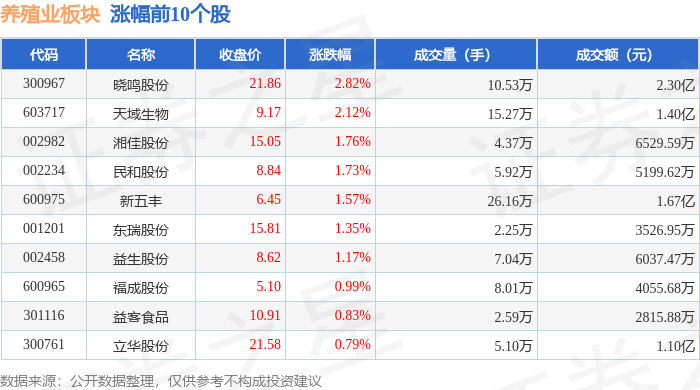
Core Insights - The aquaculture sector experienced a slight increase of 0.28% on October 23, with Xiaoming Co. leading the gains [1] - The Shanghai Composite Index closed at 3922.41, up 0.22%, while the Shenzhen Component Index closed at 13025.45, also up 0.22% [1] Aquaculture Sector Performance - Xiaoming Co. (300967) closed at 21.86, up 2.82% with a trading volume of 105,300 shares and a transaction value of 230 million [1] - Tianyu Biological (603717) closed at 9.17, up 2.12% with a trading volume of 152,700 shares and a transaction value of 140 million [1] - Other notable performers include Xiangjia Co. (002982) up 1.76%, Minhe Co. (002234) up 1.73%, and Xinwufeng (600975) up 1.57% [1] Capital Flow Analysis - The aquaculture sector saw a net inflow of 25.81 million from institutional investors, while retail investors contributed a net inflow of 4.57 million [2] - Major stocks like Jingji Zhino (000048) experienced a significant net outflow of 29.90 million from speculative funds [3] - Muyu Co. (002714) had a net inflow of 43.02 million from institutional investors, but also saw a net outflow of 26.25 million from speculative funds [3]



温氏股份(300498):公司信息更新报告:生猪出栏稳增肉鸡盈利修复,高分红投资价值显现
KAIYUAN SECURITIES· 2025-10-23 07:41
Investment Rating - The investment rating for the company is "Buy" (maintained) [1] Core Views - The company has shown steady growth in pig production and recovery in chicken profitability, highlighting its high dividend investment value [1][5][6] Financial Performance Summary - For the first three quarters of 2025, the company achieved revenue of 75.817 billion yuan (year-on-year -0.04%) and a net profit attributable to shareholders of 5.256 billion yuan (year-on-year -18.29%). In Q3 alone, revenue was 25.937 billion yuan (year-on-year -9.76%) with a net profit of 1.781 billion yuan (year-on-year -65.02%) [1][4] - The company’s pig output reached 27.668 million heads in the first three quarters of 2025 (year-on-year +28.32%), with Q3 output at 9.736 million heads (year-on-year +35.45%) [5] - The average cost of pig production in Q3 2025 was 12.4 yuan/kg (down 2.4 yuan/kg year-on-year), with a further reduction to 12.2 yuan/kg by the end of September [5] - Chicken sales for the first three quarters of 2025 totaled 948 million birds (year-on-year +8.90%), with Q3 sales at 350 million birds (year-on-year +8.44%) [6] - The company plans to distribute cash dividends of 1.99 billion yuan (including tax), accounting for 38% of the net profit attributable to shareholders for the first three quarters [6] Earnings Forecast - The company’s net profit forecasts for 2025-2027 are adjusted to 6.690 billion yuan, 11.965 billion yuan, and 16.275 billion yuan respectively, with corresponding EPS of 1.01 yuan, 1.80 yuan, and 2.45 yuan [1][4]
圣农发展(002299):公司信息更新报告:销量稳增发力C端,高分红彰显投资价值
KAIYUAN SECURITIES· 2025-10-23 06:13
Investment Rating - The investment rating for the company is "Buy" (maintained) [1] Core Insights - The company has shown steady growth in sales, particularly in the consumer segment, and high dividends reflect its investment value. The Q1-Q3 2025 revenue reached 14.706 billion yuan, a year-on-year increase of 6.86%, while the net profit attributable to shareholders was 1.159 billion yuan, up 202.82% year-on-year. In Q3 alone, revenue was 5.849 billion yuan, a year-on-year increase of 18.77%, but net profit decreased by 11.40% [4][5] - The company is expected to maintain its profit forecast, with projected net profits for 2025-2027 at 1.335 billion, 1.564 billion, and 1.740 billion yuan, respectively, corresponding to EPS of 1.07, 1.26, and 1.40 yuan. The current stock price corresponds to P/E ratios of 15.1, 12.8, and 11.5 times for the respective years [4][5] Sales and Revenue Growth - In the poultry farming and processing business, the company sold 1.0986 million tons of chicken in Q1-Q3 2025, a year-on-year increase of 7.4%, with sales revenue of 10.522 billion yuan, up 4.1%. The average selling price was approximately 9,577.64 yuan per ton, down 3.1% year-on-year. The company has seen steady growth in chicken sales and a decrease in breeding costs [5] - In the food processing segment, the company sold 357,600 tons of meat products, a year-on-year increase of 33.8%, with sales revenue of 6.911 billion yuan, up 17.1%. The average selling price was about 19,326.06 yuan per ton, down 12.5% year-on-year. The growth in sales volume has driven revenue expansion, with retail consumer and export channels maintaining rapid growth [5] Financial Performance and Dividend Policy - As of the end of September 2025, the company's debt-to-asset ratio was 51.58%, a decrease of 1.21 percentage points year-on-year, and cash and cash equivalents amounted to 1.845 billion yuan, an increase of 73.20% year-on-year. The company announced a profit distribution plan for the first three quarters of 2025, expecting to distribute cash dividends of 371 million yuan (including tax), accounting for 32% of the profit for the period [6] - The financial situation of the company has improved, and the high dividends reflect its investment value [6] Financial Summary and Valuation Metrics - The company's projected revenue and net profit for 2025 are 20.138 billion yuan and 1.335 billion yuan, respectively, with a year-on-year growth of 8.4% and 84.3%. The gross margin is expected to be 12.0%, and the net margin is projected at 6.6% [7] - Key financial ratios include a P/E ratio of 15.1 for 2025, decreasing to 11.5 by 2027, and a P/B ratio of 1.7 for 2025, decreasing to 1.4 by 2027 [7]
温氏股份(300498):成本优势稳固稳健发展,肉猪盈利收窄
CAITONG SECURITIES· 2025-10-22 11:53
Investment Rating - The investment rating for the company is "Accumulate" (maintained) [2] Core Views - The company reported a slight decline in revenue of 0.04% year-on-year for the first three quarters of 2025, with a net profit decrease of 18.29% [8] - The company is a leading player in the pig and yellow feather chicken breeding industry, with a focus on quality improvement and sustainable development [8] - The forecasted net profit for the company is expected to be 7.30 billion, 9.72 billion, and 12.27 billion yuan for 2025, 2026, and 2027 respectively, with corresponding PE ratios of 16.7, 12.5, and 9.9 [8] Financial Performance Summary - For 2023A, the company reported a revenue of 89,902 million yuan, with a growth rate of 7.4% [7] - The net profit for 2023A was -6,390 million yuan, reflecting a net profit growth rate of -220.8% [7] - The company’s earnings per share (EPS) for 2023A was -0.97 yuan [7] - The company’s total assets as of 2023A were 92,895 million yuan, with a debt-to-equity ratio of 159.1% [9] Operational Highlights - The company’s pig output increased by 28.3% year-on-year to 27.67 million heads in the first three quarters of 2025 [8] - The average selling price of pork in the third quarter was approximately 13.9 yuan/kg, down 28.8% year-on-year [8] - The company’s capital expenditure has decreased, and it continues to improve its balance sheet, with a debt ratio of 49.41% as of Q3 2025, down 3.73 percentage points from the beginning of the year [8] Market Trends - The demand for yellow feather chicken has improved, leading to a rebound in chicken prices, which helped the chicken business turn profitable in the third quarter [8] - The company sold 94.80 million yellow chickens in the first three quarters of 2025, an increase of 8.7% year-on-year [8]
(乡村行·看振兴)河南南阳:特色产业撑起县域经济“脊梁”
Zhong Guo Xin Wen Wang· 2025-10-22 09:33
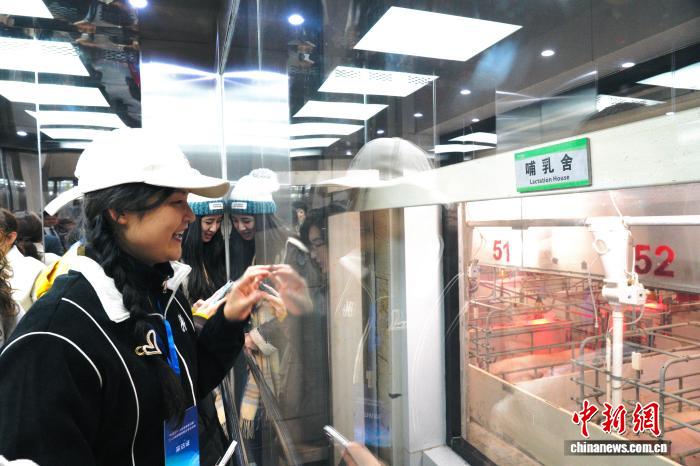
Core Insights - Nanyang's county economy has achieved a GDP of over 175.3 billion RMB in the first half of the year, contributing nearly 75% to the city's economic growth [1] Group 1: Smart Agriculture - The smart farming model at the Muyuan Food Industry Complex in Nanyang utilizes advanced technologies such as big data, 5G, and AI, significantly enhancing production efficiency [2] - The company has established a team of over 1,000 for smart technology development, creating over 30 types of intelligent equipment that cover the entire production process [2] - By the end of 2024, the company aims to service 4.7208 million acres of farmland, increasing farmers' income by 1.35 billion RMB [2] Group 2: Traditional Chinese Medicine (TCM) - Nanyang, known for its rich TCM culture and resources, has over 30 types of established medicinal materials, making it a significant area for TCM development [5] - The Zhang Zhongjing statue at the Medicinal Herb Garden symbolizes the region's deep-rooted TCM heritage, with the company cultivating 200,000 acres of specific medicinal plants [5][6] - The company has integrated modern technology with traditional practices, producing over 500 types of TCM products and enhancing the quality control process [5] Group 3: Rural Revitalization through Specialty Industries - The development of specialty industries such as kiwi fruit and mushrooms has transformed previously idle land into productive agricultural areas, significantly increasing local farmers' incomes [7][8] - Nanyang has established four major industry corridors focusing on mushrooms, fruits, medicine, and tourism, contributing to a robust county economy [8] - The mushroom industry alone has a stable annual scale of around 300 million bags, generating a comprehensive benefit of 26 billion RMB annually [8]