核聚变能源

Search documents
中国聚变能源公司挂牌,可控核聚变概念放量上涨,商业化落地提速丨行业风口
2 1 Shi Ji Jing Ji Bao Dao· 2025-07-23 11:13
Core Points - China Fusion Energy Co., Ltd. was officially established on July 22, marking a significant step in the country's nuclear fusion industry [2] - The first domestic linear fusion device, HHMAX-901, successfully achieved plasma ignition on July 18, indicating a major breakthrough in commercial nuclear fusion technology [5][6] - The nuclear fusion sector saw a notable increase in stock prices, with several concept stocks reaching their daily limit on July 23 [3] Group 1 - China Fusion Energy Co., Ltd. is a subsidiary of China National Nuclear Corporation (CNNC) and will focus on overall design, technology verification, and digital R&D [2] - The company secured an investment of approximately 11.492 billion yuan from CNNC, China Nuclear Power, and Zhejiang Energy Power [2] - The establishment of the company aims to promote the engineering and commercialization of nuclear fusion technology, often referred to as "artificial sun" [2] Group 2 - The HHMAX-901 device's successful plasma ignition is a significant milestone in the commercialization of nuclear fusion, particularly in the field of linear field-reversed configuration (FRC) technology [5][6] - The device's development began in June 2024, with the physical design starting in August, and it has undergone multiple design iterations before reaching the construction phase [7] - The successful ignition indicates readiness for subsequent experimental phases and accelerates the development of new nuclear fusion technologies [7] Group 3 - The nuclear fusion concept stocks experienced a "five consecutive days of increase," with a total increase of 5.74% as of July 23 [3] - Key stocks in the sector, such as Dongfang Electric, Xue Ren Group, and Guoji Heavy Industry, reached their daily limit on July 23 [3] - Analysts suggest continued attention to the nuclear fusion industry as it accelerates towards commercialization [7]

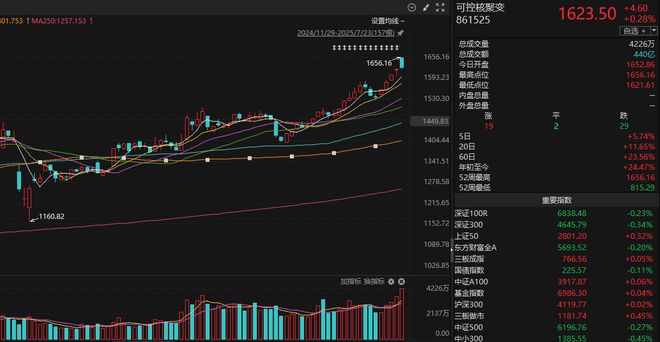
一图看懂 | 聚变能源公司概念股
市值风云· 2025-07-23 10:14
Core Viewpoint - China's investment in controllable nuclear fusion projects has reached a total scale of 136.2 billion yuan, with the next 3-5 years being a critical bidding window for infrastructure construction [1][7]. Group 1: Investment Background - As of July 22, 2025, China Nuclear Power (601985.SH) announced a planned investment of 1 billion yuan to acquire a 6.65% stake in China Fusion Energy Co., marking an acceleration in the commercialization of nuclear fusion in China [4][7]. - Zhejiang Energy Power (600023.SH) also announced an investment of 751 million yuan for a 5% stake in the same company, further indicating the momentum in the nuclear fusion sector [4][13]. - Currently, there are 14 major controllable nuclear fusion projects under construction in China, with a total investment scale of 136.2 billion yuan [1][7]. Group 2: Key Participants - China Nuclear Power is a core participant, investing 1 billion yuan and holding a 6.65% stake in China Fusion Energy Co., which is under the China National Nuclear Corporation [11][12]. - Zhejiang Energy Power, as a traditional power enterprise, is leveraging its background to promote the commercialization of fusion technology through its 751 million yuan investment [14]. - West Superconducting Technologies (688122) is the only domestic supplier of low-temperature superconducting wire for the ITER project, breaking international monopolies in this technology [15][16]. Group 3: Strategic Significance - The investments by state-owned enterprises respond to national strategic requirements for future industries and aim to solidify their core positions in the nuclear fusion sector [12][14]. - The focus on nuclear fusion aligns with the country's energy transition goals, emphasizing the importance of clean energy development [14].


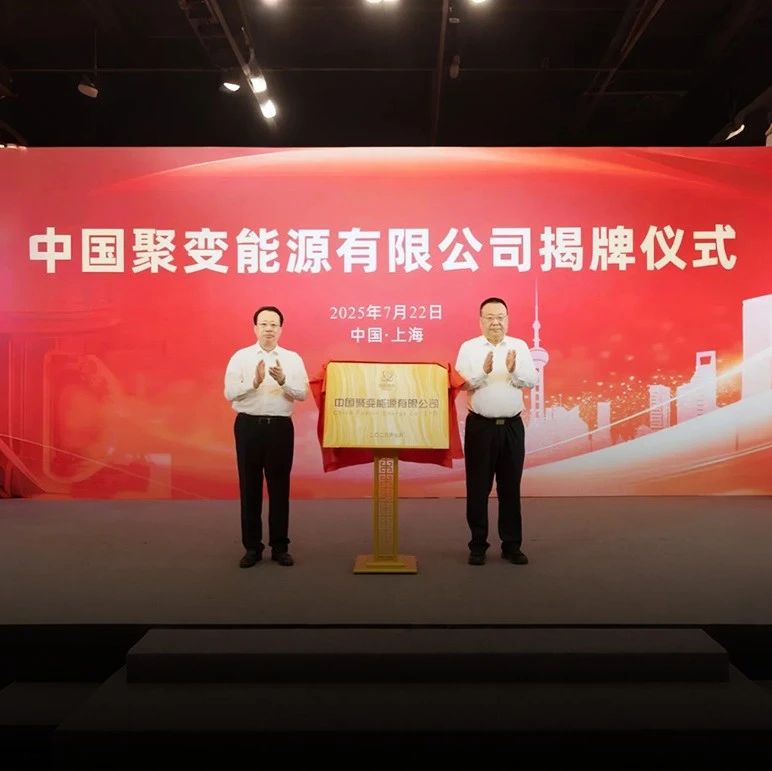
115亿,今年上海最大融资诞生
投资界· 2025-07-23 07:48
Core Viewpoint - The establishment of China Fusion Energy Co., Ltd. marks a significant step towards commercializing nuclear fusion energy, with substantial backing from major investors totaling 11.49 billion yuan [2][4][5]. Group 1: Company Overview - China Fusion Energy Co., Ltd. was officially established on July 22, 2023, in Shanghai, with a mission to achieve commercial application of fusion energy, often referred to as "artificial sun" [2][4]. - The company is backed by seven major investors, including China National Nuclear Corporation and China Nuclear Power, indicating strong institutional support [4][6]. - The company aims to develop fusion energy through a phased approach involving pilot experimental reactors, demonstration reactors, and commercial reactors [4][10]. Group 2: Investment Details - The total investment of 11.49 billion yuan positions China Fusion Energy Co., Ltd. as a new unicorn in Shanghai, with a valuation exceeding 10 billion yuan [4][5]. - Major investors include China National Nuclear Corporation (40.29 billion yuan), China Nuclear Power (10 billion yuan), and Kunlun Capital (30 billion yuan), among others [5][6]. - The investment reflects a strategic move by these companies to capitalize on the potential of nuclear fusion as a future energy source [6][11]. Group 3: Industry Context - Nuclear fusion is seen as a "ultimate energy" source due to its potential for zero-cost, zero-pollution, and unlimited availability, which could revolutionize human production and lifestyle [9][10]. - The global interest in nuclear fusion is growing, with several companies in China, such as NeoFusion and Energy Singularity, also securing significant funding for fusion technology [9][10]. - Shanghai is positioning itself as a hub for future industries, with a focus on innovative technologies, including nuclear energy, supported by government initiatives and funding [10][11].

中国聚变商业化进程加速
Sou Hu Cai Jing· 2025-07-23 03:52
Core Insights - Nuclear fusion is regarded as the "ultimate energy" solution due to its nearly limitless fuel reserves and zero carbon emissions, with China making significant advancements in technology and commercialization in recent years [2][4]. Group 1: Technological Breakthroughs - China's nuclear fusion research has evolved since the 1950s, entering a phase of intensive output, with the EAST device achieving a world record of 1.2 million degrees Celsius for 101 seconds in 2021 [4]. - In 2023, the HL-3 device achieved high confinement mode operation under a plasma current of 1 million amperes, marking a transition from "catching up" to "keeping pace" in controllable nuclear fusion [4]. - Key challenges for commercializing fusion energy include high-temperature plasma confinement, radiation-resistant materials, and tritium self-sustaining cycles, with substantial progress made in the first two areas [4][5]. Group 2: Industry Landscape - The Chinese fusion industry is rapidly forming, supported by national funding and clear policy direction encouraging private capital participation [5]. - The Energy Bureau's 2023 guidelines aim to establish a fusion demonstration reactor by 2030 and achieve commercialization by 2050, integrating fusion into the new energy system [5]. - Over 20 domestic companies are involved in the fusion sector, focusing on core component manufacturing such as superconducting magnets and vacuum chambers [5]. Group 3: Innovation Ecosystem - A new innovation ecosystem is emerging in China characterized by government guidance, enterprise leadership, and capital support, which is seen as a model for global reference [5]. - China is actively participating in the ITER project, contributing 10% of procurement tasks, while also advancing its own technology through the CFETR project, which is in the engineering design phase [6]. Group 4: Future Outlook - Despite challenges such as high startup costs and the need for a tritium supply chain, the industry anticipates that fusion power generation costs could drop below 0.3 yuan per kilowatt-hour after 2035, making it competitive in the market [6]. - The commercialization of fusion energy is crucial for national energy security and reflects humanity's aspirations for a cleaner future, with China making steady progress towards realizing this vision [6].

官宣!“中国聚变公司”成立,多股涨停!
第一财经· 2025-07-23 03:38
Core Viewpoint - The controllable nuclear fusion sector is experiencing significant activity, driven by the establishment of the China Fusion Energy Company and various collaborative agreements with key industry players [1][2]. Group 1: Industry Developments - On July 22, the China Fusion Energy Company was officially established as a subsidiary of the China National Nuclear Corporation, focusing on the engineering and commercialization of fusion technology [1]. - The company aims to develop overall design, technology verification, and digital research, while also creating a technology research platform and a capital operation platform [1]. - Collaborative agreements were signed with Shanghai Jiao Tong University and several major companies, indicating a strong push for innovation and partnership in the fusion energy sector [1]. Group 2: Market Trends - According to CITIC Construction Investment, the controllable nuclear fusion industry in China is entering a rapid development phase due to ongoing technological breakthroughs, project financing, and increased policy attention [2]. - The acceleration of project bidding and procurement is expected to positively impact the industry chain [2]. - Companies involved in the Tokamak technology route are recommended for investment, particularly those in superconducting materials, magnetic components, and power systems [2].

纳斯达克中国金龙指数收涨1.7%;外汇局探索本外币一体化管理,实现“一套规则、一站办理”——《投资早参》
Mei Ri Jing Ji Xin Wen· 2025-07-22 23:58
Market News - The US stock market closed mixed, with the Dow Jones up 0.4%, the Nasdaq down 0.39%, and the S&P 500 up 0.06% [1] - Major tech stocks showed varied performance, with Tesla rising over 1% and Nvidia and Broadcom falling over 2% and 3% respectively [1] - COMEX gold futures rose by 1.1% to $3444 per ounce, while WTI crude oil futures fell by 1.47% to $66.21 per barrel [1] - The Nasdaq China Golden Dragon Index increased by 1.7%, with notable gains in popular Chinese stocks such as NIO up over 10% and Baidu up over 4% [1] Industry Insights - The State Administration of Foreign Exchange (SAFE) is exploring integrated management of domestic and foreign currencies, aiming for a "one set of rules, one-stop service" approach to streamline cross-border transactions [2] - The establishment of China Fusion Energy Company in Shanghai, with a total investment of approximately 11.49 billion yuan, marks a significant step in the commercialization of nuclear fusion energy [3] - The upcoming press conference on Hainan Free Trade Port is expected to release positive policy signals regarding customs operations and industry support, which could significantly boost the regional economy [4][5] Stock Movements - Zhongzhou Special Materials announced that a shareholder plans to reduce its stake by up to 1.76% within three months [6] - Weisi Medical reported that a major shareholder intends to reduce its holdings by up to 3% [6] - Several companies, including Guizhou Gas and Yuantong Biological, have announced plans for share reductions by their major shareholders [6][7]
雅江集团后,又一“能源巨无霸”国家队企业挂牌成立
Xuan Gu Bao· 2025-07-22 23:29
Group 1 - China Fusion Energy Co., Ltd. was established on July 22, with a focus on nuclear fusion energy [1] - China National Nuclear Power plans to invest 1 billion yuan for a 6.65% stake in China Fusion Energy Co., Ltd. [1] - Zhejiang Energy Power intends to invest 751 million yuan for a 5% stake in the same company, contributing to a total investment of approximately 11.49 billion yuan from multiple entities [2] Group 2 - The global landscape for controllable nuclear fusion technology is diverse, with significant developments in Tokamak and FRC technology routes [2] - Major companies like Google and Microsoft are engaging in agreements to purchase fusion energy, indicating a growing interest in this sector [2] - The Chinese Academy of Sciences and China National Nuclear Corporation are focusing on Tokamak technology for their fusion projects [2] Group 3 - Breakthroughs in Tokamak technology are expected from projects like EAST and the HL-3, with the BEST project by Fusion New Energy already in the early stages [3] - The power systems for Tokamak devices are crucial, with the value of core components being significant, particularly the magnetic power systems [3]

“人造太阳”引巨头争抢!中国核电、浙能电力重金入局
Ge Long Hui· 2025-07-22 16:34
Core Viewpoint - Two major nuclear power companies, China Nuclear Power and Zhejiang Energy Power, announced their investment in China Fusion Energy Co., aiming to strengthen their positions in the nuclear fusion sector and support the national energy transition strategy [2][6]. Investment Details - China Nuclear Power plans to invest 1 billion yuan (approximately 100 million) to acquire a 6.65% stake in the fusion company, while Zhejiang Energy Power intends to invest 751 million yuan (approximately 75.1 million) for a 5% stake [1][6]. - The overall investment round involves multiple institutions, totaling approximately 11.49 billion yuan (around 1.15 billion) for the new registered capital of the fusion company [5][6]. Strategic Importance - The investments are part of a broader strategy to enhance the core leadership of central enterprises in China's fusion industry and to facilitate the commercialization of fusion technology [6][12]. - Both companies view this as a proactive move to maintain competitiveness in the energy transition process [6][10]. Market Trends - The controlled nuclear fusion sector has seen significant interest, with a reported 41.78% increase in related stocks in the A-share market during the first half of 2025 [10][11]. - The global market for controlled nuclear fusion is projected to reach 496.5 billion by 2030 and potentially exceed 1 trillion by 2050 [12]. Technological Advancements - Recent breakthroughs in controlled nuclear fusion technology in China include achieving over 1 million degrees Celsius in plasma operation and the successful ignition of a commercial linear fusion device [11][12]. - The Chinese government has incorporated controlled nuclear fusion into its strategic emerging industry development plan, providing strong policy support for the sector [12][13].
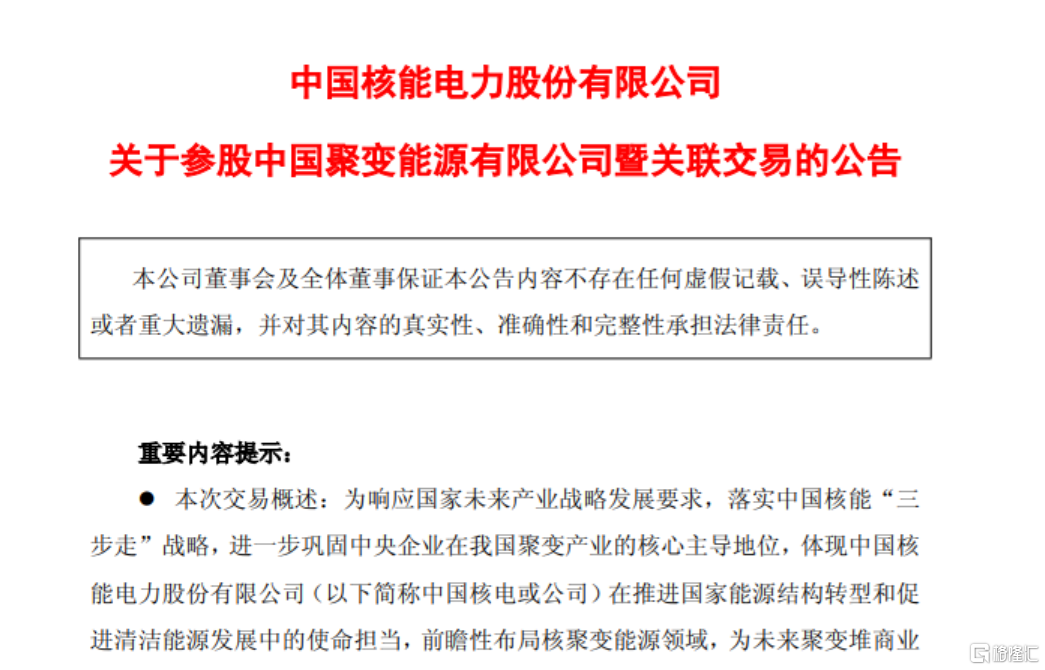
可控核聚变重磅!逾百亿元资本入局,“国家队”来了
Zheng Quan Shi Bao· 2025-07-22 15:45
Group 1 - China Fusion Energy Company was established on July 22, focusing on the commercialization and engineering of fusion energy, with plans for overall design, technology validation, and digital R&D [1][3] - The company signed a capital increase agreement with several stakeholders, including China National Nuclear Corporation and China Nuclear Power, raising approximately 11.49 billion yuan in new registered capital [3][4] - After the capital increase, the registered capital of China Fusion Energy Company will be 15 billion yuan, with specific investment commitments from stakeholders over the next three years [4] Group 2 - Shanghai is prioritizing fusion energy as a key direction for future industry development, focusing on high-temperature superconductors and attracting high-level innovation teams [6][7] - Shanghai Superconductor Technology Co., Ltd., a key player in high-temperature superconductors, has been accepted for an IPO on the Sci-Tech Innovation Board [6] - The Shanghai Electric Nuclear Power Group has become a leading supplier of core equipment for fusion systems, participating in major domestic and international projects [7]
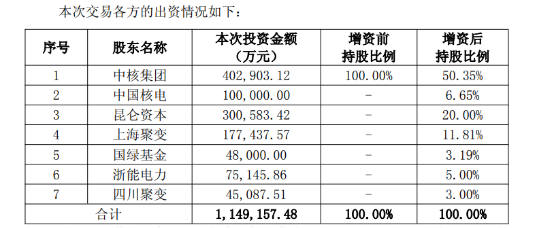
可控核聚变重磅!逾百亿元资本入局,“国家队”来了
证券时报· 2025-07-22 15:36
Core Viewpoint - The establishment of China Fusion Energy Company marks a significant step in advancing controlled nuclear fusion technology in China, with a focus on commercialization and innovation in the sector [1][3]. Group 1: Company Establishment and Investment - China Fusion Energy Company was officially established on July 22, with a focus on overall design, technology verification, and digital R&D [1]. - The company secured approximately 11.49 billion yuan in investments from several stakeholders, including China National Nuclear Corporation and China Nuclear Power, with a new registered capital of 15 billion yuan [3][4]. - The investment structure shows a significant reduction in the ownership of China National Nuclear Corporation from 100% to 50.35% post-investment [4]. Group 2: Future Development Plans - China Fusion Energy Company plans to develop nuclear fusion technology through a three-step approach: pilot experimental reactors, demonstration reactors, and commercial reactors [5]. - The company has signed cooperation agreements with various institutions, including Shanghai Jiao Tong University and Shanghai Electric Group, to enhance innovation in fusion technology [5]. Group 3: Industry Context and Support - Fusion energy is recognized as a disruptive technology, with global competition intensifying in this field [7]. - Shanghai is prioritizing fusion energy as a key area for technological advancement and talent development, focusing on high-temperature superconductors and other core technologies [7]. - The establishment of the Shanghai Superconductor Technology Co., which specializes in high-temperature superconductors, highlights the region's commitment to advancing fusion energy applications [7][8]. Group 4: Collaborative Efforts - The Shanghai government is supporting the formation of a fusion energy innovation alliance to promote collaboration across the industry [8]. - Energy Singularity, a fusion energy startup, aims to provide comprehensive solutions for fusion reactors and is working on the next-generation device, Honghuang 170, expected to be operational by 2027 [8].