核能

Search documents
埃及与俄罗斯签了
中国能源报· 2025-11-20 09:34
Core Points - Egypt signed a nuclear fuel procurement and comprehensive cooperation agreement with Russia for the Dabaa nuclear power plant [1] - The agreement will supply nuclear fuel for the reactor of Unit 1 of the Dabaa nuclear power plant [1] - The cooperation includes various fields such as nuclear power and the production of medical radioactive isotopes [1] Summary by Sections - **Nuclear Fuel Procurement Agreement**: The agreement aims to provide nuclear fuel for the first reactor of the Dabaa nuclear power plant, marking a significant step in Egypt's nuclear energy development [1] - **Comprehensive Cooperation**: The comprehensive cooperation agreement encompasses collaboration in multiple areas, including nuclear power and medical isotope production, indicating a broadening of bilateral relations [1] - **Leadership Involvement**: Egyptian President Sisi and Russian President Putin witnessed the installation ceremony of the reactor pressure vessel via video link, highlighting the strategic partnership between the two nations [1] - **Educational Exchange**: Currently, 100 Egyptian students are receiving training in nuclear energy at Russian universities, showcasing the educational aspect of the cooperation [1] - **Project Timeline**: The Dabaa nuclear power plant, located in Matrouh province, is Egypt's first nuclear project, with construction of Units 1 and 2 starting in July and November 2022, respectively, and Units 3 and 4 scheduled to begin in May 2023 and January 2024 [1]

埃及与俄罗斯签署核燃料采购协议
Xin Hua She· 2025-11-20 08:21
Core Points - Egypt signed a nuclear fuel procurement and comprehensive cooperation agreement with Russia's State Atomic Energy Corporation for the Dabaa Nuclear Power Plant [1] - The procurement agreement will supply nuclear fuel for the reactor of Unit 1 of the Dabaa Nuclear Power Plant [1] - The comprehensive cooperation agreement covers collaboration in various fields, including nuclear power and the production of medical radioactive isotopes [1] Summary by Sections Agreement Details - The agreement includes the supply of nuclear fuel for the first reactor of the Dabaa Nuclear Power Plant [1] - The comprehensive cooperation will involve multiple areas of collaboration between Egypt and Russia [1] Leadership Statements - Egyptian President Sisi emphasized that the cooperation reflects a strategic and solid relationship based on mutual respect [1] - Russian President Putin noted that the collaboration opens new prospects for professional exchanges, with 100 Egyptian students currently studying nuclear energy in Russia [1] Project Background - The Dabaa Nuclear Power Plant is located in Matrouh Province and is Egypt's first nuclear project [1] - Russia and Egypt signed a contract in 2017 for the construction of all four nuclear units of the power plant [1] - Construction of Units 1 and 2 began in July and November 2022, respectively, while Unit 3 started in May 2023 and Unit 4 is set to begin in January 2024 [1]
海陆重工(002255.SZ):未来可控核聚变产业是公司重要的目市场和发展领域
Ge Long Hui· 2025-11-20 08:17
Core Viewpoint - The company is actively monitoring developments in the controlled nuclear fusion sector, which is identified as a significant target market and area for future growth [1] Group 1 - The company has expressed a commitment to the development of the controlled nuclear fusion industry [1]

210亿美元的幻觉?奥特曼投了一家核能初创
3 6 Ke· 2025-11-20 07:56
Group 1 - Oklo, a nuclear energy startup, has reached a market valuation of $21 billion by promoting the concept of powering AI data centers, despite not having sold any electricity yet [1][14][18] - The company has seen its stock price increase by 400% over the past six months, with a reported loss of $55 million last year, indicating strong investor interest driven by the "AI + nuclear energy" narrative and supportive policies [14][18][24] - The founders of Oklo, Jacob DeWitte and Caroline Cochran, both have backgrounds in nuclear engineering from MIT, and the company has received backing from prominent investors, including Sam Altman, who has played a significant role in its market presence [18][19][24] Group 2 - Sergiy Nesterenko, a former SpaceX engineer, founded Quilter to automate the tedious process of circuit board design using AI, allowing the system to generate multiple manufacturable versions in minutes [2][10][12] - Quilter's AI system utilizes reinforcement learning and electromagnetic simulation to optimize component placement and signal routing, significantly improving signal integrity and compliance with manufacturing standards compared to traditional methods [10][12][24] - The company has secured $10 million in Series A funding to expand its platform and industrial collaborations, positioning itself as a transformative force in hardware design [12][24] Group 3 - The contrasting approaches of Oklo and Quilter highlight the divide in the current AI landscape: one focuses on storytelling and market valuation, while the other emphasizes tangible technological advancements [1][26][27] - Oklo represents the potential of narrative-driven investment, where compelling stories can attract capital even without a functional product, while Quilter embodies the practical application of AI in engineering [24][25][26] - The future of AI will likely be determined by the balance between narrative and technology, with lasting impact stemming from those who can deliver functional solutions rather than just captivating stories [27][28][29]

解决电力短缺,美国拟新增多达10座核反应堆,可能日本“买单”
Hua Er Jie Jian Wen· 2025-11-20 03:52
Core Insights - The U.S. government plans to procure and own up to 10 new large nuclear reactors to address the surging electricity demand driven by data centers and artificial intelligence [1][2] - This initiative is seen as a response to a "national emergency," indicating a significant shift in government intervention in the private market [2][3] - The plan may leverage Japan's previously committed $550 billion investment, with $332 billion earmarked for U.S. energy projects, including investments in Westinghouse's new AP1000 reactors [1][3] Government Intervention - The U.S. power system is under immense pressure due to explosive growth in electricity demand from AI data centers and potential manufacturing recovery [2] - The Energy Department has not disclosed specific site details for the reactors but expresses confidence in the project's implementation [2][3] - The government is also expected to provide "hundreds of billions" in loans to the nuclear sector, including a $1 billion loan for the restart of the Three Mile Island nuclear plant [2] Industry Beneficiaries - Key players in the nuclear energy sector are anticipated to benefit from the federal government's procurement plan [3][4] - Westinghouse, the sole large reactor design currently under discussion, is jointly owned by Cameco and Brookfield Asset Management, and is coordinating with the U.S. government [3] - BWX Technologies, Mirion Technologies, and Flowserve are positioned to gain significant contracts in heavy manufacturing and safety monitoring [3][4] Uranium Mining Sector - Domestic uranium mining companies (e.g., UEC, EU, URG, UUUU) are expected to benefit from the federal government's efforts to expand domestic uranium mining for both commercial and defense needs [4] Nuclear Power Resurgence - If the plan is realized, it could break a decade-long stagnation in U.S. nuclear power construction, with the last major project starting over ten years ago [5][6] - The previous setbacks in the industry, such as the Vogtle project exceeding its budget by $16 billion and facing a seven-year delay, have led to skepticism about large nuclear projects [5][6] - The current AI boom is changing the industry's dynamics, potentially reviving interest in large nuclear projects [6][7] Government's Role - The direct intervention of the U.S. government may be the critical impetus needed for the nuclear industry to restart amid electricity shortages [8]
核能发电可以不用“烧”铀了
Jing Ji Ri Bao· 2025-11-20 00:20
更重要的是,它的安全性极高。不同于大多需在高压下工作的核反应堆,钍基熔盐堆是常压运行, 熔盐在温度升高时会自动膨胀抑制反应,从根本上避免了高压爆炸的可能性。即使发生意外,熔盐也会 遇冷凝固,不会出现堆芯熔毁导致大量放射性物质释放的情况。 不仅如此,除了发电,高温运行的钍基熔盐堆还能"一堆多用"。"目前,这座钍基熔盐堆的运行温 度是700摄氏度,这个运行温度正好可以实现高温制氢、制甲醇。"上海应物所副所长蔡翔舟说,钍基熔 盐堆是清洁高效能源系统,有助于构建多能互补低碳复合能源系统,为我国能源安全提供全新解决方 案。 "这意味着核能发电不仅可以烧铀,烧钍也是可行的。"上海应物所所长、钍基熔盐堆核能系统战略 性先导科技专项负责人戴志敏表示,我国钍资源极其丰富,研发钍基熔盐堆、实现钍资源的工业应用, 可以在战略上实现能源独立。 "与传统核电站相比,钍基熔盐实验堆具有固有安全、无水冷却、常压工作和高温输出等优点。"戴 志敏举例,比如,很多核电站建在海边,一个重要原因是其运行过程中会产生巨大热量,需要大量的水 进行冷却,以保证运行安全。但钍基熔盐堆采用高温液态熔盐作为冷却剂,无需外部水源补给,建在内 陆干旱地区也可以。 ...
国务院国资委党委召开第二届“三优一能”表彰会暨中央企业人才工作推进会
Xin Lang Cai Jing· 2025-11-19 06:34
会议强调,要深入贯彻落实党的二十届四中全会精神,科学规划"十五五"时期中央企业人才工作,牢牢 把握"十五五"中央企业人才工作新形势新任务新要求,做到人才规划要适度超前、投资于人要优先安 排、人才结构要优化提质、体制机制要赋能增效。要改进人才教育培养体系,积极拓展人才自主培养渠 道,实施好管理人才领航培养工程、科技人才星耀培养工程、技能人才优基培养工程,全面深化人才发 展体制机制改革,强化对人才政治引领和组织关怀,营造识才爱才敬才用才的良好环境,持续加强党对 国资央企人才工作的全面领导,不断开创人才工作新局面,更好服务推动中央企业高质量发展。会上, 来自中国海油、中国电子的2名获奖代表,航天科技、中国电信、中广核等3家中央企业负责同志作了交 流发言。 ...
中国同辐与巴西国家核能委员会签署辐照钴-60放射源意向采购协议
Zhi Tong Cai Jing· 2025-11-17 11:59
Core Viewpoint - China National Nuclear Corporation (CNNC) has signed a procurement agreement with Brazil's National Nuclear Energy Commission (CNEN) for the purchase of cobalt-60 irradiation sources, marking the first export of domestically produced cobalt-60 to the Latin American market and the first substantial outcome under the memorandum of understanding signed in October 2025 [1] Group 1 - The procurement agreement will enable CNEN to enhance the irradiation capabilities of its multi-functional irradiation facility at the Brazilian Nuclear and Energy Research Institute (IPEN) [1] - The cobalt-60 sources will be utilized in various fields including technology research, material studies, and irradiation processing, contributing to the advancement of irradiation technology for the benefit of Brazilian society [1]
中国同辐(01763) - 自愿性公告 - 中国同辐与巴西国家核能委员会签署辐照鈷-60放射源意向採...
2025-11-17 11:48
香港交易及結算所有限公司及香港聯合交易所有限公司對本公告的內容概不負責,對其準確性 或完整性亦不發表任何聲明,並明確表示,概不對因本公告全部或任何部份內容而產生或因倚 賴該等內容而引致的任何損失承擔任何責任。 CHINA ISOTOPE & RADIATION CORPORATION 根據《輻照鈷-60放射源意向採購協議》,CNEN將從中國同輻採購輻照鈷-60放射 源,用於提升其下屬巴西核與能源研究院(IPEN)多功能輻照設施輻照能力,更好 地應用於技術研發、材料研究、輻照加工等多領域,持續推動輻照技術惠及巴西 社會民生。 承董事會命 中國同輻股份有限公司 董事長 肖亞飛 中國,北京,2025年11月17日 於本公告日期,董事會成員包括執行董事肖亞飛先生、張軍旗先生、霍穎穎女士 及馬曉宇女士;非執行董事陳贊先生、丁建民先生及常晉峪女士;及獨立非執行 董事潘昭國先生、陳景善女士、盧闖先生及安銳先生。 (股份代號:1763) 自願性公告 中國同輻與巴西國家核能委員會簽署輻照鈷-60放射源意向採購協議 本公告乃中國同輻股份有限公司(「中國同輻」或「本公司」)自願發出以使股東及潛 在投資者知悉本公司之最新業務進展。 ...
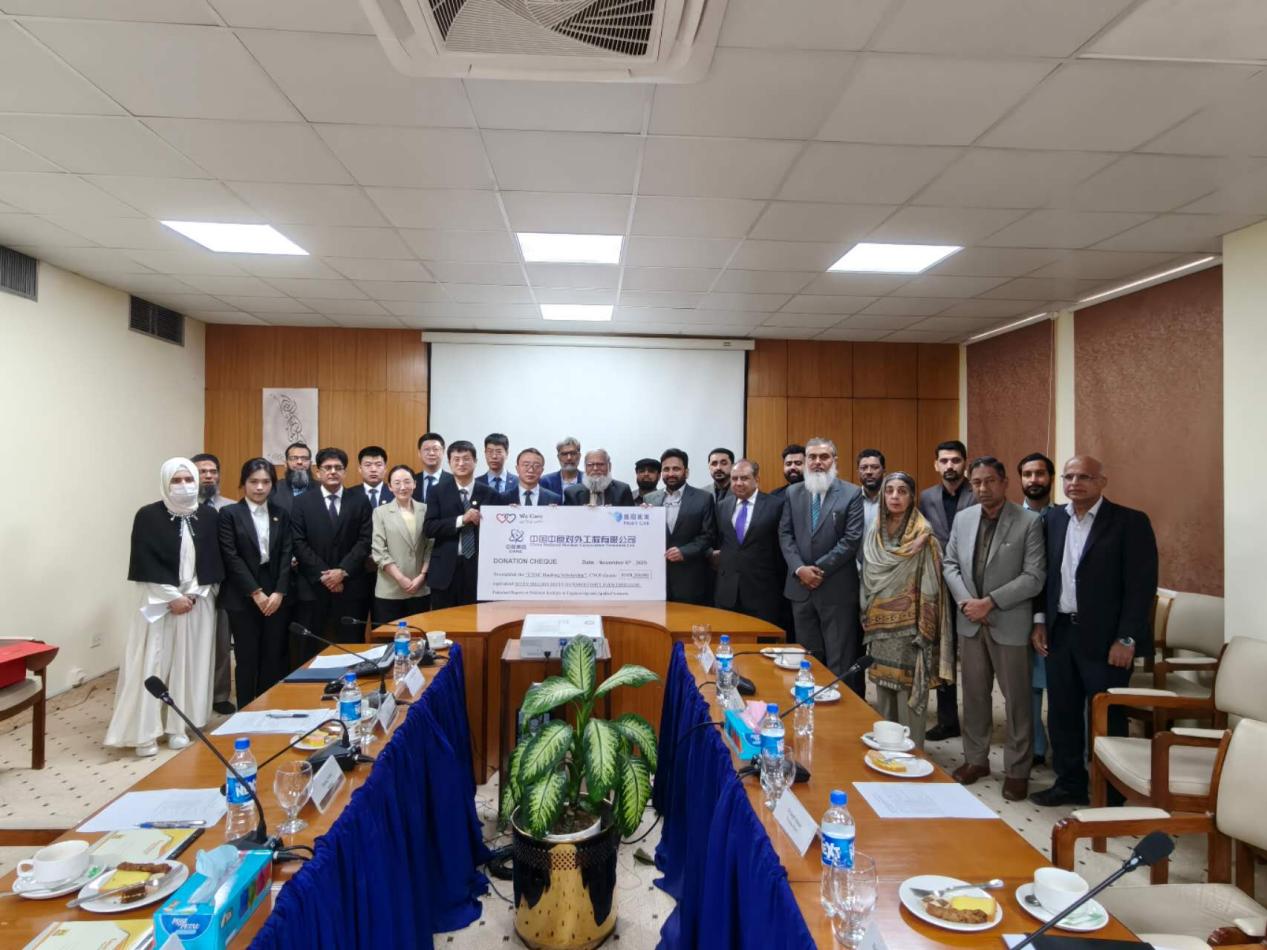
中国企业在巴基斯坦高校设立核能奖学金
人民网-国际频道 原创稿· 2025-11-17 08:41
Group 1 - CNNC (China National Nuclear Corporation) has established the "CNNC Hualong Scholarship" at the Pakistan Engineering and Applied Sciences University to cultivate more talented individuals in nuclear energy [1][2] - The scholarship program will invest 8 million Pakistani Rupees (approximately 200,000 RMB) annually for the doctoral training in nuclear energy [2] - This initiative marks the first specialized doctoral training fund in nuclear energy set up by a Chinese enterprise in Pakistan, with the university already beginning the selection process for scholarship recipients [2] Group 2 - The establishment of the scholarship is seen as a significant step in the pragmatic development of China-Pakistan strategic cooperation, extending from major project construction to areas benefiting people's livelihoods [2] - The scholarship aims to provide opportunities for underprivileged students in Pakistan, enhancing cooperation and mutual trust among young scientific talents from both countries [2] - The Pakistan Engineering and Applied Sciences University is recognized as a "cradle" for nurturing nuclear science and technology talent in Pakistan, and the scholarship will support doctoral students in their research endeavors [2][4]