晶圆代工

Search documents
中芯国际2024年营收同比增长28% 共销售晶圆802万片
Zheng Quan Shi Bao Wang· 2025-03-27 12:54
Core Insights - Company reported a revenue of RMB 57.796 billion for 2024, a year-on-year increase of 27.7%, while net profit decreased by 23.3% to RMB 3.699 billion [1] - The semiconductor market is experiencing a recovery, driven by demand from smartphones, personal computers, and consumer electronics, with emerging markets like IoT and wearables expanding [2] - The company is focusing on innovation, cost reduction, and market expansion to meet the growing demand for local manufacturing and to adapt to customer needs [2] Financial Performance - Revenue growth was attributed to an increase in wafer sales volume, which rose by 36.7% from 5.867 million units in 2023 to 8.021 million units in 2024 [1] - Average selling price of wafers decreased from RMB 6,967 in 2023 to RMB 6,639 in 2024 [1] - Gross margin stood at 18% with a capacity utilization rate of 85.6% [1] Market Segmentation - In 2024, the revenue breakdown by application was as follows: smartphones (27.8%), personal computers (16.6%), consumer electronics (37.8%), IoT and wearables (10.0%), and industrial and automotive (7.8%) [3] - By region, the revenue distribution was: China (84.6%), USA (12.4%), and Eurasia (3.0%) [3] Industry Outlook - The global semiconductor industry is characterized by both cyclicality and growth potential, with short-term supply-demand imbalances not affecting long-term trends [2] - The company anticipates stable or moderate growth in various application areas in 2025, with AI continuing to grow rapidly [4] - The company aims for revenue growth above the average of comparable peers in 2025, with capital expenditures expected to remain stable compared to the previous year [4]

中芯国际与三星差距缩小!
国芯网· 2025-03-27 04:39
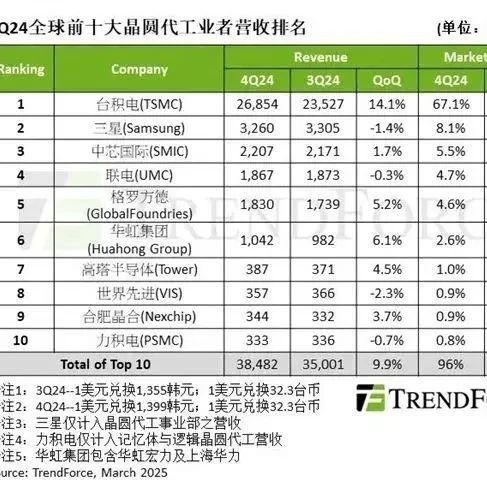
Core Viewpoint - The article highlights the competitive landscape of the global semiconductor foundry market, emphasizing the growing gap between TSMC and Samsung, as well as the rapid rise of SMIC in the rankings [1][2]. Group 1: Market Share Dynamics - TSMC holds a dominant position with a market share of 67.1%, increasing by 2.4 percentage points from the previous quarter [1]. - Samsung's market share has declined to 8.1%, down from 11.5% in Q2 and 9.1% in Q3 of the previous year, marking a significant drop into single digits [1]. - The gap between TSMC and Samsung has widened from 55.6 percentage points to 59 percentage points, while the gap between Samsung and SMIC has narrowed from 3.1 percentage points to 2.6 percentage points [1]. Group 2: Revenue Trends - The top 10 foundries experienced a 9.9% quarter-over-quarter revenue growth, primarily driven by TSMC's performance, which saw a 14.1% increase [2]. - In contrast, Samsung's revenue decreased by 1.4%, and UMC's revenue fell by 0.3%, indicating a decline in their performance [2]. - SMIC's revenue grew by 34% year-over-year in Q3, despite facing challenges from U.S. export restrictions, benefiting from increased production of older semiconductor technologies [2]. Group 3: Industry Trends - The foundry industry is showing signs of polarization, with demand for mature processes slowing down, while advanced processes driven by AI servers and smartphone applications are boosting high-value wafer shipments [2]. - SMIC has expanded its capacity for advanced 12-inch wafers and increased its average selling prices, marking a significant shift in its operational focus [2].



台积电先进封装,再度领先
半导体行业观察· 2025-03-27 04:15
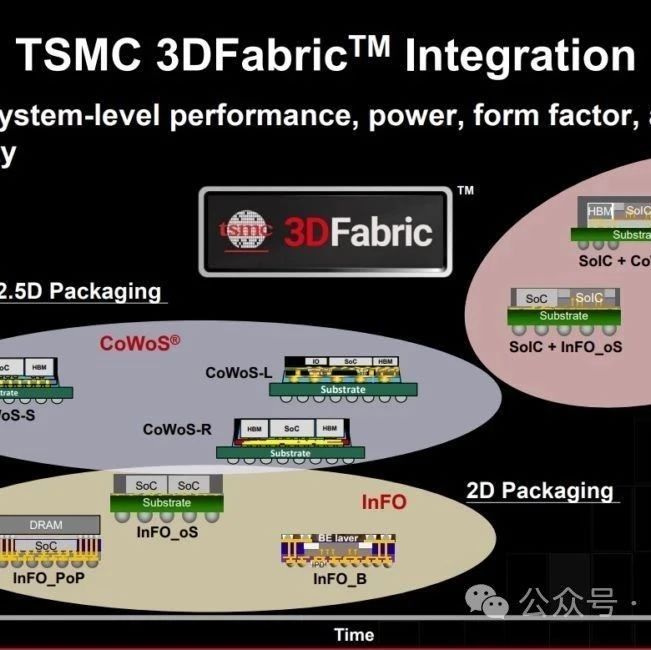
Core Viewpoint - NVIDIA's next-generation Rubin AI architecture will utilize the company's first SoIC packaging, indicating a significant shift in the hardware market with the integration of advanced components like HBM4 [1][5] Group 1: SoIC Packaging Development - TSMC is rapidly constructing factories in Taiwan to shift focus from advanced packaging (CoWoS) to SoIC, with expectations for NVIDIA, AMD, and Apple to release next-generation solutions based on this design [1][2] - SoIC allows for the integration of different chips, reducing internal circuit layout space and lowering costs, with AMD being an early adopter and Apple expected to follow with its M5 chip [2][3] - TSMC's SoIC production capacity is projected to reach 15,000 to 20,000 wafers by the end of this year, with plans to double that capacity next year [2][6] Group 2: NVIDIA's Rubin Architecture - The Rubin GPU will separate the GPU and I/O die, utilizing N3P and N5B processes respectively, and will integrate these components using SoIC packaging [2][5] - The Vera Rubin NVL144 platform is expected to deliver up to 50 PFLOPS of FP4 performance with 288 GB of HBM4 memory, while the NVL576 will provide up to 100 PFLOPS and 1 TB of HBM4e capacity [5] Group 3: Workforce and Production Adjustments - TSMC plans to adjust its workforce from 8-inch fabs to support advanced packaging facilities, aiming to recruit 8,000 new employees this year to reach a target of 100,000 [3] - The company is actively preparing for the integration of SoIC technology, which is seen as crucial for future developments in semiconductor packaging [3][6]


半导体,暂逃一劫
半导体行业观察· 2025-03-25 01:27
Core Viewpoint - The semiconductor industry is experiencing a positive outlook, driven by demand from AI and high-performance computing (HPC), with specific companies like TSMC, UMC, and World Advanced receiving favorable ratings from Citigroup Global Markets [1][2]. Group 1: TSMC and Market Dynamics - TSMC's stock price has fluctuated, closing at 972 NTD, with foreign investors showing renewed interest despite concerns about the company's short-term outlook [1]. - Citigroup maintains a positive view on TSMC's long-term prospects, indicating that any potential joint ventures will not alter the advanced semiconductor landscape [1]. - The overall semiconductor market is expected to improve due to demand recovery in various sectors, including PMIC, WiFi-7, and 10G PON products [1]. Group 2: UMC and World Advanced Ratings - Citigroup upgraded UMC's investment rating from "Sell" to "Buy," predicting a reasonable stock price increase from 40 NTD to 53 NTD, citing that the market has already absorbed the risks of price and margin declines [2]. - World Advanced's rating was also raised from "Neutral" to "Buy," with an expected stock price increase to 112 NTD, driven by rising PMIC demand and recovery in consumer electronics [2]. - The semiconductor industry is seeing healthier inventory levels in PCs, smartphones, and consumer electronics, reducing the risk of inventory adjustments [2].
2024年全球专属晶圆代工榜单,中芯国际跃居第二,芯联集成进入前十
半导体行业观察· 2025-03-20 01:19
以下文章来源于芯思想 ,作者赵元闯 芯思想 . 中国半导体正能量传播平台。为中国半导体产业服务,我们都是中国半导体产业腾飞的见证人。新闻分 析,精彩评论,独家数据,为您定制信息,欢迎拍名片回复,和行业精英交流。 如果您希望可以时常见面,欢迎标星收藏哦~ 来源:内容转自【芯思想】,作者:赵元闯,谢谢。 2024年前十大专属晶圆代工公司中,增幅排名前三的都超过20%,增幅最高的是台积电(TSMC), 年增幅32%;其次是晶合集成(Nexchip),年增幅达28%;增幅排名第三的是中芯国际(SMIC), 达27%。2024年营收唯一出现下滑的是格芯(GlobalFoundries),下滑超过8%。 在IDM厂商代工方面,三星代工2024年营收约1462亿元,英特尔1261亿元,都较2023年下滑7%。 台积电 2023年台积电的3纳米正式贡献营收,到2024年第四季营收占比达26%,全年营收占比18%。 台积电在IEDM 2024大会上首次披露了2nm(N2)工艺的关键技术细节和性能指标: 对比3nm,晶 体管密度增加15%,同等功耗下性能提升15%,同等性能下功耗降低24-35% ,同时通过NanoFlex技 术 ...


最新全球十大晶圆代工厂排名!
国芯网· 2025-03-12 04:22
Core Insights - The global wafer foundry industry is expected to see a nearly 10% quarter-on-quarter revenue increase in Q4 2024, reaching a new high of $38.48 billion, driven by advanced processes benefiting from emerging applications like AI servers and new flagship smartphones [2]. Group 1: Industry Overview - The report from TrendForce indicates a polarized development in the global wafer foundry industry, with advanced processes experiencing growth due to demand from AI servers and new smartphone platforms, while mature processes face declining demand [2]. - The leading company in the industry is projected to achieve a revenue of $26.85 billion in Q4 2024, marking a 14.1% increase and maintaining a market share of 67% [2]. Group 2: Competitor Performance - Samsung, ranked second, is expected to see a revenue decline of 1.4% to $3.26 billion in Q4 2024, with a market share of 8.1% [3]. - The third-ranked company is projected to achieve a revenue of $2.2 billion, reflecting a quarter-on-quarter increase of 1.7% and a market share of 5.5% [3]. - Other companies in the top ten include GlobalFoundries, Hua Hong Group, Tower Semiconductor, Vanguard International Semiconductor, Hefei Microelectronics, and Powerchip Semiconductor Manufacturing [4].
韩媒揭露三星晶圆代工困境
半导体行业观察· 2025-03-08 03:39
Core Viewpoint - Samsung's foundry division is struggling to close the gap with TSMC, which holds over 60% of the global market share, due to issues with yield rates and investment strategies, leading to a widening market share difference of approximately 59 percentage points as of Q4 last year [1][2][3]. Investment Strategies - TSMC has announced a significant investment plan of $100 billion in the U.S., expanding its total investment to $165 billion, which is its largest investment in the U.S. to date [1][2]. - In contrast, Samsung is facing difficulties in securing clients and making investment decisions, which hampers its ability to expand capacity [1][2]. Market Share Dynamics - TSMC's foundry market share increased from 64.9% in Q3 to 67.1% in Q4, while Samsung's market share decreased from 9.3% to 8.2% during the same period, highlighting the growing disparity between the two companies [2][3]. Production Capacity and Technology - TSMC is ahead in the production of advanced 2nm technology, with a reported yield rate of 60%, while Samsung has not disclosed its yield figures, raising concerns about its competitive position [4]. - Samsung's advanced packaging plant construction has been delayed from 2024 to 2026 due to market conditions, contrasting with TSMC's progress in Arizona [2][4]. Client Acquisition Challenges - Samsung is struggling to secure orders from major U.S. tech companies, which is critical for its foundry business, while TSMC is successfully obtaining a large number of AI semiconductor orders [2][4].
三星联手博通,挑战台积电!
半导体芯闻· 2025-03-07 10:20
Core Viewpoint - Samsung Electronics is collaborating with Broadcom to develop Silicon Photonics technology, which is expected to enhance data processing speeds by over 10 times, marking it as a key manufacturing technology for the next generation of foundry services [1][2]. Group 1: Collaboration and Technology Development - Samsung and Broadcom aim to achieve mass production and commercialization of Silicon Photonics technology within two years, with Samsung also discussing technology implementation with NVIDIA [1]. - Broadcom's strength in wireless and optical communication semiconductors, which contribute approximately 30% and 10% to its overall revenue respectively, will be leveraged in the partnership with Samsung [1]. Group 2: Competitive Landscape - Samsung is striving to enhance its competitiveness in advanced process technologies as it faces a widening market share gap with TSMC, which has secured most orders from global tech giants [2][3]. - TSMC's early development of Silicon Photonics technology and its partnerships with companies like Apple and NVIDIA have positioned it advantageously in the advanced process competition [3]. Group 3: Future Prospects and Challenges - As the semiconductor industry moves below the 3nm process, new technologies like Silicon Photonics are crucial for maximizing power efficiency and signal processing speed, especially with the growing demand for AI technologies [3]. - Samsung is currently 1 to 2 years behind TSMC in the commercialization timeline for Silicon Photonics, with TSMC planning to establish a production line by June this year [3].

联电也要去日本建厂?
半导体行业观察· 2025-03-07 01:23
Core Viewpoint - SBI Holdings has terminated its partnership with Powerchip Semiconductor Manufacturing Corporation (PSMC) for the construction of a semiconductor fab in Miyagi Prefecture, Japan, and is now seeking collaboration with United Microelectronics Corporation (UMC) and SK Hynix for the same project [2]. Group 1: SBI Holdings and Semiconductor Factory Plans - SBI Holdings announced the cancellation of its collaboration with PSMC on September 27, 2024, but will continue with the plan to build the semiconductor factory in Miyagi [2]. - The Miyagi fab will be developed in two phases, with the first phase expected to start production in 2027, targeting a monthly capacity of 10,000 12-inch wafers for 40nm and 55nm chips [2]. - The second phase is projected to begin production in 2029, expanding the product range to include 28nm chips and utilizing Wafer-on-Wafer (WoW) technology, with a full capacity of 40,000 wafers per month [2]. Group 2: UMC's Financial Performance - UMC reported a consolidated revenue of NT$18.193 billion in February, a decrease of 8.15% month-over-month, marking the lowest level in nearly eight months, but still a year-on-year increase of 4.25% [4]. - The cumulative revenue for the first two months reached NT$38 billion, reflecting a year-on-year growth of 4.21%, also the second-highest for the same period since 2022 [4]. - UMC anticipates that its wafer shipment volume will stabilize compared to the fourth quarter of the previous year, with a capacity utilization rate around 70% [4]. Group 3: Future Outlook for UMC - UMC has noted strong customer interest in upgrading to the 22nm special process platform, which offers significant advantages in power consumption and performance over the 28nm process, aimed at next-generation communication technologies and display driver ICs [5]. - The company is accelerating the production of 22nm products, expecting them to contribute significantly to revenue starting in 2025 [5]. - Key expansion projects are progressing as planned, including a third fab in Singapore to enhance supply chain resilience and a collaboration with U.S. partners to develop a 12nm process platform to meet customer demands for upgrades below 22nm [5].

专家访谈汇总:地方经济增速下调意味着什么?
阿尔法工场研究院· 2025-03-03 14:06
Group 1: Economic Outlook and Policy Adjustments - 15 provinces have lowered their economic growth targets, accounting for 31.8% of national GDP, with a national weighted average target of 5.3% for 2024 [1] - Special bonds will support computing power, emerging industry equipment, intelligent transformation, and provincial industrial parks, with the capital ratio for special bonds increased to 30% [1] - Local governments are ensuring an increase in technology investment, with Shanghai setting a target for R&D spending to reach 4.5% of GDP [1] Group 2: AI Industry Developments - DeepSeek R1 model has entered the global top-tier model ranks, leading to rapid user growth and a reevaluation of the AI industry landscape [2] - 10 cloud computing giants and 12 intelligent computing companies have integrated with DeepSeek, benefiting from short-term traffic and building long-term competitive advantages [2] - Following the DeepSeek event, Chinese tech asset valuations have recovered, with the Hang Seng Tech Index rising by 22.8% [2] Group 3: Computing Power and Investment Trends - The government is accelerating the development of domestically controlled computing power, with a target of 105 EFlops for intelligent computing construction by 2025 [3] - Internet companies are experiencing rapid growth in capital expenditures, with ByteDance's expected CapEx for 2025 reaching 160 billion yuan, doubling year-on-year [3] - Comparable companies are projected to have PS valuations of 52, 36, and 28 times from 2024 to 2026, with Cambrian expected to enjoy a valuation premium as a rare domestic AI chip player [3] Group 4: Solid-State Battery Market Insights - Solid-state batteries offer higher energy density, enhanced safety, and longer cycle life compared to traditional lithium batteries, positioning them as a key direction for next-generation power batteries [4] - Major automakers like BYD, GAC, and Changan have set timelines for solid-state battery deployment, with 2027 identified as a critical mass production year [4] - The solid-state battery market is projected to exceed 600 GWh in shipments by 2030, with a market size surpassing 250 billion yuan, indicating a period of rapid growth [4] Group 5: Semiconductor Industry Developments - By the end of 2024, SMIC is expected to have a total capacity of 421,000 wafers per month, making it the largest and most advanced foundry in mainland China [5] - SMIC operates multiple 200mm and 300mm wafer fabs in Shanghai, Beijing, Shenzhen, and Tianjin, with plans to add three new 12-inch production lines [5] - The domestic demand for AI chips is strong, and SMIC's advanced process capacity is expected to fill part of the domestic computing chip demand due to overseas flow limitations [5]