
钢结构

Search documents
精工钢构: 精工钢构市值管理制度
Zheng Quan Zhi Xing· 2025-08-27 10:29
Core Viewpoint - The company has established a value management system aimed at enhancing investment value and shareholder returns while ensuring compliance with relevant laws and regulations [2][10]. Chapter Summaries Chapter 1: General Principles - Value management is defined as strategic management actions aimed at improving company quality to enhance investment value and shareholder returns [2]. - The basic principles of value management include compliance, systematic approach, scientific management, regularity, and integrity [2]. Chapter 2: Value Management Organization and Personnel - The Board of Directors is the leading body for value management, responsible for formulating overall plans and ensuring effective implementation [3]. - The Chairman of the Board is the primary responsible person for value management, promoting internal systems to enhance investment value [3]. - The Board Secretary is directly responsible for investor relations and information disclosure, ensuring transparent communication with investors [4]. Chapter 3: Main Methods of Value Management - Company quality is the foundation of investment value, and the company should focus on core business to improve operational efficiency and profitability [6]. - The Board can develop and disclose medium to long-term dividend plans to enhance investor satisfaction [6]. - The company and its stakeholders must adhere to compliance and avoid misleading practices in value management [6]. Chapter 4: Monitoring and Emergency Measures - The company should monitor key indicators like market value and P/E ratio, and initiate warning mechanisms if significant deviations occur [7]. - In case of significant stock price declines, the company should verify the cause, enhance communication with investors, and consider share buyback plans [7][8]. Chapter 5: Supplementary Provisions - The value management system will take effect upon approval by the Board of Directors [10].

精工钢构: 精工钢构第九届董事会独立董事专门会议2025年第三次会议审核意见
Zheng Quan Zhi Xing· 2025-08-27 10:29
Core Viewpoint - The company held its third special meeting of the ninth board of independent directors on August 23, 2025, to review and approve new daily related transactions with an associated party, which are deemed necessary for the company's business operations and development [2][3]. Group 1 - The meeting was attended by all three independent directors, and the procedures followed were in compliance with relevant regulations [2]. - The board approved the proposal regarding the expected new daily related transactions, which involve business dealings with Beijing Urban Construction Precision Steel Structure Engineering Co., Ltd [3]. - The decision-making process for the related transactions adhered to the principles of fairness, justice, and transparency, ensuring no harm to the company or minority shareholders [3].
精工钢构: 精工钢构独立董事意见
Zheng Quan Zhi Xing· 2025-08-27 10:29
Group 1 - The independent director's opinion states that the financing guarantee for controlled enterprises is necessary for daily operations and business development, aligning with the company's overall operational needs [2] - The independent director confirms that there are no significant risks involved and that the interests of the company and shareholders, especially minority shareholders, are not harmed [2] - The decision-making process for the guarantee complies with relevant laws and regulations, ensuring adequate information disclosure [2] Group 2 - The related party transactions are deemed normal business activities, with the decision-making process adhering to the company's articles of association [2] - Pricing for the transactions follows principles of fairness, justice, and openness, ensuring no harm to the company or minority shareholders [2] - The company's main business will not become dependent on these related party transactions, maintaining its independence [2]
精工钢构: 精工钢构2025年半年度报告
Zheng Quan Zhi Xing· 2025-08-27 10:22
Core Viewpoint - The report highlights the financial performance and strategic developments of Changjiang Jinggong Steel Structure (Group) Co., Ltd. for the first half of 2025, showcasing significant growth in revenue and profit, alongside a strong focus on international expansion and technological innovation [1][2]. Financial Performance - The company's operating revenue for the first half of 2025 reached approximately 9.91 billion RMB, representing a year-on-year increase of 29.48% compared to 7.65 billion RMB in the same period of 2024 [2]. - Total profit amounted to approximately 397.31 million RMB, up 33.36% from 297.93 million RMB in the previous year [2]. - The net profit attributable to shareholders was approximately 349.70 million RMB, reflecting a growth of 28.06% from 273.07 million RMB [2]. - The net cash flow from operating activities was approximately 423.36 million RMB, a significant increase of 90.83% compared to 221.85 million RMB in the same period last year [2]. Industry Overview - The total output value of the national construction industry was approximately 13.67 trillion RMB, with a slight year-on-year growth of 0.2% [3]. - The "Belt and Road" initiative has driven an increase in overseas infrastructure demand, with Chinese enterprises signing new contracts worth approximately 814.87 billion RMB in 2025 for projects in Belt and Road countries, marking a 21% increase year-on-year [3]. - The domestic fixed asset investment growth has slowed, leading construction companies to seek opportunities abroad, with new contracts in the construction industry declining by 5.21% in 2024 [3]. Business Development - The company signed new contracts totaling approximately 12.51 billion RMB in the reporting period, with international orders increasing by 94.1% to 3.66 billion RMB, while domestic orders decreased by 14.5% to 8.85 billion RMB [9][10]. - The company is transitioning from a specialized subcontractor in steel structure engineering to an EPC (Engineering, Procurement, and Construction) contractor, providing comprehensive building solutions [8][12]. - The company has established a strong international presence, having completed significant projects such as the Lusail Stadium for the 2022 FIFA World Cup and the Jeddah Tower [9][10]. Technological Innovation - The company is focused on technological innovation, having developed an AI-based software for structural design and implemented an automated cutting and sorting production line [14][15]. - The company has been recognized for its technological advancements, receiving multiple awards and patents, and is actively involved in setting industry standards for prefabricated buildings [15][16]. Market Trends - The market for urban renewal in China is projected to exceed 8.6 trillion RMB by 2025, with a year-on-year growth of 18.3%, indicating a strong demand for steel structure prefabricated buildings [5]. - The company is well-positioned to capitalize on the growing trend of green building standards and energy-efficient construction practices, aligning with national policies aimed at reducing carbon emissions in the construction sector [6].
精工钢构: 精工钢构关于第九届董事会2025年度第十七次临时会议决议公告
Zheng Quan Zhi Xing· 2025-08-27 10:21
Core Points - The company held its 17th temporary meeting of the 9th Board of Directors for the year 2025, with all 9 directors present, ensuring compliance with the Company Law and Articles of Association [1][2] - The meeting approved the 2025 semi-annual report and summary, with unanimous support from all directors [1] - The meeting also approved a special report on the storage and actual use of raised funds for the first half of 2025, again with unanimous support [1] - A proposal to provide financing guarantees for controlled enterprises was approved, with independent directors expressing their agreement [2] - The board approved a proposal for new daily related transactions, with 8 votes in favor and one director abstaining due to conflict of interest [2] - The board also approved the establishment of a "Market Value Management System" [2]
精工钢构:2025年上半年净利润3.5亿元,同比增长28.06%
Xin Lang Cai Jing· 2025-08-27 09:46
精工钢构公告,2025年上半年营业收入99.11亿元,同比增长29.48%。净利润3.5亿元,同比增长 28.06%。 ...
【光大研究每日速递】20250827
光大证券研究· 2025-08-26 23:06
Group 1: Rare Earth Industry - The implementation of the "Rare Earth Management Regulations" starting from October 1, 2024, marks the beginning of supply-side reforms in the rare earth sector, with increasingly stringent regulations observed [5] - Continuous price increases for light rare earth elements since July this year, along with the re-evaluation of rare earths as strategic key mineral resources, indicate ongoing upward momentum in the rare earth sector [5] Group 2: China Hongqiao (1378.HK) - In the first half of 2025, China Hongqiao reported a 35% year-on-year increase in net profit attributable to shareholders, supported by declining costs and rising product prices and volumes [5] - The downward trend of the US dollar and sustained industry demand contribute to the resilience of electrolytic aluminum prices [5] - The company's significant share buybacks reflect long-term confidence, while high dividends continue to enhance shareholder returns [5] Group 3: Honglu Steel Structure (002541.SZ) - In the first half of 2025, Honglu Steel Structure achieved revenues of 1.06 billion yuan, a 2% year-on-year increase, but experienced a 33% decline in net profit attributable to shareholders [5] - The second quarter of 2025 saw revenues of 570 million yuan, a 3% year-on-year decrease, with net profit also down by 33% [5] Group 4: Hangcha Group (603298.SH) - Hangcha Group reported a revenue of 9.3 billion yuan in the first half of 2025, an 8.7% year-on-year growth, with a net profit of 1.12 billion yuan, up 11.4% [7] - The gross margin increased by 0.6 percentage points to 22.0%, while the net margin rose by 0.1 percentage points to 12.6% [7] Group 5: Wuxi Zhenhua (605319.SH) - In the first half of 2025, Wuxi Zhenhua's total revenue increased by 15.2% to 1.29 billion yuan, with a net profit growth of 27.2% to 200 million yuan [8] - The second quarter of 2025 saw a revenue increase of 9.5% year-on-year and a net profit increase of 31.9% [8] Group 6: Semir Apparel (002563.SZ) - Semir Apparel's revenue for the first half of 2025 was 6.15 billion yuan, reflecting a 3.3% year-on-year growth, while net profit decreased by 41.2% to 330 million yuan [8] - The company proposed a cash dividend of 0.15 yuan per share, resulting in a payout ratio of 124% for the first half of the year [8] Group 7: YK Life (300143.SZ) - YK Life reported a revenue of 843 million yuan in the first half of 2025, a 2.4% year-on-year increase, with a net profit of 62 million yuan, up 12.82% [8] - The non-recurring net profit attributable to shareholders grew by 19.22% to 61 million yuan, meeting expectations [8]


【鸿路钢构(002541.SZ)】产销量保持两位数增长,吨盈利同环比承压——2025年半年报点评(孙伟风/陈奇凡)
光大证券研究· 2025-08-26 23:06
Core Viewpoint - The company reported mixed financial results for the first half of 2025, with revenue growth but significant declines in net profit and adjusted net profit [3]. Financial Performance - In 25H1, the company achieved revenue of 1.06 billion, net profit attributable to shareholders of 290 million, and adjusted net profit of 240 million, representing year-on-year changes of +2%, -33%, and +1% respectively [3]. - For 25Q2, the company reported revenue of 570 million, net profit of 150 million, and adjusted net profit of 120 million, showing year-on-year declines of -3%, -33%, and -17% respectively [3]. Production and Sales - The company experienced a double-digit year-on-year growth in production and sales, with a total production of 2.36 million tons in 25H1, up 12% year-on-year, and sales of 2.24 million tons, up 11% year-on-year [4]. - In 25Q2, production was 1.31 million tons, an 11% increase year-on-year, with a sales volume of 1.25 million tons, reflecting a 9% year-on-year growth [4]. Profitability Pressure - The company's gross profit per ton in the steel structure business was 370 yuan/ton in 25H1, a decrease of 65 yuan year-on-year; in 25Q2, it was 362 yuan/ton, down 79 yuan year-on-year and 19% quarter-on-quarter [5]. - The adjusted net profit per ton was 106 yuan/ton in 25H1, down 11 yuan year-on-year, and 99 yuan/ton in 25Q2, down 31 yuan year-on-year and 16% quarter-on-quarter, primarily due to the decline in gross profit per ton [5]. R&D Investment - The company's R&D expenses totaled 310 million in 25H1, with an R&D expense ratio of approximately 3%, a decrease of 0.26 percentage points year-on-year; the R&D expense per ton was 138 yuan, down 25 yuan year-on-year [6]. - In 25Q2, the R&D expense per ton was 149 yuan, showing a slight year-on-year decrease of 4 yuan but a quarter-on-quarter increase of 23% [6]. Other Business Performance - Revenue from other businesses, primarily from scrap steel sales, was 330 million in 25H1, a slight decrease of 4% year-on-year, with a gross margin of 71%, up 3.7 percentage points year-on-year [7]. - Other income was approximately 100 million in 25H1, down 140 million year-on-year, mainly due to a reduction in government subsidies during the reporting period [7].

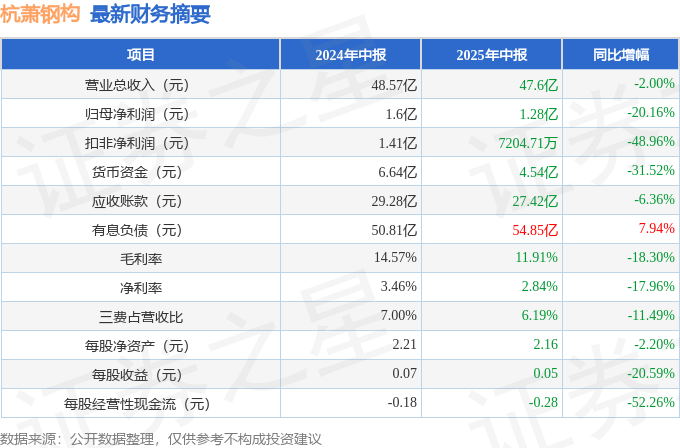
杭萧钢构2025年中报简析:净利润同比下降20.16%,公司应收账款体量较大
Zheng Quan Zhi Xing· 2025-08-26 22:39
Core Viewpoint - Hangxiao Steel Structure (600477) reported a decline in both revenue and net profit for the first half of 2025, indicating financial challenges and a significant increase in accounts receivable relative to net profit [1] Financial Performance Summary - Total revenue for the first half of 2025 was 4.76 billion yuan, a decrease of 2.0% year-on-year [1] - Net profit attributable to shareholders was 128 million yuan, down 20.16% year-on-year [1] - In Q2 2025, total revenue was 3.13 billion yuan, an increase of 3.06% year-on-year, while net profit was 78.32 million yuan, a decrease of 18.29% year-on-year [1] - Gross margin was 11.91%, down 18.3% year-on-year, and net margin was 2.84%, down 17.96% year-on-year [1] - Total accounts receivable was 2.742 billion yuan, representing a significant 1622.92% of the latest annual net profit [1] Cost and Expense Analysis - Operating costs increased by 1.06%, attributed to increased depreciation after construction projects were transferred to fixed assets [1] - Sales expenses decreased by 27.96%, due to cost control in sales personnel, intermediaries, and entertainment expenses [2] - Management expenses decreased by 16.73%, attributed to cost control in management personnel [3] - Total expenses (sales, management, and financial) amounted to 295 million yuan, accounting for 6.19% of revenue, a decrease of 11.49% year-on-year [1] Cash Flow and Debt Situation - Operating cash flow per share was -0.28 yuan, down 52.26% year-on-year [1] - Net cash flow from operating activities decreased by 52.25%, due to an increase in factoring products received [4] - Net cash flow from investing activities increased by 78.21%, due to expenditures on new factory construction in the previous period [5] - Net cash flow from financing activities increased by 28.72%, also due to an increase in factoring products received [6] Business Model and Investment Returns - The company's return on invested capital (ROIC) was 3.13%, indicating weak capital returns [7] - The historical median ROIC over the past decade was 9.78%, with the worst year being 2024 [7] - The company's performance relies heavily on research and marketing efforts, necessitating further investigation into these drivers [8] Financial Health Indicators - Cash flow situation is concerning, with cash and cash equivalents to current liabilities at only 8.12% and a negative average operating cash flow to current liabilities ratio over the past three years [8] - Debt situation is also a concern, with interest-bearing debt ratio reaching 34.66% and negative average operating cash flow over the past three years [8] - Accounts receivable to profit ratio is alarmingly high at 1622.92% [8]

鸿路钢构(002541):产销量保持两位数增长,吨盈利同环比承压
EBSCN· 2025-08-26 03:48
Investment Rating - The report maintains a "Buy" rating for the company [5] Core Views - The company achieved revenue of 10.6 billion yuan and a net profit attributable to shareholders of 290 million yuan in the first half of 2025, reflecting a year-on-year revenue growth of 2% but a decline in net profit by 33% [1][2] - Despite external demand pressures and falling steel prices, the company demonstrated strong operational resilience and competitive advantages, achieving double-digit growth in production and sales [3][4] - The report adjusts the profit forecast for 2025-2027 downwards by 28% to 7.5 billion yuan, 33% to 7.7 billion yuan, and 46% to 8.5 billion yuan, respectively, due to anticipated challenges in sales volume and profit margins [3][4] Summary by Sections Financial Performance - In H1 2025, the company produced 2.36 million tons of steel, a 12% increase year-on-year, with a sales volume of 2.24 million tons, up 11% [2] - The gross profit per ton for the steel structure business was 370 yuan, down 65 yuan year-on-year, indicating pressure on profit margins [2] - R&D expenses totaled 310 million yuan in H1 2025, with a research expense ratio of approximately 3%, reflecting a decrease in R&D intensity [2] Revenue Streams - Revenue from other businesses, primarily from scrap steel sales, was 330 million yuan, a slight decrease of 4% year-on-year, with a gross margin of 71% [3] - Government subsidies recognized during the reporting period decreased significantly, impacting overall income [3] Profitability and Valuation - The report provides a detailed profit and loss forecast, projecting revenues and net profits for the years 2023 to 2027, with a notable decline in growth rates for net profit in 2024 and 2025 [4][10] - Key financial metrics such as EPS and ROE are forecasted to decline in the coming years, indicating potential challenges in maintaining profitability [12][13]