
软件

Search documents
今日财经要闻TOP10|2026年2月13日
Xin Lang Cai Jing· 2026-02-13 11:48
Group 1 - Gold prices experienced a sharp decline, attributed to an increase in overall risk aversion, with a notable drop in Microsoft shares contributing to market concerns [1][5] - The U.S. stock market saw significant declines, with major indices such as the Dow Jones falling by 1.33% and the Nasdaq by 2.02%, alongside notable drops in tech stocks like Apple and Tesla [2] - A report from the New York Federal Reserve indicated that U.S. consumers and businesses bore approximately 90% of the costs from tariffs imposed during the Trump administration, contradicting previous claims that foreign entities would absorb these costs [3] Group 2 - The People's Bank of China conducted a 10 billion yuan reverse repurchase operation to maintain liquidity in the banking system, marking a net injection of 600 billion yuan for February, the highest in three months [7] - In January, new RMB loans increased by 4.71 trillion yuan, with household loans rising by 456.5 billion yuan and corporate loans increasing by 4.45 trillion yuan [9] - The Chinese stock market saw significant gains, with the ChiNext index rising nearly 60% over the lunar year, while the Shanghai Composite Index increased by 25.58% [8]
上周科技股和贵金属暴跌时,全球资金逃向了哪里?
智通财经网· 2026-02-13 11:14
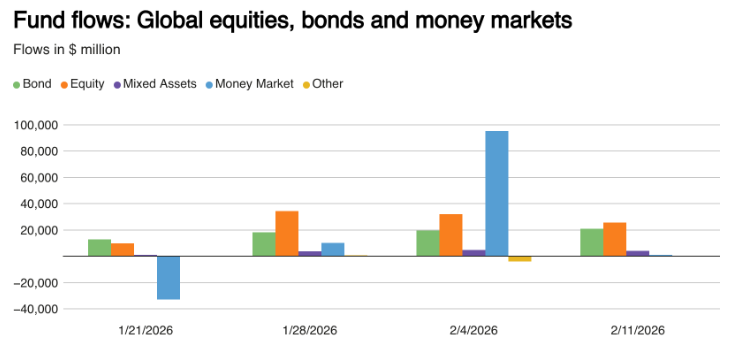
Group 1: Global Equity Fund Flows - European and Asian equity funds experienced strong inflows, with a total of $255.4 billion in global equity fund inflows for the week ending February 11, marking the fifth consecutive week of net inflows [1] - European funds saw a net inflow of $175.3 billion, the highest weekly record since at least 2022, while Asian funds had a net inflow of approximately $62.8 billion [1] - In contrast, U.S. equity funds experienced a net outflow of $14.2 billion, the first net outflow in three weeks, driven by concerns over high valuations and the impact of artificial intelligence on various sectors [1] Group 2: Global Bond Fund Flows - Global bond funds attracted investor interest for the sixth consecutive week, with net inflows of approximately $210.9 billion in the most recent week [4] - Short-term bond funds recorded net inflows of $48.7 billion, the highest since mid-December last year, while corporate bond funds and euro-denominated bond funds attracted $26.3 billion and $20.6 billion, respectively [4] Group 3: Emerging Markets Investment - Emerging market equity funds saw inflows of $8.52 billion, continuing a recent buying trend for the eighth consecutive week [7] - Bond funds in emerging markets reported a net inflow of $1.29 billion, according to data from 28,723 funds [7] Group 4: Commodity Fund Flows - Gold and precious metals funds attracted inflows for the 13th week out of the last 14, although the net inflow of $1.25 billion was the lowest in five weeks [6]

美股极其脆弱!从SaaS、PE到保险、物业甚至物流“轮流大跌”,高盛交易员“疲惫且震惊”
华尔街见闻· 2026-02-13 11:09
Core Viewpoint - The U.S. stock market is experiencing a rare and widespread panic sell-off, with AI disruptions impacting various industry sectors like a domino effect [1] Market Sentiment - The latest trigger for market panic was a statement from Microsoft's AI business leader, suggesting that most white-collar jobs could be replaced by AI within 12 months, leading investors to reassess the scope and speed of AI disruption [3] - Investors are showing a lack of willingness to buy the dip, with hedge funds and long institutions selling off but at smaller scales, indicating a growing sense of fatigue [3] Market Performance - The breadth of the market is deteriorating, with 350 out of 500 S&P component stocks declining, significantly impacted by major companies like Apple, Amazon, Microsoft, Meta, and Cisco [4] - Goldman Sachs trading activity levels surged from 4/10 to a high, with inquiry volumes reaching their highest in two weeks [5] Sector Rotation - There is an extreme factor rotation occurring, with defensive sectors becoming safe havens while previously strong tech sectors are collapsing [6] - The most notable market characteristic is investors' complete unwillingness to buy into any AI-related sharp declines, a sentiment that spans all industry sectors [7] Industry-Specific Impacts - The logistics sector has become a recent casualty, with financial and healthcare sectors also under pressure, while technology faces widespread collapse [8] - AI has been sweeping through industries, identifying potential "losers," as seen in the sell-off of CH Robinson, which was previously viewed as an AI beneficiary [9] Financial Sector Dynamics - The logic of super regional banks being attractive havens in the financial sector is unraveling, as alternative asset management companies shifted from gains to losses [10] - Defensive REITs continue to rise, but strong earnings from commercial real estate service company CBRE failed to boost its stock price, indicating that performance is currently deemed unimportant in the prevailing market environment [10] Healthcare Sector Challenges - The contract research organization (CRO) sector in healthcare has plummeted by 32% this month, following Pfizer's announcement to use AI for most clinical trials, with ICLR dropping 38% in a single day [11] - The technology, media, and telecommunications sectors, except for storage chips, are facing significant declines, with previous "winner" stocks being sold off amid risk-averse sentiment [11]


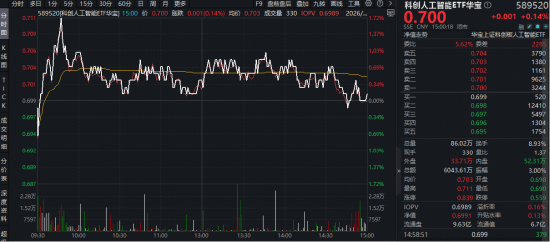
角逐“春节档”!AI大模型密集“上新”!科创人工智能ETF(589520)逆市上探1.7%,芯原股份再创历史新高
Xin Lang Cai Jing· 2026-02-13 10:56
Core Viewpoint - The domestic AI industry chain is experiencing significant growth, with the launch of new AI models and supportive government policies driving investment opportunities in this sector [3][10]. Industry Developments - As the Chinese New Year approaches, there is an "AI red envelope war" with numerous new domestic large models being released, including the globally popular Zhipu GLM-5. Upcoming models like DeepSeek V4 and Alibaba's Qwen 3.5 are expected to launch in mid-February, indicating a potential new wave of AI advancements [3][10]. - The State-owned Assets Supervision and Administration Commission (SASAC) has established a "AI+" embodied intelligence industry community, focusing on building trustworthy data spaces across 11 key industries, aiming to create over 1,000 application scenarios and more than 100,000 industry-specific intelligent applications [3][10]. Investment Opportunities - Guolian Minsheng Securities maintains a positive outlook on AI investment opportunities, validating the industry's high prosperity through four dimensions: 1. Increased capital expenditure from tech giants 2. The transition of AI assistants like Clawdbot from dialogue tools to executors, indicating a promising future for edge AI products 3. Ongoing supply-demand tension in computing infrastructure, leading to inflation in upstream costs, with cloud service prices and H100 leasing rates on the rise 4. AI entering a phase of application landing, accelerating demand, and resonating with industry chain prosperity [3][10]. ETF Overview - The Huabao Science and Technology Innovation AI ETF (589520) focuses on the domestic AI industry chain, with significant holdings in domestic GPU leaders (e.g., Cambricon), ASIC leaders (e.g., Chipone), and AI application leaders (e.g., Kingsoft). The semiconductor sector accounts for nearly half of the ETF's weight, while the software sector exceeds 30%, positioning it well for potential gains from the AI application surge [3][10]. - The ETF is a financing and margin trading target, providing an efficient tool for investing in domestic computing power [3][10].

股评下马威 | 谈股论金
Xin Lang Cai Jing· 2026-02-13 09:02
Group 1 - The core viewpoint of the article highlights the unexpected market reactions, particularly the significant drop in US stocks driven by fears surrounding AI's impact on traditional industries, especially logistics and commercial real estate [1][2] - The market's current trading logic reflects a pattern of initial declines followed by cautious reassessments, as investors struggle to predict the long-term effects of AI on various sectors [2][3] - A-shares are experiencing excessive speculation on AI-related stocks, with the market interpreting new AI applications positively, despite potential negative implications for traditional industries [2][3] Group 2 - The A-share market's core issue is the over-exploitation and hype surrounding AI concepts, leading to inflated valuations and speculative trading [2][3] - The performance of major indices shows a significant decline, with the Shanghai Composite Index down 1.26% and the Shenzhen Component Index down 1.28%, indicating widespread market weakness [3][4] - The Hong Kong market also reacted negatively, with the Hang Seng Index dropping approximately 1.7%, although the Hang Seng Tech Index's decline was less severe, suggesting some resilience in tech stocks [4][5] Group 3 - The article notes that the market's expectation for protective measures from major institutions during downturns may be unrealistic, as these entities are also part of the market dynamics [4] - The performance of specific sectors, such as shipbuilding and aerospace, showed relative strength, indicating pockets of opportunity within the broader market [4][6] - The potential for a rebound in the Hang Seng Tech Index is anticipated as AI applications gain acceptance and marketing efforts increase, suggesting a possible turning point for tech stocks [5][6]
突发暴跌!全线大跳水!发生了什么?
天天基金网· 2026-02-13 08:11
Core Viewpoint - The logistics sector has become the latest victim of "AI panic trading," following significant declines in software and financial sectors, with major logistics stocks experiencing sharp drops in both US and European markets [2][5][7]. Market Impact - On February 12, the Russell 3000 Trucking Index fell by 7.8%, with Robinson Global Logistics (CHRW) dropping over 14% and Expeditors International (EXPD) declining over 13% [2][5]. - In the A-share market, several transportation stocks also saw significant declines, with China COSCO Shipping Energy Transportation (中远海能) down over 8% and China Merchants Energy Shipping (招商南油) down nearly 7% [4][5]. Triggering Events - The sell-off was triggered by the announcement from Algorhythm Holdings (RIME) regarding its AI logistics platform, SemiCab, which reportedly increased freight volumes by 300% to 400% without adding operational staff [5][6]. - Algorhythm's stock surged by 79% during trading but closed with a nearly 30% increase, despite its market capitalization remaining below $10 million [6]. Broader Market Context - The current AI "super cycle" is reshaping global industry dynamics, intertwining technological benefits with market anxieties [3]. - Analysts noted that the panic selling is not limited to tech stocks but affects all sectors associated with AI news, leading to a "sell first, think later" mentality [7][8]. Sector Performance - The logistics sector's decline is part of a broader trend where financial services and real estate stocks also faced sell-offs due to AI-related announcements [7]. - Major US stock indices, including the Nasdaq, S&P 500, and Dow Jones, experienced declines, with the Nasdaq dropping 2% [8].






在华尔街最新一轮人工智能相关股票抛售之后 欧洲股市预计开盘走势分化
Xin Lang Cai Jing· 2026-02-13 08:08
受人工智能相关担忧引发华尔街新一轮抛售影响,欧洲股市周五开盘料将走势分化。 伦敦时间早7点,欧洲斯托克50指数期货下跌0.1%,法国CAC 40指数期货下跌0.2%。德国DAX指数期 货小幅走低,而英国富时100指数期货上涨0.1%。 周四纽约主要股指全线下跌,人工智能恐慌情绪再度席卷市场,房地产、货运及软件股遭受重创。"七 巨头"科技股收盘悉数收跌。 如何抓住黄金波段机会?聪明钱的选择,黄金+股票一键搞定>> 如何抓住黄金波段机会?聪明钱的选择,黄金+股票一键搞定>> 责任编辑:李肇孚 受人工智能相关担忧引发华尔街新一轮抛售影响,欧洲股市周五开盘料将走势分化。 伦敦时间早7点,欧洲斯托克50指数期货下跌0.1%,法国CAC 40指数期货下跌0.2%。德国DAX指数期 货小幅走低,而英国富时100指数期货上涨0.1%。 周四纽约主要股指全线下跌,人工智能恐慌情绪再度席卷市场,房地产、货运及软件股遭受重创。"七 巨头"科技股收盘悉数收跌。 投资者也在消化本周密集出炉的企业财报。欧洲方面,周五财报发布节奏将有所放缓,法国航空航天企 业赛峰集团与英国国民威斯敏斯特银行等将公布财报。 全球投资者还在等待美国劳工统计局 ...
人工智能技术冲击引发担忧 纽约股市大幅下跌
Xin Hua She· 2026-02-13 07:39
Group 1 - The New York stock market experienced a significant decline due to investor concerns about the disruptive impact of artificial intelligence (AI) on traditional industries, particularly in logistics and commercial real estate [1][2] - The Dow Jones Industrial Average fell by 669.42 points, closing at 49,451.98, a decrease of 1.34%. The S&P 500 index dropped by 108.71 points to 6,832.76, down 1.57%, while the Nasdaq Composite Index decreased by 469.32 points to 22,597.15, a decline of 2.03% [1] - The application of AI tools has raised concerns about lower costs and higher efficiency potentially reshaping the operations of industries such as software, logistics, financial services, and commercial real estate, leading to volatility in stock prices [1] Group 2 - Robinson Global Logistics saw its stock price drop by over 14% due to fears that AI will optimize logistics processes and compress traditional profit margins [2] - There is a growing concern that increased use of AI tools will weaken demand for office space, resulting in sell-offs of stocks in commercial real estate companies [2] - Financial services firms, exemplified by Morgan Stanley, are facing stock price pressures as new technologies threaten to disrupt wealth management business models [2]
综述|人工智能技术冲击引发担忧 纽约股市大幅下跌
Xin Hua Wang· 2026-02-13 07:32
另外,美国住宅销量大幅下降、联邦政府批评苹果手机推送系统偏好左派等因素也冲击相关公司股价。 (文章来源:新华网) 今年以来,随着越来越多的人工智能工具投入应用,软件、物流、金融服务、商业地产等行业受到影 响。投资者担心,人工智能可能以更低成本、更高效率重新塑造相关产业的运营方式,冲击这些领域传 统企业的业绩表现。近来,这些担忧逐步开始反映在上市公司股价波动上。 由于投资者担心人工智能将优化物流流程,压缩传统企业利润率,罗宾逊全球物流公司股价12日跌超 14%。投资者担忧人工智能工具使用率提高会削弱办公空间需求,部分商业地产企业股票遭遇抛售。因 为新技术可能颠覆财富管理业务模式,以摩根士丹利公司为代表的金融服务类企业股价也受到冲击。 美国自由资本市场公司金融分析师杰伊·伍兹表示,人工智能技术不久前曾推动相关产业股指飙升至极 端水平,如今却成为压制相关企业股价的因素。 新华社纽约2月12日电综述|人工智能技术冲击引发担忧纽约股市大幅下跌 由于投资者担忧人工智能技术大规模应用颠覆相关产业传统运营方式,美国纽约股市12日高开后大幅下 挫,跌幅在尾盘进一步放大。收盘时,纽约股市三大股指均显著下跌,其中物流和商业地产企业 ...

中望软件融资余额下降,机构关注AI军备竞赛
Jing Ji Guan Cha Wang· 2026-02-13 07:28
Group 1: Core Insights - The AI arms race is intensifying, with a focus on high-barrier software and cloud services, highlighting Zhongwang Software as a leading player in industrial software [1] - Zhongwang Software is currently in a "high R&D, high loss" investment phase, reporting a revenue of 334 million yuan for H1 2025, a year-on-year increase of 8.24%, and a net profit loss of 50.92 million yuan, with R&D expenses accounting for 67.01% of revenue [1] - The company's competitive advantage is expanding through technological barriers and opportunities for domestic substitution, but attention is needed on profitability turning points and market competition risks [1] Group 2: Stock Performance - Zhongwang Software's financing balance has been on a continuous decline, with a balance of 323 million yuan as of February 12, 2026, a decrease of 7 million yuan (2.10%) over the past five days [2] - The stock price has shown short-term volatility, with a cumulative increase of 1.66% over the past five days, but a 20-day decline of 12.01%, with the latest price at 68.12 yuan, down 1.07% from the previous day [2] Group 3: Recent Events - From February 11 to 12, 2026, Zhongwang Software's stock price experienced a fluctuation range of 3.33%, with a trading volume of approximately 412 million yuan; there were no significant company announcements during this period, and market focus was on industry policies and changes in financing sentiment [3]
