软饮料

Search documents
养元饮品对旗下私募基金增资10亿元,已投资新潮传媒、长江存储
Bei Ke Cai Jing· 2025-10-16 04:56
Core Viewpoint - The company "Yangyuan Beverage" announced a capital increase of 1 billion yuan for its subsidiary "Wenming Qianhong Investment," raising the total scale of the private equity fund from 3 billion yuan to 4 billion yuan, with the company holding a 99.925% stake in the fund [1][2]. Group 1: Investment Activities - The capital increase will be used for investments in other projects, with no additional investments planned for currently invested projects [1]. - "Wenming Qianhong Investment" has already invested in seven companies, including 1 billion yuan in "Chongqing Ziguang Huazhi Technology," 8 billion yuan in "Ruipu Lanjun Energy," and 16 billion yuan in "Changjiang Storage" [1]. Group 2: Strategic Developments - "Wenming Qianhong Investment" is currently involved in a merger with another outdoor advertising company, "Fenzhong Media," with a valuation of 8.3 billion yuan [2]. - "Changjiang Storage," the parent company of "Changjiang Storage Technology," completed its shareholding reform, indicating a significant strategic development in the semiconductor sector [2].

华润饮料(02460.HK):自产增效持续深化 盈利释放弹性可期
Ge Long Hui· 2025-10-15 20:54
Core Viewpoint - The packaging drinking water market is experiencing steady growth, with leading companies maintaining a strong competitive advantage in a rapidly expanding industry [1][2] Market Overview - The packaging drinking water market size reached 215 billion yuan in 2023, reflecting a year-on-year growth of 4.47%, accounting for 23.65% of the soft drink market; the CAGR from 2018 to 2023 is 7.10%, outpacing other segments of the soft drink market [1] - The market for packaged water has essential attributes, fulfilling basic needs and testing supply and channel capabilities, with a CR5 retail value of 58.6% in 2023; the pure water market faces more evident homogenization and higher demands for supply chain and cost control, with China Resources Beverage leading with a 32.7% market share [1] Profitability and Growth Potential - In the first half of 2025, the company's revenue from packaged drinking water and beverage products is projected to be 5.251 billion yuan and 955 million yuan, respectively, accounting for 85% and 15% of total revenue; there is an expected increase in gross margin for packaged water due to rising self-production ratios and capacity utilization [1] - The company operates 15 self-owned factories and collaborates with 35 production partners, achieving coverage in first-tier and new first-tier cities within a radius of 300-500 kilometers, indicating potential for increased capacity utilization in self-owned factories [1] Channel Expansion and Marketing Strategy - There is significant room for regional expansion beyond the home base and surrounding areas, with ongoing national expansion efforts [1] - The brand's image is strongly associated with sports concepts, and the company is gradually developing diversified marketing strategies [1] Investment Recommendations - Short-term revenue growth in the packaged drinking water segment will be driven by national expansion and channel refinement, while long-term benefits will arise from industry consolidation and an increase in the proportion of medium-sized products [2] - As the company transitions towards a platform-based enterprise, there is substantial long-term revenue growth potential in the beverage business [2] - With the gradual increase in self-owned production capacity and the release of scale effects, there remains significant room for profit improvement; projected revenues for 2025-2027 are 11.2 billion, 12.5 billion, and 13.4 billion yuan, with net profits of 1.3 billion, 1.6 billion, and 1.8 billion yuan, respectively, corresponding to PE ratios of 19, 15, and 14 times [2]
东鹏饮料(集团)股份有限公司关于使用部分闲置募集资金进行现金管理的进展公告
Shang Hai Zheng Quan Bao· 2025-10-15 19:41
Core Viewpoint - The company plans to utilize part of its idle raised funds for cash management to enhance the efficiency of fund usage and increase returns, ensuring that it does not affect the normal investment plans of the raised funds [4][13]. Group 1: Cash Management Overview - Cash management trustee: China Merchants Bank Co., Ltd. [2] - Total cash management amount: 70 million yuan [2] - Type of cash management product: Structured deposits [2] - Cash management duration: 92 days [2] - The company has authorized the use of up to 100 million yuan for cash management, ensuring it does not impact the normal investment plans of the raised funds [2][13]. Group 2: Fund Source and Usage - The funds for this investment come from the idle raised funds from the company's initial public offering, which totaled 1,851.26 million yuan, with a net amount of 1,731.93 million yuan after deducting issuance costs [5]. - The investment is compliant with regulations and will not affect the planned use of raised funds [5]. Group 3: Risk Control Measures - The company has established a robust internal control system for cash management, including risk assessment and decision-making processes to ensure fund safety [6][9]. - Independent directors and the board's audit committee have the authority to supervise the use of raised funds, ensuring compliance with regulations [7][9]. Group 4: Impact on the Company - The investment of 70 million yuan in cash management products will not significantly impact the company's main business, financial status, operating results, or cash flow [13]. - The company will account for the returns from these financial products in accordance with new financial instrument standards [13].

养元饮品对旗下私募基金增资10亿元
Zhong Guo Ji Jin Bao· 2025-10-15 16:16
Core Viewpoint - Yangyuan Beverage has increased its investment in its private equity fund by 1 billion yuan, following a surge in stock prices due to its investment in Changjiang Storage Holdings [2][4]. Group 1: Investment Details - On October 15, Yangyuan Beverage announced an additional investment of 1 billion yuan into Wuhu Wenming Qianhong Investment Management Partnership, increasing the total scale of the private equity fund from 3 billion yuan to 4 billion yuan [2][6]. - After the capital increase, Yangyuan's subscribed capital will rise from 2.997 billion yuan to 3.997 billion yuan, accounting for 99.925% of the fund [2][6]. - The additional funds will be used for investments in other projects, with no further investments planned for existing projects [6][10]. Group 2: Performance of the Private Equity Fund - The private equity fund, established in May 2021, has invested in several companies, including a notable investment of 1.6 billion yuan in Changjiang Storage, acquiring 0.99% of its shares [4][7]. - Despite multiple investments, the fund has faced poor performance, reporting a net profit of -9.03 million yuan in 2024 and -288,900 yuan in the first half of 2025 [8][10]. Group 3: Yangyuan Beverage's Business Performance - Yangyuan Beverage's main business is experiencing growth challenges, with a reported revenue of 2.465 billion yuan in the first half of 2025, a year-on-year decline of 16.19%, and a net profit of 744 million yuan, down 27.76% [10][12]. - The company's revenue has decreased significantly since reaching a peak of 9.117 billion yuan in 2015, with 2024 revenue reported at 6.058 billion yuan, nearly one-third lower than the peak [10][11]. - The company heavily relies on its flagship product, walnut milk, which contributed 5.37 billion yuan in revenue, accounting for 89.20% of total revenue in 2024 [11][12]. Group 4: Cash Flow and Dividend Policy - Despite the pressure on its main business, Yangyuan Beverage has a strong cash flow, with a net cash flow from operating activities increasing by 1358.23% to 377 million yuan in the first half of 2025 [12]. - The company plans to distribute a cash dividend of 5.00 yuan per 10 shares, totaling 630 million yuan, which represents 84.7% of the net profit for the period [12][13].


“六个核桃”豪掷10亿元,加码私募!
中国基金报· 2025-10-15 16:09
Core Viewpoint - Yangyuan Beverage has increased its investment in the private equity fund Wuhu Wenming Qianhong Investment Management Partnership by 1 billion yuan, raising the total fund size from 3 billion yuan to 4 billion yuan, with Yangyuan's contribution increasing to 3.997 billion yuan, accounting for 99.925% of the fund [2][9]. Group 1: Investment Details - The private equity fund, established in May 2021, was co-founded by Yangyuan Beverage and Beijing Wenming Investment Fund Management Co., with an initial fundraising size of 3 billion yuan [8]. - The recent capital injection will be used for investments in other projects, not for additional investments in current projects [10]. - The fund's notable investment case is Longjiang Storage Holdings, where it invested 1.6 billion yuan for a 0.99% stake, with the company's valuation at approximately 161.6 billion yuan at the time [10]. Group 2: Financial Performance - Despite the increase in investment, Yangyuan Beverage's main business is facing growth challenges, with a 16.19% year-on-year decline in revenue to 2.465 billion yuan in the first half of 2025, and a 27.76% drop in net profit to 744 million yuan [16]. - The company's revenue has decreased significantly from a peak of 9.117 billion yuan in 2015, with 2024 revenue reported at 6.058 billion yuan, nearly one-third lower than the peak [16]. - The company heavily relies on its flagship product, walnut milk, which contributed 5.37 billion yuan in revenue, accounting for 89.20% of total revenue in 2024 [17]. Group 3: Cash Flow and Dividends - Despite the pressure on performance, Yangyuan Beverage has a strong cash flow, with net cash flow from operating activities surging 1358.23% to 377 million yuan in the first half of 2025, and cash reserves reaching 1.459 billion yuan, a 58.96% increase from the previous year [18]. - The company plans to distribute a cash dividend of 5.00 yuan per 10 shares, totaling 630 million yuan, which represents 84.7% of the net profit for the period [18].
突破红海竞争,二闯港交所东鹏饮料募资加码出海业务
Zhi Tong Cai Jing· 2025-10-15 14:26
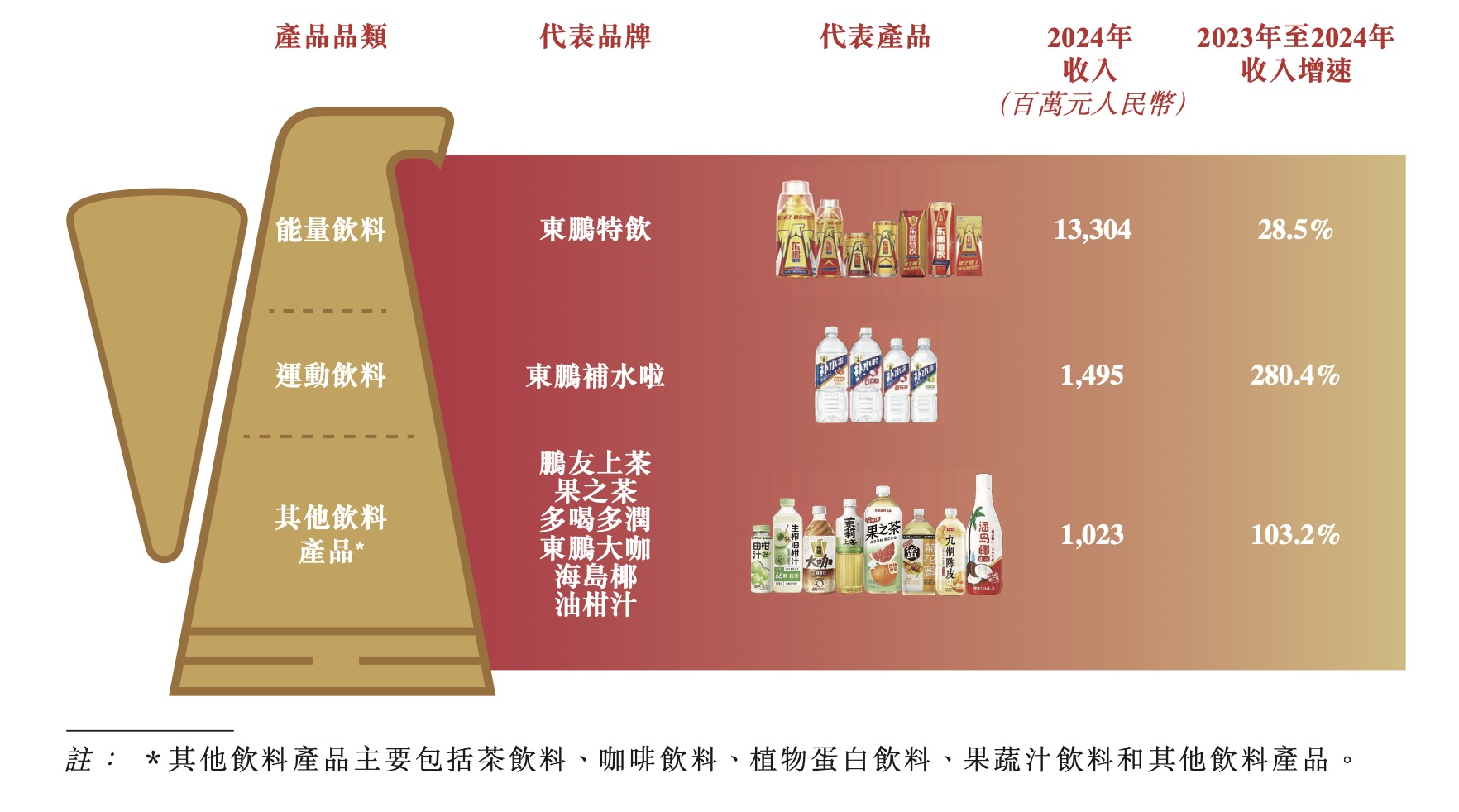
Core Viewpoint - Dongpeng Beverage is resubmitting its IPO application to the Hong Kong Stock Exchange, reflecting its determination to expand internationally and capitalize on the growing demand for functional beverages in China and beyond [1][11]. Company Overview - Dongpeng Beverage ranks first among the top 20 listed soft drink companies globally in terms of revenue growth, with a market share in China's functional beverage market increasing from 15.0% in 2021 to 26.3% in 2024 [2]. - The company has established a diverse product matrix centered around the "Dongpeng" brand, focusing on providing high-quality beverages while innovating and diversifying its product offerings [2]. Product Performance - The sports drink segment has shown the fastest growth, with the newly launched "Dongpeng Bup Shui La" generating nearly 1.5 billion yuan in revenue in 2024, a year-on-year increase of 280.4% [3]. - Revenue contributions from sports drinks are expected to rise from 3.5% in 2023 to 13.9% in the first half of 2025, indicating its emergence as a significant growth driver [3]. - Other beverage categories, including tea, coffee, plant protein, and fruit and vegetable juices, have also seen steady revenue growth, contributing 2.8 billion, 5.0 billion, 10.2 billion, and 8.8 billion yuan respectively during the reporting period [3]. Market Position - Dongpeng Beverage has maintained its leading position in China's energy drink market, with a market share of 40.1% in 2024 and a compound annual growth rate (CAGR) of 28.5% from 2022 to 2024 [10]. - The revenue from energy drinks has grown from 8.21 billion yuan in 2022 to 13.3 billion yuan in 2024, with a CAGR of 27.3% [4]. Industry Growth Potential - The Chinese soft drink market is projected to reach approximately 1.3 trillion yuan in retail sales by 2024, making it the second-largest soft drink market globally [6]. - The functional beverage sector is the fastest-growing segment, with a CAGR of 8.3% from 2019 to 2024, outpacing the overall soft drink market growth of 4.7% [6]. - The energy drink market is expected to reach 180.7 billion yuan by 2029, with a CAGR of 10.3% from 2025 to 2029 [6][8]. International Expansion Strategy - Dongpeng Beverage is focusing on international expansion, particularly in Southeast Asia, with plans to invest 1.2 billion yuan in a production base in Hainan and establish a subsidiary in Indonesia [11]. - The Southeast Asian energy drink market is valued at approximately 2.5 billion USD, with a CAGR of 6%, presenting significant growth opportunities for the company [11]. - The IPO aims to raise funds for building supply chain infrastructure to support local operations in key overseas markets [11][13]. Challenges in International Markets - Dongpeng Beverage faces challenges such as brand recognition barriers in a market dominated by international brands like Red Bull and Monster [12]. - Adapting to local consumer preferences and building distribution channels in Southeast Asia will require substantial investment and effort [12]. - The company's current overseas revenue contribution is less than 0.3%, indicating that short-term performance may be limited while focusing on strategic positioning [12].
新股前瞻|突破红海竞争,二闯港交所东鹏饮料募资加码出海业务
Xin Lang Cai Jing· 2025-10-15 14:20
Core Viewpoint - Dongpeng Beverage's second attempt to list on the Hong Kong Stock Exchange reflects its determination to expand internationally and is seen as a significant opportunity to observe how Chinese brands leverage international capital markets for global strategic positioning [1] Group 1: Company Performance - Dongpeng Beverage ranks first among the top 20 listed soft drink companies globally in terms of revenue growth, with a market share in China's functional beverage market increasing from 15.0% in 2021 to 26.3% in 2024 [2] - The company has established a diverse product matrix centered around the "Dongpeng" brand, focusing on providing high-quality beverages while continuously innovating and diversifying its product offerings [2] - The sports drink segment has shown the fastest growth, with the newly launched "Dongpeng Boshui La" generating nearly 1.5 billion yuan in revenue in 2024, marking a year-on-year growth of 280.4% [3] Group 2: Revenue and Profitability - Revenue from energy drinks, represented by "Dongpeng Special Drink," has grown from 8.21 billion yuan in 2022 to 13.3 billion yuan in 2024, with a compound annual growth rate (CAGR) of 27.3% [4] - The overall gross margin of the company has improved, with figures of 41.5%, 42.3%, 44.1%, and 44.4% during the reporting period, while net profit increased from 1.44 billion yuan in 2022 to 3.33 billion yuan in 2024, achieving a CAGR of 52.0% [5] Group 3: Industry Landscape - The Chinese soft drink market is projected to reach approximately 1.3 trillion yuan in retail sales by 2024, making it the second-largest soft drink consumption market globally [6] - The functional beverage sector is the fastest-growing segment, with a CAGR of 8.3% from 2019 to 2024, outpacing the overall soft drink market growth of 4.7% [6] - The energy drink market is expected to reach 180.7 billion yuan by 2029, with a CAGR of 10.3% from 2025 to 2029, representing 66.9% of the overall functional beverage market in 2024 [6][7] Group 4: International Expansion - Dongpeng Beverage is actively pursuing international expansion, particularly in Southeast Asia, with plans to invest 1.2 billion yuan in a production base in Hainan and establish a subsidiary in Indonesia [12] - The Southeast Asian energy drink market is valued at approximately 2.5 billion USD, with a compound growth rate of 6% in recent years, presenting significant opportunities for Dongpeng [12] - The company aims to utilize the funds raised from its Hong Kong IPO to build supply chain infrastructure and support localized operations in key markets [12] Group 5: Challenges Ahead - Dongpeng Beverage faces challenges in brand recognition as established international brands dominate the functional beverage market, necessitating significant investment to build consumer awareness [13] - Adapting to local preferences in Southeast Asia, such as taste and packaging, is crucial for success, alongside navigating regulatory and operational complexities [14] - The company currently has less than 0.3% of its revenue from overseas markets, indicating that its international efforts are still in the early stages and primarily strategic in nature [14]
养元饮品拟向私募基金泉泓投资增资10亿元
智通财经网· 2025-10-15 13:04
Core Viewpoint - Yangyuan Beverage (603156.SH) has announced a partnership with Beijing Wenming Investment Fund Management Co., Ltd. to establish a private equity fund with an increased fundraising scale aimed at optimizing idle funds for investment returns [1] Group 1: Partnership and Fund Details - The private equity fund, named Wuhu Wenming Quan Hong Investment Management Partnership (Limited Partnership), was initially set up in May 2021 with a fundraising target of RMB 3 billion [1] - The company has increased its commitment to the fund, raising the total fundraising scale to RMB 4 billion, with an additional RMB 1 billion contributed by the company [1] - The company’s contribution to the fund amounts to RMB 2,997 million, while Wenming Fund acts as the general partner with a contribution of RMB 3 million [1] Group 2: Investment Focus - The private equity fund has made a significant investment of RMB 1.6 billion in Yangtze Memory Technologies Co., Ltd. [1]
养元饮品:向私募基金增资10亿元
Mei Ri Jing Ji Xin Wen· 2025-10-15 11:34
Core Viewpoint - Yangyuan Beverage (603156.SH) announced a capital increase of 1 billion yuan to the private equity fund Wuhu Wenmingquan Hong Investment Management Partnership, raising the fund's total size from 3 billion yuan to 4 billion yuan [1] Summary by Relevant Sections - **Investment Details** - The company increased its investment in the private equity fund from 2.997 billion yuan to 3.997 billion yuan, holding a stake of 99.925% after the capital increase [1] - The additional capital will be used for investments in other projects, with no further investments in already funded projects [1] - **Investment Risks** - The investment carries significant uncertainty, with potential actual returns falling short of expectations or even resulting in losses [1] - There are exit risks associated with the private equity fund's external investment projects, and these projects do not align with the company's main business, categorizing the investment as financial rather than strategic [1] - The investment is subject to market volatility risks [1]
股东频繁套现,“不差钱”的东鹏饮料急于港股IPO,是融资还是“圈钱”?
Sou Hu Cai Jing· 2025-10-15 10:00
Core Viewpoint - Dongpeng Beverage has re-applied for a mainboard listing on the Hong Kong Stock Exchange after its initial application expired, indicating a strong desire for international capital expansion despite its robust financial performance [2][3]. Group 1: Capital Strategy - Dongpeng Beverage's journey to capital markets has been complex, transitioning from a state-owned enterprise to a private company and then listing on the Shanghai Stock Exchange in 2021, raising 1.85 billion yuan [2]. - The company has previously attempted to list in Switzerland and is now focused on Hong Kong to enhance its international presence [2][3]. - The funds raised from the Hong Kong IPO are intended for expanding overseas operations, improving production capacity, and enhancing brand development [3]. Group 2: Financial Performance - Dongpeng Beverage has shown impressive growth, with revenue increasing from 3.038 billion yuan in 2018 to 15.839 billion yuan in 2024, and net profit rising from 216 million yuan to 3.327 billion yuan during the same period [4]. - In the first half of 2025, the company reported revenue of 10.737 billion yuan, a year-on-year increase of 36.37%, and a net profit of 2.375 billion yuan, up 37.22% [4]. - The company's gross margin has improved from 41.6% in 2022 to 44.4% in the first half of 2025 [4]. Group 3: Marketing and R&D Expenditure - Sales expenses have been increasing significantly, with a compound annual growth rate of 36.01% from 2022 to 2024, reaching 2.681 billion yuan in 2024 and 1.682 billion yuan in the first half of 2025 [5]. - In contrast, R&D spending has been relatively low, with a compound annual growth rate of 19.68%, indicating a potential imbalance in investment focus [6]. Group 4: Product Dependency and Market Challenges - Dongpeng Beverage heavily relies on its energy drink product, which accounted for 96.6% of total revenue in 2022, though this has decreased to 77.9% in the first half of 2025 [7]. - The company has introduced new products to diversify its offerings, with the electrolyte water "Dongpeng Bushi La" showing significant growth, achieving 1.493 billion yuan in sales in the first half of 2025 [7]. - Regulatory changes regarding energy drinks may pose long-term risks to the company's core products [7]. Group 5: Financial Management and Cash Flow - Dongpeng Beverage has engaged in significant cash management activities, investing up to 11 billion yuan in safe, liquid financial products, while also increasing its short-term borrowing by 118.69% to 6.551 billion yuan in 2024 [8]. - The company's net cash flow from operating activities decreased by 23.24% year-on-year in the first half of 2025, raising concerns about cash conversion efficiency [9]. Group 6: Shareholder Actions and Dividends - Major shareholders have realized over 5 billion yuan through share reductions and high cash dividends, with the company distributing a total of 6.6 billion yuan in cash dividends since its IPO [10][11]. - The controlling family has benefited significantly from these capital activities, receiving approximately 4.28 billion yuan from dividends alone [11]. Group 7: Market Position and Future Outlook - Dongpeng Beverage has been a market leader in China's functional beverage sector, with a market share increasing from 15% in 2021 to 26.3% in 2024 [4]. - Despite its high growth trajectory, the company faces challenges such as market saturation, increased competition, and a potential growth ceiling due to its product dependency [12].